Blog

  • HOW TO GET MORE WEBSITE TRAFFIC

    HOW TO GET MORE WEBSITE TRAFFIC

    Driving traffic to a website is everything. If you’re running an online business and no one’s checking out your site, you’re wasting money. More visitors = more chances to turn them into customers. Simple math, right? Whether it’s a blog, an online store, or a service, getting your site in front of the right audience is everything. After hitting plenty of dead ends and endless Google searches, the right strategies were discovered. Now, let’s discuss how to get more website traffic!

     What is Website Traffic   

    Website traffic is everything. The more people that hit a site, the more chances to turn them into customers. It’s like a popularity contest, but you want to win. The struggle is real, but let’s dive in! It can be divided into several types:

    1. Organic Traffic: This is the real deal. Getting those sweet clicks from Google feels like hitting the jackpot. It’s like the internet’s way of giving a nod and saying, “Yep, you’ve earned it!” When a site ranks high for keywords, people find it for FREE. It’s pure gold!
    2. Paid Traffic: A good paid ad is like a shortcut to the traffic party. It’s fast, effective, but make sure the cash is spent wisely, don’t just blow money and expect miracles!
    3. Referral Traffic: This is like getting a shout-out from a cool kid. When other websites link to you, it’s like, “Hey, look at this!” It’s a game-changer. Some of the best traffic days come from a random blog post linking back to a site. Always be nice to people, and these links will follow.
    4. Direct Traffic: Those people who just type the URL directly into their browser? It’s like they’re saying, “I’m coming to you on purpose, baby.” This kind of traffic is the most loyal. If the domain is memorable, these visitors are gold.
    5. Social Traffic: Instagram, TikTok, Pinterest, and Twitter are social traffic powerhouses. People are scrolling non-stop, and if there’s something worth clicking on, BAM! It’s a vibe, and it works.

    Getting more traffic isn’t just about the numbers. It’s about building a brand that stands out, getting noticed, and closing those sweet sales!

     7 key strategies to increase Website Traffic   

    7 key strategies to increase Website Traffic

    1.  Create a Content Assembly Line   

    Content is everything in SEO. Without consistent, high-quality content, a website won’t get the attention it deserves. The key to success is creating a steady flow of valuable content that appeals to both new and returning visitors. Setting up a content calendar helps ensure regular posting, keeping everything organized and consistent. Focus on creating evergreen content, those topics that never go out of style, like how-to guides, FAQs, tutorials, and case studies. This type of content answers common questions and provides long-term value, which makes it more likely to rank well on search engines. The more content that’s produced, the more opportunities there are for the site to be found.

    (https://www.youtube.com/watch?v=WUqTm3SxZKQ )

    1.  Effective Keyword Research   

    Keyword research is the backbone of SEO. If the search intent isn’t clear, how can content possibly hit the mark? Tools like Google Keyword Planner and SEMrush are GOLD. They reveal high-traffic keywords that don’t require fighting with a million other websites for the top spot. Here’s the trick: focus on long-tail keywords.

    These longer, more specific search terms are far less competitive and convert WAY better. Why? Because when someone types in a long-tail keyword, they know exactly what they want, and they’re ready to take action. It’s like hitting a bullseye every time. These keywords aren’t just easier to rank for; they bring in people more likely to buy something or engage with content. Forget the big, broad terms, go for the interesting, niche ones!

    (https://www.youtube.com/watch?v=WUqTm3SxZKQ)

    1.  Optimize Title Tags to Match Search Intent   

    Title tags are everything when it comes to SEO. If the title’s not on point, the opportunity is seriously missed. A killer title tag does two things: tells Google exactly what the page is about and makes users want to click. For real, match the search intent! If someone’s googling “how to increase website traffic,” don’t just throw a random title out there, make it match, like “How to Increase Website Traffic: 7 Proven Strategies.” Boom, it’s straight to the point, promises value, and is exactly what they’re looking for.

    Keep that title under 60 characters, it’s a must for it to show up right in search results. Plus, when that title’s hot, people can’t resist clicking. It’s all about that click-through rate, babe! Seriously, that perfect title is what separates a random page from one that gets traffic. If the title’s enticing and relevant, the chances of being noticed in a crowded search result skyrocket. Make it stand out and make it irresistible!

    (https://www.youtube.com/watch?v=WUqTm3SxZKQ)

    1.  Structure Your Content with Headings (H1, H2, H3)   

    Headings are not just some random titles thrown in there, they’re a total game-changer for SEO. Using H1, H2, and H3 tags is like giving content a roadmap. The H1? That’s the main title, the star of the show. H2s? They break everything down into sections so people can easily scan. And H3s? They dive into the nitty-gritty details, making everything clear. This structure isn’t just for readers; it’s a big green light for Google to see what’s going on too.

    When content’s set up this way, it’s way more likely to show up in Google’s featured snippets or “People Also Ask” sections. More eyes, more clicks, right? Plus, people love scannable content keeping it tidy helps boost engagement. This organization signals to Google, “Hey, this content’s valuable!” And that’s what boosts rankings. Structure content right and watch the traffic roll in. Also, consider strategies that help get your content featured in Google’s snippets, which can dramatically increase visibility and CTR from search results.

    (https://www.youtube.com/watch?v=WUqTm3SxZKQ)

    1.  Linking Strategy: Internal and External Links   

    Links are everything when it comes to SEO. Think of them like the glue that holds a site together and makes it easy to navigate. Internal links? They’re like personal tour guides, leading people to other cool stuff on the site. The longer they stay, the better the chances of making a sale or getting more views. External links are street cred. Linking to big-name, trusted sites? That’s like showing Google, “Hey, this content is legit and well-researched.” Plus, those trusted sources might just link back, which is a total win.

    A solid linking strategy isn’t just about pleasing the SEO gods; it makes the site user-friendly, keeps people around longer, and helps rankings climb. Also, the more relevant links included, the more Google trusts that the content is valuable and authoritative. People spend more time exploring the site when it’s easy to find related content, so internal links are key for boosting engagement and getting those interesting SEO points!

    (https://www.youtube.com/watch?v=WUqTm3SxZKQ)

    1.  Build Links (Off-Page SEO)   

    Off-page SEO is one of the most powerful ways to get a site noticed. Backlinks from reputable sites? Total game-changer. When those are earned, it’s like Google’s saying, “This site’s legit.” But it’s all about quality over quantity. Don’t go after a bunch of random backlinks. Focus on getting links from respected sources within the niche; that’s how domain authority gets a serious boost. There are plenty of ways to earn these backlinks. Guest posting? Recommended. Collaborating with influencers? Absolutely. Creating share-worthy content like infographics or killer studies? That’s the golden ticket.

    The more solid backlinks earned, the more Google sees the site as the real deal, and boom, visibility and rankings go up, driving more traffic. Each solid backlink is like a vote of confidence from other experts in the field. The more of those gathered, the higher the site climbs, and traffic numbers will rise like crazy. But remember, it’s not just about links — how high-quality content drives SEO results is just as essential in building long-term authority and engagement.

    (https://www.youtube.com/watch?v=WUqTm3SxZKQ)

    1.  Use Surfer SEO’s Content Editor   

    Surfer SEO is like having an SEO wizard in your back pocket. This tool is everything when it comes to optimizing content and boosting rankings. The content editor? Total lifesaver. It lets users fine-tune pages for specific keywords, analyzes content’s structure, keyword density, and overall quality. It shows how content stacks up against top-ranking pages and provides actionable tips to improve. It’s like getting a cheat sheet for SEO, with data-driven insights that highlight exactly what needs improvement.

    If Surfer SEO isn’t in the toolset, seriously, what’s going on? It makes content optimization a breeze and helps skyrocket rankings and, of course, drives more traffic. What’s even better is that it shows exactly what’s missing in content to beat the competition. With Surfer, tweaking becomes easy, and that extra boost ensures not just staying in the race but leading it. It’s like having a personal SEO assistant without the drama!

    (https://www.youtube.com/watch?v=WUqTm3SxZKQ)

     Case study: RC Vision   

     Background: RC Visions’ Challenge   

    So, RC Visions was invisible in a crowded market. They had an amazing product, but couldn’t get enough eyes on their site, and turning traffic into sales? Total struggle. Their website was solid, but it just wasn’t ranking for the right keywords. Google wasn’t even noticing them. They finally realized that without a real SEO plan, potential customers would never find them. Enter NUOPTIMA, the SEO and content marketing geniuses who swooped in to save the day. With NUOPTIMA’s help, they were about to get their site noticed and finally convert those visitors into loyal customers. (https://nuoptima.com/insights/ecommerce-seo-case-study)

     The Approach: Tailored SEO Strategy   

    • Site Map Creation and Website Optimization: The site map was a total game-changer. NUOPTIMA went all in, crafting a brand-new site map that fixed all the issues on the RC Visions site. It wasn’t just about looking good, but making sure the site was easy for both users and Google to navigate. When that structure’s solid, everything clicks literally! It’s like setting up a map for Google to follow, ensuring it knows exactly where to go. Without a good site map, no one’s finding anything, let alone buying!
    • Ongoing Website Updates: Constant updates were key. NUOPTIMA made sure RC Visions’ site was always getting a facelift, new content, and fresh pages. This wasn’t just about making the site look pretty; it was about keeping it relevant so Google knew it was active and worthy of showing up in search results. Plus, people were WAY more likely to stick around when they saw fresh, engaging content. It’s like keeping the party going!
    • Keyword and Gap Analysis: Keyword analysis was like the treasure hunt of SEO. NUOPTIMA did a deep dive into organic keywords and gaps, finding what people were searching for and what RC Visions was missing. They pinpointed opportunities that made the content super aligned with what customers were already looking for. Those keywords boosted rankings and traffic like magic.
    • Google Ads Strategy: NUOPTIMA got crafty with a full Google Ads strategy, ad copies, daily performance checks, all of it. It wasn’t just about throwing money into the ads; they made sure it worked with the organic SEO efforts to drive sweet paid traffic and keep ROI looking interesting. More clicks, more sales, it was the perfect balance between organic and paid traffic.
    • Targeted Campaigns for Promotions: Then came the campaigns, which were the icing on the cake. NUOPTIMA launched targeted campaigns for big promotional seasons, like Black Friday and Christmas. These were laser-focused to bring in the right traffic at the right time. The goal? More eyeballs, more sales. And it worked. With the right promotions, the sales spike during those peak seasons was next-level. It’s all about hitting those sweet spots when people are ready to shop! (https://nuoptima.com/insights/ecommerce-seo-case-study)

     The Results   

    HOW TO GET MORE WEBSITE TRAFFIC

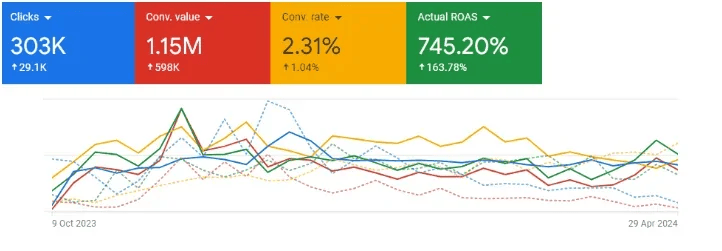
    Downloaded Image: https://nuoptima.com/wp-content/webp-express/webp-images/uploads/2024/07/RC-Visions-Ads-performance-2.png.webp

    1. Organic Traffic: Let’s talk about this insane 75.14% jump in organic traffic! RC Visions was getting noticed BIG TIME. By ranking higher for the right keywords, they pulled in SO many more visitors. And that “Clicks” data didn’t lie 303K to 329.1K? That’s a whole lot of eyeballs. When a brand starts dominating like that, it’s like they’re finally getting their well-deserved spotlight in a crowded market.
    2. Conversion Rate: Now, get this, the conversion rate doubled. A 1.04% jump might sound small, but it’s HUGE. It’s like finding that sweet spot between people looking and people actually buying. More targeted traffic, killer content, and a smooth user experience? That’s the magic combo. You can see it in the numbers, too., The “Conversion Value” went from 1.15M to 1.7 M. That’s cold, hard cash flowing in!
    3. Revenue (ROAS): Hold up, because this part is crazy, the ROAS skyrocketed by 163.78% to 745.20%. That’s not just growth; that’s a serious return on investment. The traffic wasn’t just up, it was making the site serious money. Those conversions weren’t just numbers; they were PROFITS. More eyes on the site, more customers pulling the trigger, and a huge revenue boost. (https://nuoptima.com/insights/ecommerce-seo-case-study)

    Overall Impact

    RC Visions didn’t just crush it with traffic; they slayed the conversion game. Higher traffic, more sales, and that sweet, sweet ROI? It’s like the SEO fairy godmother waved her magic wand. When good traffic mixes with great engagement, it’s a recipe for growth that’s impossible to ignore.

    Final Thoughts   

    Driving traffic to a website is the heartbeat of any online business. The more visitors, the better the chances of turning them into loyal customers. Just look at the case study of RC Visions, which is a huge growth! Organic traffic shot up, conversions got a serious boost, and their return on ad spend went through the roof. SEO is the real deal. It’s not just about racking up visitors; it’s about converting them into customers. When the right strategies align, then more clicks, more sales, and way more growth happen. That’s where trusted SEO partners like Genzpro step in to elevate your performance and scale your organic visibility with precision.

  • THE ROLE OF SEO IN DIGITAL MARKETING

    THE ROLE OF SEO IN DIGITAL MARKETING

    Organic search remains one of the most effective ways to generate traffic in today’s digital landscape. You may not know, but more than 75% of users never click beyond the first page of search results, and only 43% believe they find what they are looking for. So, every business that wishes to be seen and outshine its competition must use SEO. Partnering with a b2b seo agency in Dubai can be a strategic move for companies looking to dominate their niche in a competitive market. If you want to take your business online, be truly present, and find ways to achieve sustainable growth, this is the only blog that will show you the importance of SEO. It is like the secret ingredient that can help your brand not just to exist online, but to live there.

    SEO: A Holistic Strategy Beyond Keywords 

    Most often, SEO is seen as simply inserting a few keywords into whatever content is available on your website. Although keyword optimization is one of the basic tasks of SEO, it’s not the true potential of SEO. Being a modern SEO is a wide range of various things that each plays their role to make a website appear in a superior manner. The main goal is to create a website that satisfies both the user and the search engine by aligning it with search engine algorithms.

    Content Quality and User Engagement

    SEO is dependent on high-quality, relevant content. 77% of new buyers and consumers read blog posts regularly, highlighting the importance of having engaging content. Additionally, 84% of consumers would buy a product after watching a marketing video, showing that various content formats impact user engagement.

    Technical SEO: Enhancing Website Performance

    Technical SEO makes use of the aspects of website structure to comply with what a search engine requires. Key elements include:

    1. Site Speed: The direct impact of site speed on conversion rates is evident, as websites that load in 2 seconds experience a 9% higher conversion rate than those that take longer to load.

    2. Mobile Optimization: Since 87% of Americans use more than one device, it is imperative for your online business or blog to be mobile optimized.
      Secure Connections (HTTPS): One crucial aspect for securing your website is to ensure that the website uses HTTPS to protect user data and build trust, which can positively influence SEO rankings.

    Off-Page SEO and Link Building

    Off-page SEO involves building a website’s authority through external methods, such as link building. The high-quality backlinks are obtained from reputable websites, which give authority and ranking to your site. SEO advertising converts at a rate of 2.4%, compared to 1.3% for PPC.

     Real-world SEO Success Stories   

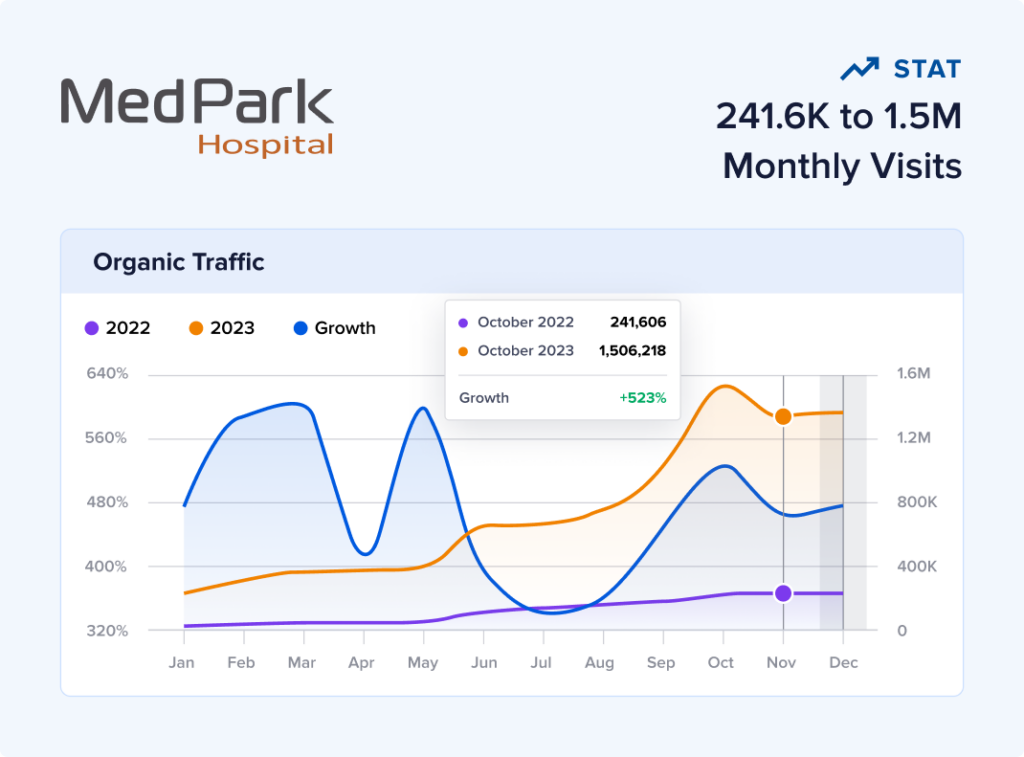
     1. MedPark Hospital: Leveraging Multilingual SEO to Expand Global Reach   

    MedPark Hospital: Leveraging Multilingual SEO to Expand Global Reach   

    Image source: https://aioseo.com/wp-content/uploads/2024/02/med-park-seo-case-study-1024×757.png

    Industry: Medical

    MedPark Hospital is a leading private healthcare provider in Bangkok, Thailand, and this has sparked the need to expand its reach within the country and further afield. MedPark in Thailand turned into a global hub for medical, and although they wanted to draw local Thai patients, they also wished to be a leading medical hub for international medical tourists from countries such as the United States and the United Kingdom.

    SEO Challenge:

    The medical industry is highly competitive, and there are several hospitals competing to attract international patients. The challenge of MedPark was to speak to both the locals in Thailand and medical tourists overseas. Adapting that content to these different patient groups was not simply a matter of translating the content from one language to another. Further, medical tourists may exploit highly specialised treatments, which avoid cities and also healthcare facilities, but both conditions are needed to obtain the desired sort of medical treatment.

    Solution and Growth:

    In SEO, MedPark’s content aimed to be in tune with the requirements of the Thai and foreign communities. This included building thousands of Thai and English pages to target both local and global audiences. For this, the hospital was able to serve relevant content in both languages and allow the search and find detailed, localized information about the hospital and what it has to offer in the English language.

    Using hreflang tags was a key part of how 1088 structured their strategy and was used to tell search engines which language or regional variation of a webpage to display to users depending on where they’re located or if they have a specific language preference. MedPark correctly used these tags to ensure their website delivered the appropriate page to the right audience, preventing content duplication and improving the hospital’s rankings in both local and international search results.

    Impact:

    The efforts of MedPark’s SEO paid off in spades. The hospital’s keyword rankings and traffic skyrocketed year over year from Thailand. Further, the hospital also progressed into the international markets as its rankings concerning U.S.-based keywords went from almost none to ranking for more than 206,000 keywords. This allowed MedPark to grow its local presence and establish itself as a global name in medical. In just one month, organic visits to MedPark’s English language pages surged past a quarter of a million, demonstrating the effectiveness of their multilingual SEO strategy.

    Key Takeaways:

    If you are trying to target multiple audiences, whether it’s from various regions, the best thing you can do is make scrupulous content that resonates with each of them. The hospital also benefits from best reaching Thai and international patients by providing content in both Thai and English, in MedPark’s case. Also, if you use hreflang tags properly, it makes sure that your content is showing up to the right audience and thus avoids your site being penalised for duplicate content. Think of structuring your content around the customer journey, like finding out what information your audience is looking for at each stage in the customer journey to help them arrive at the solution you provide, and thus, you attract local as well as global traffic.

     2. Transit: Scaling Content Production to Capture Local Search Traffic   

    Transit: Scaling Content Production to Capture Local Search Traffic 

    Image source:https://aioseo.com/wp-content/uploads/2024/02/transit-seo-case-study-1024×757.png

    Industry: Mobile App

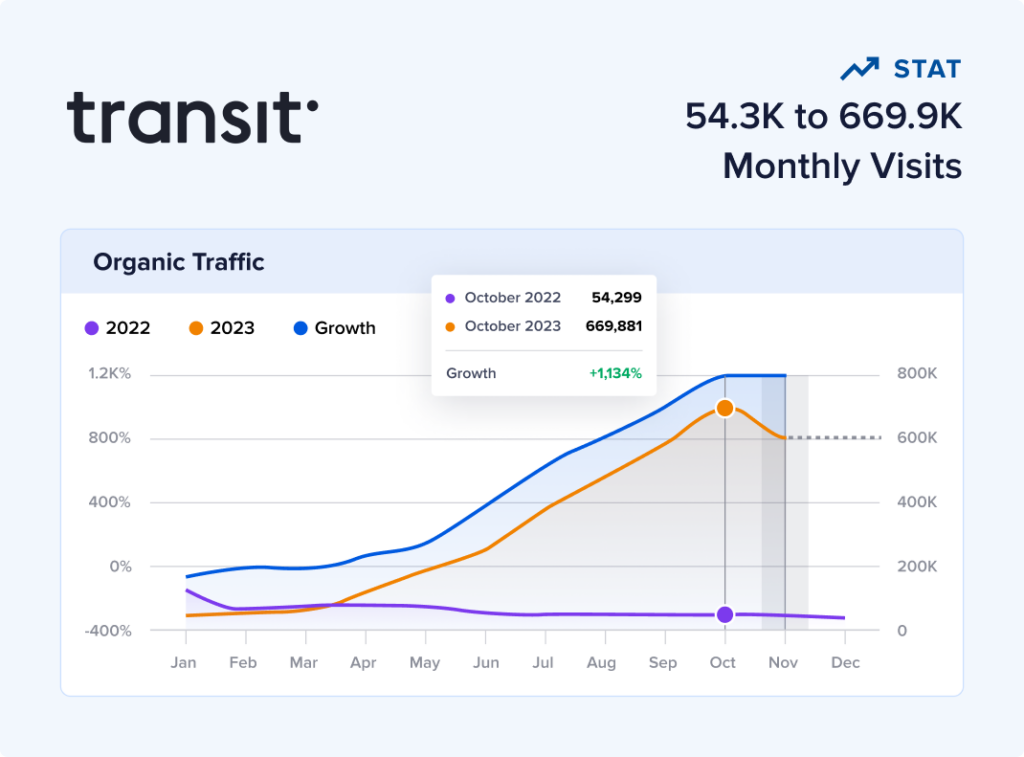
    Transit is real-time public transportation information shared with over 300 cities worldwide. Though extremely popular on Android (over ten million downloads) and Apple’s App Store, Transit faced an SEO challenge in that its website had limited pages (less than 300), which meant it could not rank for a wide set of relevant queries. The app itself had already been downloaded more or less successfully, however, the app missed out on a major opportunity to win organic search traffic by neglecting to focus on long-tail keywords around public transportation in different cities.

    SEO Challenge:

    Given that Transit didn’t have a lot of content to speak of and so few pages of content, it couldn’t rank for the specific, location-based queries that its targeted users were searching for. An example is that people will search for the bus routes or subway system in a given city. Transit lacked enough content to equip all these specific headings with unique content, and so it had been invisible to search engines, unable to get new users from organic search traffic.

    Solution and Growth:

    In 2023, Transit adopted a programmatic SEO strategy to scale its content portfolio. As an example of a widely useful application for programmatic SEO, our website Transit.com has a great need for content on many topics, created in many languages, all over the world. This was one of the ways Transit built tens of thousands of highly specific landing pages for specific bus routes, subway lines and transportation options in cities all worldwide.

    This was nothing short of a revolution. Content portfolio of Transit grew from under 300 pages to more than 10,000 to 21,000 pages. This meant that traffic to the app went into the thousands, and organic traffic and user interaction also significantly increased. Transit saw a 1344% year-over-year growth in organic traffic.

    Impact:

    The additional content gave Transit the ability to dominate search results for very specific local queries and drove a massive increase in user acquisition via the organic channels. Transit’s app with its highly localized content became the go-to source of transit information for the cities it serves. Finally, the increase in traffic resulted in higher app downloads and engagement, and had a more overall stronger presence in the mobile app and web search spaces.

    Key Takeaways:

    To attract more targeted traffic and capture a wider range of keywords, you need to build a large content portfolio that covers a broader scope of online searches. For Transit, programmatic SEO was the ability to create thousands of pages targeting very specific long-tail keywords. As a result, they were able to capture search traffic from people searching for localised transit information. When you accomplish scaling content production through automation, you can increase outreach and rank for an even broader set of keywords, which gives you more traffic towards your site.

     3. Iowa Girl Eats: Dominating the Food Blog Space with Recipe and Image SEO   

    Iowa Girl Eats: Dominating the Food Blog Space with Recipe and Image SEO 

    Image source: https://aioseo.com/wp-content/uploads/2024/02/iowa-girl-eats-seo-case-study-1024×757.png

    Industry: Food Blogging

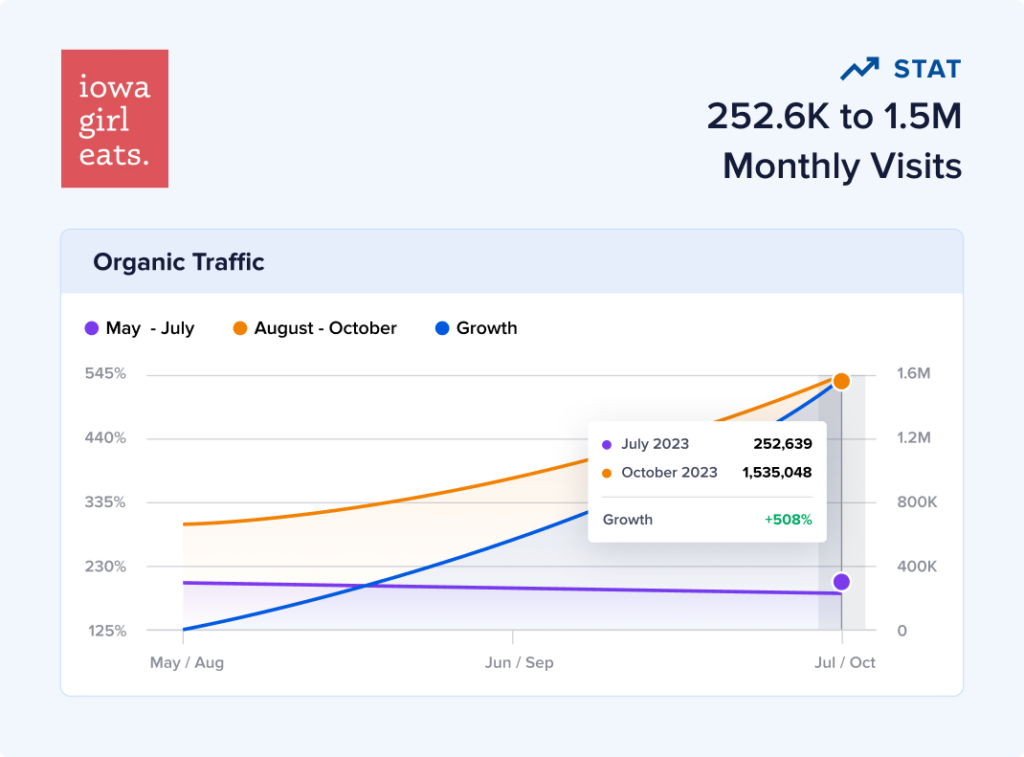
    Iowa Girl Eats is deemed as Kristin Porter’s gluten-free food blog that provides diet-restricted people with recipes, tips, etc. But despite making good quality content, Kristin found that she was competing with millions of other bloggers and desperately trying to rank for the same or similar keywords in the food blogging space. Specifically, she knows that food blogs are fighting in text-based results alone, somehow, and must make a play for visibility in Google’s image and recipe tools.

    SEO Challenge:

    Standing out in Google’s search results was a major problem (the food blogging market is already crowded), and they have to compete with numerous big brands. Kristin’s recipes must come up in the main results, but importantly also in the recipe carousel, which shows rich snippets (and is well known) at the top of the page. It was also critical to optimize her photos for Google Image Search since food blogs are usually driven by appealing images to draw readers.

    Solution and Growth:

    To overcome these challenges, Kristin adopted a multifaceted approach to SEO. To help her recipes show up in the rich snippets, she added recipe schema markup to her blog posts (structured data to her recipes that helps them show up in Google’s rich snippets and recipe carousel). This meant she was far more visible in the search results for specific recipes that users are searching for. She also optimised her food images so that they would rank well in Google Image Search and enhance the odds of them showing up in the search results when people looking for recipes to eat would carry out a search.

    Within only three months, Kristin managed to grow her organic traffic by 508%. She was regularly featured on the Google recipe carousel, and her images were very well ranked in Google Image search, helping drive more clicks and more visibility overall.

    Impact:

    By using structured data and image optimization, Kristin significantly increased the visibility of her blog in search results. In addition, her gluten-free recipes started to become more discoverable and were more engaging. This caused the organic traffic to Iowa Girl Eats to skyrocket, resulting in more page views, increased engagement and the ultimate success in her business.

    Key Takeaways:

    When competing in a highly saturated space, it’s not enough to optimize just your text-based content; you also need to optimize your images and structured data. Using recipe schema markup to help index her recipes alongside them and image optimization to rank in Google Image search was beneficial to Kristin’s food blog, especially when she used recipe schema markup for her food blog, such as Iowa Girl Eats. Besides that, user-centric content that answers common questions like the ones in Google’s People Also Ask section also helps increase organic traffic. Structured data and image SEO can be a compelling order for getting PAID organically much easier; it’s all about being focused on that.

     4. KrispCall: Scaling SaaS with Programmatic SEO   

    KrispCall: Scaling SaaS with Programmatic SEO 

    Image source: https://aioseo.com/wp-content/uploads/2024/02/krispcall-seo-case-study-1024×757.png

    Industry: SaaS

    KrispCall is a cloud-based virtual phone system that provides a host of communication entities, like virtual phone numbers and call centre software. Even though KrispCall, with its Singapore headquarters and an office in Australia, was a global player, it found itself struggling with SEO of growing online presence in the highly competitive SaaS and cloud communication space.

    SEO Challenge:

    The biggest problem that KrispCall faced was that they were unable to rank for a wide variety of keywords in various geo regions. KrispCall was one of the many SaaS companies serving customers around the world, but they had a very constrained ability to target and serve localized traffic because they had only a few hundred landing pages to help achieve those goals.

    Solution and Growth:

    KrispCall tackled this by developing programmatic SEO, a technique that builds a large number of landing pages targeting specific geographic and numeric niches, such as area codes.  KrispCall could create landing pages for each U.S. area code (and some from other popular high-traffic countries) specifically targeted at highly specific search queries. By implementing this, KrispCall was able to come within reach of users who were searching for virtual phone services in certain regions.

    The results were staggering: during the analysis period, 82% of the U.S. traffic came from area-specific landing pages driving KrispCall’s U.S. traffic. With this massive increase in visibility, both the traffic to the site and user engagement increased substantially.

    Impact:

    KrispCall was able to reach more localized audiences as it expanded its reach, all through the strategic application of programmatic SEO. A localized, high-volume SEO approach led to a 1,969% YoY growth of traffic, proving a great example of how the company grew.

    Key Takeaways:

    In a competitive, international environment, if you fail to target the suitability of your audience and match their search intent, then you will surely face failure. KrispCall achieved this by designing landing pages for the specific local areas using area codes on the search bars. KrispCall was able to much quicker and efficiently scale its content production by optimizing the page templates for programmatic SEO and subsequently achieving a massive traffic boost. It also granted the company rich snippets, as well as winning additional exposure from FAQ schema markup.

     5. The Independent Pharmacy: Capitalizing on FAQs and Schema Markup   

    The Independent Pharmacy: Capitalizing on FAQs and Schema Markup

    Image source: https://aioseo.com/wp-content/uploads/2024/02/independent-pharmacy-seo-case-study-1024×757.png

    Industry: B2C (Online Pharmacy)

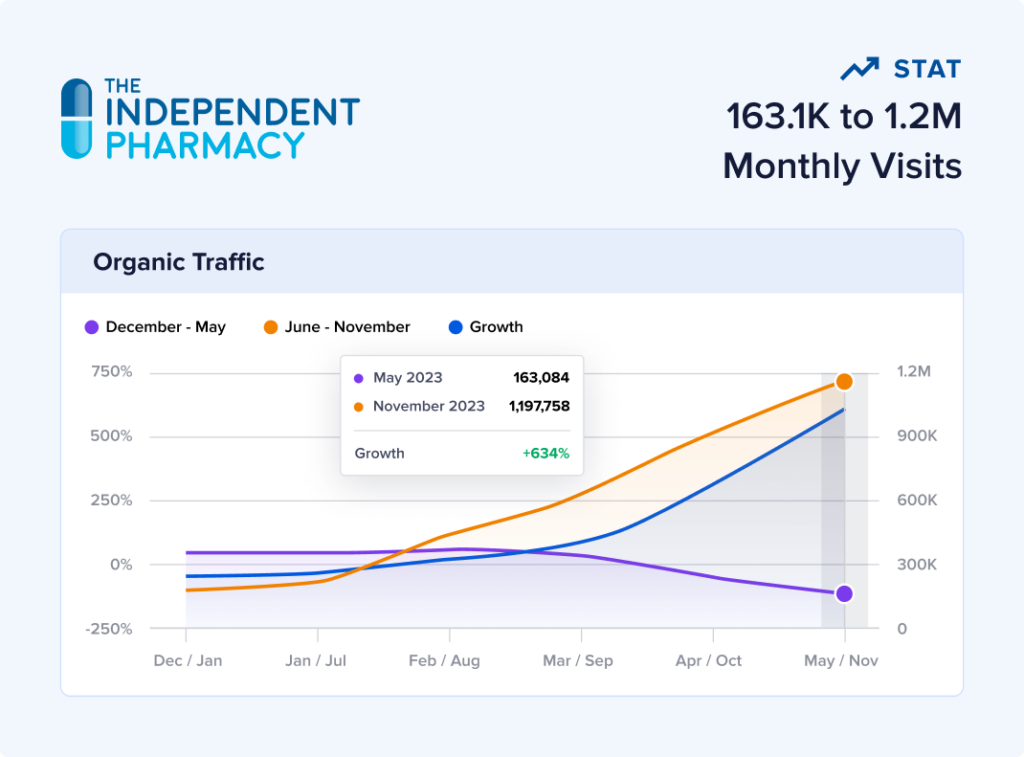
    Independent pharmacy based in Bristol, UK, is offering a range of services, including medical consultation, advice on health and dispensing prescribed drugs to people who want to buy online. The pharmacy was launched in 2013, and quickly became one of the main players in the UK online pharmacy, but due to increasing competition with both big pharmaceutical corporations and nearby clinics, the borderline was essential for pharmacy needed to secure a leadership position in the UK segment of the online pharmacy.

    SEO Challenge:

    The biggest problem for The Independent Pharmacy was to increase visibility in a very competitive market. While offering a wide spectrum of services and having over 19,000 positive reviews, the pharmacy required its content to be more searchable on Google’s search engine results page (SERP), mostly for such competitive keywords as pharmaceutical and healthcare.

    Solution and Growth:

    A major method employed by The Independent Pharmacy was to popularize the FAQs almost everywhere on the landing pages. With the pharmacy incorporating commonly asked questions about each service or product into the pharmacy, it was able to target several other long-tail keywords that were being searched by users.

    To increase the chances of the pharmacy’s list showing up in the People Also Ask (PAA) box on Google, the pharmacy began using FAQ schema markup on these pages. By allowing Google to understand the content better, and as such providing it with featured snippets, the site increased its visibility in search results.

    Thus, the Independent Pharmacy increased organic traffic by 634% over six months and crossed 1 million monthly visits for the first time. They also improved their visibility on Google by picking up over 8,700 keyword rankings in the PAA box.

    Impact:

    The combination of too much FAQ optimization and their constant new releases of content, combined with structured data, really drove lots of organic traffic to the site. This helped the Independent Pharmacy maintain its leading position in the very competitive online pharmacy space, by consistently appearing in Google’s highly visible PAA snippets and gaining better overall rankings.

    Key Takeaways:

    If you want to enhance the visibility, then FAQs can be used to optimize for the People Also Ask (PAA) results. This strategy was so effective for The Independent Pharmacy that they were able to capitalize on PAA boxes and grab a lot of traffic from those results. Additionally, they could win rich snippets and did improve their visibility if they also implemented FAQ schema markup behind the scenes. Also important to staying current and staying ahead of the competition is regularly updating your content.

     6. Hawthorn: Expanding Local SEO and eCommerce Presence   

    Hawthorn: Expanding Local SEO and eCommerce Presence

    Image source: https://aioseo.com/wp-content/uploads/2024/02/hawthorn-seo-case-study-1024×732.png

    Industry: Local & eCommerce

    A longstanding neighbourhood staple of Hawthorn Mall in Vernon Hills, Illinois, Hawthorn Mall had been a place to focus on foot traffic. Yet in 2015, Hawthorn moved into the online market, and in the year 2020, it brought to life an e-commerce platform. The problem with Hawthorn was that it needed to find a way to get traffic to the new online shopping platform without disrupting its local goings on.

    SEO Challenge:

    For an established local business, Hawthorn had to go online and compete with the likes of every other shop in the city. The issue was to get the most out of their local SEO power and build up their reach with e-commerce. Building an online shopping platform meant that an SEO strategy was needed to bring in not only local shoppers but also people from a wider area.

    Solution and Growth:

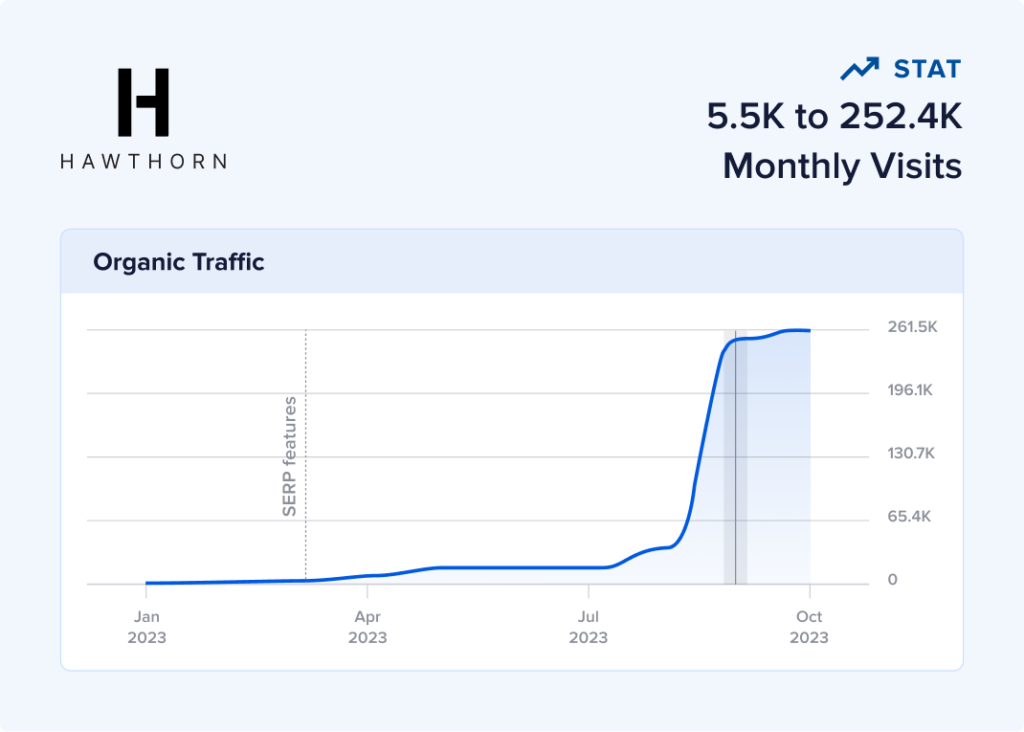
    To generate significant customer acquisition in spring 2023, Hawthorn doubled their keyword ranking, multiplying their keyword rankings by 3.5x, increasing their reach to 51,000 new pages online. Hawthorn had targeted relevant keywords that were not associated with its brand and optimised its pages for local and e-commerce traffic. Bearing that in mind, Hawthorn was able to increase the number of customers to its online store.

    As an additional point, Hawthorn also placed emphasis on image SEO to make the product images rank well in Google’s image search, and this gives potential shoppers more visibility to see. Within those five months, though, it resulted in a phenomenal 252,000 monthly visits.

    Impact:

    Content scaling worked for Hawthorn by using new landing pages in conjunction with strategic keyword optimization and image SEO to improve its online presence. This approach helped the mall successfully increase its local and eCommerce traffic, bringing it to new heights in both local and eCommerce search results.

    Key Takeaways:

    If you’re adding an online component to your brick-and-mortar business, then focus on new, fresh, relevant keywords that pertain to the products and services that you now offer. One of the reasons behind Hawthorn’s SEO success was its ability to target high-value non-branded keywords. Furthermore, they followed a 301-redirect strategy as well as an image SEO to use in order for their domain migration and eCommerce platform to be successful. You can further increase your reach and the amount of local and global traffic you receive by focusing on elements of your site.

    How SEO Ties Everything Together in Digital Marketing   

    If you look at the situation right, SEO is a connecting element that makes all those things come together in digital marketing. Other digital strategies like content creation, paid advertising, and social media play an essential part, but your efforts can only be discovered by your target audience with SEO. It’s essential to understand where SEO fits in your digital marketing strategy so each effort complements the other and contributes to long-term growth. SEO is not just about throwing in keywords; SEO is putting your website up for advancement and visibility, increasing user experience on your website, and making sure your content matches search engine keywords.

     Why SEO Is Important in Digital Marketing   

    Why SEO Is Important in Digital Marketing

    1. Increased Visibility and Traffic: SEO is the basis for providing organic traffic to websites since the ranking of content in search engine results is guaranteed. In other words, it means having a larger reach without continuous costs such as those tied to paid advertising. In reality, it is revealed in actuality that search engines are responsible for 53 per cent of all website traffic, thus emphasizing the importance of SEO as part of digital marketing. Plus, figuring out SEO is like hitting the jackpot. The site starts popping up exactly where people are looking, and suddenly there’s this steady stream of visitors without lifting a finger (well, almost). If that’s your goal, you’ll want to follow smart SEO tips to boost website traffic organically to make it happen.

    2. Content Quality and User Engagement: High-quality content has a lot to do with effective SEO. Engaging content promotes user interaction, and with a User’s Need strategy, it results in higher conversions. If you optimize your website for search engines, you are ensuring that your content reaches the right audience, and your content can be searched for blog records, items, and services. Content isn’t just about throwing words on a page and hoping for the best. When the focus shifts to making stuff actually helpful, funny, and, yeah, a little dramatic (because why not?), people actually start engaging. Like, real comments, DMs, even shares from strangers.

    3. Improved Website Performance: The main focus of technical SEO is enhancing your website’s architecture with respect to being fast, mobile-friendly and secure. Not only will these factors help to enhance user experience, but also it will also make your site aligned with the search engine needs, thereby increasing your rankings and users’ retention.

    4. Long-term Cost Efficiency: SEO efforts give permanent value, unlike paid ads. After getting your website to rank high, you no longer need to pay constantly for visibility. One of the most cost-effective ways of digital marketing is that SEO can bring you organic traffic without continuous investments. SEO is like that loyal friend who keeps showing up without asking for anything in return. Once a site ranks high, it keeps pulling in clicks day after day, no ad budget drama, no bidding wars, just pure organic magic. It’s not some one-night-stand tactic; it’s the slow burn that keeps paying off. Sure, there’s a little grind upfront, but once it’s up there? That visibility sticks. And honestly, who doesn’t want free traffic showing up 24/7 while everyone else is still throwing cash at ads?

    5. Trust and Credibility: Organic listings in the search engines are often considered more credible than paid ads. About 70 percent of users click on organic results because they increase user engagement and decrease bounce rate. The trust will ensure higher conversion rates, especially when organic search refers the consumer to the business because they know they are working with the company.

    6. Supports Other Channels: SEO as a digital marketing technique greatly enhances the efficacy of all the other digital marketing channels. For example, social media sharing can be fuelled by high-quality, optimized content and is a help in the paid search (PPC) activities. Through this, all the components of the marketing strategy work together as a cohesive strategy to reach out to a wider audience.

    SEO is also the glue that keeps your entire digital marketing strategy together. If your content is posted, it is guaranteed to reach the right audience at the right time, ensuring that all your efforts in creating content, engaging socially, and using paid ads have been successful. Among the many reasons SEO is important, some of which are a traffic booster, improving user engagement and building your users’ trust, SEO is of importance. This will help you to have long-term success and compete in the world that is becoming digital.

    Final thoughts    

    SEO is much more than a technical tool. It is a strategic element of the company that generates long-term business development. To build such a strong digital presence based on traffic, conversions and brand loyalty, all you have to do is optimize your content, focused on top quality content based on good user experience. Working with a Genzpro can help streamline this process and ensure your efforts align with the latest trends and algorithms. SEO is a continuous work, and for companies that want to advance in the digital age, it is an indispensable part of any wide marketing strategy.

  • THE ROLE OF CONTENT IN SEO

    THE ROLE OF CONTENT IN SEO

    In the world of SEO, content is still the thing that’s going to get noticed because it’s what search engines like Google use to determine relevance, authority, and value. Don’t let anyone tell you otherwise. Content isn’t just some random string of words to fill up space; it’s the backbone of a site. Google? Yeah, they’re out here constantly tweaking their algorithm, and guess what? They’re paying attention to how good the content is because Google’s algorithms prioritize sites that offer valuable, relevant, and well-organized information that meets the needs of users and answers their search queries directly. It happens over and over, which gives Google exactly what it wants (quality, structure, and purpose), and boom, the rankings climb. But, like, this isn’t just some random claim. Let’s discuss some real-life examples that show just how powerful solid content can be for SEO.

    The Importance of Content in SEO   

    SEO isn’t just about cramming in a bunch of keywords and hoping for the best. Content is the lifeblood. Too many sites throw a bunch of tech stuff at SEO and forget the heart, that’s the content. It’s what gets the search engines to care about a site. Snazzy backlinks or the fastest load time won’t help if the content isn’t up to snuff. Without strong content, a site is invisible.

    Here’s why content is so important:
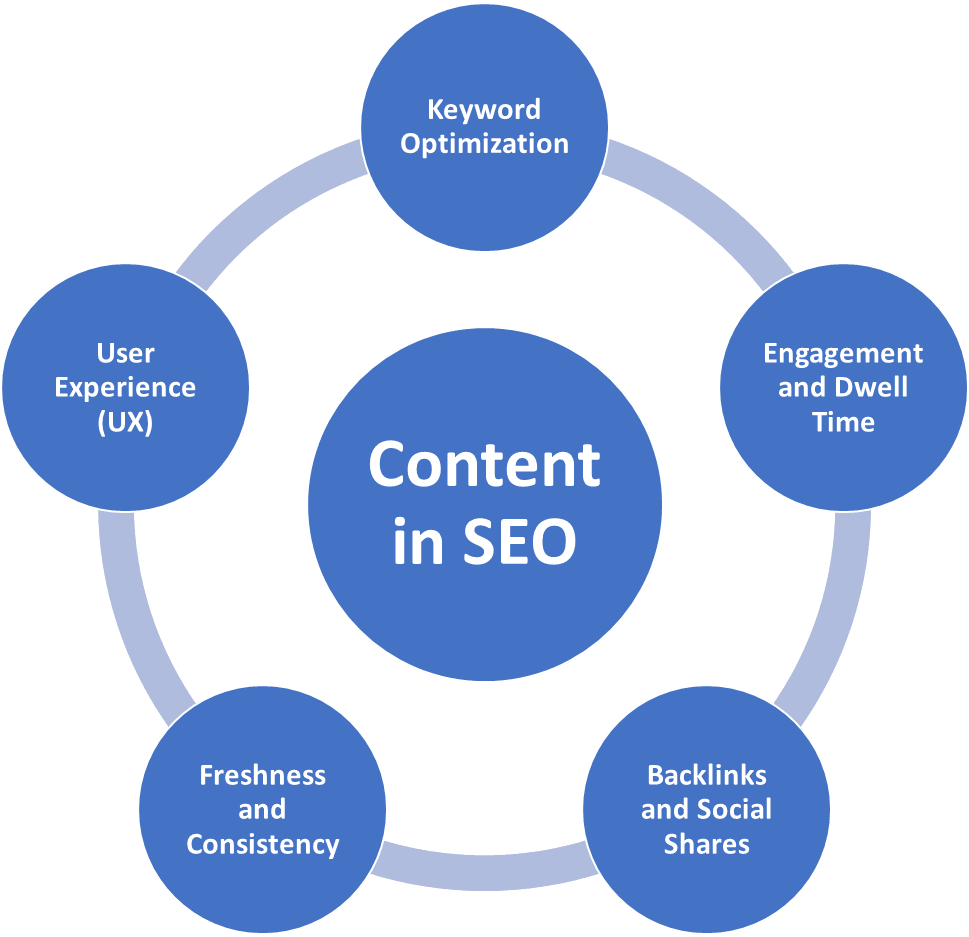
    content strategy for seo

    The Importance of Content in SEO  

    Source: Self-Made  

    1. Keyword Optimization: It’s not rocket science. The content needs to be relevant to what people are searching for. High-quality content that answers specific questions naturally incorporates keywords without sounding like a robotic mess. When content flows, hits the target, and aligns perfectly with search intent, that’s when the magic happens. And when Google notices, things start looking good in the rankings.
    2. Engagement and Dwell Time: Some websites have content so good that people just won’t leave. They’re hanging out, reading, clicking around, and the next thing you know, Google takes notice. The more time people spend on a site, the more Google says, “Oh, okay, this content must be solid!” If something keeps people engaged, a site is already ahead of the game. Dwell time is like a little secret weapon, and it makes a world of difference.
    3. Backlinks and Social Shares: Getting those sweet backlinks is crucial. The more reputable websites link to content, the more Google likes, “Okay, they must be legit!” A few shares from major platforms, and suddenly, rankings climb. It’s like when people start talking about someone at a party, suddenly everyone wants to know what’s up. That’s what backlinks and social shares do for a site. Google pays attention to this, and so should anyone working on SEO.
    4. Freshness and Consistency: Google loves fresh content. Sites that update their blogs regularly show it. People keep coming back for more, and so does Google. A stagnant site is a one-way ticket to page 15. But when content is consistently updated, Google sees it as a sign that the site is alive, kicking, and ready to serve up the freshest info. Keep things moving, stay relevant, and watch SEO improve.
    5. User Experience (UX): If content is easy to read and looks good, people (and Google) are way more likely to stick around. It’s all about creating a vibe where people feel comfortable and engaged. Think simple, clear design, and content that doesn’t give anyone a headache. When content pops, and the layout’s smooth, the bounce rate drops, and Google notices. It’s like setting up the perfect room where people want to chill all day long. That’s good UX, and it makes a huge impact on SEO.

     Real-Life Case Study   

    1.  Flyhomes: A Surge in Organic Traffic   

    Industry: Real Estate

    Challenge

    This AI-powered home search platform was out here trying to level up its online presence in a market that’s massive and insanely competitive. Everyone is on the hunt for homes, right? The real estate space is flooded with companies trying to grab attention, so standing out isn’t exactly a walk in the park. Flyhomes? Well, they were kind of flying under the radar at first. They had all the right tools, the innovative tech, and massive potential, but when it came to visibility? Not much was happening. They needed something bold, something to get people to see them.

    The real challenge here wasn’t just about having a good product, it was about cutting through the noise of a crowded industry. Real estate is a saturated field, with countless websites offering similar listings, but Flyhomes needed to make sure its content wasn’t getting lost in the mix. How could they stand out in a sea of listings, blogs, and cookie-cutter advice? They needed a strategy that would make them not only noticed but remembered. The only way to achieve that was to shake things up, create content that wasn’t just informative, but compelling and highly relevant to their audience’s real needs.

    Strategy

    Instead of just tossing out some generic content and crossing fingers, Flyhomes took a completely different approach. They didn’t fall into the trap of creating the usual “buy a home” kind of content that everyone else was doing. Nope, they went much deeper. Flyhomes focused on highly detailed housing-related guides, with a special emphasis on cost-of-living guides. And let’s be real: buying a house is not an impulse decision, it’s a huge commitment. People want the facts, the details, and the kind of deep dive that helps them make informed choices before parting with hundreds of thousands of dollars.

    Flyhomes knew exactly what potential buyers were craving: insider knowledge, the kind of info you can’t get just anywhere. So, instead of offering shallow content, they provided well-researched, value-packed insights that people needed. These weren’t just fluffy articles that sound good but add no value. These guides were rich with useful details that answered real questions. Google loves content like this because it’s not just about keywords; it’s about relevance, authority, and true value. And that’s the magic of offering such high-quality content, Flyhomes went from being a hidden gem to a go-to resource. They didn’t just make noise; they made a statement that resonated with both users and search engines.

    Results
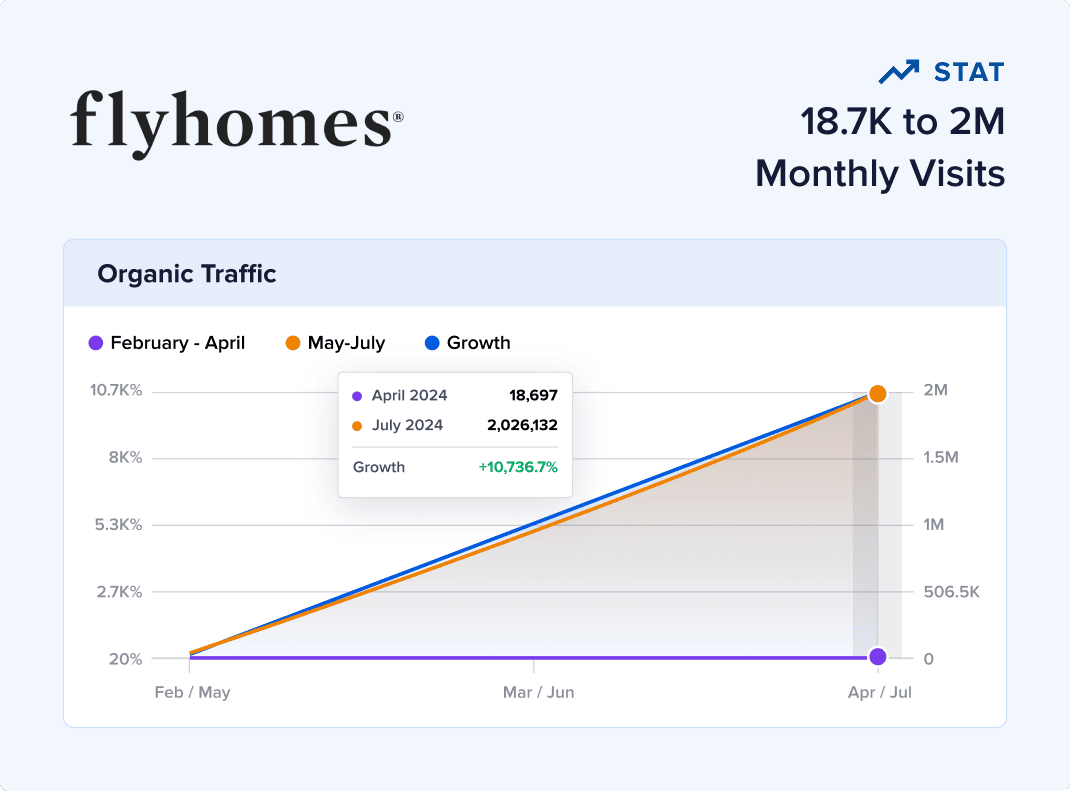
    Flyhomes: A Surge in Organic Traffic

    Downloaded Image: https://aioseo.com/wp-content/uploads/2024/12/flyhomes-seo-case-study.png

    Now for the interesting part. In just three months, Flyhomes saw a mind-blowing 10,737% increase in traffic. This wasn’t just a little bump; it was a total surge that had the site flying high. Imagine it: a site suddenly getting hit with that much traffic. That’s the kind of thing that makes competitors sit up and take notice. And here’s the kicker: over 55.5% of all that traffic came from those cost-of-living guides.

    These weren’t just a few extra visits here and there; they were the backbone, the key drivers, pulling in the right audience and making people stick around. These guides answered exactly what people were searching for, making them indispensable to anyone considering buying a home. They also gave Flyhomes a framework to measure the performance of your SEO efforts accurately, using their content as the driving force behind significant traffic growth and user engagement. 

    But wait, there’s more. Flyhomes wasn’t just seeing a little increase in traffic. No, they were pulling in over 1.1 million visits every single month, all because of content that was not only insanely helpful but also optimized to perfection. When you see those kinds of numbers, it’s clear: this is what happens when content hits the sweet spot. It’s not just good, it’s next-level good. That kind of result? It’s like content marketing on fire, turning heads and completely reshaping the digital landscape. That’s the true power of quality content. (https://aioseo.com/seo-case-studies/?utm_source)

    1.  Brainly: Leveraging User-Generated Content   

    Industry: Education

    Challenge

    So, here’s the scoop with Brainly. They were all about stepping up their game and boosting those search engine rankings, but let’s be real, standing out in the crowded world of online education isn’t exactly a walk in the park. The internet is jam-packed with hundreds of educational platforms, all competing for that sweet spot at the top of the search results. Brainly wasn’t just sitting back, hoping people would stumble upon them. Nope, they had big plans to make a splash in the sea of homework help sites. Their challenge? How to increase their search rankings and get people to not only click through but engage with their content. And trust me, that’s a lot harder than it sounds.

    Everyone’s got something to offer, so what makes one platform more appealing than another? Brainly needed more than just a solid product; they needed to make sure both Google and users were really taking notice. It wasn’t enough to have good content; it needed to be visible, valuable, and engaging. So, Brainly knew it was time to take things up a notch and come up with a strategy that would get them ahead of the competition and put them on everyone’s radar.

    Strategy

    Instead of following the usual route of offering basic answers to common questions, Brainly took a bold step by embracing the power of peer-to-peer learning. And honestly, this shift was pure genius. By allowing users to actively participate in answering each other’s questions, Brainly didn’t just create content, it sparked an entire community-driven knowledge base.

    Brainly wasn’t just tossing out a bunch of content and hoping it sticks. This approach created a giant, continuously expanding pool of content for the site. Think about it: over 2 million question landing pages. Each page was carefully crafted to match exactly what people were searching for. And the best part? Every time someone answered a question, bam, another piece of content was added. Instead of just stacking random answers, Brainly was building a searchable universe of knowledge, ready to be indexed by Google.

    This approach was especially beneficial when they decided to run a complete SEO audit for better results and optimize thousands of question-based pages to align with user intent and search demand.  It wasn’t about more content for the sake of it. Every page had the potential to be found by people desperately searching for answers. Brainly created a perfect place where students could get exactly what they needed, when they needed it.

    Google loves this kind of content because it’s high-value, constantly updated, and perfectly optimized for search. At the same time, students were getting exactly the help they needed in real time. That’s the kind of SEO magic that happens when content aligns with what users are searching for while also making search engines fall in love with the site. It’s the best of both worlds, no question.

    Results
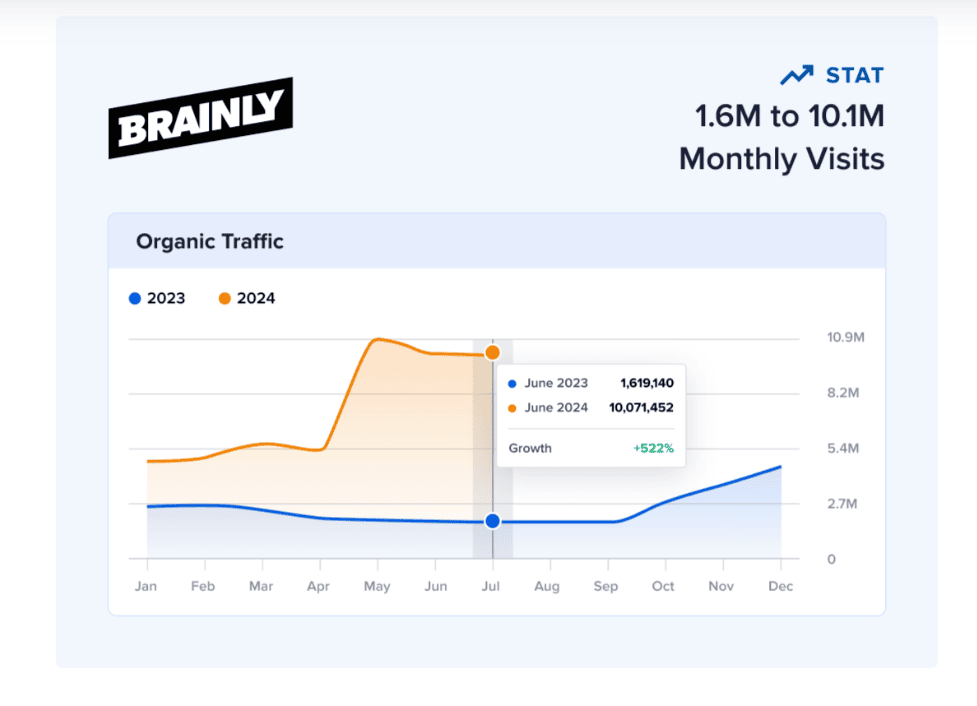
    Brainly: Leveraging User-Generated Content

    Downloaded Image: https://aioseo.com/seo-case-studies/?utm_source

    Let’s talk about the magic behind Brainly’s traffic surge using this graph. So, in June 2023, they were pulling in 1.6 million monthly visits, but by June 2024, that shot up to 10.1 million. Do the math, that’s a 522% growth! This wasn’t just a small bump; it’s a total game-changer for their visibility and reach.

    This graph is a true testament to the power of a community-driven content strategy. As more and more users jumped in to answer questions, Brainly built a self-sustaining content machine. This wasn’t a quick spike or a fluke; it was a steady increase in organic traffic. Every new answer posted made the platform even more valuable, not just for students looking for help but for Google too.

    Brainly didn’t just toss a bunch of SEO tricks together and hope for the best. They built a whole ecosystem that was working for them 24/7. They turned their users into content creators, and guess what? That made the platform explode. It wasn’t just about cranking out random content; it was about creating a space where everyone could chip in, and suddenly, boom, Brainly became the go-to knowledge hub.

    They didn’t just exist in a crowded space, they owned it. They earned trust, built credibility, and now they’re a dominant force. It’s like when you’re at a party and suddenly everyone knows your name. That’s what happened here. Brainly wasn’t just about content; it was about engaging, empowering, and letting that organic growth work its magic. When does it all click? You have outputs that are havoc. (https://aioseo.com/seo-case-studies/?utm_source)

    1.  ZOE: Optimizing for Image Search   

    Industry: Mobile Application (Health)

    Challenge

    So, here’s the deal with ZOE. This digital health platform was crushing it in terms of content, think health tips, nutrition guides, wellness advice, and all that jazz. But they had one little hiccup: image search. You know when you type something into Google and the search results are all images, like when searching for “healthy smoothie recipes” and those vibrant photos pop up? Well, ZOE’s images weren’t showing up in that magic spot. They had this treasure trove of health-related images, but it was like the internet wasn’t seeing them.

    It’s like having a killer playlist full of amazing tracks, but no one can find it because it’s buried under a bunch of other playlists. That’s exactly what was happening with ZOE’s images. They were missing out on all this potential traffic from people who were looking for the kind of content ZOE was offering. This wasn’t just a small issue; it was a visibility problem that was preventing them from being discovered, especially since image search results are a big deal for driving traffic, especially in a visually-driven industry like health and wellness. So, they knew they needed to fix this fast if they wanted to tap into that sweet, sweet organic traffic coming from Google’s image search. And that’s when ZOE rolled up their sleeves and got to work on turning things around.

    Strategy

    Here’s what ZOE did to turn things around. They didn’t just throw their images up there and hope they’d somehow magically get found. No, they got smart and optimized each image. First, they tackled alt text, that little snippet of text that describes the image for search engines. It’s like giving Google a cheat sheet of what the image is all about. Without alt text, Google has no clue what that image even represents. So, ZOE made sure every image had clear, descriptive alt text that not only helped visually impaired users but also made sure Google was in the loop.

    Next, they tackled file names. It’s crucial to stop using “image001.jpg” or whatever random string of numbers. ZOE ensured their image file names were filled with relevant keywords that matched what people were searching for. This is key because Google looks at the file name to understand what the image is about. A file name like “healthy-smoothie-recipe.jpg” is way better than “image123.jpg,” right?

    But hold up, ZOE didn’t stop there. They also added informative title tags for each image, providing even more context to search engines. These title tags were another opportunity to tell Google exactly what was in the image, especially when there were multiple similar images or ideas on the page. Essentially, ZOE turned each image into a well-optimized powerhouse, working overtime to get noticed on Google. They weren’t leaving any opportunities to improve visibility on the table; every little detail was covered. The result? A highly optimized image library that wasn’t just sitting there; it was actively working to attract traffic.

    Results
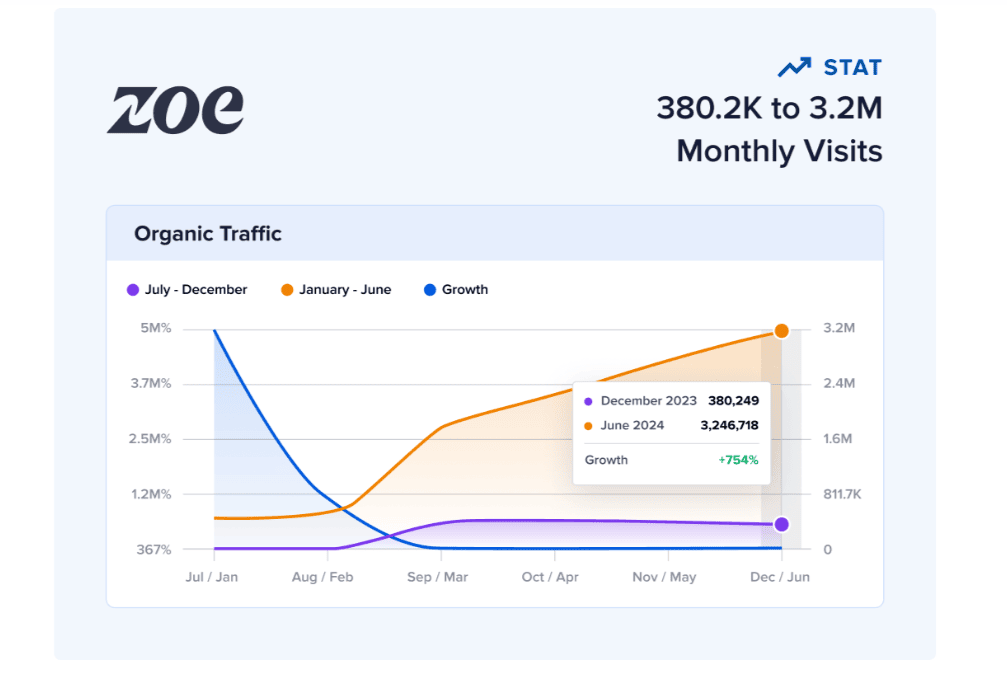
    ZOE: Optimizing for Image Search

    Downloaded Image: https://aioseo.com/seo-case-studies/?utm_source

    Looking at this graph, it’s clear that ZOE’s efforts to optimize their images for search results had a huge impact. Before they optimized their images, they were seeing 380,249 monthly visits in December 2023. But by June 2024? That number shot up to 3.2 million visits, a staggering 754% growth! Just let that sink in for a moment.

    The timing of the growth in the chart shows exactly how ZOE’s image optimization strategy paid off. In the months following their image optimization, organic traffic just exploded. The orange line (representing January-June 2024) shows a massive upward trajectory compared to the more stable, lower traffic in the previous months (purple line). It’s like ZOE went from being virtually invisible to Google’s image search to dominating the scene. Those 72,100 image snippets? Yeah, they weren’t just a one-time fluke; they were a consistent driver of traffic, showing up across Google’s search results, and pushing ZOE’s visibility to levels they hadn’t even dreamed of.

    It wasn’t just a random spike, either. The growth was steady and sustainable, meaning ZOE didn’t just get lucky; they put in the work to make sure those images kept showing up. Their visibility improved, and the traffic followed. That’s what happens when content is optimized to its fullest potential: the results aren’t just a flash in the pan, but a solid, sustained rise that keeps feeding the platform with new visitors. The graph just proves how critical image optimization can be for boosting SEO and driving organic traffic. (https://aioseo.com/seo-case-studies/?utm_source)

    1.  GameChampions: Content Expansion for Growth   

    Industry: Esports

    Challenge

    So here’s the deal with GameChampions, this online gaming platform that was ready to go big. They had the right vibe, the passionate players, the killer games, basically, everything needed to be successful in the gaming world. But there was one thing they were missing: visibility. The gaming world is packed. There’s competition left, right, and center with gaming platforms everywhere, fighting for eyeballs. So, being invisible in this kind of space? That’s a nightmare. GameChampions had all this potential, but they just weren’t cutting through the noise.

    The website was live, the community was strong, and the content? But, it was like being the coolest person at a party and no one even noticing because they’re not standing in the right spot. The user base? Okay, but they weren’t attracting new players like they should’ve been. It was a slow burn. They weren’t showing up in search results like they should’ve been. So, what’s the next move when the right product is in place but it’s not being seen? Well, GameChampions knew they had to step up their SEO game and get their name in front of gamers who were out there searching for the best of the best in gaming content. No one wants to just exist; they want to take over. That’s when they realized they needed to get serious about getting found on Google, because let’s be real, being invisible in such a massive industry? Total buzzkill.

    Strategy

    GameChampions didn’t just sit around and complain, they decided to level up in the most epic way possible. Instead of waiting for traffic to magically appear, they went all-in on content. But not just any content, this was game-changing content. They weren’t just churning out random posts to fill space. No, they went deep, creating blog posts that covered every gaming topic under the sun. From reviews of the latest games to tips on leveling up, guides on strategies, and everything in between, they became the ultimate resource for gamers.

    And here’s the thing, GameChampions wasn’t writing just for the sake of it. They were laser-focused on the things their audience wanted to know. They researched, analyzed, and figured out exactly what gamers were searching for. This wasn’t about posting random stuff and hoping it worked. They strategically aligned every blog post with the search intent of their target audience. When you give people exactly what they’re looking for, you don’t just get views, you get engagement, and that’s the key to ranking higher on Google.

    The more relevant the content, the more people started finding the site. All of a sudden, GameChampions wasn’t just another gaming site; it was the site to turn to for expert advice and insights. The result? Traffic started flooding in. Once the content started hitting the right notes, it was like the floodgates opened. Search engines took notice, and soon, GameChampions was showing up in search results for all the top gaming queries. The game had officially changed.

    Results
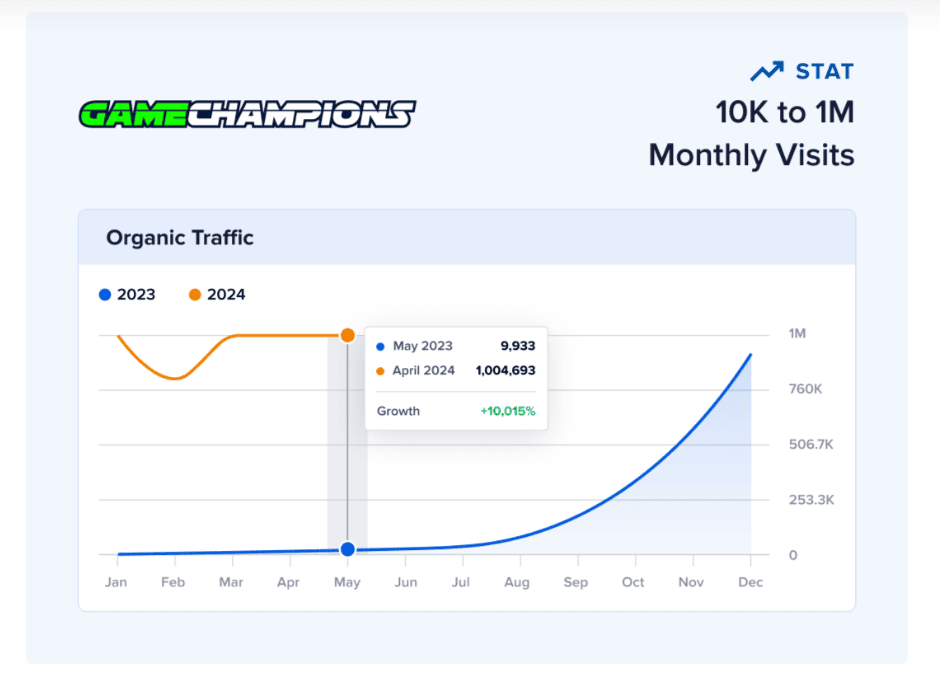
    GameChampions: Content Expansion for Growth

    Downloaded Image: https://aioseo.com/seo-case-studies/?utm_source

    Looking at this chart, it’s crystal clear how GameChampions’ strategy paid off hugely. From a mere 9,933 monthly visits in May 2023, the platform skyrocketed to over 1 million monthly visits by April 2024. That’s a jaw-dropping 10,015% growth in traffic. Going from barely being noticed to hitting over a million visits in less than a year? It’s like going from zero to hero, and that’s exactly what happened here.

    The chart shows a dramatic shift, especially after May 2023. Before that, the traffic was pretty flat, but once the content strategy started kicking in, the numbers went through the roof. The orange line (representing 2024) starts shooting upward like a rocket, leaving the previous year’s performance in the dust. That surge is directly tied to the game-changing content they were putting out, blog posts covering everything gamers wanted, which drove organic traffic like a magnet.

    The result was that those blog posts ended up generating more than 55.8% of all U.S. traffic for the platform. With 133,300 keyword rankings secured, GameChampions didn’t just make noise in the gaming world, they dominated it. Search engines couldn’t ignore them anymore. The combination of consistent, high-quality content and a sharp focus on what their audience was searching for helped GameChampions climb the ranks and claim its space in Google’s search results. Looking at this chart, it’s clear: they didn’t just level up, they completely transformed their digital presence. (https://aioseo.com/seo-case-studies/?utm_source)

    1.  Adecco: Consolidating Content for Global Reach   

    Industry: Workforce Solutions

    Challenge

    Adecco is a huge global staffing company, was doing well, but here’s the thing: they had regional websites scattered all over the place, each one doing its own thing. It’s like trying to run a company with employees who don’t talk to each other and are all doing their own thing. No coordination, no consistency, just chaos. Each region had its website with different content, different approaches to SEO, and sometimes even completely different brand messaging. So, while they were technically visible across various countries, the whole thing felt fragmented, like pieces of a puzzle that didn’t quite fit together.

    In the digital world, that’s a huge problem. You can’t show up strong globally if everything’s scattered. A unified presence is key, especially with so many brands fighting for attention. Adecco got it, chaos wasn’t cutting it. They had the platform, reach, and content, but it wasn’t synced. So, they pulled the power move: unified regional sites into one global site with one SEO strategy. That’s how you turn chaos into a powerhouse!

    Strategy

    So, what did Adecco do? They pulled off a total game-changer. Instead of leaving everything scattered with a bunch of country-specific domains, they made the bold move to consolidate all those regional sites into one global powerhouse. Enter adecco.com, the one-stop shop for everything. It wasn’t just about creating one website, though. Adecco went all-in, ensuring they didn’t just throw everything together and hope for the best. No, they were way more strategic than that. They implemented permanent redirects (think 301 redirects) for every regional site to make sure that all the hard-earned SEO value from the old domains didn’t just disappear. Imagine moving to a new house but making sure every single piece of furniture that’s valuable is brought along, without leaving anything behind. That’s exactly what was done with all that SEO juice.

    This wasn’t just about consolidating sites for the sake of it. It was about taking everything that worked on the regional sites, from keyword rankings to valuable content, and making sure it didn’t go to waste. By redirecting traffic to the new unified site, Adecco ensured it didn’t lose its hard-won SEO rankings. It was like saying, “We’re going global, but we’re bringing all the good stuff with us.” Every little detail was accounted for, from maintaining URL structures to ensuring all historical backlinks were preserved. Smart, right? It was the perfect strategy to strengthen their global SEO presence while keeping all the valuable elements intact.

    Results
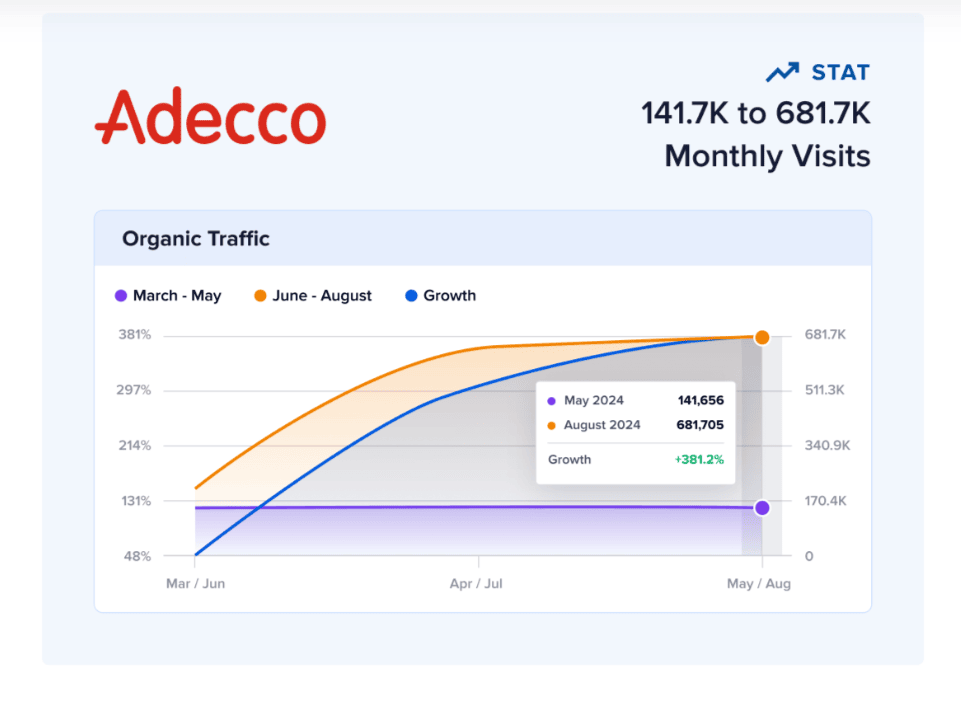
    Adecco: Consolidating Content for Global Reach

    Downloaded Image: https://aioseo.com/seo-case-studies/?utm_source


    Looking at the chart, it’s clear just how much of a game-changer this was for Adecco. In just three months, they saw a 381.2% growth in organic traffic, jumping from 141,656 monthly visits in May 2024 to a staggering 681,705 visits by August 2024. That’s not just a bump in traffic, that’s an absolute surge.

    The chart shows how quickly the traffic took off, particularly in the period from June to August (the orange line). The growth started to gain momentum, leaving behind the more stable traffic of earlier months. This wasn’t a slow, gradual increase; it was an explosive rise. What’s even more impressive is the steady and sustained increase throughout those months. It’s not just a random spike, it’s a clear upward trend that highlights the success of Adecco’s SEO strategy and the consolidation of all their regional content under one roof. (https://aioseo.com/seo-case-studies/?utm_source)

    Final Thought   

    In today’s SEO game, content reigns supreme. From Flyhomes to Adecco, brands that invested in high-quality, relevant content saw massive growth in visibility, organic traffic, and engagement. Whether it’s optimizing blog posts or consolidating regional sites, the strategy is clear: when content is done right, search engines and users take notice. Quality content fuels success.—and with a content-focused SEO partner like Genzpro, brands can turn their digital efforts into measurable growth.

  • STEP BY STEP GUIDE ON FEATURE SNIPPET

    STEP BY STEP GUIDE ON FEATURE SNIPPET

    Getting a Featured Snippet is like hitting the SEO jackpot! Who wouldn’t want that shiny box right at the top of Google, showing off their answer? It’s a significant development because it brings significantly more visibility and traffic. Countless hours are spent figuring out how to land there, and trust me, it’s all about getting the content just right. That’s where working with a SEO agency in Dubai can give you that edge.

    They can help refine your approach to SEO, ensuring you maximize your chances of securing that top spot by aligning your content with search intent.. When does it click? It’s like becoming an SEO boss. In this guide, we’ll be covering exactly what Featured Snippets are, how to optimise your content, and top tips on how to get that top spot. So let’s get started getting you that prime SEO real estate!

    What is a Featured Snippet?   

    A Featured Snippet is Google’s way of saying, “Here’s the quick answer you’re looking for!” It pulls a short, sweet piece of content from a webpage and plops it right at the top of the search results. It’s like the VIP section of Google, and everyone wants in. Some posts land that prime real estate, and trust me, it feels like a total flex. Plus, it drives crazy traffic to your site, so, yeah, getting a Featured Snippet is the goal.

    • Paragraph Snippets: These are the quick, snappy answers that Google loves to show off. Imagine you ask a question, and bam, there’s the answer right at the top. Content landing in one of these is seriously satisfying. It’s all about keeping it short and sweet, give Google what it wants: a clear, direct response. No fluff. Keep it real, keep it simple, and you’re golden.
    • List Snippets: Now, onto List Snippets, oh, these are the favorites. Who doesn’t love a good list? Google just eats them up. You’ve seen it, right? The “Top 10” or “5 Steps to” kind of answers. Posts landing in these can be a game-changer. People love lists, Google loves lists, and guess what? So does everyone else when content gets featured. Break it down, number it out, and you’ll be in the running!
    • Table Snippets: These are perfect for when comparing stuff. Google loves to show a clean, easy-to-read table with all the info laid out. These are perfect for product comparisons or specs, and they stand out. If there’s data, get it in a table format. It’s like telling Google, “Here, take this perfectly organized info and showcase it!” And it works. Every time.
    • Video Snippets: And don’t forget about Video Snippets! If a YouTube video answers a popular question, it could land in the Featured Snippet spot. A few videos showing up here feel like a mini-celebrity moment. A little preview of the video appears, and if people like what they see, they click. Not using video to answer questions? Seriously, what are you doing? It’s a total power move.

     Why Featured Snippets Matter?   

    Featured Snippets are everything for SEO. They boost visibility like crazy, get more clicks, and build your brand as a total authority. Landing that snippet feels like a total flex. Data backs it up too, showing just how much of a game-changer they are.

    Increased Visibility    

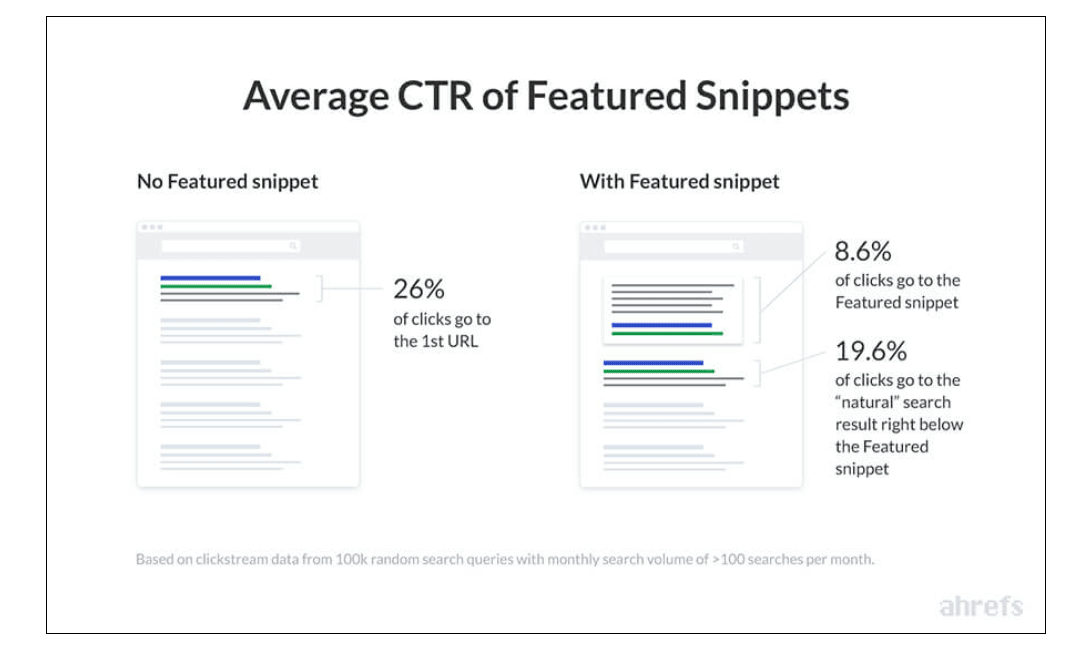
    Featured Snippets are like the crown jewels of Google. They sit at the top of the search results, right under the search bar, stealing all the spotlight. Data shows that when content gets a snippet, visibility skyrockets. For example, Ahrefs conducted a study that showed the first organic result’s CTR drops from 26% to 19.6% when a snippet is present, but the snippet itself grabs an 8.6% CTR! It’s like having the best seat in the house while everyone else is stuck way in the back. (https://searchengineland.com/wp-content/seloads/2017/05/ahrefs-featured-snippets-ctr.jpg).

    average ctr of featured snippets

    Downloaded Image: https://searchengineland.com/wp-content/seloads/2017/05/ahrefs-featured-snippets-ctr.jpg

    More Click-Throughs   

    Even if your website isn’t holding down the number one spot, landing a Featured Snippet can still drive more clicks than the top organic result. Studies have shown that the presence of a Featured Snippet can lead to a 35.1% share of all clicks, highlighting their role in boosting website traffic. (https://www.searchenginewatch.com/wp-content/uploads/2020/12/unnamed-4.png).

    featured snippets

    Downloaded Image:  https://www.searchenginewatch.com/wp-content/uploads/2020/12/unnamed-4.png

    Brand Authority   

    Securing a Featured Snippet positions a brand as an authoritative source. A case study by Moz revealed that a website ranking 10th for a keyword achieved a Featured Snippet position, resulting in a 516% increase in organic sessions and a CTR boost from 2% to 8%. (https://alfarank.com/the-impact-of-featured-snippets-on-seo-case-studies-and-methods-for-gaining-visibility/)

    Voice Search Optimization   

    Featured Snippets are frequently utilized in voice search responses. Research by Ahrefs found that approximately 40.7% of voice search results come from Featured Snippets, indicating their importance in voice search optimization. (https://alfarank.com/the-impact-of-featured-snippets-on-seo-case-studies-and-methods-for-gaining-visibility)

    Step-by-Step Guide to Getting Featured in a Snippet   

    Step 1: Identify Potential Queries   

    If you’re not aiming for Featured Snippets, what’s the point? Featured Snippets are those shiny little boxes at the top of Google’s search results, giving people quick answers right away. No scrolling, no digging, just bam, here’s the answer. We’re talking about direct answers, whether it’s a paragraph, list, table, or even a video. And trust, getting that spot is like VIP status in the search world. It’s all the attention. Google loves them, users love them, and honestly, it’s like hitting the SEO jackpot.

    Categories of Queries Leading to Featured Snippets

    Questions

    If you’re not targeting question-based queries for Featured Snippets, what’s the point? Seriously, people Google things like, “What is SEO?” or “How do I bake a cake?” and boom, if the right answer is right there, it’s golden. It’s all about getting straight to the point. Google’s not here for fluff. Just give them the goods and make it snappy.

    Definitions

    Now, don’t sleep on definitions! When someone Googles “What does AI stand for?” or “What is blockchain?” they want a clear, no-nonsense answer. They’re asking for a definition. So, if that’s nailed down, it’s perfect snippet material. Definitions are just begging to be featured.

    List Searches

    List snippets are the best. Who doesn’t love a good “Top 10” or “How to” list? It’s like a cheat code for Featured Snippets. You’ve seen those queries, right? “Top 10 programming languages” or “Steps to bake a cake.” They’re super common, and Google loves to grab them. The trick? Make sure the list is clear and well-structured. Number those steps, make it pretty, and bam, Google will eat it up.

    Comparison Searches

    Comparison searches are the real power moves. People love comparing stuff. iPhone vs. Android? Yes, please. Best laptop for gaming? Google’s always looking for those clean side-by-side comparisons. When writing the content, don’t just answer. Lay out the pros and cons, make it easy to compare, and the snippet is one step closer.

    Case Study: Enhancing Organic Traffic Through Featured Snippet Optimization

    There’s this digital marketing agency that worked with a home improvement retailer, and let me tell you, they took their online visibility from zero to hero. The retailer was struggling with organic traffic, relying on these long, boring product descriptions stuffed with keywords, yawn, right? But the agency came in like a superhero, revamping the content strategy. They transformed product pages by making them more engaging and clearer. They added cool stuff like product comparison tables with real customer feedback and made sure everything was mobile-friendly. And then they cleaned up the structure, problem-solution statements, price comparisons, and neat little decision boxes. The best part? They used schema markup, which helped Google see their content in a whole new way. Within just six months, 45% of their targeted keywords scored Featured Snippet positions, making them way more visible. Not to mention, their average order value jumped by 15%, and mobile conversions soared by 20%. That’s how you take an SEO strategy and make it shine! (https://www.penbreeze.com/featured-snippet-optimization)

    Tools for Discovering Keywords with Featured Snippets

    Now, let’s talk about the tools to crush it. Google Search Console is a best friend here. It’ll tell which queries are bringing users to a site and help find opportunities for snippets. Ahrefs and SEMrush are also lifesavers. Track which keywords are triggering Featured Snippets and see where competitors are getting their snippet love from. It’s all about finding those sweet spots and optimizing content to snatch up that prime real estate.

     Step 2: Analyze the Existing Snippets   

    Moz dove into 1.4 million Featured Snippets, and trust, they found all the interesting details about what works. It’s like they cracked the code for getting those top spots!

    Content Format

    Okay, let’s dive into the formats because this is where the magic happens. Featured Snippets can be in all kinds of formats, but the big three are paragraphs, lists, and tables. Paragraph snippets are like the quick answers people are craving, short and sweet, usually between 40 to 50 words. Lists? Oh, honey, Google LOVES them. People are always asking “Top 10” or “Steps to” questions, and if the content has those numbered lists, Google will snatch it up faster than a Starbucks coffee on a Monday morning. And don’t sleep on tables! When people are comparing things, like “Best laptops for gaming,” Google is all over those clean, well-structured tables.

    Answer Length

    Now, the golden rule for paragraph snippets? Keep it tight. The answer needs to be about 40-50 words (around 300 characters). No one’s trying to read a novel, so just get straight to the point. Concise wins the race, trust.

    Featured Snippet Position

    Let’s talk about the position zero flex. Featured Snippets sit at the very top of Google’s search results, and it is the prime real estate. If you land there, it’s like being in the VIP section of a concert, everyone’s looking at you. But here’s the catch: Sometimes Google switches things up, and the snippet could show up further down the page or be replaced by other features like knowledge panels or image carousels. But still, being at the top? Major win.

    Case Study Example

    EducationDynamics wasn’t just throwing content at a wall and hoping it sticks. Oh no, they came in with a plan. They teamed up with a super reputable educational institution and made Featured Snippets the star of the show.

    They started by zeroing in on high-value, relevant content that could bring in those Featured Snippets. No filler here, just content that people were searching for, whether it was about the programs, admission process, or general school info. Then, they didn’t just optimize for keywords. They took it a step further and focused on crafting clear, concise answers for each search query. They didn’t want to beat around the bush or write a novel. They wanted Google to be like, “Yup, that’s the answer I’m looking for.”

    They also made sure that the content was super structured with tables, bulleted lists, and paragraphs that were easy for both humans and Google bots to digest. And don’t get started on that “Snippet Bait” thing they used. It’s like they were giving Google an irresistible reason to select their content for that sweet position zero. It’s honestly a little genius.

    The results? It’s crazy. They didn’t just secure a snippet or two; they bagged 17 Featured Snippets, with some of them even hitting position zero for multiple keywords. That’s SEO royalty. The pageviews? A 60% bump, which is huge. It’s like everyone started flocking to those pages. One blog post alone saw a 127% increase in organic traffic. That’s more than doubling the organic traffic, which means a massive increase in visibility, potential customers, and overall engagement.  And don’t forget about the steady 14% month-over-month growth in organic traffic, which shows just how sustainable this strategy was. The traffic? Off the charts. The visibility? Beyond what anyone could hope for.

    This isn’t just a “good SEO practice” story. This is a full-on SEO glow-up. They hit the jackpot, not just for the client but for every other company out there looking to crush it in Featured Snippets. It’s a perfect example of how thoughtful, strategic optimization can change the game. (https://www.educationdynamics.com/featured-snippets-a-case-study/).

    Step 3: Optimize Your Content for Featured Snippets   

    Securing a Featured Snippet position involves tailoring your content to meet Google’s preferences. Here’s how to optimize for Paragraph Snippets

    1. For Paragraph Snippets
    • Direct Answers: Provide concise answers within the first 100-150 words.
    • Use Headers: Utilize H2 or H3 tags to structure your content, aiding Google’s identification of your answer.
    • Avoid Ambiguity: Ensure clarity by directly addressing the query without unnecessary details.

    Case Study: Dental Practice Q&A Optimization

    A dental practice aimed to rank for the query “how long does it take to put on braces.” By implementing Q&A format content, they addressed common questions directly. This strategy led to a 46.10% increase in organic traffic and a 235% rise in conversions over a year. This case demonstrates that creating content tailored to Google’s Featured Snippet-related algorithms can dramatically improve visibility and engagement.

    (https://moz.com/blog/featured-snippets-qa-content)

    1. For List Snippets
    • Numbered Lists or Bullet Points: Organize content into ordered or unordered lists, as Google favors these formats for queries involving steps or rankings.
    • Clear Structure: Ensure each list item is concise, descriptive, and directly addresses the user’s query.
    • Match the User’s Query: Align your content with the user’s intent by clearly outlining steps or rankings in a format Google can extract.

    Case Study: Q&A Content Strategy for Healthcare Provider

    A mid-sized healthcare provider aimed to improve its visibility in Google’s featured snippets. They implemented a Q&A content strategy, focusing on common patient questions. By restructuring their content to directly answer these queries using clear headers and concise lists, they achieved a 20-35% increase in featured snippet visibility over twelve months. This optimization led to a 25-30% growth in organic traffic to their medical information pages. (https://www.penbreeze.com/featured-snippet-optimization)

    1. For Table Snippets
    • Data Organization: Present data in well-structured tables with relevant headers and concise information, matching the search query’s intent.
    • Markup: Use schema markup for tables to help Google understand and display your content effectively.

    Case Study: E-commerce Store’s Implementation of Schema Markup

    An e-commerce store that sells consumer electronics wanted to step up its game and boost its CTR in those juicy search results. They slapped some schema markup on their product pageslike, we’re talking all the details, like prices, reviews, and availability, so Google could see exactly what they’re offering. The results? They got an extra 13,000 impressions a day for review snippets, and that’s some serious visibility. But it gets better, they saw a 2% bump in CTR compared to the usual product pages. And wait for it… they climbed the rankings too, with product pages jumping up a position on average. So, with a little bit of markup magic, they were able to get better placement, more clicks, and tons of extra exposure. Just goes to show, a little structured data can work wonders.

    (https://www.searchenginejournal.com/schema-success-stories-structured-data-boost-traffic/372734)

    1. For Video Snippets
    • YouTube Hosting: Host videos on YouTube, as Google frequently pulls these for video snippets.
    • Clear and Concise Titles: Align video titles with search queries to improve visibility.
    • Transcriptions: Include transcriptions or captions to help Google understand the video’s content.

    Case Study: Video Content Optimization for How-To Queries

    MX Player is a huge video streaming platform in India, and wasn’t just playing around, they decided to seriously level up their game with video content optimization. First, they rolled up their sleeves and tackled the technical side by incorporating structured data, specifically, the VideoObject markup. Now, if you’re not into the tech stuff, think of it as a fancy language that helps Google figure out what’s in the videos, so it knows exactly what to show users. But here’s the kicker: Google now gets the content and context of the videos way faster and more accurately.

    But they didn’t just stop there. MX Player wasn’t done flexing. They made sure to keep their content up-to-date and fresh by constantly updating and submitting their video sitemaps to Google. This is crucial because it keeps all the new content indexed and searchable, which means Google is more likely to pick it up and feature it in search results. This consistency? Major key to success.

    Now, let’s talk about the results because this is where it gets wild. Over just six months, their traffic tripled. Yep, tripled. That’s not a small jump, that’s a whole damn rocket ship lifting off. And if that’s impressive, get this: video page views per session shot up by 100% from organic search traffic. That meant more people were clicking, watching, and sticking around. By making sure the content was optimized for search engines and the user experience was on point, MX Player captured the attention of a huge audience.

    The best part? MX Player didn’t just see one-time gains. The traffic was sustained, the engagement was strong, and that steady growth came from consistently delivering optimized content. For anyone thinking video content optimization isn’t a big deal, MX Player just showed how it can flip the script. From structured data to sitemaps to consistent updates, they made all the right moves, and the results speak for themselves. Paying attention to video SEO can unlock some serious traffic and engagement potential. (https://developers.google.com/search/case-studies/mx-case-study)

     Step 4: Mark Up Your Content with Structured Data   

    1. FAQ Schema Implementation: Incorporating structured data markup for frequently asked questions helps search engines understand and display Q&A content directly in search results.
    2. How-to Schema Implementation: Applying structured data to step-by-step guides allows search engines to present instructional content effectively, often appearing as rich snippets or in the “How-to” carousel.

    Case study: Driving Traffic and Engagement with Schema Markup

    Alright, let’s break this down because this is some serious SEO gold. So, this Denver bakery wasn’t just sitting back and waiting for customers to stumble upon their site. Nope, they decided to take control of their visibility and put their best foot forward. How? They implemented FAQ schema on 15 of their product pages using Rank Math, and the results were straight-up mind-blowing.

    Let’s talk about that 72% boost in voice search traffic, yeah, you heard right, 72%. That’s because when FAQ schemas are marked up, Google knows exactly what the content is about. So when someone asks their phone, “Hey, where can I get gluten-free cupcakes near me?” guess who’s answering? This bakery! By giving Google clear, concise, and well-marked-up content, they made sure that their page appeared in front of customers looking for exactly what they offer. That’s like having your business plastered all over the front page of Google for those key search queries.

    And as if that wasn’t enough, the bakery didn’t stop there. They snagged eight featured snippets for different keywords. Seriously, getting just one featured snippet is a huge win, but eight? That’s SEO royalty right there. Featured snippets are like the crown jewels of the internet; they’re the first thing people see, and they get clicked like crazy. More clicks = more traffic, and more traffic = more customers, simple as that.

    Now, here’s where the magic happens, the “How-to” schema. If running step-by-step guides (which, let’s be real, who isn’t?), that schema markup is a must. It’s like giving Google a cheat sheet on exactly how to present content. Google eats this stuff up, and so do users. Everyone loves a good, easy-to-follow guide, especially when it shows up right at the top of search results. It’s like giving the audience a shortcut to exactly what they’re looking for, without all the fluff.

    And the final result? This bakery wasn’t just sitting pretty with traffic; they were dominating their niche. Their visibility went through the roof, and they became the go-to spot for gluten-free cupcakes. So, if FAQ or How-to schema aren’t part of the content strategy, what’s the hold-up? This bakery just proved it’s one of the most effective ways to rise to the top of search results and stand out in a crowded market. (https://digitechjournals.com/how-to-implement-faq-schema/)

     Step 5: Focus on Content Quality   

    Be Accurate: Accuracy is everything. If you’re not giving people the right answer, Google won’t even blink at your content. Make sure everything is fresh, correct, and on point. Google’s out here looking for facts, not fiction. So, if you’re not 100% sure, don’t risk it. It’s like showing up to a party wearing the wrong outfit, you just don’t do it.

    Comprehensive Content: Now, let’s talk about going deep. Google loves it when you cover every damn angle. Don’t just skim the surface, go all in. If you’re answering a question, give the full picture. If people are looking for “how to do something,” give them the whole damn manual. The more you know, the better you come off as an expert. Google notices when you know your stuff and isn’t shy about putting you front and center.

    Engagement: Alright, let’s be real, nobody wants to read a snooze fest. If your content’s boring, it’s going to be like that one friend who talks too much and nobody listens. So, keep it fun, clear, and engaging! Don’t just drop knowledge, drop it with flair! People want answers, but they want them served with a side of personality. Make it easy to read, easy to follow, and most importantly, make it valuable. Give them a reason to stay, read more, and share it with their friends.

    Case study: The Role of SEO Adjustments and Promotions

    From the graph, it can be understood that the search query “+saigon cinnamon store” popped up in search results a total of 2,410 times. But here’s the kicker: out of all those times it showed up, only 1.2% of people clicked. Yeah, it’s not mind-blowing, but hey, that’s still a solid conversion rate. Now, the content’s chilling around the 5th or 6th position in search results, so it’s not at the bottom of the pile. The graph also shows those big spikes in impressions—probably some SEO wizardry or a promo that got it noticed. Honestly, this graph just shows how, with the right tweaks and timing, visibility can really jump. It’s like watching the content climb its way up, getting more attention as the months go on. And if that doesn’t scream the power of consistent SEO, nothing does. (https://searchenginesmarketer.com/case-studies/rankings-and-faq-schema/)

    The Role of SEO Adjustments and Promotions

    Downloaded Image: https://searchenginesmarketer.com/case-studies/rankings-and-faq-schema/

    Step 6: Track Your Performance   

    After optimizing your content for Featured Snippets, it’s essential to track your results. Use tools like Google Search Console to monitor:

    • Tracking Results: Now that the work is done, it’s time to see how it’s paying off. Use tools like Google Search Console to keep tabs on how the content is performing. Check the rankings, CTR, and whether the sweet position zero has been snatched.
    • Position Tracking: If everything’s been optimized right, the content should be moving up to position zero. Check if the page is now the star of the show! Honestly, there’s no better feeling than seeing that top spot secured.
    • Click-Through Rate (CTR): Is the Featured Snippet sending more traffic to the site? Make sure to track how many people are clicking through. If the CTR is looking good, the snippet is working its magic!
    • Keyword Rankings: Keep an eye on the targeted keywords. Is the content ranking higher? If the rankings are climbing, the optimization efforts are working, and it’s time to celebrate that SEO win!

    Final Thoughts   

    Let’s be honest, landing a Featured Snippet is like hitting the SEO jackpot. But it’s not just about luck! You’ve got to optimize like a pro, use that structured data, and give Google exactly what it craves. If you’re looking to refine your strategy even further, working with a b2b SEO agency in Dubai like genzpro can make all the difference.

    They bring expertise in targeting your specific business needs, ensuring your content stands out while debunking the myth that SEO is dead in 2025 . Once it’s done right and that snippet is grabbed? It’s like the SEO universe is on your side. Keep fine-tuning, tracking, and making the content pop, and before you know it, that top spot will be yours. The hustle is 100% worth it!

  • HOW TO TARGET NICHE AUDIENCES

    HOW TO TARGET NICHE AUDIENCES

    In today’s fast digital world, the idea of traditional mass marketing will simply not generate significant revenues. However, the way in which a business approaches marketing has to change: it used to be about casting a wide net and attracting any potential customer it could, but now that consumers’ behaviour evolves, businesses need to set their sights specifically on a small but precious niche market.

    Suppose we could focus our marketing on the 10% of our target market who are most likely to engage and convert, then just imagine how much more efficient and profitable that would be? That is the power of niche marketing. In the following blog, we’ll discuss why targeting the right niche can completely change your results from marketing and cause your business to grow.

    1. Why Niche Audiences Matter   


    Today, niche marketing has achieved the status of a cornerstone of most successful advertising strategies. As consumer behaviour evolves, brands are shifting toward narrow, targeted audiences instead of the previous broad market approach. Personalization is the driving force behind engagement. Once considered a trend, it has now become a necessity, driving this strategic shift.

     The Shift Toward Personalization   

    Traditional mass marketing by brands has fallen out of favour. A 2019 HubSpot study revealed that 72% of consumers respond more positively to marketing that is directed at them. These days, consumers have started to look for brands that are aware of their unique needs, preferences and values. A niche coffee brand instead could decide to appeal to organic coffee enthusiasts since, unlike all coffee drinkers, they can be expected to appreciate the brand’s particular offerings more.

     Numerical Insights on Niche Marketing Effectiveness   

    Fifty per cent of marketers believe that focusing on specific audiences improves conversion rates, with some reporting results up to five times better than those of broad campaigns. Other than that, businesses that are focused on certain markets have about 20 percent higher retention with their customers over time relative to their mass marketing peers. It suggests not only higher engagement but enhanced customer loyalty, i.e., something that is critical for sustained business.

     Case Study: Patagonia’s Success in Niche Marketing   

    Patagonia, the outdoor clothing brand that is famous for caring about sustainability, is a prime example of a nice marketing success. Patagonia has managed to create a raving loyal customer base by promoting that they offer eco-friendly products that make an effort to care for the environment.

    It has a deep connection with its niche audience, due to brand-targeted messaging around sustainability and its eco-friendly practices that fit in the current market condition. Of course, this isn’t the only case in which a small clothing company has achieved great things by focusing on a specific consumer segment alone. Patagonia proves that a more focused branding strategy can result in a stronger brand identity and increased customer loyalty.—something Gen Z Pro emphasizes in our approach to niche and content-driven digital strategies.

    2. Defining Niche Audiences   

    To target a niche audience successfully, you need to understand what makes them distinct. Niche audience is a specific segment of the market that has some specific traits, namely demographics, behaviour and interests. Although these smaller groups may not be so apparent in the bigger market, they usually represent a very close and loyal customer group.

     What Defines a Niche Audience?   

    What Defines a Niche Audience?

    A niche audience is a group with specific interests and preferences that set them apart from the general population. Then, these groups can be defined by different factors as well, such as age, income, location, lifestyle or values. Let’s consider a luxury watch brand targeting high-income professionals. The brand creates content that appeals to their desire for exclusivity, quality, and craftsmanship, traits that resonate more with this group than with broader luxury segments.

     Targeting Specific Market Segments   

    Businesses gain the advantage from focusing on a well-defined niche by being able to define their messaging and offerings in a much more precise fashion. Brands can narrow their focus to capture a more specific, highly targeted audience. Personalized content helps in building a stronger connection with consumers more willing to buy the products and services of the company.

     The Benefits of Niche Marketing   

    Another major advantage comes in the form of eliminating competition. Small and highly defined groups appeal because you will not be as brutally competing with the same group of companies as with broader markets. Furthermore, due to the small size of your potential audience for business, marketing costs can also be lower as you are marketing to an interested audience as opposed to a broad, expensive net.

    Numerical Insight: Conversion Rates and Cost Efficiency

    Research shows that ads targeting specific niche groups can have conversion rates up to 5 times higher than those aimed at broader audiences. This is because the ads in question are niche-targeted, they are much more relevant and personalized, thus increasing the engagement and purchase rates.

     Real-World Example: Apple’s Success in Niche Marketing   

    Apple is a great example of niche marketing, given that Apple targets tech-savvy consumers and sells quality, innovative, and well-designed products. Apple has built a strong following and established itself as a premium brand by consistently meeting the needs and values of its niche audience. And because Apple has taken such a targeted approach, it can continue to charge more and enjoy loyal customers.

    3. The Importance of Niche Marketing    

    The Importance of Niche Marketing

    Refrence:

    https://fastercapital.co/i/Niche-Marketing–How-to-Find-and-Dominate-a-Niche-Market-with-Channel-Marketing–Understanding-Niche-Marketing.webp

    In the present-day landscape of the digital age, targeting a specific marketplace provides a business with substantial benefit. Focusing on the smaller, highly targeted groups allows for better results, higher engagement and also a more efficient usage of the resources. There is really a lot of evidence that supports the ‘niche’ marketing.

     Increased ROI with Niche Marketing   

    A study on niche marketing strategies as conducted by HubSpot in 2023, concluded that at least 63% of marketers were able to realize a measurable increase in ROI after they adopted such strategies. You can successfully narrow your focus and make your effort have an effect directly on those who are most likely to respond. Its targeted approach truly gives better results than with broader marketing campaigns, as it gets rid of the inefficiencies associated with the broader marketing campaigns.

     Higher Engagement Rates   

    The most notable benefit of niche marketing is increasing engagement. Because you’re focusing only on a certain segment, you can create your messages to address exactly what each member of your audience needs and wants. It helps build your brand in a way that encourages audience engagement through clicks, shares, and purchases.

    For example, a sustainable fashion brand that slashed its focus and redirected it towards ‘eco’ consumers saw a 45 per cent increase in customer engagement. This more specific approach, compared to last year’s broader strategy, clearly shows the effectiveness of focusing your efforts on a well-defined niche audience.

     Cost Efficiency in Niche Marketing   

    Niche marketing is a key advantage as it helps you to cut costs. If you engage in marketing targeting, you are more likely to maximize the probability of getting a return on your marketing dollars, and you focus this on a well-defined group of consumers. Focusing on this narrowly allows you to minimize the wasteful nature of generally targeted ads, where often limited of the audience cares about your products and services.

    One example is a skincare brand that offers organic, sensitive skin care products. They focused on a particular group of eco-friendly customers, and the brand was able to pull in 85% of their sales from this extremely loyal crowd. By focusing on this targeted strategy, the brand was able to efficiently focus its efforts on the people most likely to purchase and increase the return on investment.

     Improved Conversion Rates   

    If you target niche audiences, conversion rates are most often better. Getting researched by Google, niche-targeted ads are 5 times more likely to convert than ads aimed at the bigger picture. The reason is that niche audiences are more likely to respond to messaging that aligns with their values and needs.

    For example, a fitness brand that puts out a CrossFit influencer saw their sales increase by 200% when they went after those CrossFit people. Finally, this success speaks in favour of having such a highly engaged audience that values the particular product offerings, and is more inclined to act.

     4. Key Strategies to Target Niche Audiences    

    Key Strategies to Target Niche Audiences

    Downloaded source: https://learn.g2.com/hs-fs/hubfs/Maturity%20model.png?width=600&name=Maturity%20model.png

    To reach niche audiences, we have to provide them with something of superior value to something they can access for free. To be able to reach out to a specific group of consumers, you will have hands-on techniques that help you understand their behaviour and engage with them more effectively. Some necessary strategies you can follow to target niche markets successfully:

     1. Market Research: Understand Your Audience   

    Any kind of niche marketing depends on thorough market research. In order to find the best opportunity for them, look to understand their behaviour, preferences, pain points and needs. Google Trends, social media listening, and survey platforms can be some of the tools allowing you to understand the uniqueness of the audience you are targeting.

    Data Insight:

    As Content Marketing Institute found in 2019, the surveys and audience insights of 70% of marketers are focused on niche markets. Collecting data on this makes certain that your marketing messages strike a chord with the exact needs and wants of your target audience.

    Dollar Shave Club is an excellent example of a market research project that was successful in attaining a type of consumer looking for affordable, good-quality grooming products. Through research, the company determined what the market gaps were, and delivered it as a subscription service, which is where the company became a disruptor. By addressing specific consumer pain points, Dollar Shave Club could give value and ease where broader grooming brands were not paying attention.

     2. Content Tailoring: Personalize Your Messaging   

    Creating personalized content is essential to attract the attention of your niche audience. When you tailor your content to your audience’s interests, it will mean more and get better engagement. The communication you offer in any form should directly address the concerns and aspirations of your intended target group.

    Numerical Insight:

    According to Campaign Monitor research, personal emails generate 50 percent higher conversion than generic emails that are sent only to your entire email list. The relevance of this data is emphasized once again for personalization– seeing the impact it can have on your results by putting out the right message.

    For example, Glossier, a beauty brand, focuses on millennial women who value simplicity and self-care. Glossier has specialized by turning its content towards minimalist beauty routine posts and promoting products that target specific skin concerns, very much its specific niche audience. Their success would not have been possible if they had not adopted this personalized approach to their target audience, thereby creating loyalty and trust amongst them.

     3. Influencer Partnerships: Leverage Trusted Voices   

    The key is to work with influencers with strong followers within your niche, who can augment your reach significantly. Influencers can act as a great path to reach the audiences who trust them and, as a result, have higher engagement and conversion rates. Partnering with niche influencers allows you to reach highly targeted consumers who are more likely to convert as they trust the authority of the influencer in the niche.

    Numerical Insight:

    It has been proven that the engagement rate of working with the niche influencers is 40% higher than it would be from traditional advertisements. Furthermore, a small fitness brand that has made a partnership with a CrossFit influencer has a two hundred percent increase in sales in a few months.

    One of the biggest strengths of influencer marketing is when you work with someone whose followers are already going to find some amount of appeal in your brand. Frequently, using trusted voices in your niche will make authentic and strong connections with potential customers.

     4. Paid Advertising: Reach Your Ideal Audience   

    A powerful way to reach a niche audience is to pay for advertising on Facebook, Instagram, LinkedIn etc. With these platforms you can use the very same audience segmentation to be sure that only the exactly right type of people sees your ad and thus your message will be as relevant as it can be.

     The Power of Niche Marketing Strategies   

    To reach your niche audience, you need to understand their behaviour, create personalized content, partner with influencers, and use paid ads to increase visibility. If you concentrate on these techniques, you could align with your marketing efforts for the most success, generate brand commitment, and develop several long-term relationships with your customers.

    Not only is this tactic more efficient in its marketing, it’s able to help your company’s brand communicate more effectively with the people who really matter to your business.—especially when you understand how high-quality content drives SEO results and builds long-term visibility. 

    5. Real-Life Case Study: Targeting a Niche Audience in Action    

    Glossier is a beauty brand that set out with a strong intention to conquer the beauty market, but unfortunately, they didn’t meet the ‘beauty market’ trademark and they had to start over from scratch. Glossier achieved significant growth and market differentiation by focusing on women who prioritize skincare over makeup.

     Challenges Faced by Glossier   

    Glossier had a lot of challenges when it started its beauty business. Glossier, as a new player in the highly dominated market by big beauty giants, had broad appeal, but a non-specific identity. The brand was competing with other brands offering multiple works of beauty such as skincare, cosmetics and without a unique value proposition.

    Differentiation and establishing a niche in a crowded market was the challenge, and the problem was perfectly clear: Glossier needed to set itself apart from the pack. However, the brand was presented with an opportunity to attract an audience that was broad, but struggled to reach deep into any particular group and were unable to create a loyal band of customers.

     Strategy: Focusing on Skincare-First Consumers   

    Strategy: Focusing on Skincare-First Consumers

    Downloaded source: https://d3.harvard.edu/platform-rctom/wp-content/uploads/sites/4/2018/11/glossier-1.png

    To address these challenges, Glossier chose to concentrate on a particular niche in the beauty business: women who do not spend a lot of focus on getting heavily into lipstick and eyeshadow but instead invest a lot of attention on skincare. This is an important decision that enabled Glossier to differentiate itself from others and build products catered to the needs of this niche audience.

    By focusing on simple skincare-based beauty routines, Glossier resonated with consumers who prioritize natural beauty, simplicity, and great skincare solutions. Glossier also took on a more community driven content strategy, meaning that they had content created by customers directly in the community through social in, and encouraging user generated content. Glossier built trust and a loyal following of customers that identified the brand’s ethos by creating a sense of community.

     Results: Strong Growth and Increased Engagement   

    This was a huge payoff to switching the focus to hitting a more specific audience. In just two years, Glossier found success by recognizing that skincare first women do well:

    1. Organic Traffic Growth: The targeted approach had the power to see Glossier getting a 65% increase in organic traffic. Consistent traffic to their website was driven by the brand’s content strategy, which focused on issues such as sensitive skin and skincare regimen.
    2. Repeat Customers: This made the brand also saw a 33% rise in repeat customers, which is quite evident that they had managed to generate loyalty in their targeted audience.
    3. Improved Engagement: This means that the average session duration of Glossier’s website increased by 27% and indicated a higher rate of customer engagement or more invested audience.

    Numerical Insight:

    Glossier was able to experience 180,000 people visiting a single product page in 12 months, all thanks to their dedication to long tail search queries such as ‘Best moisturisers for sensitive skin. With a targeted SEO driven approach, Glossier’s content was served to the exact audience that would convert them into sales.

    6. Tools and Platforms for Niche Audience Targeting    

    Succeeding in niche marketing requires tools and these are the right tools. Today with the presence of the digital landscape we see that applying Facebook Ads, Google Ads, Linked Ads they have to provide capability to target exactly specific audiences in a very precise manner. Effective use of such tools can help you make sure that whatever you are doing in terms of marketing efforts is spread to the most deserving and responsive audience segments and thus you get more engagement and more returns..

     1. Facebook Ads: Precise Audience Targeting   

    Facebook Ads: Precise Audience Targeting

    Downloaded source: https://www.socialpilot.co/wp-content/uploads/2025/03/Facebook-Advertising-Audience.webp

    Among the most used platforms while regarding targeted niche audiences, Facebook Ads is the first among them! Facebook’s Lookalike Audiences tool enables you to locate potential customers who have some traits or behaviours in common with your current followers. The key with this is that you can actually get more reach without losing your current relevance. Rather than casting a wide net, you can seek those that will be more likely to engage with your brand as they are more like your best current customers.

    If your target audience is eco-conscious consumers, you can use Facebook to target users interested in sustainability, organic products, and environmental issues. Doing so doubles your chances of your ads reaching those who you would want to be reached by your ads.

     2. Google Ads: Targeting High-Intent Audiences   


    Downloaded source: https://images.ctfassets.net/dfcvkz6j859j/3OesaIW9cN1D1ygYQlwDZq/11ba54ab3ebbc9f801d70a2afe1e30ed/CriticalGoogleAdsMetrics_SupportingChart-02.png

    Google Ads is another vital tool for niche marketing. While Facebook offers broad targeting, Google Ads is especially effective for reaching users with strong purchase intent, Google Ads’ ability to target users who search a high-intent query is what makes it worthwhile. This makes it an ideal platform to reach consumers actively searching for the solutions you offer.

    For instance, if your niche product is vegan body oil, you can get traffic for such long tailed keywords as best vegan moisturizer for dry skin or cruelty free face wash for sensitive skin. When you target the exact queries for ads, you are more likely to see the ads by those who are ready to make that purchase.

    Numerical Data:

    WordStream says niche campaigns on Facebook and Google see 2x R.O.I. than mass market ones. This proves that it is effective to send the right message to the right audience.

     3. LinkedIn Ads: Reaching Professional Niches   

    LinkedIn Ads is a strong tool for targeting professional niche audiences for B2B marketers. Having access to LinkedIn’s advanced targeting possibilities, you can focus your ads on specific job titles, industries, firm dimensions and seniority degrees. With this, you can connect with people with the power of ordering your products or services since it is easier for them to pull a tab from frequent users they think might be interested in such products and services.

    Example: if you are in a niche of digital marketing software, targeting ads to marketing managers, CMOs, digital strategists, etc, in companies in industries such as technology, or eCommerce. This guarantees that your ads are being displayed to people related to your business who are professionals.

     4. Google Analytics: Refining Your Strategy with Data   

    Google Analytics: Refining Your Strategy with Data   

    Downloaded source: https://lh6.googleusercontent.com/oyJaltDNE6ADSphU-XSikXPo5gMTrEbizgOFS6hQOBlVIAwcntSp2ycKRGqa1F8MRGhbEIx0-FrP3ZozkNQt0Ku6CrFdXWnayM7qjKM7PVawMIIDa6W7XbK95HHfcaNFIKt90Y-_XELfv0CpoF534kY

    The only thing that can help you best with refining your niche marketing strategies is Google Analytics. You can analyse your user’s behaviour on your website to find out what are the most popular things for your audience to read, how Users browse through your site and what part of it is more of a success for proposal. It allows you to continually improve your campaigns by refining your targeting and messaging.

    For example, if you notice that visitors from a certain geography, for example, of your interest to a particular product, you can adapt their ad targeting or content strategy to concentrate on geography.

    7. Overcoming Challenges in Niche Targeting    

    Overcoming Challenges in Niche Targeting

    Downloaded source: https://fastercapital.co/i/Niche-Marketing–A-Strategy-for-Market-Share-Growth-in-Competitive-Markets–Embracing-Niche-Marketing-for-Sustainable-Market-Share-Growth.webp

    There are clear benefits to using the niche marketing approach, but catalysts too have to be recognized. The smaller audience is the main obstacle. Scaling the business in a niche market tends to be much more difficult, by definition. The solution, however, lies in a small target market coupled with more efficient, more quality engagement that provides greater customer loyalty.

     1. Scaling the Business   

    Less audience means fewer potential customers, but this does not mean that there are fewer opportunities. In reality, niche marketing is much more lucrative because the engagement, loyalty and the size of those groups are higher. When you focus on the fact that you can deliver something in value to an audience that is exceptional then gradually your business can become a solid, sustainable business.

    To scale, you will have to diversify the people you market to on multiple channels. This could include combining social media marketing with email campaigns or leveraging paid ads through content marketing. Marketing across channels assists you to keep up a suitable information of the channels where you have touch with your clientele and the methods of engaging these audiences.

     2. Leveraging Cross-Channel Marketing Strategies   

    One of the most effective ways to overcome challenges in niche targeting is cross channel marketing. By using multiple channels together, you can increase your brand’s presence and consistency with your target audience. For instance, coordination of social media campaigns with email targeted marketing can result in more lasting engagement and help you bring your knowledgeable audience close to you.—especially when you understand where SEO fits in your digital marketing strategy and how it supports long-term channel synergy.

    Numerical Insight:

    MarketingProfs Report showed that cross channel marketing brands raised their customer retention by 29% than those relying on single channel. This is evidence that if you are not able to attract your niche audience, nor keep them interested, it means that you are not doing things correctly.

     3. Building a Stronger Community   

    In order to address the smaller audience challenges, building a strong sense of community is critical. However, interactive content, social media groups, as well as personalized communication with your audience will actually deepen your bond with customers. People are more eager to serve your brand if they see you as a part of the community, allowing them to be loyal to your brand and be comfortable talking about the good you bring to them, which will naturally help to grow your audience.

    8. Numerical Insights on Niche Audience Performance    

    A demonstration of the real-life dataset confirms that targeting a niche audience can improve your business performance rapidly. In other words, doing so helps divide the scope of the business into smaller, well-defined pieces that can provide a much higher conversion rate, a better ROI and customer retention.

     1. Conversion Rates   

    Here you can reach out to the potential customer and offer what they really need from you like just some simple quizzes on various topic areas and you’d be surprised how effective it works. As a result, it brings much higher conversion and a higher conversion rate than broader marketing channels.

    1. Niche marketing campaigns can lead to conversion rates up to twice as high as those of mass marketing campaigns. The reason is that niche targeted messaging is more relevant and resonating better with the audience.

     2. Return on Investment (ROI)   

    Niche marketing allows businesses to use their marketing spending more effectively, guaranteeing budgets to those that will convert. This leads to higher ROI.

    1. Niche marketing has maximum ROI for 3x projects than mass market strategies. The downside is that when it comes to waste, less wasted ad spend means that niche marketing efforts are not only not wasted, but they also directly lead to more meaningful (i.e. increased sales, brand loyalty, customer engagement) outcomes.

     3. Customer Retention   

    The focus on a particular audience helps you to build solid relationships with a particular community. Your brand becomes these customers’ favourite since the posts resonated with their special needs and interests, leading to better retention of them as customers.

    1. Businesses that focus on limited markets rather than on a wider one witness customer retention at a rate not less than 20% greater than the ones with general marketing strategies. Customers that have tied their blind faith in your brand, will come back for repeat purchases and leave positive messages which will help with your growth.

     Graph: Mass Marketing vs. Niche Marketing Performance   

    Graph: Mass Marketing vs. Niche Marketing Performance   

    Downloaded source: https://0901.static.prezi.com/preview/v2/6eyzcfopft3r2m6mxylamuy2ad6jc3sachvcdoaizecfr3dnitcq_3_0.png

    A visual graph depicting the comparing performance of mass marketing vs niche marketing can be like the following;

    1. Conversion Rates: Mass marketing at 1x vs. Niche marketing at 2x higher conversion rates.
    2. ROI: Mass marketing at 1x vs. Niche marketing at 3x better ROI.
    3. Mass marketing is the selling of 1x as compared to niche marketing showing a 20% higher customer retention.

    This graph shows that while helping small, well-defined groups increase immediate performance, it also prepares for later success.

    Final Thought 

    Creating a targeted audience marketing strategy is more than a tactic, it’s an opportunity to build better trust, stronger and more powerful connections with your customers. When you can define who to focus on, you will be able to build tailored messaging, provide a more personal experience and nurturing overall loyalty. The statistics are cut and dry, businesses that invest in niche marketing achieve higher conversion rate, better ROI and a higher customer retention rate.

    Given that the digital world is evolving, niche marketing is only becoming more important. Refining your focus, using the right tools and knowing your audience’s specific needs can give you knew growth opportunities and make sure your business succeeds sustainably in the market.

  • HOW TO GET HIGH RANKINGS ON GOOGLE

    HOW TO GET HIGH RANKINGS ON GOOGLE

    Let’s discuss SEO, while it may seem overwhelming, it’s a manageable process if approached strategically. This is all about selecting the right keywords and optimizing your content so Google will start giving you some attention. Put some energy into those “underperforming” keywords, go to town on your title tags and build some backlinks like a boss. If you do all that, your traffic will break the records. So let’s get into it and help you get ranked higher!

    Understanding the Foundation of SEO Success   

    SEO isn’t magic, it’s strategy. You’ve got to know your audience, nail your keywords, and seriously commit to optimizing your pages. Once you figure this out, your traffic will go through the roof. Get your strategy right, and you’ll be high-fiving yourself in no time.

     Step 1: Identify Underperforming Keywords   

    1. Find Keywords that Are Performing Decently but Aren’t Ranking High Enough

    If you’re already on page 1 of Google but traffic is disappointing, then it’s time to take a good, hard look at those underperforming keywords. Seriously, those are the golden tickets. We’re talking about keywords that are already doing “okay” (hello, positions 3-10), but aren’t quite at the top where you want them. Trust me, a tiny bump in ranking (like going from 4th to 3rd) can make a massive difference. It’s like sitting at the cool kids’ table at lunch instead of on the outskirts where nobody notices. So, jump on Ahrefs or Google Search Console, sort those keywords by estimated CTR (click-through rate), and start hunting for the ones that are JUST about to pop. Don’t overthink it! Find the ones with potential and give them a little TLC to get them ranking higher.

    1. Prioritize Keywords to Improve

    So there’s a list of keywords, but which ones are worth the time? Spoiler alert: not all of them are! Don’t waste time on keywords that are more competitive than a top-tier industry leader in your niche. Focus on the ones that bring in actual business keywords that convert, not just bring traffic for the sake of it. Look for the ones that already get some love from Google, but maybe don’t have SERP features like featured snippets or video carousels crowding them. If significant traffic is already coming in but a little boost is needed, prioritize those; don’t waste time on keywords that are never going to get anywhere.

    1. Analyze Why You’re Being Outranked

    If a page is outranking, there’s probably a reason for it. Let’s understand why that’s happening. First off, is the content matching search intent? It’s like offering someone a gift they didn’t request; if it doesn’t align with their needs, it’s unlikely to be effective. Next, check those backlinks. If the competition has a stack of backlinks like a celebrity’s Instagram followers, it’s time to step it up. Don’t forget page-level authority, it’s like the page’s “street cred.” Higher authority means better rankings, so don’t neglect it. Lastly, is the overall website authority low? That could be holding things back too, so check the Domain Rating and show Google that the site is an authority in the space.

     Step 2: Optimize Your Page to Beat Competitors   

    1. Search Intent Issue

    Let’s talk about search intent. If the content doesn’t match what people are searching for, it’s just wasting everyone’s time. Seriously, it’s like submitting a proposal that doesn’t align with the client’s needs, it’s not what they were expecting, and now you’re left with no credibility. If the blog title doesn’t match the exact question someone’s Googling, it’s never going to get the love it deserves. Understanding exactly what the audience wants is key.

    If the ranking is there but the clicks aren’t, it might just be that the answers aren’t hitting the mark. Another common blind spot is missing out on targeting niche audiences for better SEO impact, which ensures your content is reaching the exact users most likely to convert.

    1. Backlink Issue

    Backlinks are crucial. If a competitor with an abundance of backlinks is outranking your page, it’s time to step up the game significantly and focus on building quality links to boost your rankings. Don’t expect to slide by with just one or two links. Think of backlinks like a popularity contest. If competitors have an army of people vouching for them, they’re getting the spotlight. Nothing stings more than seeing a page outrank due to more backlinks. It’s time to go out, make connections, and stack up those quality backlinks. It’s a total game changer.

    1. Page-Level Authority

    Page-level authority is vital. This refers to the level of credibility and trust a specific page holds in the eyes of Google. If the page doesn’t have enough authority, it won’t achieve high rankings. No one wants to sit at the kids’ table. Great content doesn’t matter if the page lacks authority. It’s like showing up to a party without an invitation. To improve this, focus on internal linking and ensure that other high-authority pages on the site are linking to the one in question. The more authority the page has, the higher it will rank.

    1. Website Authority Issue

    Website authority is essential, as it plays a crucial role in determining how well a site can rank across various search queries. If the domain lacks reputation, it will be challenging to outrank established competitors. A site with low authority is like trying to get noticed at a party when nobody knows you. Google wants to see that the site’s got some clout, some real reputation. If it’s just starting and nobody’s backing it up, it’s like competing with the big names while still trying to get a foot in the door. So, what’s the solution? Start building those high-quality backlinks, optimize the content, and get the brand out there. The more recognition the site gets, the higher the Domain Rating, and the better the chances of ranking for a ton of keywords. Don’t let that low authority hold things back, it’s time to level up!

     Step 3: Track Your Rankings and Adjust   

    1. Monitor the Impact of Your Optimizations

    Okay, so the hard work’s been put in, and the changes are live. Now it’s time to just sit back, relax, and watch those numbers soar, right? Wrong. The fun’s only just begun. This is when tracking and adjusting become crucial. First, set up rank tracking. Seriously, whether using Ahrefs’ Rank Tracker, Google Search Console, or any other tool, tracking rankings is non-negotiable. Watching those numbers rise? It’s like hitting a jackpot, it’s addictive, and it feels so good. But don’t get too comfortable. Keep an eye on things and adjust when needed. For instance, jump into Google Analytics to track traffic and rankings. Look at how tweaks are paying off.

    Did adjusting the title tag push the ranking higher? Or maybe landing a couple of quality backlinks and seeing the position improve? Take notes on what’s working and what isn’t. Keep a log of every change made, and pay attention to the patterns. Tracking is key. Think of it like following the drama of a reality show, you can’t just fast-forward; you need to watch every detail. Stay on top of rankings, adjust when needed, and continue tweaking to make those numbers climb higher. After all, SEO is a marathon, not a sprint. Keep working it, and the results will speak for themselves.

     Step 1: Repeat the Process   

    So the tweaks have been made, results are showing, and maybe the feeling is like being on top of the SEO game. But listen, don’t get too comfortable. SEO isn’t a one-time thing, it’s a constant hustle. The key here is repetition. The work doesn’t stop after a few tweaks, and expect the world to change overnight.

    So, what’s next? Go back to

    Step 2: Identify more underperforming keywords.

    Thought the work was done? Think again. There are always more gems hiding in positions 3-10. Once found, prioritize. Focus on the ones that are going to give the most bang for the buck. If they’re not performing well yet, but could lead to conversions, that’s the goldmine.

    After optimizing, track results like keeping an eye on rankings, traffic, and overall performance. If something isn’t working, adjust. No one’s got time to sit around waiting for something that’s not going anywhere, right?

    Then, once the changes are made, repeat. Keep that cycle going. SEO isn’t a sprint, it’s more like a marathon with an endless to-do list. Keep tuning the process, finding new opportunities, and making the necessary moves. Rinse and repeat. Yes, sometimes it feels like being in a never-ending loop, but that’s the fun part. Watch the site climb higher, get more traffic, and eventually, dominate.

    1. Additional SEO Tips: Focus on the Title Tag   

    Additional SEO Tips

    Let’s talk about title tags. If they’re not optimized properly, you’re missing out on major SEO potential. If this isn’t nailed, it’s a missed opportunity. It’s like putting a half-assed effort into an outfit before a big night out, you’re not going to turn heads. Make sure the target keyword is front and center. Keep it tight, relevant, and simple. Google’s obsessed with this, and playing the game right from the start is key.

     Step 1: Shift Your Mindset   

    Alright, let’s get this straight: SEO doesn’t have to be some big, complicated mess. Seriously, it’s not rocket science. A lot of people overthink it, and that’s not the move. The first thing to get in your head? The title tag is a big deal. Google practically looks at it first when figuring out what the page is about. If the title tag isn’t on point, don’t even bother expecting high rankings. Focus on simplicity! Don’t get caught up in every little detail. Make sure that the title tag is tight, relevant, and includes the exact keyword you want to rank for.

    Think of it as a billboard; if it doesn’t communicate what you’re offering, people are just going to drive past. You want your title to be both informative and enticing, making users want to click. Make sure it reflects what the searcher is looking for and speaks to their intent.

    But here’s where most people mess up. They’ll start fiddling with hundreds of ranking factors and forget about the basics like their title tag. It’s like forgetting to wear shoes to a party and still expecting to look good. It happens all the time. So, take a step back, focus on the one thing that matters, and optimize that title. Keep it simple, keep it direct, and, already ahead of the game.

    SEO’s all about playing smart, not hard. Think about the title tag as the VIP pass into Google’s world. Get it right, and everything else follows. No need to make SEO more complicated than it needs to be. Once that mindset clicks, legit results will start showing up.

     Step 2: Find Low-Competition Keywords Using Modifiers   

    Now that the headspace is right, let’s talk about finding the good stuff. You know, those low-competition keywords that are just sitting there, waiting to be snatched up. These are the hidden gems. And here’s a little secret: Google’s search operators, like the “in title” modifier, are key to unlocking these opportunities.

    This approach is a complete game-changer. Simply search “in title: Euphoria Interiors,” and just like that, you’ve got the data! The number of pages already using that keyword in their title is right in front of you. The less competition? The better. It’s like fishing in a pond with hardly any fish. Catching something becomes a breeze.

    Moreover, here’s where it gets interesting. If only a few pages are ranking for your target keyword, it’s time to dive in and grab that ranking. When there are fewer than 100 results, that’s a green light to move in. Competing with 500 pages? No thanks. But with 50? Doable. It’s like being the only one at the party with the best dance moves everyone’s watching, and the spotlight is yours.

     Step 3: Select Keywords with Low Competition   

    Now that low-competition keywords have been found, it’s time to pick battles wisely. The goal is to focus on keywords with low competition, and when low is mentioned, that means under 100 search results. The fewer the results, the less competition there is, making it easier to rank. This is the sweet spot where growth can really happen.

    For example, if targeting “web design Euphoria Interiors,” and only 52 results pop up, that’s a clear green light, it’s a goldmine waiting to be tapped. It means fewer people are fighting for the same spot, and you’re in a prime position to outrank them. Think about it: when there are only 52 pages, it’s like being one of a handful of people trying to get into an exclusive VIP event. The odds are in your favor.

    These low-competition keywords are your secret weapon. They might not be the most searched or the high-profile keywords, but they can lead to quick wins, and who doesn’t want quick wins? These keywords can bring in traffic faster than you think, and the best part is that ranking for them will give you that momentum to push forward. It’s like starting with a small win and using that energy to keep growing.

    The beauty of targeting low-competition keywords is that they often lead to faster results. As you rank higher for these terms, you’ll start building authority and trust with search engines. And guess what happens when you build that trust? You can start expanding to higher competition keywords and keep scaling. It’s like starting with a few small steps and gradually running a marathon.

    So, take a good look at your list of potential keywords, ensure they’re under that 100-result threshold, and pounce on them like it’s Black Friday. The low-competition keywords are the stepping stones to building a solid foundation for your SEO strategy, and once you have that foundation, the sky’s the limit. Don’t overlook them as these keywords could be the secret to unlocking higher rankings and driving more traffic.

     Step 4: Optimize the Title Tag   

    Alright, if the importance of the title tag hasn’t sunk in by now, let’s make it crystal clear. The title tag is literally the most crucial element of a page’s SEO. It’s like the cover of a book, if it doesn’t grab attention, no one is going to bother opening it. This is the first impression Google gets of the content, and that impression needs to be solid. If the title tag isn’t on point, no matter how much time was spent on creating content or selecting keywords, it’s all going to fall flat. Many have made this mistake, and it’s clear getting this right matters.

    So, what’s the secret? The first step is ensuring the exact keyword being targeted is front and center in the title. No fluff. No unnecessary creativity. Straight to the point. Google cares about relevance and whether it matches the search intent, not how fancy the title is. The more specific, the better. Instead of something vague like “Web Design,” it’s better to go with something like “Web Design Euphoria Interiors.” This approach targets the searcher’s intent directly. A little extra detail helps the title stand out in the best way possible.

    Now, don’t get carried away. Google isn’t a fan of keyword-stuffed titles that read like spam. The title needs to feel natural, with the keyword fitting smoothly in. Think of it as making a great first impression at a party, confident and friendly, but not trying too hard. Keep it clean, clear, and don’t skip over including the main keyword, as it remains the centerpiece of the title.

    When this is done right, rankings will climb. A perfectly optimized title tag is like the golden ticket to better visibility on Google. If done wrong, the page will sit there in the search results like a forgotten book on a shelf. Get it right, and it could be the boost needed to soar to the top of the SERPs.

     Step 5: Use Tools for Efficiency   

    Let’s talk about tools. If they aren’t part of the SEO strategy, then it’s basically like trying to drive a car with no gas; you’re going nowhere fast. SEO can get overwhelming quickly if you’re manually researching every keyword, tracking each result, and trying to analyze every tweak. That’s not sustainable, and it’s a serious time-suck. This is where Shine Rinker comes in as a game-changer. This tool streamlines the entire process and makes SEO much simpler, saving both time and energy.

    Shine Rinker allows users to do things like the “in title” search automatically, which alone cuts down hours of work. Instead of painstakingly checking each result, keywords that are easiest to rank for can be quickly identified, and keyword difficulty can be tracked Plus, using these insights strategically can help you get your content featured in Google’s snippets—a powerful way to gain visibility at the top of search results.

    It’s like having a personal SEO assistant that’s always on point. Plus, progress can be easily monitored, meaning no more manually checking rankings every single day. The satisfaction of watching rankings climb quickly is exactly what Shine Rinker helps speed up.

    But wait, there’s more! This tool also allows users to delegate tasks, so there’s no need to micromanage. Specific keywords can be assigned to writers, letting them optimize content while the focus stays on the big picture. Less time spent overseeing every little detail means more time scaling and expanding. This is how SEO should be efficient and scalable.

    Using the right tools like Shine Rinker doesn’t just make things easier; it also makes everything faster and more efficient. If SEO’s a marathon, this tool’s like giving a head start, fine-tuning the process so results come quicker, leaving more time to focus on strategies that can grow the business. So, if SEO feels overwhelming, let Shine Rinker do the heavy lifting and watch how much smoother everything flows.

     Step 6: Scale Your Efforts   

    Once a few low-competition keywords have been nailed and optimized like a pro, it’s time to scale. But don’t rush into it like you’re in a race to the finish line. Take time to build a solid foundation before expanding. The goal is to steadily create more content, optimize more titles, and target even more keywords. It’s all about steady growth, not jumping ahead and trying to tackle everything at once.

    Here’s the secret learned along the way: don’t try to do it all at once. Focus on the best keywords, optimize them, and then add the next set. These approaches are similar to building a playlist. You start with the bangers, the songs that’ll move the crowd, and you put those in place and then you fill in the rest of the tracks that work with the bangers and keep the flow going.” Over time, reliable input of optimised keywords will accumulate, leading to more traffic.

    Over time, as the optimization process goes on and more keywords are added, positions for a wider variety of terms can ramp up. But attempting to do it all at once only causes overwhelm and misdirected effort. The optimal strategy is refinement, optimization,  and scaling. Stay disciplined with the process, and real, sustainable results will come.

    It is important to note that SEO is not a “set it and forget” type of game. It’s all about continual adjusting, optimizing and constructing over time. SEO is akin to a garden; it requires constant watering, attentiveness, and nurturing to grow. And the more content that you create and optimize, the better you can move up the rankings and ultimately conquer Google.

    Patience is key. SEO takes time, it is not something that will work overnight. But once the pieces fall into place, the results will follow. Scale slowly, stay disciplined, and success will compound over time. Once that starts happening, eventually Google will take notice too, and the traffic will follow.

    2. Build Authority with Backlinks   

    Build Authority with Backlinks  


    Backlinks are essential; if you’re not building them, your site is stuck in traffic. Backlinks are the lifeblood of SEO; they’re like high school popularity. If no one’s talking about you, you’re invisible. So, how do you get noticed? Time to dive into the process and learn how to get these backlinks working for you like a charm!

     Step 1: Target Reputable Websites for Quality Backlinks   

    First things first, don’t just grab any link from some random site. Seriously, avoid making that mistake. Quality backlinks come from reputable, authoritative websites. It’s like getting a shoutout from a major influencer instead of a distant acquaintance with a low-profile online presence. Tools like Ahrefs or SEMrush are essential for finding quality domains in a niche. These sites with strong traffic and Domain Authority will move the needle. Start with those, make connections, and get those backlinks flowing. It’s all about building a solid circle of trust. Go for the reputable ones, and the results will follow.

     Step 2: Outreach Like a Pro   

    Backlinks won’t just fall into your lap. Outreach is key. Reach out to top-tier sites with a friendly, personalized email. Don’t just ask for a link; offer something valuable in return, like a guest post or a resource. Avoid sliding into DMs with a simple, “Hey, can you link to me?” That approach is lazy and won’t get far. Think of it like making friends: show up with something of value, and backlinks will naturally come.

     Step 3: Guest Post Like a Boss   

    Guest posting is an effective way to score quality backlinks. While it does take some effort, the payoff is worth it. Find blogs in the niche with solid traffic and engagement, and offer to write a guest post for them. Avoid throwing together anything mediocre; ensure the content is top-notch. When the post is well-crafted, not only does it bring a valuable backlink, but it also drives traffic to the site. It’s a long-term strategy that, when done right, delivers results.

     Step 4: Leverage Broken Links   

    Broken link building is a sneaky but effective tactic. The trick is to find broken links on high-authority sites in the niche and offer your content as a replacement. It’s a win-win situation, you help them fix their broken link and get a shiny new backlink in return. Though this method takes more effort, the rewards are worth it. It’s much more effective than simply asking for links and provides real value to the site owner.

     Step 5: Keep Track of Your Backlink Progress   

    Once backlinks are secured, it’s important not to forget about them. Regularly track their performance using tools like Ahrefs or Google Search Console. Check if the backlinks are still active and relevant. Think of it like checking a credit score; if something’s off, the right adjustments can be made. Tracking helps ensure that backlinks are doing their job and driving the desired results.

     Step 6: Build Relationships, Not Just Links   

    Backlinking goes beyond just collecting links, it’s about building meaningful relationships. Engage with the niche community, leave thoughtful comments, share content, and interact with others. The more involved, the more people will notice. And the best part? They’ll start linking back naturally. Building relationships within the niche leads to a network where everyone supports each other. Create these connections, and the backlinks will come.

     Final Thoughts   

    SEO isn’t a quick fix; it’s a journey, and trust me, it’s learned the hard way. But once the hang of it is found, the magic starts happening. First things first, optimize those title tags, target those underperforming keywords, and get those backlinks rolling in. At Gen Z Pro, we believe SEO isn’t just about rankings—it’s about consistent execution, smart targeting, and long-term growth. 

    That’s where the real success lies! It’s not about overnight wins; it’s about staying patient and consistent. Keep refining, keep scaling, and with every tweak, the rankings get closer to domination. The traffic will follow, and success? It’ll be all yours! Keep grinding, it pays off!     

  • WHY IS SEO SO DIFFICULT?

    WHY IS SEO SO DIFFICULT?

    SEO sounds easy, right? I used to think you could just throw in a few keywords and boom, instant rankings. But, spoiler alert: that’s not how it works! After diving deep into the SEO world, I’ve realized it’s a total maze of technical details, never-ending updates, and strategies that constantly need adjusting. And if you’re in Dubai, finding the right strategy is even more critical, which is where a SEO agency in Dubai can really make a difference.  But trust me, once you nail it then it will be so worth the effort!

    1. Why SEO Isn’t a One-Size-Fits-All Solution   

    SEO Isn’t a One-Size-Fits-All Solution

    SEO is like a puzzle, and trust me, I’ve spent way too much time trying to figure out how all the pieces fit together. Here’s the thing: there’s no one-size-fits-all solution. I’ve seen people obsess over getting the perfect keyword strategy, but guess what? It doesn’t always work. Every website, industry, and goal has its own set of rules. What worked for one site won’t necessarily work for another. I’ve tried to copy strategies from other successful websites, but I quickly learned the hard way what clicks for one audience might flop for another.

    SEO isn’t just about throwing in the right keywords or optimizing for the latest trend. It’s about understanding your unique audience, your niche, and your goals. Honestly, it’s like building your roadmap, and let me tell you, it’s one wild ride!

     A Web of Factors Influences SEO Success   

    Page Content: It’s the backbone and powerhouse of your website. No one cares about 200 words of nonsense. I’m talking about rich, detailed, and relevant stuff that’s gonna grab people’s attention and satisfy Google. I learned this the hard way: Google’s all about serving the best stuff to users. If your content’s weak, don’t even bother.

    Page Structure and Coding: Okay, so you’ve got your content, but is your website set up to be besties with search engines? If your structure’s all over the place, or if you’ve got sloppy code, you’re making life difficult for Google. Trust me, I’ve had my share of headaches with broken links and messy URLs. That stuff? It can tank your rankings faster than you can say “SEO disaster.” So yeah, make sure your pages are neat, clean, and coded for success.

    CMS Setup: If you’re using WordPress or something else, the setup matters WAY more than you think. Don’t get lazy with this, okay? I’ve tried a few different CMS setups, and let me tell you some make SEO a breeze, others make you pull your hair out. A solid CMS is like your best friend, it’ll help you tweak all the little things, like metadata and images, without breaking a sweat.

    Technical SEO: Okay, brace yourself. We’re getting into the nerdy stuff now, but listen technical SEO is where the magic happens (or doesn’t happen, if you screw it up). Stuff like schema, structured data, and hreflangs? Yeah, you can’t ignore those. I mean, I tried, and oh boy, the consequences. Think of it like your site’s backstage crew; without them, your show won’t even make it to the stage.

    External Platforms: Google My Business, Angie’s List, Yelp, all that jazz, use them. Seriously. I almost didn’t, and then I realised, wait, these platforms are like SEO BFFs. They give your site a credibility boost, especially for local searches. So if you’re not leveraging these, you’re seriously missing out.

    Bottom line: SEO isn’t a one-hit-wonder. You can’t just fix one thing and call it a day. Nope. You need to get all these elements working together, like a perfectly synced dance. I’ve learned that the hard way, trust me! And when everything clicks? Oh, honey, that’s when the rankings start to shine.

    1.  Why Quick SEO Fixes Are Ineffective   

    Why Quick SEO Fixes Are Ineffective

    Okay, let’s be real, tempting as it is to think you can just do a quick SEO fix and suddenly have your site ranking at the top, it’s not that simple. I’ve totally been there, diving in, making a few tweaks, and hoping for instant results. But here’s the thing: SEO is NOT a one-time deal. It’s ongoing, and it requires consistent effort. Like, your website has to be constantly evolving and adapting. Trust me, I learned the hard way. Those quick fixes might give you a temporary boost, but if you’re not staying on top of things, your site will drop faster than a hot mess in a breakup drama.

    One-Time Changes Don’t Ensure Long-Term Success   

    Search engine algorithms are constantly evolving.

    Google’s algorithms change all. The. Time. I can’t even tell you how many times I’ve done all the right things, followed the latest trends, only for Google to switch things up the next day. It’s like playing chess with a partner who keeps changing the rules mid-game. I’ve had ranking drops that made my stomach drop, too. What worked last week? Yeah, might be out of the game this week.

    I remember thinking I finally cracked the code, only for some random Google update to make my site tumble. It’s a rollercoaster, my friend, and if you’re not on top of these updates, you’ll get left behind. So, the moral of the story? Stay updated and be ready to adapt, because SEO is basically a game of constant change.

    Continuous effort is essential.

    Listen, SEO is like this ongoing, never-ending saga that demands your attention. I’ve tried to just optimize my site once and call it a day, thinking I could kick back and relax. Ha! Big mistake. If you’re not continuously tweaking, adjusting, and evolving, you’re basically asking to be buried under your competitors. Google’s algorithms don’t just change once in a while; they evolve constantly.

    You can’t just do the work and forget it. I’ve learned that the hard way. Keep checking in on your site, keep testing, and keep improving. Tools like Search Console or Analytics help you measure the performance of your SEO efforts accurately, ensuring you’re not wasting time on things that don’t work. Otherwise, your rankings will drop faster than your last binge-watch session’s plot twists. Trust me, I’ve been there. You’ve got to keep that SEO engine running or risk getting left in the dust.

    1.  The Central Pillar of SEO: User Experience   

    SEO is all about the user experience. You can have killer content, but if your site’s a nightmare to navigate, good luck. Google loves sites that are easy to use and give people what they’re looking for. If you’re not focused on UX, you’re falling behind.

     Delivering Value to the User   

    Content Quality: Ensure your content is helpful, relevant, and high-quality

    Content is king, but let’s be real, it can’t just be a random mess thrown together.  Once you start focusing on real, quality content, things will take a major turn. Your rankings shot up, and Google doesn’t mess with fluff, so you’ve got to bring the goods!I used to focus on cranking out blog posts, but let me tell you Google doesn’t give a damn if you write 20 posts a week if none of them help people.

    I had to slow down and think about what my audience wanted, what answers they were looking for, and how I could give it to them in a way that felt valuable. The content has to hit and solve a real problem, not just be full of fluff and keywords. Quality wins, period.

    Clear Layout and Structure: Organize your site so users can easily navigate it

    Listen, if your site’s layout is a hot mess, good luck. I’ve been there thinking I could get away with a cute design, only for it to be impractical. Big mistake. When I took the time to organize my site so users could find what they wanted in like two clicks, things got way better. It’s not just about looking pretty, it’s about making sure your visitors can easily navigate through your content and find what they’re after.

    I realized that if people couldn’t get to the info they needed fast, they’d bounce, and I didn’t want that. A clean, clear structure helps keep them engaged and, trust me, that boosts your rankings like nothing else. No one wants to dig through a maze for an answer.

    Ease of Conversion: Whether it’s filling out a form or making a purchase, ensure your site facilitates smooth conversions

    If your website isn’t converting, what’s the point? I used to think that traffic was everything, but I quickly learned that getting people to convert was the real game-changer. I’m talking about filling out forms, making purchases, signing up for newsletters, you name it. If your site’s checkout is a nightmare or the forms are too long, people will drop off, and it hurts your rankings.

    I’ve revamped my conversion process over time, making it as easy as possible for visitors to take action. The simpler and smoother it is, the better the results. Trust me, when you make things easy for your users, they’re much more likely to follow through.

    1.  Uncovering Low-Hanging SEO Opportunities Through Audits   

    Uncovering Low-Hanging SEO Opportunities Through Audits 

    Website audits are like a cheat code for SEO. I’ve done a ton of audits, and let me tell you, it’s all about finding those easy wins that can seriously boost your rankings From fixing broken links to applying smart SEO tips to boost website traffic organically, you’d be surprised at how much of an impact small changes can make. Little fixes like outdated content or broken links? Game changers. I used to ignore those, thinking they weren’t a big deal, but once I cleaned them up,

    my site performance improved big time. Plus, fixing those redirects and making your URLs cleaner? Seriously, it makes such a difference in how your site functions and how search engines crawl it. Don’t skip the basics, those low-hanging fruits might just be the easiest wins you’ve been missing.

     Key Areas to Address in an SEO Audit   

    Outdated Content & Broken Links

    Ugh, I’ve been there, leaving outdated content and broken links on my site like a messy closet I just didn’t wanna deal with. But let me tell you, cleaning that stuff up is like a breath of fresh air for your site! I started by going through old posts, refreshing them, and fixing broken links, and wow, it felt like magic. Google loves fresh, relevant content, so I started updating my older blogs and deleting anything that wasn’t helpful anymore. And those broken links? Seriously, they’re like SEO poison. Fix them. Trust me, it’s not just good for your user experience, it’s good for your SEO. Clean URLs and no redirects? Your site will thank you, and so will Google.

    Navigation Optimization

    Okay, I’ll admit it, I used to think the more complicated the navigation, the fancier the site. WRONG. When I finally took a step back and cleaned up the navigation? EVERYTHING changed. I started thinking about how people use my site, and trust me, it’s not about making them click through a maze. I cut down on unnecessary clicks and made sure they could get where they wanted quickly, and honestly? It was a game-changer. Google loves a good, clean path. You want users and bots to find the destination page with as little effort as possible. Trust me, the easier it is for people to navigate, the better your site’s gonna perform.

    Page Load Speed

    Oh my god, if you’re not optimizing your page load speed, you’re committing SEO suicide. I can’t even tell you how many times I’ve had to deal with slow pages, and yeah, it was embarrassing. I mean, if I’m waiting more than 3 seconds for a page to load, I’m already bouncing. So, I started compressing large images (headshots were my downfall, don’t even get me started) and trimming down file sizes. I mean, who’s got time for slow websites? Not your visitors, not Google. Once I sped things up, I saw my bounce rates drop and my rankings go up. Moral of the story? Make your site fast.

    Content Quality & Length

    You want to keep things quick and to the point. But here’s the thing: Google loves content that says something. I used to post these quick, 300-word blogs and wonder why I wasn’t seeing results. Then, I started putting in the effort writing longer, more informative posts (around 650-850 words) that helped people. And bam, my rankings went up. Don’t get me wrong, you don’t want to write a novel for no reason, but your content should give real value. And trust me, the longer users spend on your page? Google notices that. So, go ahead, give the people what they want, and let Google reward you for it.

    Enhance User Experience

    Let me tell you, user experience is EVERYTHING. I used to think if my site looked pretty, that was enough. WRONG again. You can’t just have a bunch of text and images thrown around. I started adding relevant images and videos to my content, and the change was wild. Not only did it make my pages more engaging, but Google also loved it. It’s about making the site easy to navigate, keeping users engaged, and making sure they get what they came for. And don’t forget about internal linking! I started linking to related articles, and it was like a bonus, more engagement, more time on site, better rankings. It’s the little things!

    Avoid Minimalistic Content

    Okay, let’s talk about minimalistic content. I know, I know, it looks sleek and trendy, but here’s the cold, hard truth: Google needs content to be substantial to rank it well. I used to just throw a few sentences down and call it a day, but guess what? My rankings tanked. When I started fleshing out my content, I saw a huge improvement. Google needs to see that you’re giving your users something valuable. Short content? It’s cute for Instagram captions, but not for SEO. Give them at least 650 words and watch how your site performs better. It’s worth it.

    1. SEO: A Complex Web of Skills   

    SEO is not just about slapping a few keywords onto a page and calling it a day, trust me, I’ve tried that, and it doesn’t work. What makes SEO so tricky is that it’s a whole mix of skills across different areas. You need to understand everything from technical stuff like coding to marketing strategy to content creation. Seriously, it’s like trying to juggle while riding an unicycle. I’ve had to learn a lot of these things on the fly, and let me tell you, it’s not easy. But when all these skills come together? Magic. So yeah, SEO is a lot more than just optimizing a page, it’s like building an empire.

    SEO as an Integration of Many Disciplines   

    Technical Expertise

    When I first dove into SEO, I thought I could just focus on keywords and call it a day. Nope. There’s so much more to it, like technical expertise, which I learned the hard way. You can’t ignore things like JavaScript, hreflangs, or rel=canonical tags. I had to seriously up my coding game, and let me tell you, I was not ready for all that. I remember when I first tried to figure out why a page wasn’t ranking, and then someone dropped the term “rel=canonical” on me. Like, what even is that? But once I got the hang of it, things clicked.

    You need to understand code-level optimization, and don’t get me started on structured data. It’s all a puzzle, but once you solve it, the results are amazing. So, yeah, SEO is way more technical than you think, and if you want results, you better be ready to dive into the nerdy stuff.

    Cross-Platform Marketing

    Here’s the tea: SEO isn’t just about your website. You can’t just optimize a site and hope it works; nope, you need to make sure your marketing is firing on all cylinders. When I first started, I didn’t realize how much cross-platform marketing matters. Social media? It’s like your sidekick in this SEO journey. And email campaigns? Yeah, they need to be in sync too. I used to think SEO was this solo mission, but the truth is, it’s a whole team effort.

    You need to make sure everything’s working together: your social media, your content, even your paid ads. If you’re not cross-promoting and integrating all these channels, your SEO efforts will fall flat. Once I started pushing content on multiple platforms and driving traffic from all sides, I saw a huge difference. It’s not just about what’s happening on your website; it’s about how everything works together to give your SEO a little extra oomph.

    Project Management

    I don’t know about you, but I used to think SEO was all about writing good content and slapping in some keywords. That was adorable. But the real secret? It’s project management. SEO projects need coordination, lots of it. When I first started, I realized quickly that I wasn’t just optimizing a site; I was also juggling a million tasks. There are different people involveddesigners, content creators, developers, marketing teams, and you’ve got to make sure everyone’s on the same page.

    I learned that the hard way when I’d get ahead of myself with content but forget about site speed. Talk about a mess. Once I started managing SEO projects with a clearer plan and timeline, everything clicked. SEO doesn’t just need creativity; it needs organization. I don’t know about you, but I’m not trying to be the one dropping the ball. Make sure your team is synced up so that every little detail gets attention. Trust me, it makes all the difference.

    Conversion Optimization

    Alright, here’s the truth bomb: traffic is great, but if it doesn’t lead to conversions, what’s the point? I used to think SEO was just about getting people to my site, but then I realized if no one’s taking action, it’s all a waste. Whether it’s filling out a form or buying something, conversion optimization is key. I’ve been there getting all that traffic, but then seeing no sign-ups or sales. It was frustrating.

    But once I started focusing on making things easy for my visitors, like streamlining the checkout process, improving call-to-action buttons, and making sure my forms weren’t a nightmare, things turned around. SEO isn’t just about drawing people in; it’s about getting them to do what you want them to do. So yeah, don’t just focus on getting traffic, make sure it leads somewhere. Trust me, it makes all the difference.

    1. The Struggles of Learning SEO   

    The Struggles of Learning SEO 

    SEO is not something you can just pick up overnight. I wish. I remember thinking I could binge-watch a few YouTube videos and boom, I’d be a pro. Spoiler: I was wrong. SEO is this massive beast with a million moving parts. Sure, the basics are easy to grasp, but mastering them? That takes real time and effort. I’ve spent hours (okay, days) testing things, making mistakes, and learning the hard way. There’s no shortcut, but honestly? The struggle makes the wins so much sweeter. If you’re in it for the long haul, keep grinding.

    The Need for Continuous Learning   

    Master the technical aspects.

    Okay, here’s the real tea: if you wanna be good at SEO, you’ve got to get your hands dirty with some techy stuff. Like, at first, I thought I could just write good content and call it a day. Nope. I had to dive deep into how my site’s architecture affects SEO. Things like page speed, internal linking, even headers, they all matter, and trust me, I learned that the hard way. Once I started tweaking the technical side of my site (like fixing broken links and optimizing images), my rankings seriously leveled up. The nerdy stuff is key.

    Understand consumer psychology

    Okay, this one’s huge and I had to learn it fast. I used to think SEO was just about ranking high on Google. But, honey, if you don’t understand why people click on your site, you’re missing the point. I had to really dive into consumer psychology and figure out what makes my audience tick. Why do they stay on my page? What makes them bounce? Once I started designing my content around them and their needs, offering solutions, answering questions, and keeping it relatable, everything changed. Understanding how users behave is half the battle. Your content needs to speak to them, not just to Google.

    Stay up-to-date

    Girl, I can’t stress this enough: SEO is constantly changing. Like, constantly. I used to think I could learn it once and be done, but I quickly realized that’s not how it works. I started following the experts Moz, Rand Fishkin’s Whiteboard Friday, Search Engine Land and honestly, it’s a game-changer. SEO’s always evolving, and if you’re not staying in the loop, you’re getting left behind. I literally have Google Alerts set up for SEO news, because you never know when the next update will drop. Keep learning, keep adapting, and keep up with the changes. It’s the only way to stay ahead.

    Building a network of trusted experts

    Okay, here’s the secret I wish I knew sooner: networking. I mean, I thought I could do this SEO thing solo, but then I started connecting with other experts, and it was like a lightbulb went off. They help you stay ahead of trends, share tips, and even save you from making dumb mistakes. I began to spend some time in SEO communities, listening to the experiences of others who have been in this for years. It’s leveraging trusted advisors that can help you go in the right direction. Get yourself a team who knows what they are doing, it is a world of difference!

    1. SEO’s Perception Problem   

    SEO has a serious PR problem! I don’t want to tell you how many times I see business leaders freeze entirely when I hear the value of SEO. They believe it’s some ‘quick fix’ that’s going to boost their ranking through the roof overnight. Newsflash: it’s not. The constant battle is to get people to see SEO as an investment and not a hack. I’ve had to say so many times that SEO is about creating a strong foundation for the relatable future, not just for knocking your rake for a few days. SEO’s true value is poorly understood. It has one of its biggest hurdles.

    The Challenges of Educating Stakeholders   

    Undervaluation of SEO

    SEO is not some afterthought; it is a critical part of the business strategy, and I’ve had to put so much work into convincing business leaders that that is the case. It’s frustrating, as many of them take it very lightly, undervaluing it a lot. They do SEO as and done project, and wonder why they aren’t seeing results. Let me be the first to tell you: I’ve had to explain over and over that SEO is a long-term step (not a one-and-forget-it if you will).

    The worst part? When businesses don’t invest properly in SEO, they miss out on massive growth potential. It’s not about a quick fix; it’s about committing time and resources for long-term success. Believe me, I’ve been there, and it’s a fight every single time!

    Misconceptions about SEO’s Effectiveness

    SEO often gets treated like some magic trick that delivers instant results. Trust me, I’ve had to burst that bubble for so many clients. I remember explaining to one that SEO is a slow, steady process. Yeah, you might see a small improvement after some tweaks, but don’t expect to land on the first page by next week! SEO takes time, effort, and constant tweaking.

    I’ve had to get real with a lot of business owners about patience, especially when they expect immediate results. Setting the right expectations is key because, honey, SEO isn’t a magic pill, it’s a long-term strategy. So, don’t expect to be on top tomorrow, but if you stick with it, the payoff is so worth it.

    1. Looking to the Future of SEO   

    SEO is always changing. I mean, I’ve barely caught up with one update before Google drops another one! If you’re not staying ahead of the curve, you’re falling behind. I’ve learned the hard way that SEO isn’t a one-and-done thing; it’s an ongoing hustle. If you’re serious about staying on top, you’ve gotta keep up with trends, adapt to new strategies, and always be learning. AI, voice search, you name it, it’s all shifting the SEO game. So, get comfy with change, because this is one space that’s never static. The future? It’s a rollercoaster, honey, and we’ve got to hang on tight.

    Adapting to Changing Algorithms   

    If you think SEO is a set-it-and-forget-it deal, I’ve got news for you: it’s not. Google’s algorithms are changing all the time. I remember when I thought I finally cracked the SEO code, only for Google to throw a curveball. You’ve got to stay on top of these updates, or your rankings will drop faster than a bad reality TV show plot twist.

    I’ve had to tweak strategies, change content, and optimize for new things I didn’t even know existed. And don’t even get me started on AI. If you’re not evolving with these changes, you’re losing ground. So yeah, get ready to keep adjusting, because if SEO’s not evolving, you’re falling behind. It’s all about being flexible and adapting to the changes. This isn’t a race; it’s a long-term game.

    Final Thoughts   

    SEO sounds easy, right? I used to think you could just throw in a few keywords and boom, instant rankings. But, spoiler alert: that’s not how it works! After diving deep into the SEO world, I’ve realized it’s a total maze of technical details, never-ending updates, and strategies that constantly need adjusting. And if you’re in Dubai, finding the right strategy is even more critical, which is where a SEO agency in Dubai can really make a difference. Agencies like Gen Z Pro understand the local market and can help you implement strategies that actually move the needle.

  • Is paying someone to do seo worth it?

    Is paying someone to do seo worth it?

    Let us talk SEO for a minute. Getting noticed is the result of behind-the-scenes SEO magic. However, here is the big question: is there a need to employ someone to take care of it? I’ve done it myself (spoiler: it didn’t work as expected) and I’ve had professionals do it as well. Sometimes it works, sometimes it doesn’t. I’ve got some strong opinions on this, and trust me, I’ll develop some. Let us begin!!

    Understanding SEO Services  Technical SEO: Behind-th

    Understanding SEO Services  Technical SEO: Behind-th

     e-Scenes Optimization    

    We had a website that needed a lot of improvement in its technical setup. Its performance was hindered by issues such as poor site structure, slow loading speeds, and lack of optimization, and most importantly, it was not able to achieve the desired results due to those things. Pages took more than 8 seconds to load, so the site’s speed was particularly problematic. To tackle this, the team put in compression and caching such that the load time, for example, went down from 8 seconds to 3.5 seconds, or 56% better. User engagement noticeably improved as the bounce rate decreased.

    Then the team tackled the website’s internal linking structure, which was messy and inefficient. They cleaned it up, fixed broken links, and fixed navigation, which made the site much easier for search engines to crawl. On the organic traffic side, however, this resulted in a 25% increase.

    Another focus was mobile optimization since the site was not mobile-friendly. With the implementation of responsive design, the mobile traffic increased by 30%, and mobile conversions did in fact grow. It also revamped the URL structure, which was previously confusing and not search engine friendly. Once I cleaned it up, its rankings for the targeted keywords increased 20%.

    A critical part of improving the website performance and driving such significant results has been technical SEO (often overlooked).

    On-Page SEO: Making Your Content Shine   

    A popular way in which the SEO blog Backlinko, run by Brian Dean, took a strategic approach to on-page SEO, boosting ranks and traffic. Backlinko chose to focus on implementing keywords that were relevant to their audience, like “advanced link building strategies “, rather than just conducting research. This earned them 40% more organic traffic within those three months. They also enhanced the meta description and title tag for a more compelling search result. For example, they changed their old title tag from “Link Building Techniques” to “The Ultimate Guide to Link Building in 2025”, which boosted the click-through rate by 25%.

    Backlinko used that to improve their internal linking by making sure key articles were easy to find through contextual links. It allowed them to crawl deeper within their site and enhance their page authority, which in turn actually brought them to a 20% increase in keyword rankings for key topics.

    In addition, they were able to optimize images by compressing them without lowering the quality of the image and reducing page load time by 30%. As a result, all these on-page SEO changes brought a 50% increase in overall traffic and firmly established Backlinko as a leader in the SEO space. And yes, measurable results on multiple SEO metrics could be observed through targeted optimization by Backlinko.

    Content Creation: Fueling Your Website   

    The subscription-based grooming brand Dollar Shave Club effectively used content to engage consumers and boost sales simultaneously. Firstly, the company successfully used blog posts, articles and landing pages covering grooming tips, product reviews, and life advice consistently. It was given to the audience it was meant for and made SEO optimized. Consequently, in six months they have increased their organic search traffic by 45%.

    To revamp their product descriptions further and informational content on the site, they also did. Each product page featured engaging, brand-infused copy that highlighted product benefits, leading to a 30% increase in conversion rates.

    Additionally, Dollar Shave Club’s content strategy was all-encompassing with videos, infographics and user-generated content. From a social media engagement perspective, their social channels increased by 50 percent as YouTube content alone increased customer referrals by 60%. Dollar Shave Club not only grabbed new customers but also built a loyal community, and by increasing retention by 25% over the year, Dollar Shave Club was able to get a good grip on its growth.

    But their content-driven strategy is a textbook example of a way to shoot website growth and customer loyalty because it is the content you build (and they build) that will drive people there. That’s why aligning your content with search intent is key to ensuring your audience finds what they need — and stays engaged.

    Off-Page SEO: Building Authority   

    Off-page SEO was used by Moz, a leading SEO software company, to establish its online authority and to gain traffic to its site. The backlink building was one of the main tactics. Moz had authoritative sites like Search Engine Journal and Neil Patel backlink the post along with high-profile industry blogs. This significantly boosted their domain authority and, more importantly, increased organic traffic by 35%.

    In addition, they focused on managing local SEO to target businesses in the Seattle area, where Moz is headquartered. Moz optimized their Google My Business profile and encouraged review by working with Yelp, leaving reviewers with programmatic Thank You emails after submitting a review, as well as updated NAP (name, address, phone number) consistent across all online directories, and an increased 50% local search visibility. It consequently drove an increase in local leads and inquiries.

    Lastly, Moz used Moz for Building Brand Awareness through optimizing their social media profiles. When it came to social media platform engagement, they aimed at raising engagement by posting SEO tips that make sense and linking them back to their happy little site. These platforms brought 40% of referred visitors to their website.

    Moz had boosted its authority using backlinks, local SEO, and social media to grow its traffic and brand visibility to significantly higher levels across multiple channels. If you’re looking for expert help tailored to your business, Genzpro Tech offers strategic SEO solutions that bridge technical, content, and off-page SEO into one seamless growth plan.

    Analytics & Reporting: Measuring Progress   

    Analytics and reporting have greatly helped Airbnb make measurable improvements to online performance. They used SEMrush for ranking reports, which helped track their keyword rankings.

    Airbnb consisted of tools such as Google Analytics to track website traffic as well as how users were behaving on the site. It found out where the visitors were coming from and which pages were more engaged. The data that they analysed made them realise that mobile traffic was growing so fast that they needed to optimise their mobile experience. Mobile traffic was 25% up in the last six months as a result.

    The tools Airbnb used for ranking reports included SEMrush, which helped track their rankings for the various search terms like vacation rentals and short-term rentals. They identified which keywords were underperforming keywords and used that data to revise their content and SEO strategy. If you’re trying to achieve similar improvements,

    it’s critical to run a complete SEO audit for better results, ensuring all areas of your site are optimized for search engines and users alike., which gave them the ability to change their content strategy and SEO tactics so that they are able to get a 30% improvement in rankings for these keywords.

    Airbnb also took the time to closely keep an eye on conversion rates as a way to measure how well their website was converting viewers into bookings. They optimized their checkout process and A/B tested various landing page layouts to finally improve their conversion by 15%. Airbnb did this through comprehensive analytics and reporting and thereby got their foot forward to drive targeted improvements and as a result boosted traffic, rankings and bookings.  

     2.  The Good, the Bad, and the Ugly of SEO Providers        

    good seo vs bad seo

     The Good: High-Quality SEO Providers   

    Aira is another great example of a good and long-term SEO provider. The Fitnessista works together with them to enhance their SEO visibility and audience engagement. The difference between Aira and agencies that guarantee results was that they set up a sustainable SEO base, giving organic traffic a 50% gain in 6 months.

    Their track record of proven success with strategic and white hat SEO using clients such as T Mobile and Gumtree stands as evidence of a track record backed by success. When starting with The Fitnessista, Aira did research on keywords that were low in competition but had high value and that applied to the audience. Then they used already existing blog content and optimized it to match these keywords, increasing their ranking on these key terms to a large extent, thus contributing to the massive traffic increase.

    The Fitnessista’s ability to see exactly what was going to change made them feel comfortable enough to communicate transparently, so The Fitnessista knew exactly what was going to change. Aira also came with some clear proposals on what each phase of the SEO strategy is meant to be (content updates, on-page updates and link building). This increased engagement, organic leads resulted in long-term growth for The Fitnessista.

    Aira has stood for the most part and has built trust and obtained real outcomes for clients through their commitment to serious, moral SEO rehearses.

    The Bad: Avoid These Red Flags   

    A business, DoodlePrints, that provides custom print on demand fell into the trap of a budget SEO provider who was ‘guaranteeing overnight rankings’ for a whopping small fee of $200 per month. The agency, without providing any evidence, promised to get them on the first page of Google in 30 days for several competitive keywords, guaranteed. When they were excited at first to start seeing some initial improvements in their traffic, a spike arrived and disappeared.

    The agency purchased backlinks to their website from irrelevant sites with poor quality, which Google flagged as black hat tactics. About a month later, the DoodlePrints website dropped its rankings drastically and organic traffic tanked by 45%. Worst of all, the agency would not be transparent about the methods they used and refused to provide any details to repeated requests. Moreover, they continued sending mass emails with generic offers for ‘more discounted’ services, showing a lack of attention to DoodlePrints’ actual needs.

    Hence, the business wasted months recovering from the penalties, which not only blew away their rankings but also slashed their sales by 50%. The plight of Yahoo SEO represents just how critical it is to be on the lookout for agencies on offer low prices, unrealistic guarantees, and short-term guarantees that invariably end up causing perpetual injury to your SEO and your general business execution.

    The Ugly: Beware of Scams   

    When I hired an SEO scam agency to bring me rankings for just $150/month, in the end, it all fell into the hands of GreenTech Solutions, which was a small environmental consultancy. GreenTech signed on, desperate to expand their online presence, but the offer seemed just too good to be true. The agency, however, had no professional website, no professionally written MI, and no client testimonials or case studies to back up their claims. GreenTech completely overlooked these red flags.

    He paid for the service and never got any useful reports or updates. The agency’s so-called ‘SEO programme’ was vague with a lot of overuse of keywords and just shady backlinks from dodgy sites. GreenTech held a static rank within a month, and yet organic traffic did not improve. And worse still, as they ranked well for their keywords, they were starting to drop in the Google rankings, and Google was flagging their website for unnatural linking practices. This reduced traffic by 35% and leading the company to lose potential clients due to the penalty.

    The agency could not be reached for clarity or results following repeated requests, and GreenTech was stuck with nothing to do. All that cost them more time and money to recover from the penalties. Clearly, in this case, one should not trust agencies willing to offer them a deal that is too good to be true, untrustworthy and unable to produce verifiable results.

    3.  When Should You Pay for SEO?    

    When to Invest in SEO

    Glossier faced intense e-commerce competition, which required expert SEO intervention to scale effectively. A popular brand with a direct-to-consumer model in its DNA was aware it had several technical issues related to its website—old, slow load times, bad mobile optimization, etc. When Glossier had unsuccessfully been trying to do their SEO in-house, they chose to hire SEO services to help overcome these challenges.

    In order to optimize their site’s technical aspects, they hired a specialized agency. Its ability to fix issues such as page speed, mobile responsiveness, as well as site structure allowed the agency to improve their mobile traffic by 35% and their bounce rate by 25%. In addition to this, the agency also did keyword research to focus on high-value beauty-related keywords that are optimised for the search engines as well as user intent. It led to a 50% increase in organic traffic in the first six months.

    With intense industry competition, SEO expertise was essential for Glossier to continue growing and maintain its leadership. By hiring an expert, they could solve the technical issues and the industry-specific thing; in other words, they do not have to bother with the SEO things anymore and concentrate on different angles of business development that deliver so much measurable SEO success. The unfortunate fact of this case is that in these cases, you have a complicated project, a technical barrier, is outside of your control or if you don’t have much time, you’re in an industry with specific needs, you should invest in a professional SEO.

    When Not to Pay for SEO   

    Melbourne electrician Jason Rainsforth says he spent nearly $20,000 under the impression Supple Digital would help his business improve its online rankings. Despite a significant investment in technology and the website, he received only four visits a month and no leads. Over 17 months, his Google search rankings declined, and Supple Digital suggested purchasing additional keywords for an extra $500 per month. When attempting to terminate the contract early due to dissatisfaction, Rainsforth was informed he would need to pay 50% of the remaining fees to exit the agreement.

    This case illustrates the risks of hiring an SEO firm without thorough vetting. Any business should be sceptical of agencies who overpromise results, lack transparency or demand upfront payments and deliver no tangible results. Research and selection of reputable SEO partners is important to formulate their marketing budgets efficiently and thus lead to tangible business growth.

    4.  Key Investments for SEO Success    

    SEO Tools   

    The main SEO tools would be Ahrefs, SEMrush, Moz Pro, and Screaming Frog. In other words, these tools give you the innermost insights of how you can improve your website and what you should be working on. Ahrefs and especially Ahrefs have backlink analysis and keyword research, which exposes that the websites are linking to you and what keywords you’re ranking for.

    With SEMrush, you have the opportunity to completely analyse your competitors’ strategies to follow and adjust your own. Within Moz Pro, there are a number of tools that come in handy for auditing your site, tracking your keywords and developing a link-building strategy. Screaming Frog is great for conducting the technical audit, finding things like broken links, missing meta tags, or duplicate content, for instance.

    Having a use for these tools at all times, you can monitor your SEO progress, identify opportunities and improve your strategy to achieve the desired results. Backbone for an effective SEO campaign.

    Training and Education   

    Staying ahead of the SEO curve is fundamental in ever ever-changing world of SEO, and it is necessary to keep investing in your learning continuously. Platforms such as Coursera or Udemy provide us with in-depth SEO training courses that one can take online. Be in touch with workshops and webinars to know about the best practices and latest trends on the market. MozCon or even SMX is the type of industry conference where you can network with other SEO experts directly and get some valuable insights. These resources help you become familiar with SEO intricacies and apply effective strategies to your website.

    Quality Content Creation   

    One big thing to invest in is hiring professional writers, content strategists, and subject matter experts who will have a huge impact on your SEO efforts. Professional team, these experts can create excellent, interesting, as well as optimized for search engines content that is both informative and helpful. Written content will gain you more authority, usher in more organic traffic and hold users engaged. Having dedicated content strategists means your content will help you towards your SEO goals, and subject matter experts bring the credibility and depth to your topics. This combination improves your rankings, provides a better user experience and will strengthen your site’s overall SEO performance.

    Technical Audits   

    It’s essential to have regular technical audits to preserve a good-performing website in search rankings. Such audits help determine and fix such things as poor mobile optimization, slow load times, broken links, duplicate content, etc., that can impede SEO. They can be identified using tools such as Screaming Frog or Google Search Console.

    This is done by doing these audits often, to ensure your site is completely optimised and therefore, search engines will crawl and index your site well. Get technical issues fixed immediately to avoid a penalty and keep or even improve the position of your web page on the search results list.

    5.  How to Choose the Right SEO Provider    

    How to Choose the Right SEO Provider

    Research Before You Hire   

    Before hiring an SEO provider, it is necessary to do proper research to make sure you choose wisely. First, check their website and portfolio. This will give you an understanding of the types of existing businesses they’ve worked with and their abilities. A strong portfolio of successful projects is a good indicator of their expertise. Second, search for client testimonials and case studies to determine how the company has aided in the success of a customer or two.

    They are useful real-world examples and give good insight into their effectiveness. In addition to that, read online reviews, but be wary of writing too positive reviews; some reviews might be biased or even faked. Look out for any repeating type of feedback, as it can be useful in understanding if their services match with what you need. And when you carry out this research, you choose a good, well-set-up and reputed SEO service provider who can yield measurable results.

    Ask the Right Questions   

    If you are going to entrust an SEO provider with your business, you should ask these kinds of questions to know whether they could be a good fit for your business. Therefore, the first thing you will probably want to ask is about their strategy for your business. They do not have the one-size-fits-all approach and instead should opt for adapting the plan to your industry, goals, and target audience.

    Then, inquire about how they define their success. Do they care about traffic growth, conversions, or keyword rankings? Aligning expectations with performance is what will help you to understand their metrics. Finally, have questions about what you can realistically expect as results. SEO is a long-term strategy, so avoid anyone who promises immediate results, as it takes time to show outcomes. A reputable SEO company should have defined objectives for your site, and outline the timetable for which you can anticipate seeing obvious signs of progress. These questions guarantee that you are hiring a provider that is transparent, realistic and really cares about seeing your business succeed.

    Get Everything in Writing   

    Before hiring an SEO provider, you need everything in writing to avoid miscommunication and keep things transparent. Then, ensure that deliverables are set out in the agreement in order of specific goals, services offered and what is expected from them. Both parties know exactly what is expected of you in the event.

    Then set out timelines for which each phase of the SEO strategy will be carried out and milestone dates to review progress. Pricing structures need to be agreed on flat fees, hourly rate or on a performance basis upfront. It takes out surprise charges, or it doesn’t have any hidden fees. Finally, decide upon your set communication expectations: how often will you communicate, what methods of communication are preferred, and to whom are you your key points of contact. This ensures accountability and alignment with the SEO provider on clear, measurable goals.

    Set Realistic Expectations   

    Patience is what SEO is all about. While paid ads are able to yield instant results, SEO is rather a long-term strategy that needs to be left to bear fruit after some time. On average, you should see measurable results anywhere between 6 and 12 months as SEO results vary depending on industry competitiveness, the quality of your website and the effectiveness of your SEO strategy.

    When we talk about SEO, each part is of equal importance: technical optimizations, content creation and link building – each will lead to gradual changes in rankings and traffic. Setting realistic expectations means understanding that SEO isn’t a quick fix; it’s about regular growth over time. Find out anyway you can if any SEO provider offers to deliver instant first-page rankings. Think of SEO as a journey and one with consistent effort, which leads to sustainable growth and long-term results.

    6.  The DIY SEO Approach    

    Learn the Basics   

    Moreover, just to start learning SEO, you must learn the basics. Then begin by tracking down respected SEO blogs such as Moz, Backlinko, or even Neil Patel’s blog, because they tend to regularly share understandable, helpful, and in the case of many, even humorous insights, secrets, and updates.

    They will also serve in keeping you up to date with changes within the industry and what the best practice is. It should also include taking online courses from platforms like Udemy, Coursera, HubSpot Academy, or similar, which provide beginner-friendly tutorials and certifications. Moreover, join SEO communities on forums such as Reddit or Twitter and ask questions, share experiences and learn from people. Interacting with other SEO Goers will further help you to understand better and get support while learning this skill. This will help you: a) learn about SEO from these steps b) understand these very foundational SEO steps.

    Focus on the Fundamentals   

    When it comes to SEO, there are a few top things you can do to get long-term success. The first step is to have quality, valuable and relevant content. Google rewards good quality sites with useful well well-written content. Subsequently, mobile friendliness should be prioritized since more people browse on mobile devices than on desktops.

    Your website should be easily responsive, and the navigation to be easy on any device. And finally, if your website structure is to be user-friendly, your website has to be a user-friendly one with clear headings, easy-to-read content and the like. A structured website that makes users and search engines to find what they need also helps in increasing engagement and rankings. Consistently working on these fundamental parts will both give your web page some SEO friendliness and improve your site’s quality to please Google with higher rankings.

    Use Free SEO Tools   

    It doesn’t cost you much to start with SEO tools. Google Search Console and Google Analytics are free tools. Google Search Console lets you see how your website performs in search results and find errors, such as crawl errors, and submit site maps for indexing. It shows you how visitors interact with specific pages on your site and deep down where they came from.

    These are SEO metrics tracking tools that help you track what you need to and help you find what you have overlooked. Furthermore, Bing Webmaster Tools as well as Google Keyword Planner can aid in your keyword research as well as allow content to be optimized based on real user data. Using these free tools regularly will help you fine-tune your SEO strategy and see your progress without spending too hard.

    Monitor, Adjust, and Improve   

    SEO isn’t a quick task and should not be followed up with set and forget. Keep track of your rankings in the promotion of the targeted keywords. Tools like Google Search Console and SEMrush help you track your keyword rankings and monitor how they evolve. Use Google Analytics to watch your traffic and see which pages and which drivers bring the most visitors.

    If the pages are simply not performing, then the content might need tweaks, or on-page elements could be optimized. Finally, based on the data, adjust your tactics. If something isn’t working, it is the most straightforward thing to do to change it to see if that solves it and to be as specific as possible about what isn’t working. SEO is an ongoing process, so continuously improving based on data helps your site stay competitive and visible.

    7.  The Power of SEO: Why It’s a Game-Changer    

    SEO vs. Paid Ads: A Long-Term Strategy   

    One such example of that difference between SEO and paid ads is the case of Everlast, a popular fitness brand. Everlast had always relied on pay-per-click advertising to drive high amounts of traffic to its website. They initially drove traffic from paid ads, but this brought instant traffic at a constant budget, which was required to maintain it. After they focused on SEO, they started by developing organic rankings for high-converting keywords.

    In the next 12 months, their site’s organic traffic went up by 60%, yet the cost plummeted for acquiring new visitors. The key benefit? Consequently, their organic traffic continued to grow even without ongoing ad spend, and paid ads only provided them temporary traffic. This switched them to SEO, thereby saving costs on ads and improving the revenue on investment with time. By the end of the year, paid ads cost per acquisition dropped by 35%, and the company experienced an increase in sales revenue through organic search.

    Revenue Growth Through SEO   

    Revolve, a widely popular fashion retailer, decided to take advantage of SEO to complement its already successful paid advertising campaigns. Up until recently, Revolve heavily relied on paid ads to get traffic, but they saw the potential long-term benefit of focusing more on organic search. In the content area, they invested in creating high quality SEO optimized fashion collection, influencer partnerships and seasonal trends-related content. In its first six months, Revolve went from gaining 40% more organic traffic to $50K of organic revenue and $ 250 K.

    But the key to their success was that they were targeting specific long-tail keywords from their niche, one of which was ‘summer dresses for beach weddings’ or ‘sustainable fashion brands.’ However, while these long-tailed keywords are more competitive, they did help Revolve show up higher on Google for highly relevant, high-converting search terms. This traffic was SEO driven growth, which meant they did not have to rely on expensive ads to start getting traffic and convert at a higher rate.

    Therefore, by adopting a long-term SEO strategy, Revolve has built a steady revenue stream that is now a big part of its business growth and, in doing so, reduced reliance on ad spend, leading to greater profitability.

    ROI from SEO   

    A good example of a business that has gotten so much return on its SEO investment is Shopify, the e-commerce platform. It was only by investing heavily in SEO by creating a comprehensive content strategy and honing its technical SEO that both Shopify and Dropbox saw a 3X return on an investment within the first year. Their strategy involved rendering their website structure and content, which has value, then building backlinks from trusted domains.

    This led to them becoming over 50% more traffic from the organic search traffic year over year, and conversions from organic visitors increasing by 40%. With Shopify, for each dollar spent on SEO, there was $3 of additional revenue. This is an example of an ROI, proving that SEO delivers strong returns when businesses invest in long-term, sustainable strategies rather than quick fixes. Future years show that SEO offers one of the most cost-effective digital marketing solutions, as returns can only continue to increase on such an appreciative platform.

    Final Thought   

    A long-term, inexpensive strategy of SEO is strong and delivers sustainable results, but it demands patience and smart skills in creating one. Some businesses may get away with paid ads for the moment, but it can pay off more in terms of building long-term, in terms of growing, having conversions and generally things that really make your ROI bigger. Regardless of whether you do it yourself or hire experts, you have to make sure that you have realistic expectations, choose the right provider and make the right investments into the right tools to be successful in SEO.

  • SEO Is Alive and Thriving: How to Win in 2025 and Beyond

    SEO Is Alive and Thriving: How to Win in 2025 and Beyond

    Every few months, a bold headline makes the rounds in the digital marketing world: “SEO is dead.” But let’s be clear, the SEO agency in Dubai isn’t dead, it’s evolving. What worked five years ago won’t cut it today, and blindly following outdated tactics can hold your site back or even damage its performance. In this step-by-step guide, I’ll break down why SEO is still alive and thriving, how it has changed, and the practical strategies you need to stay ahead in 2025 and beyond.

    Don’t Rely Solely on Google: Diversify or Risk Losing Everything   

    James Dooley, a well-known SEO expert, stresses a key lesson many marketers learn the hard way: relying only on Google traffic is a ticking time bomb. Diversifying your traffic sources isn’t just a “nice-to-have”, it’s essential for survival and growth in today’s volatile SEO environment.

    The Niche Site That Lost It All Then Bounced Back Through Diversification   

    One of James’s students built a successful affiliate site in the health niche, generating over 90% of traffic from Google. Everything was going smoothly until a core Google update hit. Overnight, traffic dropped by more than 60%, and with it, the site’s revenue.

    But instead of giving up, they shifted strategy:

    • Started publishing short-form tips on Twitter/X, gaining traction in the health community.

    • Answered niche-specific questions on Quora, linking back to the site.

    • Created evergreen video explainers on YouTube and embedded them into existing blog content.

    • Leveraged Pinterest for traffic through visual infographics (especially effective in the wellness space).

    • Created a small but loyal email list to drive repeat visits.

    Within 6 months, their Google traffic partially recovered, but more importantly, their total traffic was now more stable and diversified. They began to earn backlinks naturally as content was discovered across platforms, not just through search. This directly improved their Google rankings in the long term.

    Google alone is too risky. Multi-platform presence makes your site more algorithm-resistant and increases brand visibility across the web.

    Build a Brand, Not Just a website: Think Long-Term, Not Just Rankings   

    building brand Not Just Rankings   

    In the past, anyone could spin up a website, do some keyword research, and rank quickly. But with Google now prioritizing E-E-A-T (Experience, Expertise, Authoritativeness, and Trust), brand-building has become the backbone of sustainable SEO. James Dooley and many other experts advocate for investing in real brand equity rather than just chasing rankings.

    Beardbrand: From Niche Blog to Industry Leader

    Beardbrand started as a simple blog and YouTube channel targeting men’s grooming tips. Instead of trying to game search engines, they focused on:

    • Building a strong visual identity and tone of voice

    • Sharing personal grooming journeys via YouTube videos

    • Creating a loyal community through social media and storytelling

    • Offering value-packed, trustworthy content with a consistent publishing schedule can even help you get your content featured in Google’s snippets — one of the best ways to instantly build authority and visibility for your brand.

    As a result, they not only ranked highly in Google over time but also became a recognizable brand in the grooming industry. Their blog content ranks well, their YouTube channel drives product interest, and their brand name itself now brings in thousands of monthly branded searches, which Google loves.

    When algorithm changes hit other grooming niche sites hard, Beardbrand’s traffic held strong because people weren’t just searching for “beard oil,” they were searching for “Beardbrand beard oil.”

    Build a brand people remember and search for by name. Not only does this increase direct traffic and loyalty, but it also signals to search engines that your site is trustworthy, authoritative, and worth ranking.

    Adapt to SEO’s Evolution, Not Its Obituary   

    bing and google discover

    The phrase “SEO is dead” gets thrown around often, but the truth is, SEO is very much alive; it’s just changed form. The old tricks (keyword stuffing, link spamming, exact-match domains) don’t work anymore. What does work? Smart strategies, how high-quality content drives SEO results, and technical excellence — the new core pillars of sustainable SEO in 2025.

    NerdWallet: From Niche Blog to SEO Powerhouse   

    NerdWallet started in 2009 as a simple personal finance blog. At the time, many sites were still ranking through aggressive backlinking and thin content. Instead of playing that short game, NerdWallet focused on building trustworthy, in-depth, and user-centric content. They also invested heavily in technical SEO, clean architecture, fast-loading pages, and mobile responsiveness.

    Fast forward to 2023:

    • NerdWallet gets over 18 million organic visitors per month (Ahrefs data).

    • Ranks on Page 1 for ultra-competitive keywords like “best credit cards,” “mortgage rates,” and “student loans.”

    • Has over 40,000 indexed pages, many ranking via high-quality clusters and structured content.

    Even during volatile Google updates, NerdWallet’s rankings have remained relatively stable because they never relied on loopholes. Instead, they focused on long-term, trustworthy SEO built around user intent.

    Takeaway: SEO today rewards sites that focus on users, not just algorithms. E-E-A-T (Experience, Expertise, Authoritativeness, Trust) is the new SEO currency.

    Watch Emerging Channels Like Bing & Google Discover   


    Many SEOs underestimate the power of non-Google search platforms until they see the numbers. Bing, Google Discover, and Google News can collectively drive tens of thousands of visits per day, especially when Google’s core search traffic becomes unstable.

    In 2022, a mid-sized tech review site with about 250,000 monthly users noticed a 30% drop in Google organic traffic after a core update. Instead of panicking, they took two key actions:

    1. Optimized for Bing SEO:

      1. Ensured proper schema markup.

      2. Focused on Microsoft ecosystem keywords (e.g., “Surface Laptop tips”).

      3. Improved crawlability in Bing Webmaster Tools.

    2. Leveraged Google Discover:

      1. Focused on timely, visually rich content with engaging headlines.

      2. Used large images, shorter intros, and mobile-optimized layouts.

      3. Published content tied to trending news and evergreen topics.

    Results (over the next 4 months):

    • Bing traffic rose by 80%, growing from 12,000 to 21,600 monthly users.

    • Google Discover traffic jumped from 5,000 to 38,000 monthly visits, outperforming their homepage organic clicks.

    • Overall traffic surpassed pre-update levels, despite Google search losses.

    Takeaway: Bing and Google Discover aren’t secondary anymore; they’re essential parts of a diversified SEO strategy. Especially during algorithm shifts, these platforms can keep your traffic steady (or even growing).

    Master Content Strategy in the AI Era   

    AI + Human = Winning Combo   

    Yammy Ross hits a critical point here: AI is not the enemy, abuse of AI is. Google has made it clear through its recent Helpful Content Updates (especially in 2023 and early 2024) that mass-produced, low-quality AI content won’t rank. However, when paired with human editing and strategic oversight, AI becomes a powerful tool.

    BankRate & CNET’s AI Content Rollout (2023–2024)

    Both BankRate and CNET, massive players in the personal finance and tech space, were publicly found to be publishing AI-generated articles starting in late 2022. Initially, they faced a backlash, but what’s more interesting is how they recovered and adapted:

    What Went Wrong:

    • The initial AI content had factual errors and little human editing.

    • Google’s Helpful Content System reportedly de-ranked dozens of AI-heavy articles.

    • Traffic dropped: CNET’s organic search traffic fell by over 50% in early 2023 (per Similarweb).

    How They Recovered:

    • Both sites revised their workflows to include heavy human fact-checking and rewriting.

    • CNET publicly committed to adding clear bylines and editorial oversight to AI content.

    • New AI-assisted content went through 3 layers of human editing, including a final editor check.

    Results by Early 2024:

    • CNET regained approximately 60% of lost traffic after updating and re-publishing AI content with proper editorial quality.

    • Time on page increased by 37%, and bounce rates dropped across articles that were manually improved.

    • Featured snippet rankings began returning to previously de-ranked articles.

    Takeaway: AI content can scale your content strategy, but without human involvement, it can sink your rankings. Treat AI like an assistant, not the final author.

    Reduce Keyword Stuffing: Clarity and Relevance Over Density   

    James Oliver’s advice about keyword stuffing is more relevant than ever. Google is smarter now, it evaluates context and user intent, not just frequency. Overuse of keywords, especially in intros and meta descriptions, can trigger penalties or make your content feel spammy to readers.

    Niche Tech Blog’s Keyword Optimization Revamp (2023)

    A mid-tier tech blog (~100K monthly visitors) noticed that its top-ranking reviews were losing ground after Google’s August 2023 core update. Their intros were keyword-packed with unnatural repetition, like this:

    “If you’re looking for the best budget smartphone 2023, this best budget smartphone 2023 review is for you.”

    They conducted a 60-day optimization experiment:

    • Rewrote intros and meta descriptions to prioritize clarity and flow.

    • Reduced keyword density from 3.5% to 1.8% on average.

    • Focused on semantically related terms and user questions instead of repeating exact matches.

    Results After 60 Days:

    • Bounce rate decreased by 22% on updated articles.

    • Average session duration increased by 31%, indicating improved readability.

    • Organic rankings for “best budget smartphone” rose from #12 to #4.

    • Click-through rate (CTR) on SERPs increased by 18% due to more natural meta descriptions.

    Takeaway: Modern SEO is about writing for humans first, search engines second. Over-optimization is a red flag in today’s algorithms. Clean, helpful intros and metadata matter more.

    Leverage Expired Domains the Right Way   

    Alex from Odis stresses an important truth: expired domains are not dead assets; they’re powerful marketing tools when aligned strategically with your niche. The mistake many SEOs make is treating expired domains as loopholes for quick wins. Instead, they should be viewed as media properties with pre-existing equity, capable of boosting authority, accelerating indexing, and shortening the trust-building process for new projects.

    Rebranding via Expired Domain: A DTC Pet Brand (2023–2024)   

    In 2023, a new Direct-to-Consumer (DTC) pet supplement brand was entering a highly competitive space. Instead of launching on a fresh domain, they acquired an expired domain previously owned by a well-known pet health blog (which had shut down but still had good standing and backlinks).

    Strategy:

    • The expired domain had 1,800+ referring domains, including links from WebMD Pets, PetMD, and Huffington Post.

    • It had no spam history, and its past content closely aligned with the new brand’s target audience (pet owners concerned about health and nutrition).

    • Instead of a blind 301 redirect to the homepage, they:

      • Rebuilt key high-traffic pages using updated content.

      • Mapped expired URLs to relevant new product or blog pages.

      • Used branded anchor text to preserve topical relevance.

    Results After 90 Days:

    • Domain Authority increased from 6 to 28 (Ahrefs DR).

    • Average page indexing time dropped from 10+ days to under 48 hours.

    • Received over 50,000 sessions in the first 3 months without running paid ads.

    • 22% of traffic came from referral backlinks originally pointing to the expired domain’s old content.

    • The brand achieved page one rankings for 8 high-intent keywords (e.g., “best joint supplement for senior dogs”) in under 4 months, results that would typically take 12–18 months on a new domain.

    Key Lessons from the Case:

    1. Topical Relevance is Non-Negotiable: The domain worked because it was in the same niche. Google rewarded the continuity.

    2. Don’t Use Blanket Redirects: Mapping expired URLs to appropriate new content preserved link equity and improved UX.

    3. Treat It Like Media Buying, Not a Shortcut: The brand treated the domain as an acquisition, not a quick SEO play. This mindset shift ensured a sustainable foundation.

    Expired domains are like pre-built roads in a city; if you pick the right one, traffic can flow faster. But if you’re trying to drive people from a travel blog to a fintech startup, you’re asking for confusion and penalties. With strategic alignment, expired domains can slash your time-to-rank and supercharge your SEO without cutting corners.

    Diversify Your SEO Monetization    

    Diversify Your SEO Monetization

    Relying solely on display ads or affiliate commissions is risky in today’s SEO landscape. Ad rates fluctuate, affiliate programs change policies, and Google updates can tank your traffic overnight. The key to sustainability is monetizing across multiple verticals from lead generation to info products and strategic content placements.

     A Data Journalism Site Monetizing via Backlink Bait and Lead Gen (2023–2024)   

    A small digital publishing team launched a data-focused blog in late 2022 covering trending global statistics in areas like mental health, tech adoption, and education. Initially, their plan was the standard model: ads + affiliate links. But by early 2023, they saw low RPMs (under $5) and inconsistent affiliate earnings, prompting a pivot.

    Strategic Shifts:

    1. Built Valuable “Link-Bait” Pages:

      • Published deep research pieces on topics like “Global Smartphone Usage Stats” and “AI in Education: 2024 Trends”.

      • Optimized these pages with charts, original data visualizations, and embeddable graphs.

    2. Promoted Those Pages Using Paid Ads:

      • Spent around $2,000 on Facebook and Reddit ads to drive initial visibility.

      • Journalists and bloggers discovered the pages, resulting in natural backlinks from major sites like Mashable, TechRadar, and Visual Capitalist.

    3. Added Lead Gen via Downloadable Reports:

      • Gated their raw data as downloadable PDFs in exchange for emails.

      • Created segmented email flows promoting research services and custom reports to startups and agencies.

    Results After 6 Months:

    • Earned over 180 high-authority backlinks, many DA 70+.

    • Page authority for link-bait posts jumped from 17 to 43.

    • Email list grew from 0 to 11,200 subscribers.

    • Launched a new service offering custom research, generating $42,000 in B2B revenue by Q1 2024.

    • Dropped reliance on display ads to under 10% of monthly revenue.

    Stop thinking of content as just a vehicle for clicks. Think of it as a revenue engine: a well-placed piece can generate backlinks, attract leads, and convert visitors into high-value customers. Diversify not only your traffic sources but also your income channels.

    SEO Is a Business Function, Not Just a Skill    

    SEO Is a Business Function

    Mads Singer nails a crucial truth: being good at SEO isn’t enough anymore. The SEOs who win big in 2024 are those who think like business operators, not just traffic hackers. That means building systems, leading teams, managing deliverables, and aligning SEO with business goals, not just optimizing meta tags and disavowing links.

    You can only scale so far as a solo SEO freelancer. Real growth comes when you transition from “doing SEO” to building an SEO-driven business.

    The Solo SEO Who Built a 7-Figure Agency (2021–2024)   

    A UK-based SEO consultant, who started as a solo freelancer in 2021, initially worked with 4–5 local business clients doing all the SEO work manually, audits, content, outreach, technical fixes, and reporting. Burnout was real, and monthly revenue hovered around £4,000–£6,000/month with no room to scale.

    The Shift:

    In early 2022, they decided to shift from freelancer to SEO business owner, based on advice from consultants like Mads Singers.

    Here’s what they did:

    1. Hired & Delegated:

      • Built a team of 3 full-time VAs (content, reporting, prospecting).

      • Partnered with a white-label tech SEO provider to handle audits and fixes.

    2. Created Repeatable SOPs:

      • Turned every SEO task into a step-by-step process (onboarding, link building, audits, content briefs, reporting).

      • Used project management tools (ClickUp + Loom) to manage workflows and track KPIs.

    3. Moved Upmarket:

      • Stopped taking local “everything SEO” jobs and instead focused on niche SaaS clients.

      • Offered monthly strategy, execution, and reporting, not just rankings.

    4. Repositioned as a Growth Partner:

      • Focused conversations around leads and ROI, not rankings.

      • Included SEO in a broader funnel strategy with CRO, analytics, and lead capture.

    Results by Q1 2024:

    • Revenue scaled from £5K/month to over £45K/month.

    • 18 active clients on retainers between £1,500–£5,000/month.

    • SEO deliverables were 95% outsourced or delegated, freeing the founder to focus on sales and strategy.

    • Grew an internal email list of 3,000+ agency leads and launched a productized offer.

    • SEO stopped being just a service and became a core business engine.

    Key Lessons:

    • Systems = Scale: Turning services into repeatable processes allows growth without burnout.

    • Leadership > Technical Skill: Managing people and setting clear expectations gets better results than doing everything solo.

    • Client Success = Business Success: When clients see SEO as a business investment, not a cost, they stick around and refer others.

    If you want to thrive in SEO long-term, stop thinking like a technician and start thinking like a CEO. SEO isn’t just a skill, it’s a lever for real business growth. And the people who build systems, teams, and value-driven offers are the ones who dominate the space.

    Focus on UX, Branding, and Execution   

    Patrick Rice hits the nail on the head: too many SEO strategies look perfect on paper, but flop in execution. It’s not enough to know what should be done; you have to implement it correctly, consistently, and with user experience (UX) and branding in mind.

    In 2024, Google’s algorithms prioritize user behavior signals, such as bounce rate, dwell time, and interaction, alongside branding cues like branded searches, return visits, and engagement metrics. SEO is no longer siloed; it’s tied to how your site feels and how users perceive your brand.

    Allbirds: SEO Growth Through UX and Brand Execution   

    In 2020–2021, Allbirds’ organic traffic growth had slowed, and competitors like Rothy’s and Veja were catching up. Despite having strong brand recognition offline, their on-site experience and content strategy weren’t translating to consistent online growth.
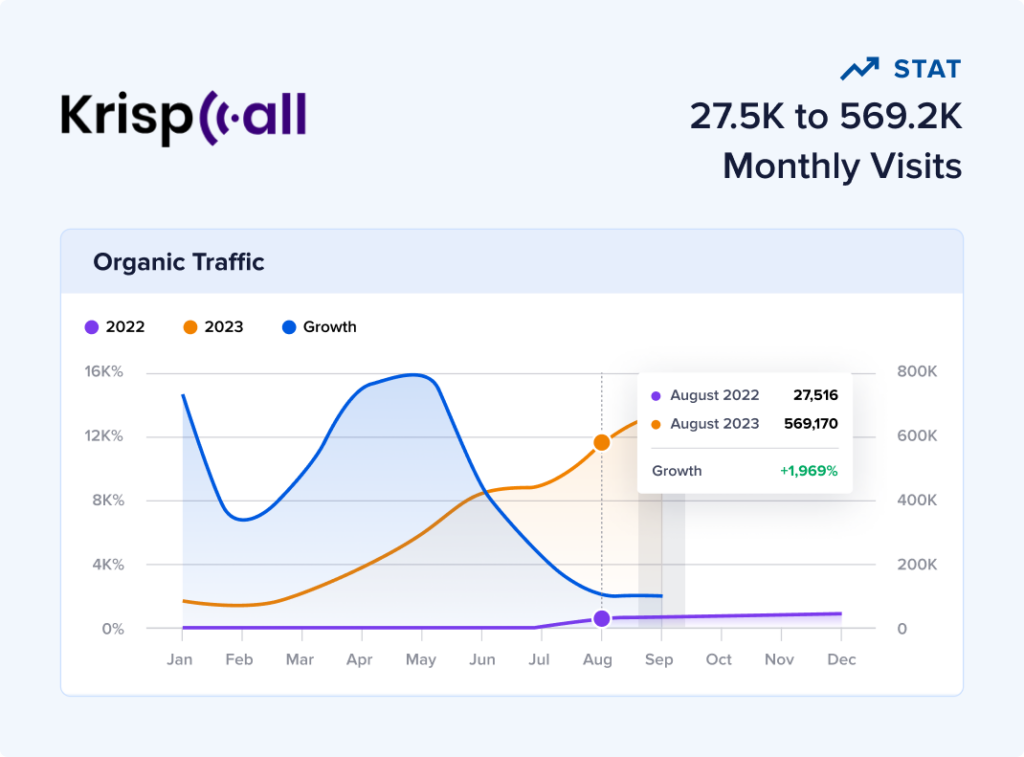
    What They Did (Execution Improvements)

    1. UX Optimization

    • Revamped their mobile experience with faster loading speeds and a clean, minimalistic layout tailored for quick browsing.

    • Used sticky menus, simplified CTAs, and personalized shopping guides.

    • Improved Core Web Vitals, which are direct Google ranking factors.

    2. Branded Content Strategy

    • Shifted from generic product descriptions to story-driven product pages, integrating their sustainability mission into every part of the customer journey.

    • Added FAQ schema, educational pages like “Why Wool?”, and sustainability reports.

    • Emphasized “brand-first” SEO optimizing for long-tail branded terms like “Allbirds sizing,” “Allbirds sustainability,” and “Allbirds vs Nike”.

    3. Executional Consistency

    • Rolled out localized content in key markets (UK, Canada, Australia).

    • Used heatmaps and scroll tracking to adjust content blocks based on user behavior.

    • Created a content hub focused on sustainability education, driving backlinks and engagement.

    4.Numerical Results (2021–2023)

    • Organic traffic grew from ~230K/month in early 2021 to over 590K/month by mid-2023 (source: Similarweb and Ahrefs).

    • Branded searches for “Allbirds” increased by 85%, according to Google Trends.

    • Bounce rate dropped by over 25% after UX optimization.

    • Their product and story pages began earning natural backlinks from publishers like Fast Company, Forbes, and WIRED.

    • Featured in Google Discover, boosting visibility for their sustainability content.

    Takeaways

    • Allbirds didn’t win SEO by chasing hacks; they won by executing a strong user experience, aligning brand values with content, and rolling out SEO changes cleanly across markets.

    • UX and branding improved not just SEO rankings, but user engagement, dwell time, and repeat visits.

    • Their SEO growth was the result of smart strategy + flawless execution.

    Don’t Just Learn but Experiment    

    In today’s fast-moving SEO landscape, analysis paralysis kills momentum. Instead of obsessing over perfect content, test, publish, measure, and adjust. Experts like Julian Goldie, James Dooley, and Patrick Rice repeatedly emphasize that speed of execution and experimentation matter far more than trying to get everything perfect from day one.

     Ahrefs’ YouTube Channel Growth (2019–2023)   

    Ahrefs is one of the leading SEO tools, but in 2019, its YouTube presence was minimal, with only a few tutorial videos and basic walkthroughs. Instead of overthinking production, Ahrefs took a bold approach under Sam Oh’s leadership: commit to consistency, publish often, and treat content like live testing.

    Experimentation Strategy

    1. High-Frequency Publishing:

      • They published 20+ videos within a few months to gather feedback, identify high-performing topics, and dial in their tone and style.

      • Topics ranged from beginner SEO to advanced link building and case studies.

    2. Rapid Iteration:

      • Early videos had basic editing and simple intros.

      • Based on viewer retention data and comments, they:

        1. Shortened intros from 30+ seconds to under 10 seconds.

        2. Added structured outlines (chapters).

        3. Improved thumbnails and titles based on A/B testing.

    1. Cross-Platform Feedback Loops:

      • Used blog readers and newsletter subscribers to seed video views.

      • Asked for feedback directly in YouTube comments and via email.

    Numerical Results

    • Subscribers grew from ~7,000 in 2019 to over 360,000 by early 2024.

    • Their top video, “SEO for Beginners: A Basic Search Engine Optimization Tutorial”, surpassed 3.8 million views.

    • Watch time increased by 2.5x within the first year due to editing and format tweaks.

    • Their YouTube channel became a major top-of-funnel driver, bringing thousands of signups per month for Ahrefs’ SEO tool.

    Key Lessons from Ahrefs:

    • Perfection isn’t the goal, progress is. Their first 10 videos didn’t have polished production, but they taught valuable lessons.

    • Publishing 20+ pieces of content quickly gave them enough data to understand audience behavior and improve.

    • Each experiment (title, CTA, length, thumbnail) was treated as a data point, not a final product.

    Takeaway:

    If even a data-driven brand like Ahrefs prioritizes speed, testing, and feedback over perfection, that’s your cue: you don’t need the best setup or strategy, you just need to start. Publish, learn, and refine. It’s the fastest path to SEO and content mastery.

    Master Technical SEO Basics   

    Saurabh Rana’s core SEO belief is simple yet powerful: you don’t need fancy hacks, you just need to execute the fundamentals well. And time after time, websites that experience ranking drops often haven’t nailed the basics.

     Canva’s Technical SEO Overhaul (2022–2023)   

    Canva’s blog and design tutorial sections had thousands of pages, but inconsistent performance across regions. Their growth was plateauing in several competitive search verticals, especially outside the U.S.

    They hired Aira, a UK-based SEO agency, to conduct a full technical SEO audit and optimization plan across their global content infrastructure.

    What They Fixed (Core Technical SEO Areas)

    1. Meta Tags Optimization:

      • Standardized titles/descriptions across 10,000+ template pages.

      • Removed duplication and used keyword research to craft meta tags aligned with local search trends.

    2. Clean, Consistent URLs:

      • Consolidated multiple versions of URL structures (e.g., /infographic-template-123/ vs /templates/infographic-123/).

      • Implemented a scalable URL taxonomy to match searcher intent.

    3. High-Quality Structured Content:

      • Rewrote thin blog content and added clear HTML structure (H1, H2, bullets, and internal linking).

      • Used structured data (Schema.org) for articles, FAQs, and templates.

    4. Site Speed Optimization:

      • Reduced LCP (Largest Contentful Paint) from 4.9s to 1.8s on average using:

        • Image compression

        • Lazy loading

        • CDN enhancements

      • Monitored and benchmarked speed using PageSpeed Insights and WebPageTest.

    5. Indexing and Crawlability:

      • Fixed broken internal links and redirected orphaned pages.

      • Updated robots.txt and sitemap.xml to prioritize indexable, revenue-driving pages.

      • Used Google Search Console and Sitebulb to detect crawl anomalies.

    Results Within 6 Months (Q3 2022 – Q1 2023)

    • Organic traffic increased by 124% to tutorial and template pages across non-US regions (e.g., India, UK, Australia).

    • Average keyword rankings improved by 3.7 positions globally (based on SEMrush and GSC data).

    • Indexed URLs reduced by 20%, eliminating duplicate content and crawl waste.

    • Page speed improvements led to a 17% drop in bounce rate across mobile devices.

    • Enhanced structured data earned them new featured snippets and FAQ-rich results, especially in how-to content.

    Why It Worked:

    • They didn’t try to game the algorithm; they focused on fixing what was broken.

    • They followed Saurabh Rana’s principle: optimize what you already have before building more.

    • They used basic but powerful tools: PageSpeed Insights, GSC, and Sitechecker to guide execution.

    Takeaway:

    Whether you’re Canva or a small affiliate blog, technical SEO fundamentals never go out of style. Clean structure, fast load times, smart metadata, and crawlable architecture are non-negotiables in 2024.

    Recovering from Google Updates    

    Getting hit by a Google algorithm update feels like getting sucker-punched. But the difference between sites that recover and those that fade away? A calm, analytical approach. As the saying goes: Don’t panic diagnose.
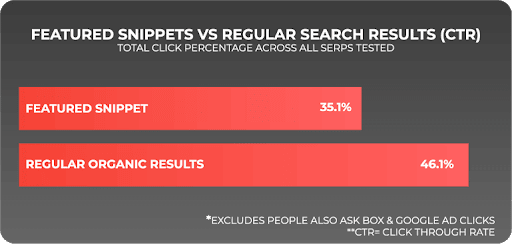
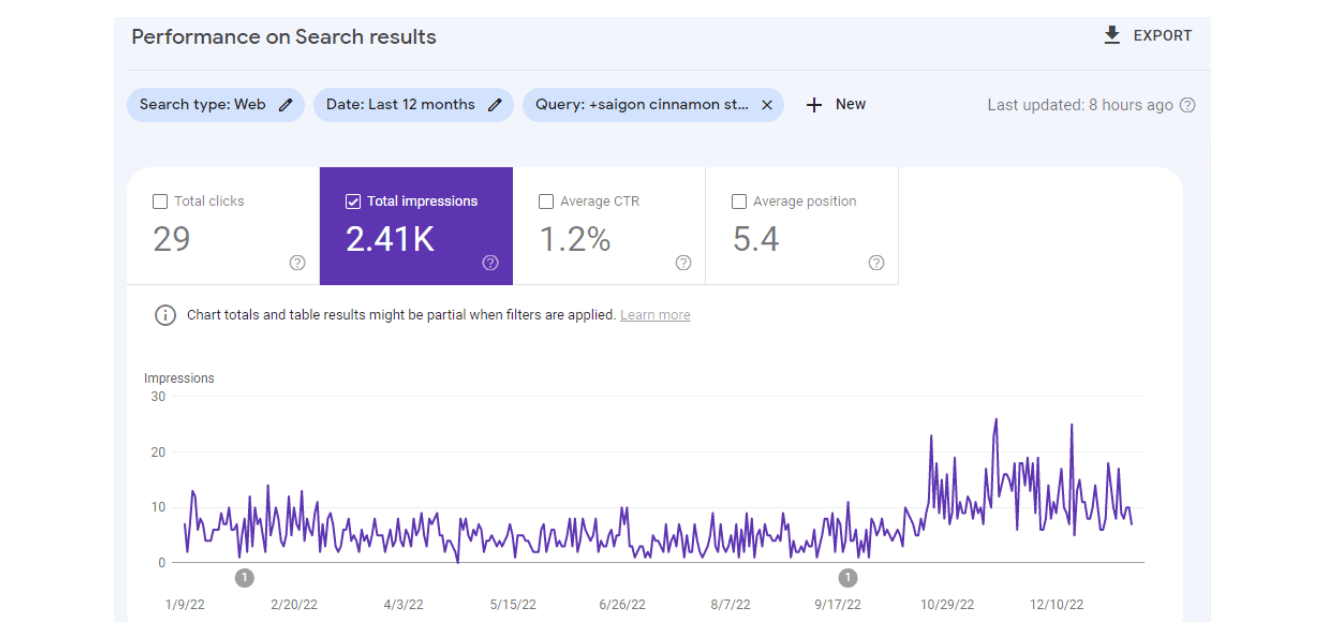
    Rather than blaming Google or clinging to outdated tactics, treat your site like a patient. Diagnose. Prescribe. Fix. Monitor. Repeat.

     Search Engine Journal (SEJ) – Core Update Hit & Recovery (2023)   

    In August 2023, Search Engine Journal, one of the most trusted sources in SEO news, experienced a significant drop in organic visibility not just in traffic but also in rankings across high-volume pages.

    Instead of panicking or jumping to drastic domain moves, the editorial and SEO team acted like doctors: audited everything, fixed foundational issues, and took a data-led approach.

    Their “Doctor’s Approach” to SEO Recovery

    1. Conducted a Full SEO Audit

      • Used SEMrush, Google Search Console, and Sitebulb to identify:

        • Thin content

        • Keyword cannibalization

        • Broken internal links

        • Pages with declining CTR and dwell time

    2. Fixed Site Speed & Schema Issues

      • Improved mobile load times by optimizing images and scripts.

      • Updated or added missing schema on articles, especially for FAQs and How-To formats.

      • Audited Core Web Vitals, leading to:

        • LCP improvement from 3.2s → 1.6s

        • CLS stabilized to <0.1 on most pages

    3. Removed & Refreshed Underperforming Content

      • Deleted or redirected outdated posts (especially news content older than 5 years).

      • Consolidated articles on overlapping topics to strengthen topical authority.

      • Updated meta titles and intros to reduce over-optimization and improve clarity.

    4. Used Lightweight Chrome Tools for Spot Checks

      • Lighthouse, Web Vitals Extension, and Redirect Path were used for spot-checking.

      • Checked for broken JavaScript, slow-loading fonts, and unnecessary plugin bloat.

    5. Stayed Patient & Tracked Progress

      • Made no sudden changes to site structure or domains.

      • Waited for the next data refresh and began to see rankings improve within 3–4 months.

    Recovery Results (Aug 2023 – Jan 2024)

    • Organic traffic rebounded by 52% by January 2024 (per Similarweb & GSC).

    • Top informational pages regained 8–15 positions in SERPs.

    • Bounce rate dropped by 19% and average session duration increased by 27%.

    • Over 120 pages updated or consolidated, with a clear impact on visibility and engagement.

    Key Lessons from SEJ:

    • Don’t chase hacks, fix fundamentals.

    • Google updates are not punishments, they’re pressure tests.

    • SEJ didn’t start over, but they also weren’t afraid to prune and rebuild weak areas.

    • Patience paid off. It took ~6 months, but the site not only recovered it also came back stronger.

    Takeaway:

    Getting hit by an update is painful, but it’s not the end unless you give up. If your rankings drop, don’t whine or panic; run a full diagnostic. Most sites can recover if you focus on speed, structure, content quality, and user experience.

    Learn from the Big Brands   

    The most successful brands today don’t bolt SEO onto a finished product. They bake it in, starting with keyword research, content mapping, and technical structure before writing a single line of content or code. This is how brands like PhysicsWallah, NDTV, and Adda247 dominate SERPs despite heavy competition.

     PhysicsWallah – SEO-Led Product Launches (2022–2024)   

    PhysicsWallah (PW), founded by Alakh Pandey, started as a YouTube channel but quickly became a full-stack edtech platform. Today, it competes directly with giants like BYJU’S and Unacademy but with a leaner content-first, SEO-smart approach.

    PW doesn’t treat SEO as a marketing function. It treats it as part of product development. Every new course, exam prep series, or subject-specific resource is mapped out with SEO in mind.

    How PhysicsWallah Integrates SEO from Day One

    1. Product Planning with Keyword Research

    • For every new exam category (e.g., CUET, NDA, UPSC), they:

      • Analyze search trends.

      • Identify top queries like “CUET 2024 syllabus,” “CUET mock test free,” or “best CUET study plan.”

      • Use these to define product scope and content modules.

    2. Wireframe & Content Architecture

    • Before launch, the content team collaborates with product and dev teams to wireframe:

      • Landing pages

      • Chapter-wise breakdowns

      • FAQs and resource hubs

    • They ensure a clean URL structure, breadcrumb navigation, and schema markup readiness.

    3. Technical SEO Foundation

    • Sites are optimized for Core Web Vitals, mobile performance, and crawlability.

    • Early deployment includes sitemap indexing, internal link structure, and page speed optimization.

    • Technical stack allows for lightning-fast page rendering, even on mobile and tier-2/3 internet speeds.

    4. Content Rollout with Purpose

    • Instead of mass-publishing content, they release strategic content clusters around high-intent search terms.

    • Example: The “NEET 2024 Biology” page internally links to “Chapter-wise Notes,” “Previous Year Questions,” “Mock Tests,” and “Video Explanations.”

    5. Backlinks Come Naturally

    • Their high-value content earns mentions and citations from forums like Quora, Reddit, and student blogs.

    • They rank without relying on guest posts or paid links.

    Numerical Results (2022–2024)

    • Organic traffic grew from 1.2M to over 9.5M monthly visits in less than two years (Ahrefs + Similarweb).

    • Over 70% of traffic is non-branded, meaning it comes from keyword-targeted queries.

    • Average time on page: 6+ minutes, particularly on structured notes and mock test pages.

    • Pages like “NEET Biology Chapter-wise Notes” and “CUET 2024 Syllabus PDF” consistently rank in the top 3 for competitive keywords.

    • Bounce rate decreased by 28% after implementing content-aligned wireframes and internal linking.

    Why This Works:

    • SEO is part of product development, not a separate marketing task.

    • Their pages are purpose-built for searchers, not retrofitted.

    • Everything is done in tight coordination between SEO, content, and dev teams.

    Takeaway:

    Brands like PhysicsWallah don’t chase rankings; they design for them. When SEO is built into your wireframes, content flows, and product offerings, you get search visibility, engagement, and conversions by design, not luck.

    Avoid Common SEO Mistakes   

    You can have the best SEO strategy in the world, but if your team doesn’t implement it well, it won’t deliver. Common culprits? Broken indexing, slow load speeds, sloppy AI content, and over-prioritizing backlinks. As with any business process, execution and communication between teams (writers, devs, and marketers) make or break the outcome.

     The Verge: Technical Issues & Traffic Dip (2022–2023)   

    In September 2022, The Verge underwent a major redesign aimed at improving UX and unifying content across platforms. While the visual overhaul looked great, the execution from an SEO and technical standpoint was flawed.

    Despite being one of the top digital publications in tech news, The Verge suffered from several execution errors post-launch.

    Execution Mistakes Identified

    1. Crawlability and Indexing Issues

      • Important sections of the site became non-indexable due to errors in robots.txt and incorrect use of meta tags (e.g., noindex inadvertently applied to key article templates).

      • Result: Dozens of high-authority evergreen posts disappeared from Google SERPs.

    2. Slow Site Speeds

      • The new design was heavy on JavaScript and animations.

      • Core Web Vitals tanked:

        • LCP jumped to 5.3 seconds (above Google’s recommended <2.5s).

        • CLS (Cumulative Layout Shift) increased due to dynamic ad loading and embedded media.

    3. Rushed AI/Automated Content Testing

      • The Verge experimented with AI-generated summaries and widgets for tech specs without thorough editorial review.

      • Some summaries were inaccurate, affecting trust and engagement.

    4. Over-Focus on Link Equity

      • While their backlink profile was massive (~5 M+ referring domains), they didn’t prioritize internal linking or on-page clarity, which affected new article discoverability.

    5. Poor Team Communication

      • Writers reported delays in CMS updates and unclear formatting standards.

      • Developers weren’t aligned with SEO best practices, and changes were rolled out without SEO sign-off.

    Numerical Results (Oct 2022 – Feb 2023)

    • Organic traffic dropped by ~34%, according to Similarweb.

    • Dozens of top-performing articles lost rankings, especially those in evergreen content categories like “best phones,” “how-to tech guides,” and reviews.

    • Google Search Console showed crawl anomalies and a 17% decrease in indexed pages.

    • Bounce rate increased by 21% on mobile due to slower speeds and layout instability.

    • Featured snippet appearances fell by 40%, especially in product comparison posts.

    Recovery Efforts

    • By mid-2023, The Verge’s SEO team rolled back some JavaScript-heavy components and restructured internal linking.

    • Pages were reindexed after technical audits using Screaming Frog, GSC, and PageSpeed Insights.

    • Editorial and dev teams implemented a cross-functional publishing checklist, improving execution flow and QA.

    • Gradually, traffic recovered, but the recovery took 5–6 months and significant manual effort.

    Takeaways:

    • Execution is where great strategies live or die.

    • A redesign, AI integration, or content revamp means nothing without cross-team alignment.

    • SEO is a team sport; devs, writers, strategists, and project managers must work in sync.

    • You can’t “backlink” your way out of poor site speed, UX issues, or indexing blocks.

    Understand User Intent and Behavior    

    Sim Camp put it best: Google is the world’s biggest store, and every search is either someone browsing or someone buying. Too many businesses focus on vanity keywords or broad topics. But the real wins come from thinking like the customer and targeting intent-driven, long-tail queries that signal a high likelihood of purchase or conversion.

     Glossier: Capturing Buyer Intent with Long-Tail SEO (2022–2024)   

    Glossier is a DTC beauty brand that rose to fame via content and community-driven marketing. Initially, their SEO strategy was fairly basic, focused on branded search and some high-level skincare terms. But as competition in the beauty eCommerce space exploded, they pivoted to a more searcher-focused, intent-based SEO strategy.

    How Glossier “Thought Like the Searcher”

    1. Shift from Brand-Led to Intent-Led Pages

      • Instead of targeting “Glossier skincare” or “Glossier moisturizer,” they focused on questions people were asking, such as:

        • “Best moisturizer for sensitive skin under $30”

        • “Where to buy fragrance-free face cream”

        • “Is Glossier good for acne-prone skin?”

    2. Optimized for Long-Tail, Purchase-Driven Queries

      • Created FAQ-rich content, comparison pages (e.g., Glossier vs The Ordinary), and listicles.

      • Added schema markup for FAQs, product reviews, and How-Tos.

    3. Built Search-Optimized Product Descriptions

      • Instead of fluff marketing copy, they included:

        • Ingredients, usage instructions

        • Answers to common buyer questions

        • Social proof via review snippets

    4. Localized Purchase Intent

      • Targeted location-modified keywords like:

        • “Where to buy Glossier in Canada”

        • “Glossier shipping UK – customs & duties explained”

    Numerical Results (2022–2024)

    • Organic traffic increased by 65% from mid-2022 to early 2024.

    • Over 22% of all organic conversions came from long-tail, intent-driven keywords.

    • One single page titled “Best Skincare for Sensitive Skin Under $30” generated over 180,000 visits and a 3.2% conversion rate in under 12 months.

    • Featured snippet wins rose by 50%, particularly for product-related questions.

    • Branded search volume increased as users discovered them through informational queries and moved down the funnel.

    Takeaways

    If you’re not targeting searchers who are asking “Where can I buy [product] now?” or “Best [product] for [pain point],” you’re missing the most valuable SEO opportunities. Glossier built a beauty empire by answering real questions, not just pushing product pages.

    Final Thought    

    SEO in 2025 isn’t dead, it’s just grown up. Success today demands more than keyword tricks; it’s about building trust, diversifying traffic, mastering technical foundations, and thinking like a brand, not a blogger. Whether you’re leveraging AI, expired domains, or long-tail intent, sustainable growth comes from experimentation, execution, and empathy for your users. The best SEO strategies are no longer standalone; they’re business strategies. This is where partnering with a B2B SEO agency like Genzpro Tech can make a significant difference — offering guidance built on real experience, scalable systems, and proven content strategies.