Blog

  • 6 illegal ways to bleed your money by not to choose right SEO agency (2026)

    6 illegal ways to bleed your money by not to choose right SEO agency (2026)

    In 2026, an era of ai-driven search, SGE (search generative experience), and hyper-aggressive spam filters, most businesses don’t lose money because SEO doesn’t work. They lose money because they don’t know how to choose right seo agency.

    In a recent study by search engine journal, 40% of businesses hit by severe manual penalties in 2025 went out of business within six months. The set it and forget it era is over.
    If your agency is promising guaranteed #1 spots or secret sauce link building, they are likely bleeding your bank account while putting a target on your back.

    Moreover, the loss isn’t small.

    It’s slow. Silent. Compounding.

    You pay ₹50,000… ₹1,00,000… ₹3,00,000 over months.
    Traffic reports look “busy.
    Rankings move for random keywords.
    But leads? revenue? sales-qualified calls? almost zero.

    I’ve consulted over 100+ business owners and spent the last decade navigating every major algorithm shift from the first penguin updates to the current ai-retrieval era we’ve seen exactly where the website bodies are buried. I’ve recovered sites that lost 90% of their traffic by shifting them from content volume to topical authority.

    In this guide, i’m going to show you 5 “illegal (but shockingly common) ways businesses bleed money when they fail to choose right seo agency in 2026. More importantly, you’ll get a clear, executable framework to evaluate any seo agency in 15 minutes before you sign a contract.   

    1. Guaranteed rankings in 2026 = guaranteed risk 

    Guaranteed rankings in 2026 choose right SEO agency

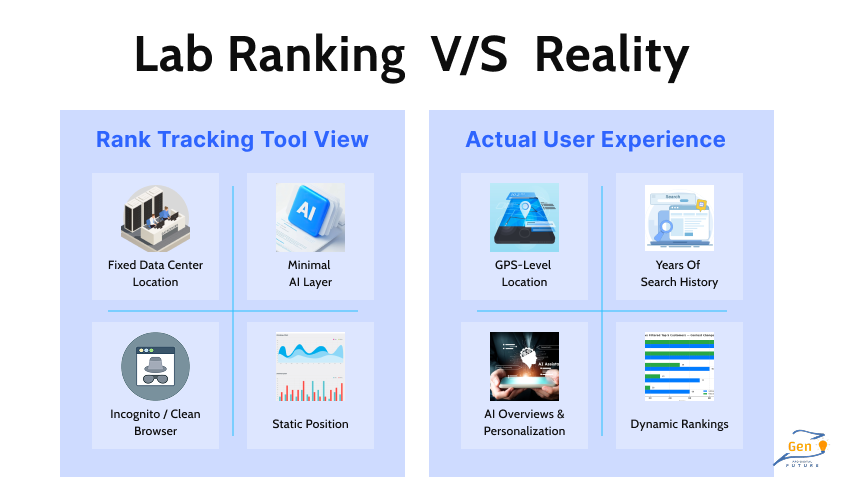
    If an agency guarantees you #1 rankings, they’re either lying… or they’re planning to manipulate something they don’t control.

    And in 2026, that’s not just risky it’s reckless.

    I’ve audited campaigns where business owners were promised:

    • “top 3 in 60 days.

    • “guaranteed first page.

    • “secret link network.

    • “proprietary ranking formula.

    Six months later?

    Manual penalties.
    Deindexed pages.
    Brand damage.
    And in some cases complete revenue collapse.

    Since the full rollout of gemini-powered ai overviews (sge), the search result page is no longer a static list of 10 links. It is a living, breathing entity that changes based on:

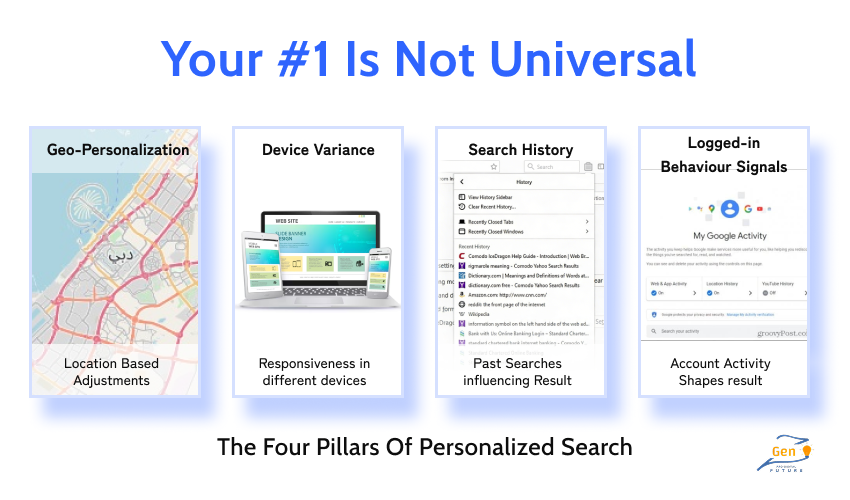
    • The user’s search intent: google now reinterprets the serp in real-time based on the user’s previous 3 searches.

    • Ai personalization: two people searching for the same term in the same city will now see different ai-generated summaries.

    • Algorithm volatility: in early 2026, we saw “super-heated” volatility where rankings shifted daily as google calibrated its helpful content weights.

    Google’s own documentation explicitly states: “no one can guarantee a #1 ranking on google.” any agency claiming otherwise is operating in direct violation of google’s guidelines, putting your entire business at risk of a manual action penalty.

    If you want to understand why ranking guarantees violate search guidelines and how to spot the red flags early, read the full breakdown

    Before you sign any contract, understand why #1 ranking guarantees are impossible in 2026.

    2. Vanity metrics are the silent killers of your budget  

    Vanity metrics choose right SEO agency

    Ranking is not revenue. Traffic is not profit.impressions are not impact. And yet, most seo reports are built to celebrate exactly those numbers.

    In the current ai-retrieval era, search engines are excellent at sending you information seekers (people looking for free definitions) while keeping the problem solvers (people ready to buy) inside the google interface.

    So if your seo agency is still reporting: total traffic, keyword count, domain rating, impressions. Which means your agency focuses purely on search volume, they are likely targeting top-of-funnel keywords that the ai already answers.

    You pay for the content, you pay for the optimization, but the user never leaves google to visit your site. This is how budgets bleed dry: paying for rankings that don’t result in clicks, and clicks that don’t result in cash.

    This is exactly why many business owners start believing that SEO services are a scam — when in reality, they were sold metrics instead of revenue.

    To stop the bleed, you must stop looking at what the agency does and start looking at what the agency earns for you.

    The pivot: Ranking KPIs vs. Revenue KPIs

    Let’s understand this concept through a table which differentiates between ranking kpis and revenue KPIs.

    Ranking KPIs (Vanity Metrics)Revenue KPIs (Business Metrics)
    Total Organic Traffic Can be inflated by viral fluff posts or bot traffic.Qualified Lead Volume How many visitors actually filled out a form, booked a call, or made an inquiry?
    Keyword Rankings Ranking #1 for a term no one buys from is a hobby, not a business.Sales-Qualified Clicks (SQC) Traffic landing on bottom-of-funnel pages (pricing, services, demo).
    Domain Authority (DA) A third-party metric that Google doesn’t actually use for ranking.Conversion Rate by Landing Page Is SEO traffic actually taking action once they arrive?
    Impressions Seeing your link 10,000 times means nothing if CTR is near 0%.Customer Acquisition Cost (CAC) Is the cost of the SEO agency lower than the profit generated from leads?

    How i shifted clients from traffic growth to lead growth

    I recently audited a b2b saas client, who was thrilled because their growth was recorded as 42% yoy traffic growth, 300+ ranking keywords. 80 blog posts published.

    Revenue impact?

    Minimal.

    Why?

    Because 70% of their traffic was informational. Only 8% was bottom-funnel. And their agency was writing definition articles like what is project management? terms dominated by ai summaries.

    We cut the fluff. We focused on high-intent clusters like project management software for architecture firms and best alternatives to [competitor].

    Here’s the exact framework we use — The Ranking Domination Blueprint.

    Step 1: intent audit  

    We categorised every ranking keyword into:

    • Informational

    • Commercial investigation

    • Transactional

    • We discovered their blog strategy was targeting research-stage users with no buying intent.

    Step 2: commercial cluster rebuild  

    Less traffic.more money.we built:

    • Service-specific landing pages

    • Comparison pages

    • Problem-solution content

    • Buyer-focused faqs

    Step 3: conversion alignment  

    We added:

    • Clear CTAs

    • Lead magnets aligned with search intent

    • Internal linking toward service pages

    • Conversion tracking improvements

    The result: total traffic actually dropped by 15%, but qualified demo requests increased by 140% in 5 months.

    Now the dashboard showed: leads per keyword cluster, revenue per landing page, assisted conversions from blog content.

    That’s when SEO became an asset not an expense.we stopped paying for tourists and started attracting buyers.

    If your agency only reports traffic, you need to see The KPI Dashboard Checklist You Should Demand.

    3. The link-building package trap that triggers manual penalties  

    link building package trap choose right SEO agency

    If an agency sells you “1,000 backlinks for ₹9,999”, you’re not buying authority. You’re buying a future penalty. I’m not saying this theoretically.

    Over the last decade especially after updates from google, I have personally worked on recovery projects where websites lost 70% to 90% of their organic traffic because of aggressive, artificial link building.

    In most cases, the pattern was identical:

    • Bulk guest posts on irrelevant sites

    • Private blog networks (PBNS)

    • Footer/sidebar site-wide links

    • Exact-match anchor text spam

    • Foreign-language domains with zero topical connection

    This pattern worked temporarily, then the algorithm recalculated trust signals.

    The cost of cheap links  

    I have sat across from CEOs who were moved to tears because their 10-year-old domain the lifeblood of their company, lost 90% of its traffic overnight.

    Just because you hired someone from fiver for a standard link-building package that blasted the site with 500 low-quality forum links and guest posts on irrelevant sites.

    And, when you realise. It took 14 months and over ₹15,00,000 in consultant + execution fees to disavow the toxic links, rewrite the content, and beg google for reconsideration.

    Also, That cheap ₹20,000/month package ended up costing them millions in lost revenue for your business.

    Real link acquisition vs. Artificial backlink blasts  

    In 2026, the distinction is binary: you are either earning authority or you are faking it.

    FeatureArtificial Blasts (The Trap)Real Acquisition (The Asset)
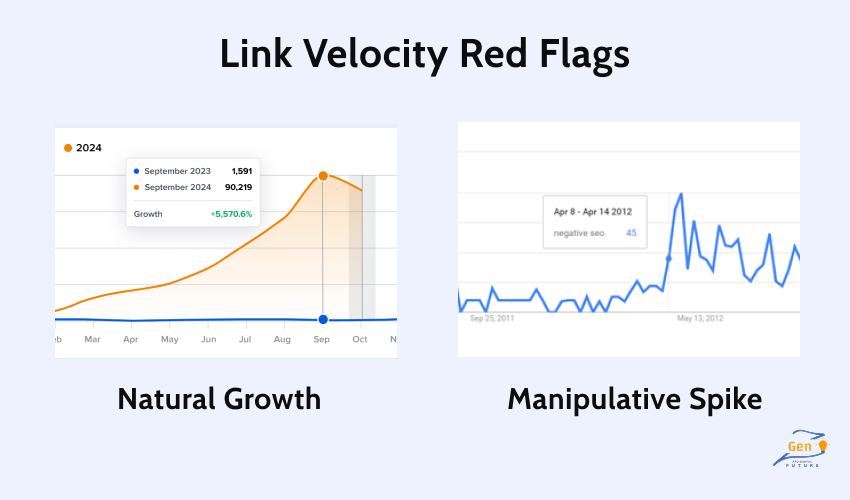
    Velocity100 links appear in one week. Sudden spikes that look unnatural.Links grow steadily over time as content is shared and referenced.
    RelevanceA dental site gets a link from a random global news blog.A dental site earns links from a medical journal, local health guide, or relevant industry site.
    Anchor TextOver-optimized anchors (e.g., “best dentist dubai” repeated 50 times).Natural anchors (e.g., brand name, “this study,” “Dr. Smith’s clinic”).
    Source“Write for us” sites and guest post farms created only for link selling.Sites with real human readers, editorial standards, and high information value.

    Why link packages are dangerous in 2026  

    In the ai-retrieval era, search engines don’t just count links.They evaluate: topical relevance, domain trust history, anchor text naturalness, link velocity patterns, contextual placement, network footprints

    When agencies sell fixed-volume link packages which they are optimising for quantity, not credibility, there quantity without context becomes a red flag.

    Manual actions today aren’t just about spam links.They’re about manipulative intent signals. Once they are triggered, recovery can take: 3–6 months minimum, A full backlink audit, Link removals and rejected files, Authority rebuilding from scratch

    I’ve seen businesses spend ₹3 lakhs on link packages…then ₹5 lakhs fixing the damage. Cheap links become expensive lessons.

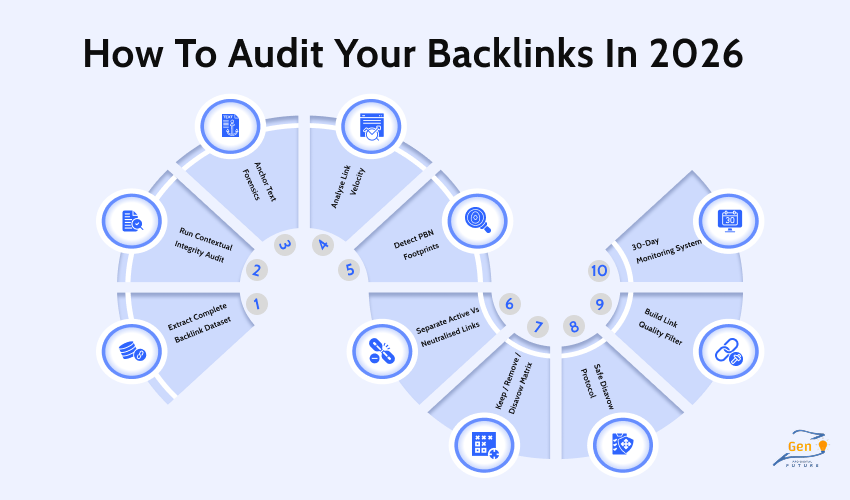
    The 3-step backlink audit test (run this today)  

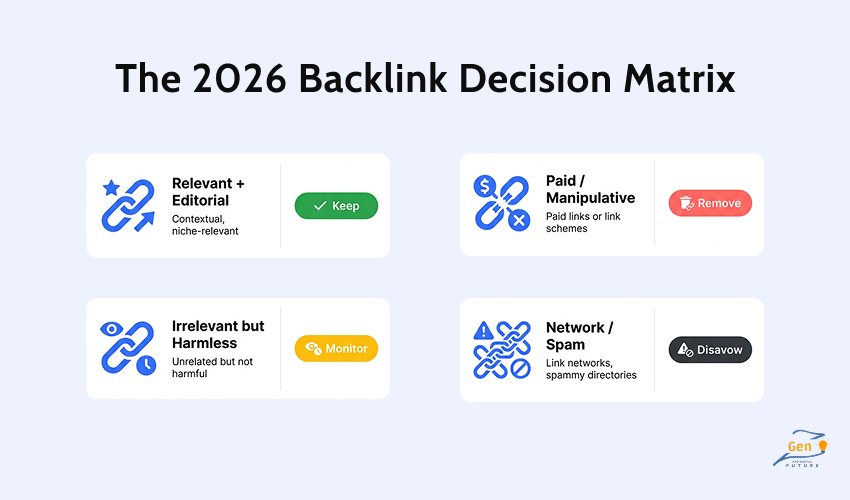
    You don’t need to be an seo expert to see if your agency is killing your site. Use a tool like ahrefs or semrush (or ask your agency for a full backlink export) and look for these three red flags:

    1. The out-of-country fingerprint  

    Filter your backlinks by country. If you are a business in India or Dubai, but 80% of your new links are coming from (.ru) Russia, (.cn)china, Poland domains, your agency is using a cheap bot network. This is a primary trigger or a manual penalty.

    2. The link farm visual check  

    Open 5 random sites that have linked to you this month.

    • Does the site look like a real magazine, or does it cover 50 unrelated topics (e.g., tips for credit cards right next to best dog food)?

    • If the site exists only to post articles with outbound links, it’s a link farm. Google has already blacklisted these; your link there is a negative signal.

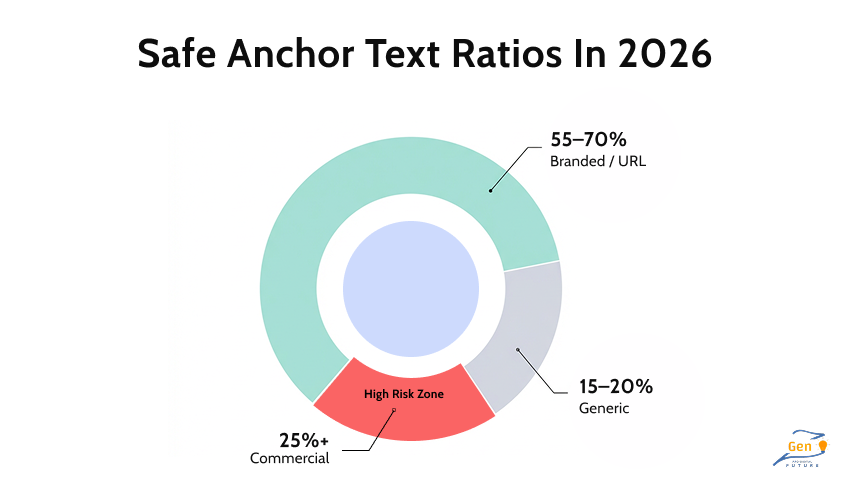
    3. The anchor text spam ratio  

    Look at your anchor text distribution (the clickable text of the link).

    • Safe: 70% brand name or url (e.g., your brand.com).

    • Danger: 50%+ exact match keywords (e.g., buy real estate dubai). If your agency is forcing specific keywords into the links, they are handing google the evidence needed to penalise you for link schemes.

    Every business owner should know how to audit your backlinks in 2026 (before Google penalizes you).

    4. Content volume without topical authority is a 2022 strategy  

    Content volume without topical authority choose right SEO agency

    The content mill model is dead. Most agencies still try to sell you 4 blogs a week because it’s easy to outsource to cheap ai writers. But in 2026, google’s helpful content system (and Google gemini’s retrieval layer) looks for topical authority.

    During the shift from volume to authority i’ve seen businesses spending ₹2,00,000/month on seo content that generated zero leads because the articles were disconnected. We pivoted them by reducing their output by 60% but increasing the depth of their core clusters.

    The result: one client went from 200 random articles to 40 interconnected authority pillars. Their traffic doubled, and their conversion rate tripled because google finally viewed them as an expert, not just a publisher.

    Here’s a breakdown of why 100 blog posts won’t save you in the AI-retrieval era and what will work instead.

    The real problem: random content creates zero trust  

    Here’s what most agencies do: publish disconnected blog posts, target unrelated keywords, ignore internal linking structure, focus on traffic, not authority depth

    This creates what i call content islands. Each page exists alone, without reinforcing the overall expertise of your domain.search engines don’t just evaluate individual pages anymore.they evaluate your entity-level expertise.

    They ask:

    Does this site deeply understand this subject? or is it just publishing surface-level articles?

    If your content lacks structural cohesion, your rankings will always remain fragile.

    What changed: from content volume to topical authority systems  

    Around 2022–2024, publishing frequency alone could still move rankings.

    But after multiple core updates and ai retrieval integration, authority signals became more structural.

    I’ve personally worked on projects where we stopped publishing random blogs and instead rebuilt the entire content system around topical authority.

    One example:

    Before restructuring:

    80 blog posts published, traffic unstable, few qualified leads, rankings fluctuating constantly

    After implementing the topical authority framework:

    Reduced publishing frequency, reorganized content into structured clusters, built internal authority signals, traffic stabilised within 4 months, lead quality increased significantly

    Before publishing another article, understand this: The 2026 Topical Map Framework explained.

    Understanding entity clusters (the foundation of modern seo)  

    Think of your website like a university. You don’t become known as a medical expert by publishing random articles about business, marketing, and fitness.

    You become an authority by covering one subject deeply and structurally. That’s what entity clustering does.

    It organises your content into 3 levels:

    First level is  pillar page (core authority page)   which targets your main commercial keyword. For example: interior fit out company in dubai, villa interior design services, this page becomes your authority anchor.

    Second level is supporting cluster pages   these support the pillar with focused subtopics. Examples: cost guides process explanations, mistakes to avoid comparison articles, each page strengthens the pillar’s authority.

    Third level is supporting micro content   these cover highly specific search intent variations. Examples: timeline breakdowns, material comparisons, case-specific questions, this builds semantic depth.

    If you want sustainable rankings, start by understanding entity clusters and how they shape topical authority.

    Internal linking: the authority multiplier most agencies ignore  

    • Internal linking isn’t just navigation.

    • It’s authority flow control.

    • Here’s what most low-quality agencies do:

    • Random links

    • No structure

    • No keyword relationship mapping

    Here’s what real authority systems do: cluster pages link to pillar pages, pillar pages link back to cluster pages, supporting content interlinks strategically, anchor text reflects entity relationships

    This creates a clear authority signal to search engines.

    It tells them: “this site owns this topic.”

      The 15  minute agency pressure test  

    Ask your seo agency to show you their topical hierarchy.

    • If they show you a spreadsheet of keywords, they are in 2022.

    • If they show you a visual map of entities and clusters, they are ready for 2026.

    Experience angle:

    • Show how you shifted from volume to topical authority

    • Explain entity clusters & internal linking logic

    • Provide a simple topical map framework

    5. Agencies that don’t understand your unit economics will drain you  

    unit economics will drain you  choose right SEO agency

    In 2026, traffic is a commodity : abundant, readily available, and often interchangeable while profitable acquisition has become the primary asset.

    An agency can rank you for a high-volume keyword, but if the cost to rank for that keyword exceeds the profit you make from the customer, that seo success is actually a financial loss.

    An agency that doesn’t ask about your margins, lead-to-close ratio, and customer lifetime value is just playing with your money.

    The math of SEO: Customer Acquisition Cost, Lifetime Value and Conversions  

    To stop bleeding your money, you must move from search metrics to business maths.

    Customer Acquisition Cost (CAC): This is the total amount you spend on seo divided by the number of new customers it brings in. If you spend ₹1,00,000/month and get 5 customers, your cac is ₹20,000.

    Lifetime Value (Ltv): How much is a customer worth to you over their entire relationship with your brand? If a customer spends ₹15,000 once and never returns, but your according to seo your customer acquisition cost is ₹20,000, you are losing ₹5,000 per customer.

    The conversion rate math: 1,000 visitors at a 0.1% conversion rate is 1 lead. 100 visitors at a 5% conversion rate is 5 leads. High-authority, low-volume seo is often 10x more profitable than viral traffic.

    How SEO must align with your revenue model  

    Your SEO strategy should change based on how you make money. Most agencies use a one-size-fits-all approach that ignores your specific unit economics:

    Business ModelSEO PriorityThe Bleed Risk
    High-Ticket (Real Estate / SaaS)Authority & Trust (E-E-A-T signals, thought leadership, strong brand positioning)Spending heavily on “how-to” blogs attracting visitors who can’t afford your service. Traffic without buyer intent.
    High-Volume (E-commerce)Technical SEO, product feeds, category structure, crawl efficiencyRanking for products with low margins or high return rates  traffic grows, profit shrinks.
    Local Service (Clinics / Lawyers)Google Maps visibility, local SEO, conversion rate optimizationRanking nationally for keywords that require local presence visibility without real-world conversions.

    The simple formula to evaluate your ROI potential  

    Before you sign a contract or continue a campaign, run this seo sanity check formula. If the numbers don’t trend toward a positive ROI within 6–12 months, the strategy is flawed.

    $$roi = \frac{(\text{total organic leads} \times \text{close rate} \times \text{profit per sale}) – \text{seo cost}}{\text{seo cost}}$$.

    How to use it:  

    • Total organic leads: ask your agency for the number of actual inquiries (not just clicks).

    • Close rate: what % of those leads actually pay you? (e.g., 10%).

    • Profit per sale: your net profit after all expenses, excluding seo.

    • Seo cost: your monthly retainer + content costs.

    Example of an unskilled budget:

    Leads: 20, close rate: 20% (4 sales), profit per sale: ₹50,000, total profit: ₹2,00,000, seo cost: ₹50,000, result:400% roi. This is a healthy, scalable campaign.

    The red flag reality :

    If your agency says, we can’t track leads, we only track rankings, they are hiding the fact that your roi is likely negative. In 2026, with advanced tracking and ai-driven crm integration, untraceable seo is a myth used to hide failure.

    Not sure if your campaign is profitable? Here’s how to calculate SEO ROI in 2026.

    6. The 15-minute framework to choose right seo agency (before you sign) 

    15 minute framework to choose right seo agency

    You’ve seen how agencies bleed your budget with vanity metrics and dangerous link packages. To protect your investment, use this pre-contract evaluation checklist. If an agency cannot pass these five tests in a 15-minute discovery call, do not sign the contract.

    This is the part which most businesses skip.

    They compare prices, they compare promises, they compare presentation decks, but they don’t compare thinking. After auditing 100+ seo campaigns (including disaster recoveries where brands lost 70–90% traffic), i’ve noticed something:

    You can predict whether an agency will succeed or fail within 15 minutes of asking the right questions.

    Here’s your executable checklist.

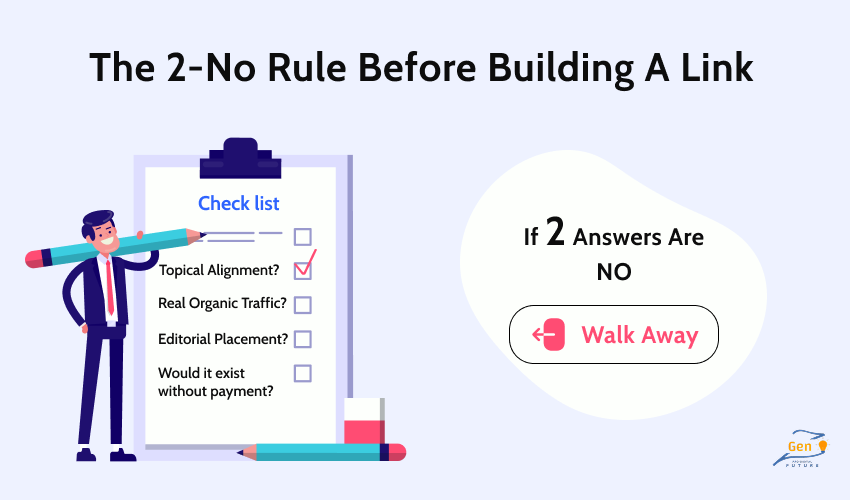
    If an agency fails 3 or more of these then you should not sign a contract with them.

    1️. what reports you must ask for (before paying anything)

    In 2026, a 50-page pdf of keyword rankings is a smoke screen. Demand to see reports that track business maths, not just search volume.

    Lead attribution by cluster: which specific topical pillar is actually driving sales-qualified leads?

    Assisted conversion report: how many users read your expert content before eventually converting on a service page?

    Information gain score: a report showing how your content provides unique value that ai models (like gemini) can’t simply scrape and summarise.

    Share of voice (sov) in ai overviews: how often is your brand cited in sge (search generative experience) compared to your competitors?

    2. What client case studies must show (not just growth charts)

    Generic traffic growth graphs are easy to fake. Real authority is proven through:

    Algorithm resilience: ask to see a site’s performance during the last three major google core updates. If the traffic crashed and stayed down, they don’t understand modern authority.

    Revenue correlation: a case study must show that a 10% increase in traffic led to a measurable increase in roi.

    Topical map visuals: ask them to show the actual entity cluster map they built for a successful client. If they only show a list of blog titles, they are stuck in 2022.

    3. Technical questions you must ask (to test depth)

    Go beyond Wesite speed. Ask these to see if they understand the ai-retrieval era:

    How do you optimize for entity recognition? They should talk about schema markup and json-ld that defines your relationship to your industry.

    What is your process for content pruning? They should explain how they delete or merge zombie pages that dilute your site’s overall authority.

    How do you handle ‘zero-click’ searches? They should explain how to optimize for featured snippets and ai boxes so your brand gets the credit even if the user doesn’t click

    4.  How to test their thinking live (the 5-minute challenge)

    Give them your url and ask this one pressure test question:

    Based on our current site, what is the ‘topical gap’ our competitors are using to steal our high-intent leads?

    The amateur answer: you just need more backlinks and 4 blogs a week.

    The 2026 pro answer: you have ‘information’ content, but you lack ‘comparison’ and ‘decision’ content. Your internal linking isn’t funnelling authority to your money pages, so google sees you as a library, not a leader.

    5. What contract clauses to avoid  

    Read the fine print to ensure you aren’t being held hostage:

    Ownership of assets: ensure the contract explicitly states that you own all content, technical optimizations, and link data the moment they are created.

    The secret sauce clause: avoid any agency that claims to use proprietary tech or secret networks they won’t disclose. In 2026, transparency is the only way to stay safe from manual penalties.

    Long-term lock-ins without performance exits: never sign a 12-month contract that doesn’t have a 30-day exit for cause clause. If they stop performing, you shouldn’t keep paying.

    Automated link building: if the contract mentions guaranteed number of links per month, run. Quality links cannot be guaranteed on a fixed schedule; they must be earned.

    The final test before you choose right seo agency  

    Before you sign that retainer or authorise that first payment, there is one final stress test you must conduct.

    Most agencies are great at selling a process (we write blogs, we build links), but in 2026, you are buying market authority. To see if they can actually deliver it, put their pitch through this 60-second filter:

    The intent vs. Volume reality check  

    Ask the agency to pick their top 3 target keywords for your business. Then, ask them:

    If we rank #1 for these, what is the specific friction point in the customer’s journey that this content solves? if they answer: it has 5,000 search volume,  walk away. They are selling you tourists.

    If they answer: this keyword targets the ‘comparison’ stage for users frustrated with [competitor x], and we’ve mapped the internal links to lead them directly to your pricing page, sign the contract. They are selling you revenue.

    The skin in the game question  

    Finally, ask them how they handled their biggest failure in 2025. The ai updates of the last year were brutal. Any agency claiming they never saw a drop is likely lying or hasn’t managed enough high-stakes accounts to know what a real algorithm shift looks like.

    You want the partner who says: we had a client hit in the october update. We diagnosed it as information thinness, pivoted their strategy to topical pillars, and recovered 110% of their traffic in 90 days.

    Your pre-contract evaluation checklist this should be your strongest section.

    Include: what reports to ask for, what client case studies must show, what technical questions to ask, how to test their thinking live, what contract clauses to avoid

    Compare your current agency with what a real SEO agency actually looks like in 2026.

    Frequently asked questions (Faq)  

    Q1: is seo a scam? i’ve heard many people say it is.  

    No, seo is not a scam, but cheap seo often is. Scammers send cold emails promising #1 rankings for $100 using bots. Real seo is about data, content, and site health. If an agency cannot explain their strategy in plain english or refuses to show you real case studies, walk away.

    Q2: how is seo in Dubai different from other markets?  

    In Dubai, search is very local and multi-lingual. An seo agency in Dubai must understand how to rank in the google map pack and how to optimize for both English and Arabic. The competition in sectors like real estate and tourism is world-class, meaning you need a high-authority seo expert to win.

    Q3: how long does it actually take to see results in 2026?  

    While the old answer was 6 months, modern seo specialists can often see movement in 3 months due to ai’s speed in identifying expert sites. However, to reach the break-even point where the profit exceeds the cost, you should plan for a 6 to 12-month commitment.

    Q4: will ai and ChatGPT kill seo?  

    No. Ai has changed how we search, but not why. People still need solutions. Seo in 2026 is about becoming the cited source for ai. If your seo firm isn’t talking about information gain and geo, they are living in the past.

    Q5: should i choose seo or google ads (ppc)?  

    Ideally, both. Ppc gives you immediate leads, while seo builds a long-term asset.

    • Use ppc to test which keywords actually result in sales.

    • Use seo to stop paying the ad tax for those keywords once you rank organically.

    Q6: what should be included in a standard seo package?  

    A professional seo package should always include:

    1. Technical audit: fixing site speed and mobile errors.

    2. On-page optimization: improving existing content and headers.

    3. Content creation: writing new, high-value articles.

    4. Authority building: earning links from other trusted websites.

    5. Monthly reporting: showing you leads and roi, not just rankings.

    Q7: why did my organic traffic suddenly drop?  

    This usually happens for three reasons: a google algorithm update, a technical error on your site, or ai displacement (where google shows the answer in an ai box, so no one clicks). An seo consultant can perform a recovery audit to find the exact cause.

  • You think seo services are a scam (Yes, unless you read this)

    You think seo services are a scam (Yes, unless you read this)

    You think seo services are a scam (Yes, unless you read this)

    The belief that seo service is a scam isn’t a fringe theory. It’s a sentiment backed by millions of dollars in lost revenue. Many Dubai business owners feel like the character in a horror movie who walks toward a threat, knowing something is wrong but feeling powerless to stop it.

    I’m not guessing here. After consulting with 100+ business owners and generating millions of dollars in revenue from pure SEO, I know exactly why you feel burned. I’ve seen the “black hat” invoices, the fake reports, and the wasted budgets firsthand.

    In the next 15 minutes, you’ll know whether an seo service is legitimate or a complete waste of money before you invest a single dollar. Also, as a bonus, you’ll know how to evaluate any seo agency & freelancer in under 15 minutes that just don’t bleed money, but they actually help you to print money.

    What you’re about to see will either save your business or expose why it’s bleeding money.

    The seo economic reality: a $148 billion room   

    seo economic reality Seo Services Are a Scam

    To understand if seo service is a scam, look at the size of the room. According to industry research from Mordor Intelligence, the global seo market is projected to reach nearly $148.86 billion by 2031, reflecting steady growth in organic digital investment. Additional seo statistics published by aio seo support this upward trend.

    If the seo market is this big, then there must be a seo framework that is working for some businesses that’s already printing millions of money for business owners.

    Let’s understand the seo market share and projected value in this data table.

    Market growth and projections

    Market Segment2025 Market Share2026 Estimated Value2031 Projected Value
    Total SEO MarketUSD 83.98 BillionUSD 148.86 Billion
    Small & Medium Biz58.40%USD 49.04 BillionUSD 86.93 Billion
    E-commerce & Retail26.25%USD 22.04 BillionUSD 39.07 Billion
    On-page Services41.80%USD 35.10 BillionUSD 62.22 Billion

    Now, the question comes in your mind, are seo services are a scam?

    Will prove in this article.
    For now, you need to ask how to get seo services without getting scammed.

    Before proceeding, let’s understand …

    Why 99% business owners say seo feels like a scam  

    business owners say seo feels like a scam Seo Services Are a Scam

    Let’s understand this with an example.

    When you feel frequent urination and fatigue, the doctor suggests it’s high sugar symptoms, and he gives a medication to control sugar without hbac report.

    Similarly, 99% of seo agency and freelancers give you a solution without doing proper seo and business audit.

    Seo audit doesn’t just rely on technical, off-page and on-page. You have to dive deep down into

    • Business understanding

    • Understand the customers

    • How seo algorithm actually works for your niche in 2026

    The reality is everyone is selling a dream: “get your website ranked on first position” and “get 1000+ backlinks for just $100”. You must have seen many advertisements like this, or received plenty of marketing emails promoting the same claims.it’s not that all seo agencies are fake.

    The problem is the illusion that ranking and getting backlinks is quick and effortless. When readers or customers discover the actual complexity behind it, that’s when frustration sets in.

    Every month, they send a report full of impressions, keyword positions, and traffic graphs. But they never show you one thing that actually matters is revenue.

    You don’t care about “impressions.”
    you care about leads.
    You care about sales.
    You care about profit.

    That gap between reports and real money is why seo starts to feel like a scam.

    That’s why you need the right system to choose a right seo company who understands your business just like you. Ofousre they should be the best seo experts on this planet earth.

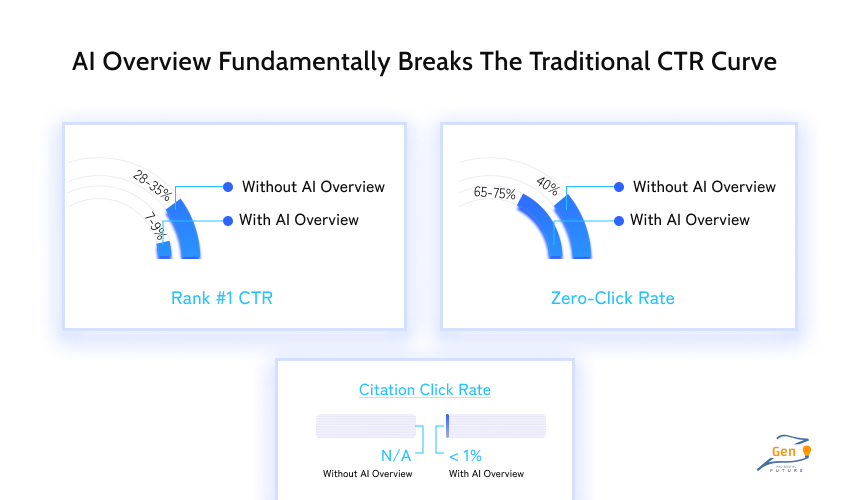
    A 2026 digital marketing analysis by socialfirm reports that more than half of google searches now end without a click especially on mobile devices where ai-generated answers dominate the results page.

    Artificial intelligence (ai) overviews now sit at the top of google and give answers immediately. If you measure success only by website visits, your data looks like a disaster. 8 out of 10 mobile searches end on the search page. The “answer engine” gives the user the solution, and they leave.

    For a business paying thousands for “traffic,” this feels like a scam. But here is the catch: brands cited inside these ai summaries see a 35% higher click-through rate than those left out. The game has changed from winning a “blue link” to winning a “citation.”

     Zero-click search data (2026)   

    Search TypeDesktop Zero-ClickMobile Zero-ClickAI Presence
    General Search58.50%77.10%High
    Informational64.00%80.0%+Dominant
    Local Business46.00%50.0%+Growing

    Why are seo agencies so vague? (and how to cut through the fog)  

    seo agencies so vague Seo Services Are a Scam

    Whenever i asked my seo guy when i was working on my business in 2018 what he actually did this month, and he gives me a long, confusing answer about “canonical tags” and “crawl budget”?

    He is confusing me on purpose all the time, might be you to.

    If they can’t explain it to a 10-year-old, they are either lying or they don’t know what they are doing. Also, there is a case they don’t understand the business(what matters for you most).

    You nod. You pretend to understand. But deep down, you feel like you just got hustled.

    The Dirty Little Secret is this: Confusion is a strategy.

    If they can confuse you, they can control you. If you don’t understand the work, you can’t fire them for not doing it.

    Here is why the fog exists and how to shine a light on it.

    1. They are hiding the “busy work”   

    Most agencies sell hours, not outcomes. They need to fill the time. So, they do “busy work.”

    They fix 100 typo errors on page 50 of your website. They tweak a meta tag. They run a generic scan. Does this help you sell more? No. But it looks like work on an invoice.

    The Hack They Don’t Want You to Know:Activity does not equal achievement. You don’t care about “tasks.” You care about the Ranking Domination Blueprint. If their monthly report lists “fixes” but no strategy, they are wasting your cash.

    2. The “secret sauce” lie   

    Agencies love to say, “We have a proprietary method we can’t share.” Or, “We have a special relationship with Google.”

    The Ugly Truth: There is no secret sauce. There is no special relationship. Google is a machine. It follows math.

    If an agency won’t show you their work, it’s because:

    A) They are doing nothing.

    B) They are doing illegal “Black Hat” stuff that will get you banned.

    A real partner opens the Visibility Vault. They show you exactly how the SEO Ignition System works. Transparency creates trust. Secrecy creates scams.

    3. They Can’t Explain the “Momentum Multiplier”   

    Bad agencies promise instant wins to get your credit card. But when the wins don’t happen in Month 1, they panic. They get vague to buy time.

    Nobody Tells You This:Real SEO is a Compounding Growth Flywheel. It is like pushing a heavy train.

    Month 1-3: You push hard. The train barely moves. (This is where weak agencies hide).

    Month 4-6: The wheels turn. The Momentum Multiplier kicks in.

    Month 6+: The train is unstoppable.

    If they can’t explain this timeline simply, they don’t have a plan.

    How to cut through the fog (your bs detector)   

    Stop accepting vague answers. Ask these three questions to expose a fake immediately.

    Question 1: “Show me the Roadmap.” Don’t accept “we are optimizing.” Demand to see the Ranking Domination Blueprint.

    “What pages are we building this month?” (The Content Command Center)

    “Who are we getting links from?” (The White-Hat Authority Machine)

    Question 2: “Explain it to me like I’m 10.” If they use big words to explain a simple concept, they are lying. A pro can explain the Results Compounder in one sentence: “We are getting trusted websites to vote for you so Google trusts you more.” If they stumble, they don’t know the subject.

    Question 3: “Where is the Revenue?” Tear up the ranking report. It doesn’t matter if you rank #1 for a word nobody searches. Ask for the ROI Amplification Framework.

    • “How many leads came from Google?”

    • “How many sales did we close?”

    Vagueness is a red flag. Clarity is power. If they can’t show you the Market Domination Pathway, it’s because they don’t know the way.

    Bad seo vs. Fake seo vs. Real seo 

    Bad seo vs. Fake seo vs. Real seo Seo Services Are a Scam

    There is a difference between being bad at your job and being a criminal.

    FeatureFake SEO (The Scam)Bad SEO (The Amateur)Real SEO (The Pro)
    The Promise“Guaranteed #1 in 30 days!”“We will try our best.”“We build a market domination pathway.”
    The TacticBuying spammy links (black hat)Writing boring blogs no one readsBuilding an evergreen impact engine (people want to read)
    The ResultYour site gets bannedZero leads. Wasted timePredictable growth and sales
    The CostCheap ($300/mo)Mid-range ($1,000/mo)Premium (Investment in the profit multiplier method)

    10 red flags: how to spot an seo scam in 2026  

    10 red flags Seo Services Are a Scam

    Cheap services from an seo company in dubai aren’t a way to save money; they are “technical debt” that can get your brand banned. 

    1. Pricing lower than labour: if an agency offers a cheap seo packages for $125 to $375, they aren’t working. Senior specialists have fixed costs. A “cheap” provider uses bots or stolen content, which leads to an 80% risk of being filtered out by google.

    2. The top 10 guarantee: no one owns google. If they promise a #1 spot, they are lying. They usually rank you for “zero-volume” keywords that no one actually searches for.

    3. Selling link quantity: in 2026, buying thousands of links from “link farms” is dangerous. Ai models like gpt-5 and gemini see these patterns and will ignore your brand instantly.

    4. Keyword-only content: modern computers understand natural language. “keyword stuffing” just makes you look like spam. Content must be “ai-ready” with clear data and tables.

    5. No roadmap: if they don’t mention ai search optimization (aiso) or show a 6-12 month plan, they are just taking your money.

    6. special relationship claims: google does not give any agency an advantage. Being a “google partner” only means they know how to run paid ads.

    7. Results in 30 days: seo is a marathon. It takes 4 to 6 months for real movement and up to a year to dominate. Instant results usually involve “black-hat” tricks that get you banned later.

    8. Secret methods: real seo specialist are transparent. If they won’t show you their tools (like ahrefs or semrush), they aren’t doing the work.

    9. Ai persona fraud: scammers create fake, ai-generated “experts” with fake faces.google eventually finds out and punishes the site for lack of trust (e-e-a-t).

    10. “hundreds of search engines”: only google and bing matter. Submitting to hundreds of unknown directories is a waste of time and often a front for malware.

    What real seo actually looks like (behind the scenes)   

    You want the insider look? here is what happens when you hire a true expert in 2026.

    Expert don’t just “blog.” they build an authority amplifier.

    1. The audit (the truth serum): They look under the hood to find the “tech debt” that is silently killing your rankings.

    2. The strategy (the map): They don’t guess they understand the real business and algorithm. They find exactly what your customers are asking and answer it better than anyone else.

    3. The content (the voice): They don’t write fluff. Every sentence is designed to hook the reader and push them to buy.

    4. The authority (the vote): They go out and earn trust. They use the backlink growth catalyst to get high-power websites to link to you.

    Can you do it yourself? yes. You can also fix your own car engine and sew your own clothes. But do you have the time? seo is not a hobby. It is a war for attention. If you aren’t using an seo ignition system, your competitor who is will crush you.

    How to know if your seo is bleeding money   

    Thanks me later “nobody tells you this,” but you can audit your agency right now in 3 simple steps.

    Step 1: The “site search” test go to google. Type site:yourdomain.com. Look at the results. Are there weird pages? junk text? pages in other languages? if yes, you’ve been hacked or spammed. Major red flag.

    Step 2: The “speed” check pull up your site on your phone. Count to 3. Did it load? if not, you are losing 53% of your customers. Your agency failed the basic visibility amplifier test.

    Step 3: The “content” read read your latest blog post. Is it boring? does it sound like a robot wrote it? if it doesn’t make you want to buy, it won’t make anyone else buy either. You need the story-to-sales framework, not robot text.

    Why some businesses fail even with a good partner ?

    some businesses fail even with a good partner Seo Services Are a Scam

    I have talked about scams. I have talked about bad agencies. I have talked about the thieves. But now, I need to have a hard conversation. I need you to look in the mirror as well.

    The Ugly Truth is that sometimes, the agency is perfect. The strategy is solid. The Growth Ignition is ready to fire.

    And the business still fails.

    Sometimes, the seo agency is great, but the business fails. Why?

    The “helicopter client” syndrome you hire an expert, then you tell them what to do. You refuse to change your website text. You say “no” to their upgraded suggestions. You block the growth ignition. You have to trust the pilot if you want to fly.

    The budget mismatch you can’t buy a ferrari with a toyota budget. If you want market domination, you have to invest in the fuel.  

    Is seo worth it? the 2026 calculation  

    According to compiled seo performance statistics published by aioseo, long-term seo campaigns can generate roi levels of up to 700%, making it one of the highest-return digital marketing channels.

    ChannelROI EstimateKey Benefit
    Local SEOHigh42% of clicks go to the Map Pack
    Content MarketingCompoundingResults last for years
    Paid AdsTemporaryStops when you stop paying

    How to protect yourself before signing   

    Don’t sign another contract until you ask these questions. This is your freedom framework:

    1. “show me the roadmap for the first 90 days.”

    2. “do you use the white-hat authority machine or do you buy cheap links?”

    3. “how do you measure the results compounder? (if they say ‘rankings’, run. If they say ‘revenue’, stay.)”

    You don’t need “seo.” you need revenue. You need freedom. You need a competitive edge engine. Stop paying for “packages” and start investing in an outcome.

    Is your current strategy a cost, or is it a profit multiplier? 

    Would you like me to run that 15-minute ‘bleeding money’ test on your site right now?

    FAQ 

    Why can’t they guarantee results?

    Because they don’t own the casino. Google is the casino. We are just counting cards. We know the math works, but we can’t control the dealer. Anyone guaranteeing you a #1 spot is selling you fake seo.

    Why does it take 6 months?

    I know you want sales now. But seo is a compounding growth flywheel. Think of it like a steam train. It takes massive energy to get the wheels moving. Inch by inch. But once that momentum multiplier kicks in? you become unstoppable. You can’t stop a train with a pebble.

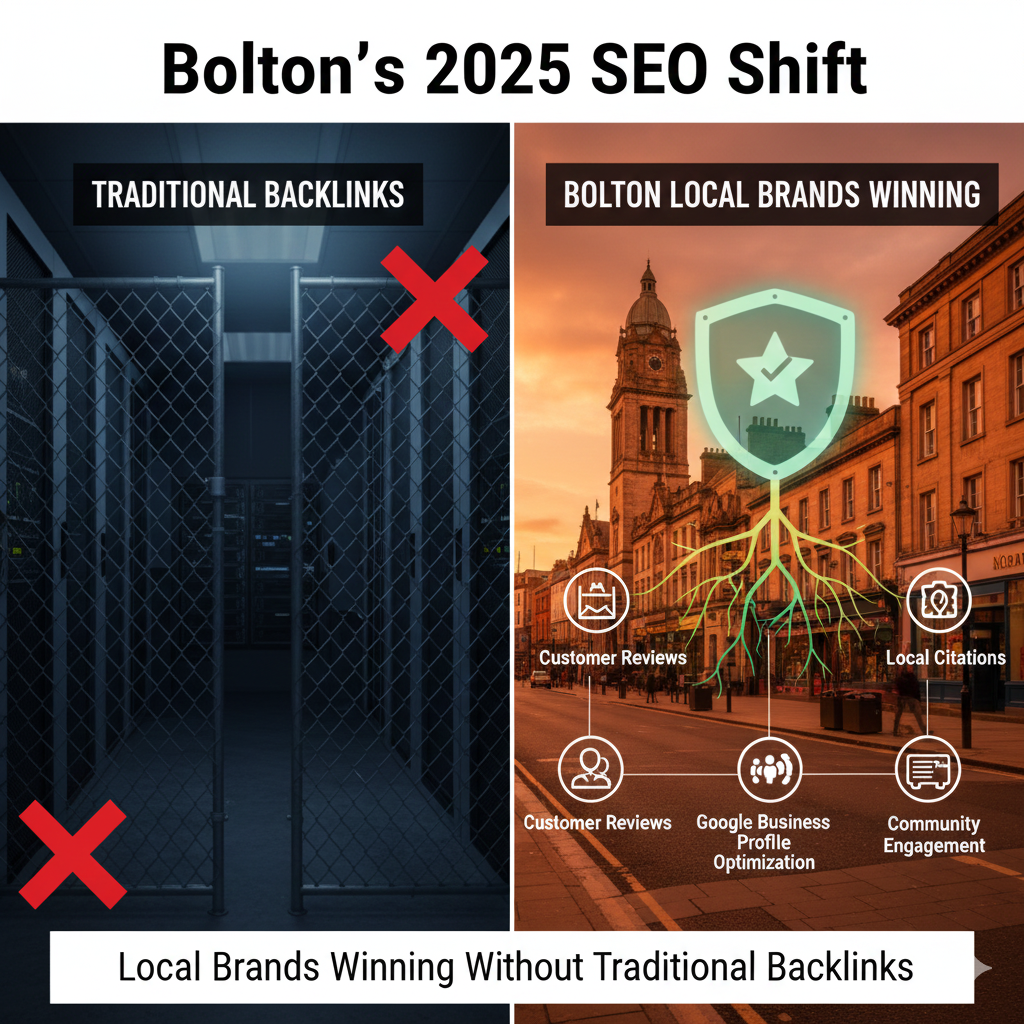
  • Bolton’s 2026 SEO Shift: How an SEO Company Bolton Wins Locally

    Bolton’s 2026 SEO Shift: How an SEO Company Bolton Wins Locally

    Local companies in Bolton have become able to gain lasting visibility without the need to have large portfolios of backlinks by optimising Google Business Profiles, ensuring the presence of citation consistency, authentic reviewers, and topical authority through structured materials. Most of the operators engage a SEO company Bolton. This democratisation of local SEO allows team resources that are limited to compete on equal terms.

    Google Business Profile Optimisation as Main Ranking Engine

    Local Falcon (2026) states that the category of Google Business Profile takes the first place in ranking in Google search and Maps, which is more important to the business than conventional metrics of backlinks. The firms offering SEO services in Bolton make sure that the profiles are complete and of good quality with proper NAP information, usage of appropriate categories, good photographs and frequent posts. Unless via links, operators perpetuating fresh content, reacting on review, seeding Q&A sections with frequently asked questions, and otherwise, are an indicator of activity and relevance and will influence rankings.

    Relevance, Proximity and NAP Consistency Over Links

    Businesses in Bolton have found a radical competitive change in 2026. Search atlas (2026) explains that the proximity is the most influential overall driver of Google local ranking with 55.2 percent influence of position one to twenty-one with reviews and relevance determining the competitive advantage. The physical location of the businesses in Bolton is not something that can be changed, yet, the location-specific keywords and NAP consistency can help the businesses to be more relevant. Local SEO Bolton plans are crafted to focus on the quality of citations rather than quantity of backlinks since mixed listings create confusion in search programs and damage ranking.

    Local SEO power by Bolton company

    Survey Signals and User Response Measures

    BrightLocal (2026) reports that 89 percent of consumers will prefer a company that replies to all of its reviews and 75 percent of consumers claim to always or regularly read online reviews when searching local businesses. With the help of a SEO company Bolton, Bolton operators are automating review-request processes, reacting to feedback as fast as possible, and keeping track of sentiment to sustain good reputations. The behavioural indicators of users, such as profile clicks, direction requests, and phone calls, feed into Google ranking of prominence which recommends businesses that provide excellent service without need of a backlink portfolio.

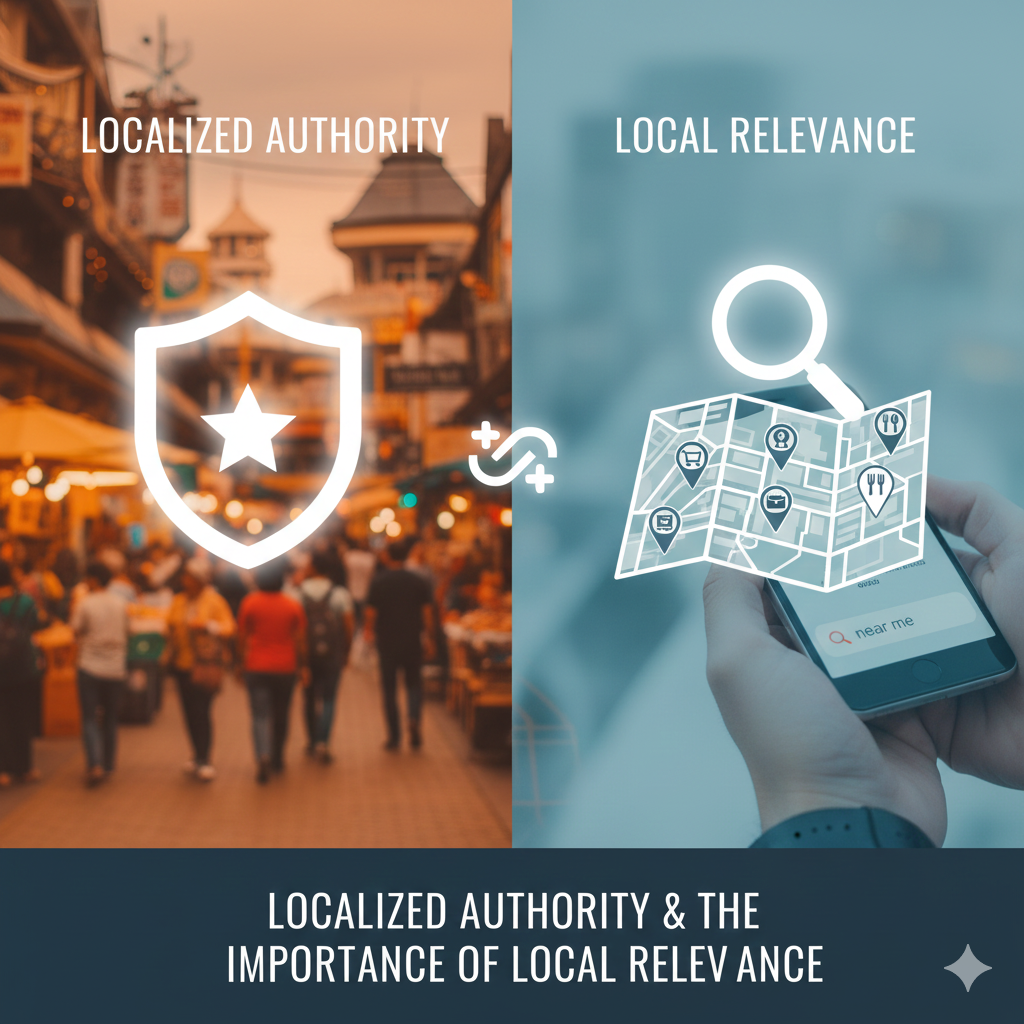
    Localized Authority and the Importance of Local Relevance

    Editorial Link (2026) says that it is possible to rank high without any backlinks when dealing with low-competition keywords in niche matters, and the development of a powerful topical authority through thorough content would make it possible to achieve visibility without links. Businesses that seek SEO services in Bolton build location pages, also blog about local events and publish neighbourhood guides that show and portray the connection of the community. Local SEO Bolton strategies are built systematically based on topic clustering to establish authority that compresses time-to-rank without the need to run an old fashioned, financially draining link-building initiative.

    Local SEO Map pin shows authority

    Acquisition of Off-Site Brand Signals and Citations

    The majority of searches end now with search results to pull on those off the page (including social media, news contents, and video sharing and social media forums, and reviews) effective 60 percent of all search results according to Rise at Seven (2026). Brand presence outside of websites has become a crucial ranking variable. Bolton companies that work on local references, mentioning the brand, and social interaction establish authority without linkage.

    An SEO company Bolton assists the operators to focus on the reputation management, directory listing, and involvement with the community, which promote the local packs without the overhead of acquiring links. To Bolton SMEs, investments of proximity, relevance, and prominence are now made to give compounding returns with the continued usage of the local algorithmic approach by Google which is focusing on trust and engagement over the number of backlinks.

    Conclusion

    Bolton local businesses gain visibility without the traditional portfolios of back links. Operators can optimize Google Business Profiles, sustain citation consistency, generate reviews automatically, and create topical authority using structured content by collaborating with a SEO company bolton or going direct using modern local SEO tools. This has led to long-term local pack rankings, increased conversion rates, and a competitive edge that is not pegged on link volume.

  • Trust Signals Over Backlinks – SEO Service Derby

    Trust Signals Over Backlinks – SEO Service Derby

    When it comes to local rankings, Google has upgraded the level of trust such as review, NAP, user behaviour and E-E-A-T credentials considerably more than the volume of traditional backlinks. This development has evened the playing ground of resource challenged businesses who can no longer compete in terms of the acquisition of backlinks only. This development has evened the playing ground for resource-challenged businesses, making professional support like an SEO service Derby essential for those who can no longer compete solely through backlink acquisition.

    E-E-A-T and Experience Based Trust Signals

    A SEMrush study found that pages having emerged with strong E-E-A-T signals enjoyed a propensity of being ranked within the top three positions at least 30 percent better than those with weak signals, which has only increased in 2025 (Single Grain, 2025). Experience, Expertise, Authoritativeness and Trustworthiness is the priority of Google: it depends on the content that proves first-hand knowledge and credible credentials.

    Derby companies seeking SEO management Derby maximise author bio, provide professional qualifications and present actual customer case studies to reinforce indicators of experience. Derby companies seeking SEO service Derby can maximise author bios, provide professional qualifications, and showcase real customer case studies to reinforce indicators of experience.

    Gravital Agency (2025) writes that security is enhanced by HTTPS encryption, payment gates that are secure, and the clarity of the About Us page, and research indicates that over 40 percent of users will seek HTTPS-secured web sites before giving out confidential data. These technical and contextual components work together to establish the confidence of the algorithmic installation that is not based on the number of backlinks.

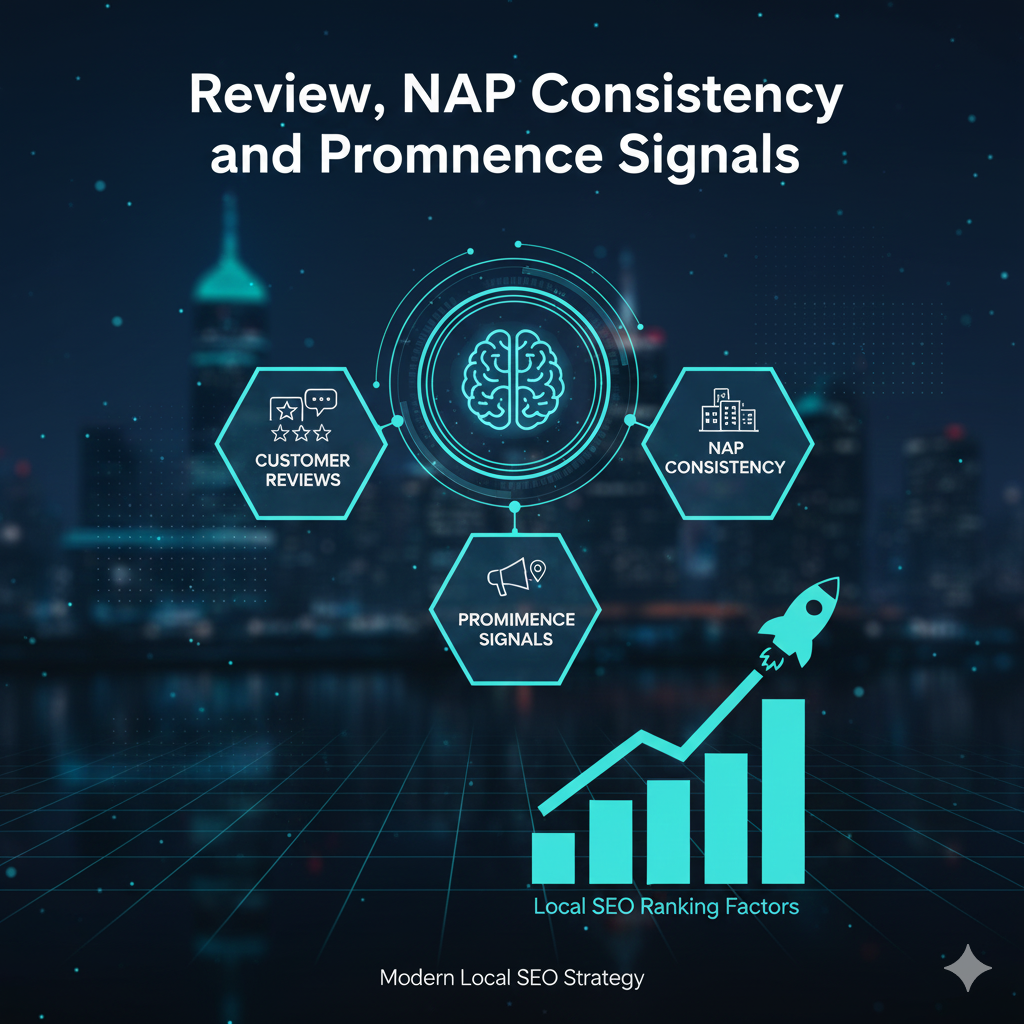
    Review, NAP Consistency and Prominence Signals

    In the year 2025, the local search environment in Derby has taken a new turn. Workflows involving the review-request of derivative services are automated by the SEO company Derby, and prompt feedback responded to and sentiment tracked to keep positive reputations. The reviews, both volume and keyword alignment, are consistently increasing the visibility in any industry, which is even better than some of the historical indicators of SEO power such as domain authority or backlinks, according to Local Falcon (2025).

    SEO Service Derby focus on Reviews, NAP

    The presence of NAP consistency through Google Business Profile, directories as well as websites listing also indicates reliability. Marketing Now (2025) states that Google does not understand un-consistencies in listing, however, it seems that with the help of tools, such as BrightLocal, it becomes easy to save time and effortlessly increase trust signs containing NAP data across directories to align Google with the algorithm. Such operational efficiency assists smaller teams to remain accurate and avoid the use of manual audit.

    User Engagement & User Behaviour Metrics for SEO Service Derby

    Google has confessed that such metrics as click-through rate and interaction of the searcher with pages on the result list are ranking factors, just as Google has leaked out documents and testified. SEO service Derby assists operators with optimisation of profile fullness, uploading high quality photos, and the seeding of the Q&A part with inquiries that are regularly asked to draw people into the interaction. These are the improvements in terms of better visibility of local packs without having to have large portfolios of backlinks.

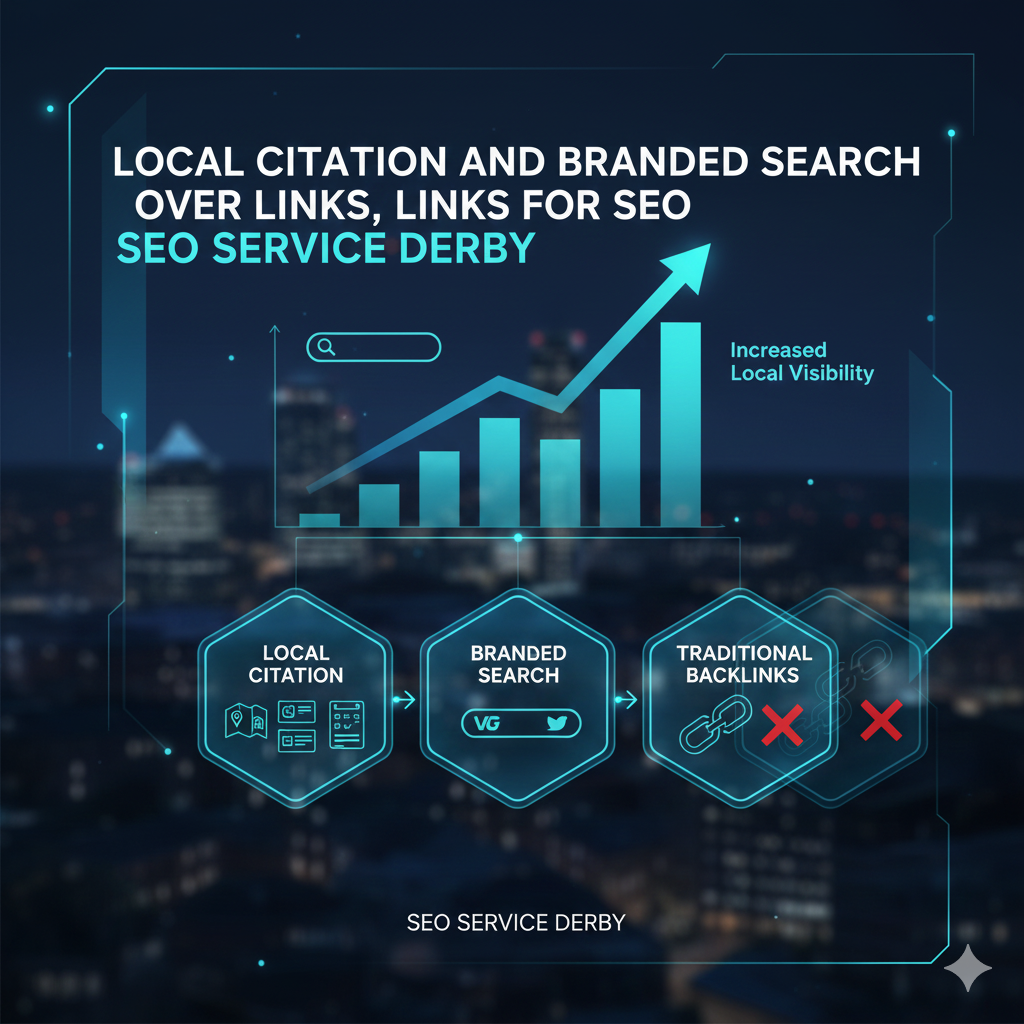
    Local Citation and Branded Search Over Links for SEO Service Derby

    Derby operators that engage with local citations, brand names and social signals develop prominence without having to resort to conventional link-building. Trust Signals (2022) suggests that branded searches provide a high trust signal to the Google algorithm and the more visitors a website obtains through branded searches, the greater the rank in SEO, which Google grants to the brand. An SEO Service Near Me search query more and more results in businesses with high review profiles, full GBP entries and regular citations as opposed to the ones with the highest number of backlinks. This change favors operational quality and customer contentment as opposed to link-acquisition strategies.

    SEO Service Derby prioritizing local citation and branded search.

    Three Major Factors: Proximity, Relevance, and Prominence

    Businesses in Derby have no control over their physical format but can maximise relevance by way of keyword-enriched GBP content and prominence by review generation and citation administration. Element or (2025) indicates that Google review number, quality, and speed is a huge signal of prominence and citations, where the business was mentioned in reputable websites, also play a role.

    Companies that engage a SEO Company Derby give great priority to these factors that they can control and get noticed without necessarily waiting for the backlinks to build up. The algorithmic transition towards rewards based on trust and prominence gives business an opportunity for excellent service and the availability of the correct information on the internet. The outcome is that local pack visibility, increased conversion rate and sustainable competitive advantage is attainable without being tied to the acquisition of links. As end users search in SEO Service Near Me, companies with high levels of trust will always position above the other companies with high backlink networks.

    Conclusion

    Google will in 2025 use trust in its local algorithm to rank sites and not only backlink amounts. The Derby businesses can maximize the E-E-A-T credentials, automate the review-generation process, control the NAP consistency, and keep the users interested by utilizing the partnership with a SEO service Derby or deploying modern reputation-management tools.

  • AI Content Clusters for SMEs with Christchurch SEO Company

    AI Content Clusters for SMEs with Christchurch SEO Company

    In 2025, Christchurch small businesses have reached a transformational competitive stage. Most operators today use AI-driven content clustering to gain more visibility than traditional search engine optimization strategies can enable. The local companies are collaborating more and more with a Christchurch SEO company to execute topic-cluster models, semantic keys grouping and automatic interlinking, that squeeze time-to-rank and provide quantifiable traffic improvements. This systematic strategy aids resource constrained teams to compete with larger organisations, by accruing topical authority in a systematic manner.

    Christchurch SEO Company: Driven by AI, Topic Clustering & Semantic Relevance

    SEO.ai (2024) defines topic clustering as an organisational method that enables search engines and users to know what each page is about with the pillar pages, which discuss broad topics, and cluster pages, which discuss narrower ones. Businesses in Christchurch, which utilize AI tools can map related keywords into thematic groups based on a search intent that makes it possible to plan content at once more in whole domains. This implies that companies that engage the SEO services Christchurch are able to create internal linking networks that enhance the importance of relevancy signals and enhances crawlability without necessarily employing external backlinking.

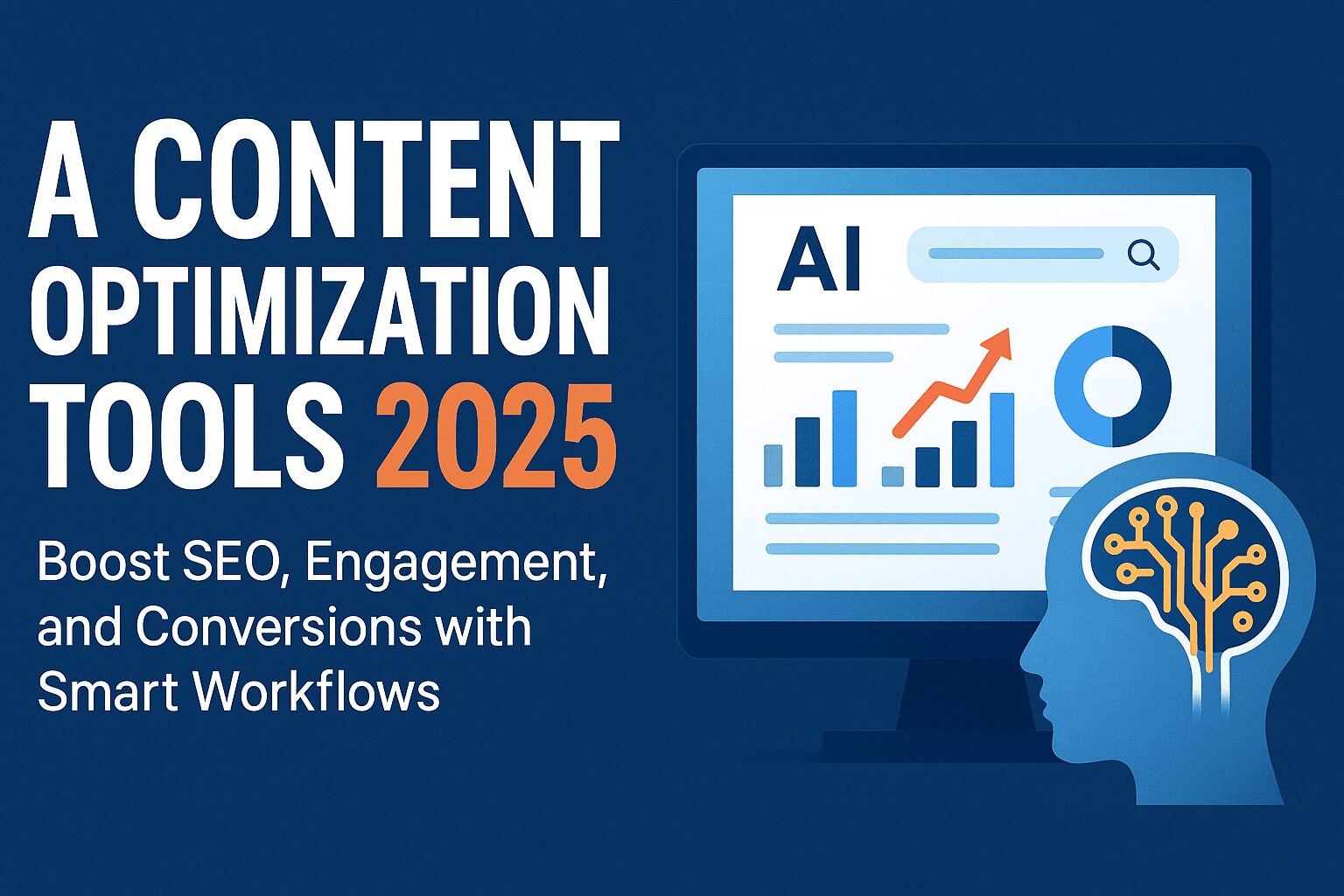
    The image features the text A Content Optimization Tools 2025 with AI-driven data visuals and charts.

    Rapid Ranking with a Christchurch SEO Company Strategy

    Keyword.com (2025) claimed that the optimisation of pages in semantic clusters is 32% more effective than the optimisation of a single piece of content in terms of its positioning and dwell time. The AI tools focus on determining missing content and examine where a site has covered a particular issue versus its competitors and then propose semantically related keywords to add on the site. Christchurch SMEs relying on such capabilities make public exhaustive content ecosystems that convey expertise to search algorithms, becoming more visible more quickly since the content responds to user intent on numerous related queries at the same time.

    Automated Site Architecture and Interlinking

    RevvGrowth (2025) says that the tools of AI can examine the structure of the site, topical clusters, and user paths to draw internal linking strategies that increase crawlability and interlineal theme relevance. Christchurch operators using a Christchurch SEO company automate internal links placement such that pillar pages link to supportive cluster content by use of descriptive anchor text. Tighter internal connections also minimize the bouncing by directing the users to similar materials, which enhances the engagement indicators that determine rankings.

    Topical Authority and Speed of Content Production

    A study by McKinsey (2024) showed that marketing functions companies relied on generative AI decreased the time spent creating content by up to 60 percent and allowed their teams to concentrate on the higher order planning. Rapidly, Christchurch SMEs that utilize AI drafting software generate cluster content, which is optimized by refining outputs to make them relevant and accurate. SEO services in Christchurch assist the firms to pinpoint the most central topics, create the supportive material, and keep the content up-to-date and frequently updated, which makes the visibility increase with time as search engines grow their interests in full, well-organized content rather than disjointed pages.

    Christchurch SEO AI speeds content for topical authority

    Why Christchurch SMEs Win with a Christchurch SEO Company

    AI content clustering builds local high value, a mixture of high-speed production of content, formal site structure, and content relevance. It is also useful in determining micro-niches where local intent is high but the competition is low. By optimising cluster content when it comes to neighbourhood-personalised queries or combinations of services, businesses tap into demand that national rivals are simply ignoring. By enlisting the services of a local SEO agency Christchurch or implementing modern AI platforms directly, the firms of Christchurch have quantifiable traffic gains and a long-term presence. Compounding benefits are obtained by the businesses that establish topic authority early.

    Conclusion

    An example of a useful accelerator of SMEs in Christchurch is AI-driven content clustering in 2025. Through the collaboration with a seasoned Christchurch SEO company or in-house application of AI tools, the local companies can map topical ecosystems, automate their interconnection, and release holistic content that ranks more rapidly than the old formations.  The outcome is quantifiable visibility, increase in engagement, and a feasible avenue on which small teams can outperform larger competitors. To Christchurch operators, now using structured topic clusters would bring about compounding returns as search engines will increasingly priorise topical authority over solitary keywords.

  • How SEO company Cambridge Helps Startups Switch to Predictive SEO Models

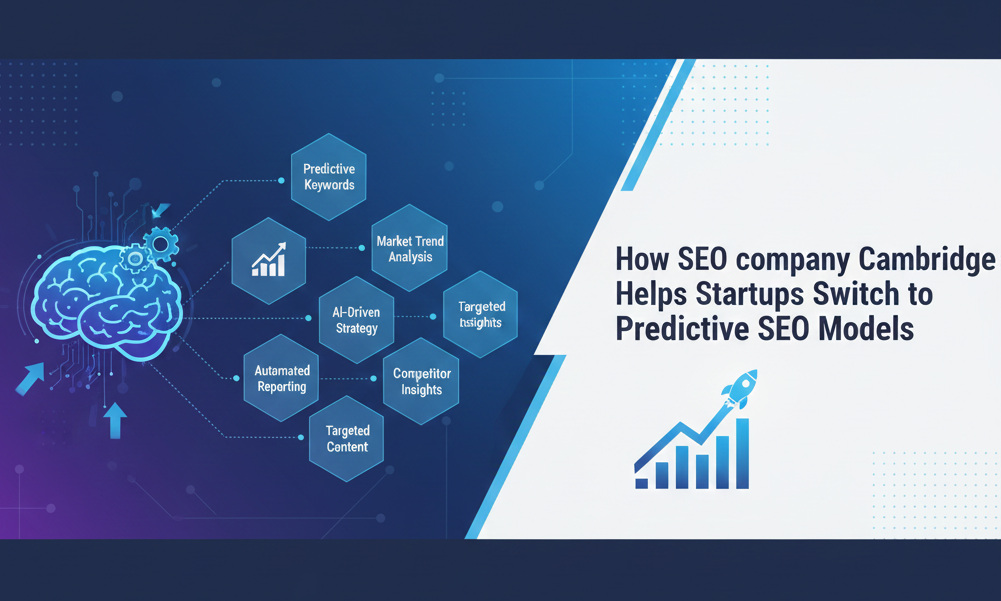
    How SEO company Cambridge Helps Startups Switch to Predictive SEO Models

    Cambridge has traditionally been associated with progressive innovation, and its startup ecosystem is moving at an even more rapid pace in 2025. As AI is changing the way digital visibility is attained, numerous founders are breaking away with conventional SEO and pursuing predictive models. They can either be collaborating with an SEO company Cambridge or using in-house AI; either way, start-ups are seeking the types of SEO that can predict rather than respond to user behaviour.

    SEO company Cambridge Driving the Emergence of Pro-Active Search Behaviour

    Search Engine Journal (2024) defines predictive SEO as an application of machine learning technology that evaluates search behaviour, seasonal demand by itself, as well as intent prior to it becoming visible in publicly accessible key-search technologies. This early instinct is invaluable to Cambridge start-ups with businesses that operate in fast-changing industries such as biotech and deep tech.

    Traditional SEO tends to be behind the new trends, which makes companies undetected at a time when a new demand emerges. This is among other reasons why more founders are resorting to a SEO company Cambridge that focuses on predicting SEO opportunities and creating content before a rival even realises that there are changes in the market.

    How AI Is Changing SEO Keyword Strategy

    Reasons why Real-Time Data Models are preferable in startups

    HubSpot (2025) observed that almost all decision-making processes in the scaling mode of business, such as content planning and product releases, are affected by real-time analytics. Predictive SEO is able to fit in with these systems, because it provides insights in real time that are adapted whenever the algorithm algorithm or user pattern changes.

    To founders of the SEO company Cambridge, the top agencies in Cambridge have currently attracted predictive dashboards that demonstrate ranking risk and opportunity. This model is appropriate when the company is in a startup and requires agility: as opposed to waiting months to gain traction through SEO, predictive systems enable businesses to change directions in a few days as new search behaviours arise.

    Efficiency and Lean Expansion

    As Forbes Technology Council (2024) explain, when entering the market at the initial stage, a significant part of the budget is spent by companies on outdated SEO practices that have not kept up with the intent and expectations of the users. Predictive models minimize this loss by emphasizing on high-probability keywords and topics that are therefore likely to drive conversions.

    This accurate prediction is driving the increase of the demand of Cambridge SEO services specialising in machine-learning optimisation. Predictive SEO is used to determine which keywords will be important weeks down the line and allow start-ups to not drain resources on overcrowded or waning issues. In the case of business ventures with constrained seed round finances, the strategic efficiency underpins healthier and more proximate expansions.


    Smart Content Planning and SERP Forecasting

    Ahrefs (2025) argues that predictive tools are capable of identifying the search trends even before they are seen by traditional key-word platforms. To the Cambridge founders operating in niche technical markets, this assists in framing content calendars based on the opportunities in the future rather than responding late to trends.

    The need to provide SERP forecasting and competitive modelling with their main service packages in many founder companies nowadays in search of SEO Service Near Me. To satisfy this need, data analysts and AI experts are employed more and more in SEO company Cambridge and can read the shifts in algorithms and predict the ranking results more precisely. This transforms SEO into a marketing activity to a strategic development role.

    Advanced Strategy from your SEO company Cambridge: Algorithm-Ready

    Search Engine watch (2025) suggests that the recent changes by Google reward anticipatory pages which demonstrate long-term relevance, and which appeals to changing user behaviour. Predictive SEO is a perfect one as it gains authority before competitors. That is why nowadays, a lot of early-stage founders refer to a SEO company Cambridge to the venture of new features or new verticals. Predictive optimisation means that visibility is achieved when interest is high and not months into the future when it drops. This futuristic approach is a reflection of the start ups engine in Cambridge, which works in the same manner.

    Conclusion

    The culture of innovation at Cambridge has resulted in predictive SEO in 2025. Be it founders collaborating with a SEO Service Cambridge, or seeking a SEO Near me cursory to a local area, the idea is the same: remain ahead of user intent, and not behind it. Predictive SEO is transforming the way Cambridge startups scale, compete in a rapidly changing digital environment with smarter data, algorithm-ready strategies as well as faster decision-making.

  • How Bradford SEO Services Are Using AI Tools to Help Local Businesses

    How Bradford SEO Services Are Using AI Tools to Help Local Businesses

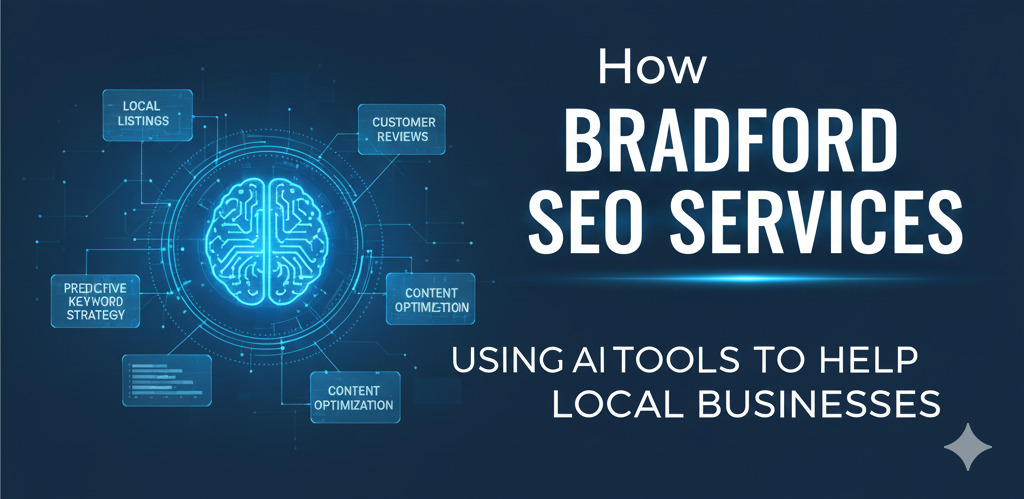
    The digital economy of Bradford has reached a new stage. By the year 2025, more local small and medium enterprises use AI-powered Bradford SEO services to achieve visibility over their competitors nationwide. The reason is that, many owners now engage a SEO company Bradford to carry out predictive keyword strategy, automated local listing and content optimisation pipelines that were once done by much larger teams.

    Intelligent Keyword Context Forecasting

    SEMrush (2024) argues that with AI technology, it is possible to plan content before it becomes trending and reduce risk by discovering increased search queries and topic gaps in their early stage before volume rises. Bradford operators with these features give precedence to long tail queries and hyper-local phrases most national brands are seldom targeting. This is a strategy that enables small teams to release the most relevant content at the ideal time and can often attract niche demand with small budgets and a shorter period of turnaround. The overall impact is reduced time-to-rank on targeted queries and better ROI on content creation since there are less resources that are invested on low-value topics.

    Bradford SEO AI-powered growth for SMEs, dominating competition

    Bradford SEO Services: Local Listings, Reviews, and Reputation

    Bright Local (2024) points out that reviews and map results make consumers greatly depend on local searches when selecting services, and AI has become automated in monitoring the reputation and repairing the listing. Bradford companies employing Bradford SEO services integrate the maintenance, consistency of citations, and review-response processes of Google Business Profile to ensure that the profiles remain updated and respected. That local hyper responsiveness makes smaller businesses seem higher in local packs when users use an SEO Service Near Me search, automated sentiment tracking will also bring issues with product or service quality to the fore, where teams can rectify operations or change listings before negative waves of movement take hold.

    Helpful-First Signals and Content Quality

    Google Search Central (2024) notes that search engines do place emphasis on low-quality content and give priority to helpful, people-first content. The Bradford users of AI-assisted editors and semantic analysis close information gaps, enhance topical depth, and reveal expert credentials, unlike the old manual processes. When the content is matched to the intent of the user, and the E-E-A-T rules are adhered to, the local websites receive trust signals, which in turn promote higher rankings in comparison to larger brands which may offer generic and broad material. HubSpot (2025) claims that faster content cycles and improved audience needs lead marketers to optimise content with the help of AI to report increasing authority as time goes by.

    Forecasting Site Health and Technical SEO

    Due to the adoption of AI, McKinsey (2024) notes that the decision speed and operational efficiency continues to rise across the marketing functions. By using machine-learning auditors, Bradford websites find crawling problems, schema problems, and performance regressions much faster than regular manual audits. Predictive alerts guide technicians to focus on fixes with high impact thus keeping the indexability and user experience intact. Integrate Bradford SEO Services technical hygiene with focused content also achieve the benefit of continuous visibility improvements without the necessity of maintaining the huge engineering departments, lowering the operating expense and making the smaller teams competitive.

    AI-powered marketing auditor in a modern Bradford SEO Service

    The Reason Hyperlocal Strategy Wins

    Artificial intelligence enhances local usefulness through a combination of keyword prediction, reputation figures and quicker technical recovery. It is also used to determine micro-niches – which are neighbourhood services or event-based queries – where local intent is high and competition is low. A local customer who requests an SEO Service Near Me can jump up the search results of their local area when Bradford businesses are customizing their location pages, structured data, and service-specific content based on AI assistance. With the introduction of AI-powered improvements to Bradford SEO services embraced by Bradford companies, more and more companies translate local intent into quantifiable traffic and revenue, demonstrating that scale is typically not the appropriate metric.

    Conclusion

    AI-SEO tools will be a feasible equaliser of SEO company Bradford in 2025. With the help of an established seo business bradford or by going straight to newer platforms, local firms can anticipate demand, keep local listings sparkling clean and that actually useful information is published which fits the search intent. The outcome is quantifiable increases in visibility, increased local conversions, and a possible avenue of small scale companies to outperform significantly larger competitors. At Bradford SMEs, the point in time to make the adoption is now, not tomorrow. First movers receive quantifiable benefits.

    As brands look for trusted partners to execute this shift, Gen Z Pro stands out as a forward-thinking Bradford SEO services that fully embraces AI-powered optimisation. Instead of relying only on outdated keyword strategies, Gen Z Pro integrates machine learning, predictive search patterns, and automated local SEO workflows that help businesses stay ahead of algorithm changes effortlessly. For Bradford businesses trying to scale without increasing marketing budgets, this combination of human-led strategy and AI automation unlocks faster ranking opportunities, stronger online visibility and long-term growth.

  • HOW TO AVOID COMMON SEO MISTAKES THAT CAN HURT YOUR RANKINGS

    HOW TO AVOID COMMON SEO MISTAKES THAT CAN HURT YOUR RANKINGS

    SEO is like this magical power to get people to your website, but so many people crash their progress with the most obvious mistakes. It’s easy to feel like SEO is a beast sometimes, but avoiding these basic screw-ups will keep things on track. Mistakes happen, but avoiding these five essentials is the key that will save your site from getting lost in the SEO void.

     Common SEO Mistakes That Can Hurt Your Rankings   

     Common SEO Mistakes

    1.  Invest in a Mobile-Responsive Website   

    Listen, if the website isn’t mobile-responsive, it’s like tossing away a huge chunk of traffic. We’re talking 60% of online searches now happen on mobile devices, and Google? Yeah, they’ve noticed. They’re boosting mobile-friendly sites in search rankings, and if your site isn’t optimised, you’re just setting yourself up for failure. People aren’t even going to stick around if they’re trying to browse on a glitchy, slow site; they will bounce faster than you can say “SEO fail.”

    Your site has to be smooth on mobile. That means everything needs to load quickly, buttons need to be easy to click, and navigation should be intuitive, no weird zooming or sideways scrolling. Users should get a seamless, fast, and enjoyable experience. If it feels clunky or takes forever to load, your bounce rate’s going to skyrocket, and your rankings are going to take a nosedive.

    And don’t just assume it’s good because it looks fine on your phone. Test it on every device. Seriously. Different screen sizes, operating systems, you name it. Google sees this as a massive factor in ranking, and so should you. The whole website needs to work flawlessly across mobile, tablet, and desktop. A mobile-friendly site isn’t just a nice touch anymore, it’s a must if SEO is going to work for you. So, yeah, don’t sleep on this. It’s a total game-changer.

    1.  Optimise Your Page Load Speed   

    Optimising page load speed is one of the most important things to focus on when improving your site’s SEO performance. Let’s face it, no one has the patience to wait for a page to load. In a fast-paced world, if a site takes more than a few seconds to load, users are clicking away, which is a killer for your bounce rate. And a high bounce rate? That’s bad news for SEO rankings.

    Google cares a lot about page speed when ranking sites. Slow-loading pages get pushed down in search results because Google wants to provide users with the best experience. Studies show that pages on the first search results page load in around 1.65 seconds. If your site isn’t close to that, you’re missing out.

    The good news is, improving speed is possible! Tools like Pingdom, Google PageSpeed Insights, and Woorank can measure your site’s load speed and break it down into actionable insights. Aim for under 2 seconds. Anything longer, and you risk losing users.

    To speed things up, start with optimising images, as they’re often the main culprit behind slow loading. Compress images without sacrificing quality, leverage caching to make future visits faster, and minimise your code to remove unnecessary bloat. Regularly check your page speed and keep improving it. A faster site means better user experience and a higher chance of ranking well. Keep those load times tight and watch your rankings soar!

    1.  Prioritise Content Quality Over Quantity   

    When it comes to SEO, content isn’t just king, it’s the whole damn kingdom. But here’s the thing: quality content is the real star, not just a bunch of fluff. People aren’t here for surface-level stuff. Google loves it when users stay on your page, so the longer they stick around, the better your SEO rankings will be. To keep them hooked, your content has to be relevant, informative, and helpful.

    Quality content means answering real questions, diving deep, and offering value. No one wants to click away because your article didn’t deliver. Google rewards pages where users stay longer, and that signals that your content is valuable. Relevance and depth matter big time. When users engage, your SEO gets a huge boost.

    So, what’s the key? Start by creating well-researched content that answers what people are asking. Don’t just post for the sake of posting; give real value. Update older content to keep it fresh, and always make sure it’s user-focused. Keep it about their needs, not just your business. The more your content connects with your audience, the more Google will reward you for it! Quality over quantity every time.

    1.  Address Your Audience’s Interests and Concerns   

    One of the biggest mistakes businesses make is creating content that’s totally off the mark. Like, they’re so focused on what they think their audience wants, they miss the point entirely. And guess what? That’s why people bounce fast. If the content isn’t answering what the audience cares about, it’s a major miss, and the SEO is about to tank.

    Here’s the thing: the focus needs to shift. Start crafting content that hits the audience where it hurts like, like getting in their heads. What are they stressing about? What questions keep them up at night? When the real stuff is answered, people stick around, and SEO looks way better. It’s that simple.

    So, how do you figure out what they care about? Easy do some damn research! Hit up surveys, stalk forums, and dive into analytics. See what topics are getting the most love, and use that as the blueprint. This isn’t about guessing, it’s about knowing exactly what people need.

    And here’s the kicker: make it real. Speak to the stuff they’re dealing with every day. If content can be the solution to their problems, they’ll keep coming back for more. Google notices that, and the rankings? Yeah, they’ll start climbing. So, get real, get relatable, and watch SEO thrive!

    1.  Keep Your Information Up-to-Date   

    Keeping content up-to-date is everything. Outdated content? It’s like having a crusty old sandwich sitting on your page. No one wants to deal with that, especially Google or users. If the content is stale, they’re outta there, and guess what? Google’s ranking is lower, too. Staying relevant is a big deal.

    Here’s the deal: make a content plan and review posts regularly. This isn’t a “once in a while” thing. Consistency is key. When updating old posts, toss in new facts, fresh insights, or more resources. Don’t just slap a new date on it and call it a day; make sure the info is legit and up to speed with what’s trending.

    And look, don’t be afraid to delete stuff if it’s straight-up useless. If it’s misleading or doesn’t add any value, just bury it. Keeping content current is like sending a “hey, I’m still here and I know what I’m talking about” message to both the audience and Google. Keep things fresh, and watch that SEO magic happen! (https://www.youtube.com/watch?v=RhpgcWltxLM)

     Case Study: Organic & All-Natural Superfoods Manufacturer   

     Technical Issues   

    1. 404 Error Pages: Clicking on a link and being slapped with a 404 error completely messes up the experience. Not only does it frustrate users (who are probably already a few seconds away from bouncing), but it’s also a massive hit to traffic. If people can’t find what they’re looking for, they’re outta there, and guess what? That’s a killer for SEO rankings. (https://crowdo.net/blog/case-study-seo-success)

    2. Unoptimized Images: Unoptimized images can seriously slow down page load times. Pages are taking forever to load because images weren’t compressed? That’s a major problem. Not only does it annoy users, but search engines notice that slow load times, too. Slow-loading pages are ranked lower, and that’s not helping anyone. Optimising images is a game-changer.

    3. Technical Pages Open for Indexing: When technical pages are left open for indexing, it’s like giving Google a bunch of duplicate content to sift through, making it harder for them to find the valuable stuff. Keep those technical pages hidden if you don’t want them messing with SEO.

    4. Unoptimized Meta-Tags: Meta tags can make or break SEO. When they’re not optimised, it’s like shooting yourself in the foot. How can Google find content if it’s not labelled properly? Without clear meta tags, pages are invisible, meaning fewer clicks, less organic traffic, and a ton of wasted potential.

    5. Incomplete Basic Redirects: Redirects need to be set up properly. Clicking a link and landing on a dead page or the wrong place is super frustrating. Google doesn’t like that mess either. When redirects aren’t right, it makes the site look sloppy, and search engines might abandon it. Everything needs to flow smoothly, or SEO will suffer. Fix those redirects and save the rankings!

     Strategies    

    Link Building Strategy: It’s all about finding those authoritative, high-quality websites related to the client’s industry. That’s the magic sauce for backlinks that mean something for SEO. But it doesn’t stop there. Active efforts were made to reach out to relevant sites for collaborations. As a result, the client’s link profile started looking amazing, and their SEO authority shot through the roof!

    Monitoring and Reporting: The strategy wasn’t a “set it and forget it” deal. Regular reports were sent out to track progress and measure how things were going. This wasn’t just about doing the work and hoping for the best; the client (Organic & All-Natural Superfoods Manufacturer) was kept fully informed, with feedback incorporated to make quick adjustments. It was a constant vibe check to make sure things were always improving.

     Result   

    Organic Traffic Increase

    In February 2023, the site was sitting at 10,782 visitors. That was the starting point before all the magic started happening. Fast forward a few months to July, and the traffic jumped to 18,031! That’s a solid 67% growth. Who wouldn’t want that kind of success? The chart below shows a steady rise, and it’s all about those SEO efforts kicking in. Better content, stronger backlinks, and optimising everything finally paid off big time. You can seriously see how the right moves pulled in way more traffic, and that’s the real power of SEO.

    traffic trends grpwth

    Growth in Organic Keywords

    Back in July 2022, the website was ranking for 8,460 keywords, but most of those were chilling in the lower spots like 21–50 and 11–20. Fast forward to February 2023, and boom, the number jumped to 15,157, a solid 79% increase. More keywords meant the site was showing up for a ton of relevant search terms. The chart’s looking super promising big spikes in keywords in the 21–50 and 11–20 range, which means the site’s visibility and audience reach are blowing up. And yes, even keywords in positions 1–3 saw a little bump! This all shows that the SEO strategy is crushing it. More keywords = more potential customers. Those extra rankings meant more organic traffic, and it’s clear that the SEO efforts are pulling in the clicks and bringing the site more love from search engines.

    organic keywords growth

    Improved Website Visibility & Rankings

    The website’s killing it with keyword rankings, like one keyword went from sitting at positions 7-8 straight to position 1. And don’t even get me started on the 1–3 and 4–10 positions; those are gaining some serious traction. This means the site is now popping up higher in search results for those terms. Plus, there’s been a huge boost in traffic, with some keywords seeing growth as high as 365. That’s insane! The SEO strategy is pulling in more visitors as those rankings climb. Even keywords that weren’t pulling in traffic before are starting to shine, and the more competitive keywords are also moving up. As these keyword rankings go up, visibility soars the site is reaching a whole bigger audience now. With all these rankings and traffic skyrocketing, the site’s becoming more competitive and snatching more clicks from search engines.

    Improved Website Visibility & Rankings

    Downloaded Image: https://crowdo.net/blog/wp-content/uploads/2023/09/download.png

    Backlinks

    From July to October 2022, the referring domains were creeping up, but like, super slowly. It went from 300 to 500, which is good, but not exactly setting the world on fire. Then, boom, February 2023 hits, and those domains shoot up to 951. There’s some serious hustle behind that, probably tons of outreach, smart partnerships, or content that just clicked with the right people. Then, from March to July 2023, it didn’t even slow down. It just kept climbing, hitting over 1,200 referring domains by July. The backlink strategy is clearly on point, and it shows in the way the SEO’s popping. Those new backlinks are driving the site rankings up, sending in traffic, and improving the site’s online level.

    referring domains growth

     Final Thought   

    SEO is a total game-changer, but avoiding common mistakes is essential to its success. If you’re not on top of mobile responsiveness, slow load times, and fresh content, you’re shooting yourself in the foot. Learned that the hard way! Ignoring those things didn’t help rankings. But once attention shifted to details like fixing slow pages and updating old posts, things started clicking. Google loves that! And don’t even get started on broken links and unoptimized images. Ignore that, and SEO will laugh at you. Just take care of the basics, stay consistent, and watch traffic climb like a plot twist!


  • WHY SEARCH INTENT IS CRUCIAL FOR SEO SUCCESS

    WHY SEARCH INTENT IS CRUCIAL FOR SEO SUCCESS

    Let’s be real, if search intent isn’t on point, it’s a one-way ticket to failure. Trust me, messing this up stings. Google’s mission is all about giving the best answers to people’s questions, and if the content doesn’t match what they’re looking for, that high ranking is a lost cause. Been there, done that, learned the hard way.

    Here’s the thing: crushing SEO means understanding what people are searching for and aligning content with that. No guessing here, take a moment to figure out what’s on the searcher’s mind, and make sure the content speaks to that. It’s not rocket science, but nailing it. Total game changer. In this blog, we will discuss the importance of search intent in SEO success.

    What is Search Intent?   

    What is Search Intent?  

    Search intent is all about figuring out why someone is typing in that search. Like, what are they after? Are they looking to buy something, learn how to do something, or just kill time? I’ve messed this up before, and it cost me. When you get it right, though, it’s like a lightbulb moment. You create content that helps people, and boom, you’re in the right spot. Understanding what people need and where they’re at mentally is like giving them exactly what they’re looking for, and honestly, it’s the difference between actually getting noticed or just disappearing into the invalid.

    (https://www.youtube.com/watch?v=izHWK-WIe0Y)

    The 4 Types of Search Intent   

    Informational Intent: When someone’s searching to learn something, like “How to bake a cake” or “What is SEO,” they’re just trying to gather info. They’re not ready to buy anything yet, just need answers. People want knowledge and help solving a problem, no strings attached.

    Navigational Intent: Ever searched for something like “Facebook login” or “Yoast SEO plugin”? It’s not about browsing the entire internet, just need that one thing, like a shortcut to the destination. People know what they need and are using Google to get there faster. They’re not looking for random stuff, they want to get straight to the point.

    (https://www.youtube.com/watch?v=izHWK-WIe0Y )

    Commercial Intent: When searching for things like “Best laptops for gaming” or “iPhone vs Samsung Galaxy,” it’s all about research. People aren’t buying yet, but they’re getting their options straight. They want all the details, side-by-side comparisons, before pulling the trigger. It’s about making an informed choice.

    Transactional Intent: When searching for “Buy wireless headphones” or “Discount flight tickets,” it’s clear they’re ready to buy. They’ve researched, compared, and are now ready to commit. The content needs to match that urgency, or it won’t convert.

    Why Knowing Search Intent is Important   

    Google’s whole vibe is to give the best answers, right? So, if search intent is off, it’s like setting up a one-way ticket to bad rankings. For instance, when someone types in “best dog stroller,” Google assumes they want a list of the top options, not just one stroller. If the content focuses solely on one stroller, it’s not going to rank well. It’s all about understanding what people are after and making sure the content lines up with their needs. If it doesn’t, it’s wasting time because it won’t perform well in the search results.

    Matching the right content with search intent is key; otherwise, it’s a miss. And here’s where many businesses start questioning whether is hiring an SEO expert still worth it in 2025? The answer depends on how well you or your hired expert understand user intent and optimize accordingly.

    (https://www.youtube.com/watch?v=izHWK-WIe0Y)

    How to Discover Search Intent   

    Put Yourself in the Visitor’s Shoes

    When trying to figure out what people are searching for, it’s all about getting into their heads. Are they in a mad rush to find something, or maybe they’re just looking for the best deal? Are they trying to get reassurance before making a decision? Trust, putting yourself in their shoes makes a huge difference. Seeing how much it helps when the content speaks directly to their mood or mindset, it’s like giving them exactly what they need at the perfect time.

    Check Google’s Search Results

    To nail it, just type your keyword into Google and see what’s popping up in the top results. If you search “How to learn roller skating,” you’ll probably get a bunch of step-by-step tutorials with classic informational intent. But when you type “Best roller skates,” Google’s going to throw Google Shopping at you, then product lists, yep, that’s commercial investigation intent. And if you search “Moxie Skates vs Impala,” get ready for comparison videos with straight-up transactional intent. Simple, right? Just pay attention to what Google’s serving up!

    Example:

    • “How to learn roller skating” → Step-by-step tutorials (Informational Intent).

    • “Best roller skates” → Google Shopping, followed by product listings (Commercial Investigation Intent).

    • “Moxie Skates vs Impala” → Product comparison videos (Transactional Intent).

     Types of Searches Based on Intent   

    Time-Sensitive Searches

    Some searches are straight-up urgent. Like, if someone’s looking for a “quick breakfast recipe,” they’re not trying to spend two hours on it; they need something fast. Scrambling to make breakfast because something was forgotten, people just want something they can whip up in 10 minutes. It’s clear that people searching like this are in a rush and need quick solutions, not a three-course meal they don’t have time for.

    Location-Specific Searches

    When seeing keywords like “website agency in London,” it’s pretty clear people want something local. Searching for services, they’re not looking to get something shipped from across the world when they need it now. If targeting local users, make sure the content speaks to them, especially with location-based searches. It’s all about making it easy for them to find what’s right in their area!

    How to Optimise for Search Intent Using the FAT Model   

    How to Optimise for Search Intent Using the FAT Model  

    To effectively optimise content for search intent, focus on the FAT Model: Format, Angle, and Type.
    Format


    When searching for something like “How to do SEO,” step-by-step guides are what pop up, right? That’s exactly what people want! So, give them exactly that. If the content format doesn’t match what they’re expecting, it’s a waste of everyone’s time. It’s all about matching the vibe. People want guides and tutorials, so don’t just throw up some random list; deliver what they’re already searching for.
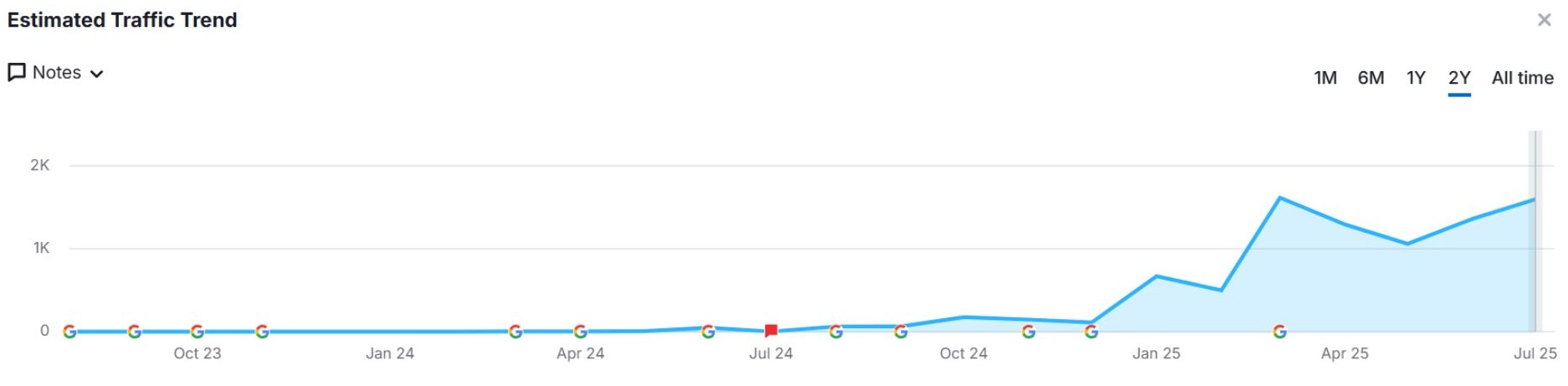
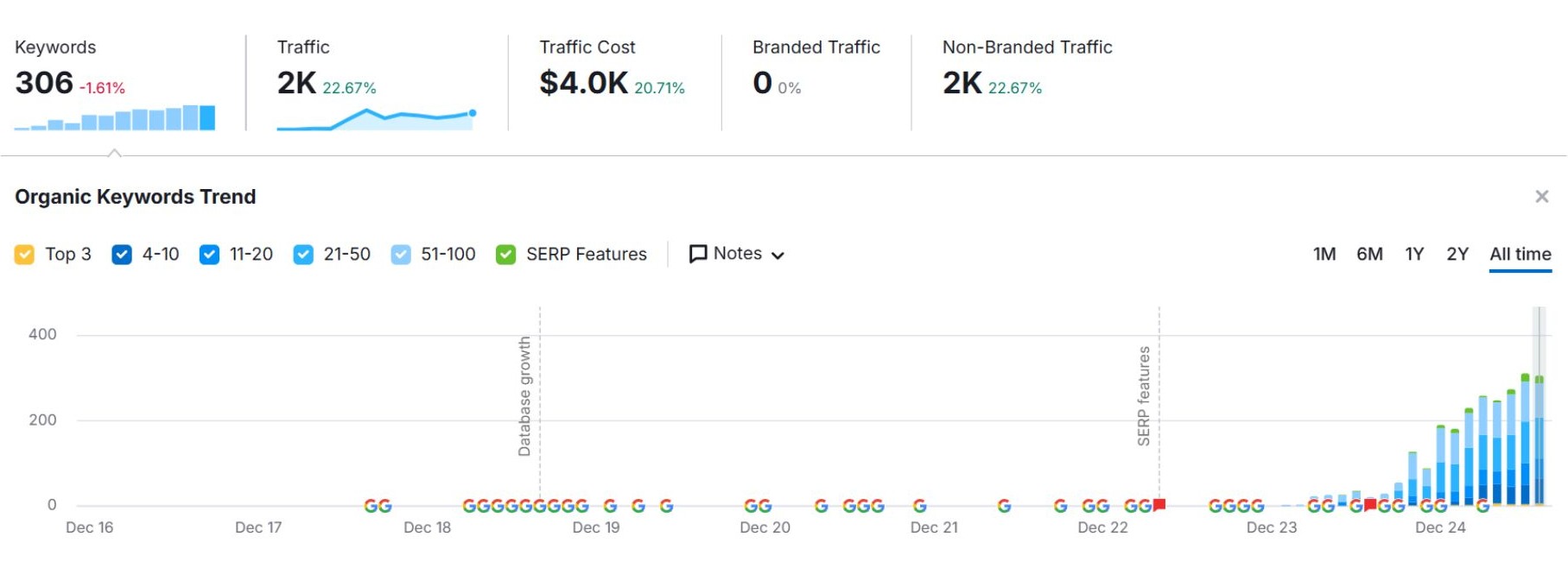
    Example: For “How to do SEO,” you might notice that search results are mostly step-by-step guides. Create content that matches this format to align with user expectations.

    Angle


    The angle is where things get interesting. If every other “SEO guide” out there focuses on beginners, why not switch things up? Try an advanced SEO guide or something super niche to stand out. Make it unique and fresh, don’t just replicate what’s already out there. Google is showing what’s popular, so use that to figure out how to one-up it with something better. Don’t play it safe and stand out!

    Example: If the top-ranking content for “SEO guide” focuses on beginners, consider offering an advanced SEO guide or a niche-focused guide that appeals to a different audience.

    Type


    When searching for “Best dog stroller,” what’s expected? A product review or a blog post with options, right? No one’s looking for just a single product page. If that’s all you offer, people will bounce. Ensure the content matches the type they’re looking for, whether it’s a blog post, review, or comparison page. Stick to the format Google’s already showing and make it even better.

    Example: If users are searching for “Best dog stroller,” they might expect to see a blog post or a product review page rather than just a single product page.

    Get FAT to Rank Better   

    FAT = Format, Angle, and Type

    If you want to level up, understanding search intent is everything. When content matches what people are searching for, Google starts loving it. Always, always check the search results before diving in. See what’s out there and make sure the content hits those sweet spots. It’s like having the winning formula — give people exactly what they expect and then some.

    That’s how to crush it in SEO. When the content aligns with what users need, the results speak for themselves, and those rankings will soar. Still wondering why SEO seems harder than ever for most businesses? It’s often because they fail to align their content with modern search behavior.

    (https://www.youtube.com/watch?v=izHWK-WIe0Y)

     Case study: How an E-Commerce Client Boosted Keyword Rankings by 3,403%   

    Background   

    In April 2024, SEO consultant Peter Rota began working with an e-commerce client whose website had limited organic visibility, ranking for only 157 keywords and receiving just 30 daily clicks. The site struggled to gain traction until they implemented a strategy based on this eCommerce SEO content case study, which details the exact steps taken to scale rankings and traffic.

    Challenge   

    Peter Rota is an SEO Master, started working with an e-commerce client in 2024. The client had literally zero SEO game going on, like, they were ranking for only 157 keywords! No blog content, no real strategy, just nothing. Peter spotted a massive opportunity, though. With some killer SEO work, they bumped those rankings up to almost 5,500 keywords. That’s a major glow-up in the SEO world! It’s like turning a forgotten corner store into the hottest spot in town. ()

     Approach   

    Let’s talk about the strategy that turned a dusty e-commerce site into an SEO powerhouse:

    1. Start With an SEO Content Audit

    First off, Peter Rota jumps in with an SEO content audit. This isn’t your basic checklist, no, he’s hunting for every gap, every opportunity, digging deeper than anyone else would. It’s like a total detox for the site, finding what’s broken and what could be shining if given a little TLC.

    2. Optimise Existing Content

    Next up, he doesn’t throw everything away and starts fresh. That’s a rookie mistake! Instead, Peter optimises existing content. Why toss stuff that’s already gotten some love, right? He tweaks those title tags, H1S, and internal links just like freshening up a closet with some accessories. It’s simple, but it gets the job done. Suddenly, those pages get a boost like they’ve been working out at the SEO gym.

    3. Build a Content Strategy

    Then comes the real magic. Building a content strategy. This isn’t about guessing what works; Peter’s out here thinking, “What does the audience need?” Using Surfer’s Topical Map, he gets the lowdown on what’s hot and what’s going to drive traffic, like finding those juicy keywords that everyone else overlooked. He’s not out here throwing spaghetti at the wall, nope, he’s going straight for the gold.

    4. Create Top-performing Content

    The final piece? Creating top-performing content. Peter’s not just playing the numbers game; he’s making sure every post has 4-5 internal links, building a web of content that Google loves. It’s not just about clicks, it’s about turning visitors into customers. It’s like throwing a party, but everyone leaves with a shopping cart full of goodies.

     Results   6 months SEO performance graph

    The growth on this chart is wild! It all began with barely any clicks back in September 2023, nothing impressive. But then, out of nowhere, bam! The clicks start piling up, and now we’re at 37.3 K. This is exactly what happens when the keyword strategy is on fire.

    Impressions Skyrocketing

    Those impressions? They started low, but slowly but surely, they shot up past 1.14 million. It’s crazy, right? It’s like the site suddenly became everywhere. That’s why clicks followed suit; more eyes on the site equals more action.

    Click-Through Rate (CTR) That Feels Just Right

    Now let’s talk about CTR. Sitting at 3.3%, it’s perfect. Sure, more clicks would’ve been nice, but honestly, this steady pace means the clicks are quality, not just random ones. The right people are coming through, and that feels good.

    Ranking on Page One or Two

    The average position is 15, and that’s something to celebrate. If a site’s ranking is on the first or second page, it’s in the game. That’s where the magic happens, and that’s exactly where the site has been.

    The Long Game Pays Off

    All of this is proof that when the focus is on ranking well and staying consistent with content, the traffic will come, and it’ll come strong. Stick with it, and results like this are possible. It’s a long game, but damn, it’s so worth it.

    Final Thought   

    Understanding search intent is everything when it comes to SEO. Seriously, once content matches what people are searching for, it’s like magic. Visibility skyrockets, attention flows in, and it feels like everything is on fire. Knowing what people are after, whether they need information, want to get somewhere fast, are comparing options, or are ready to make a purchase, lets you hit them at just the right moment. The key is giving them exactly what they want, in the format they expect, with that perfect twist. Nail search intent, and it’s a total game changer. Genzpro Marketing services will help you to beat the ranking.

  • HOW TO CONDUCT AN SEO AUDIT

    HOW TO CONDUCT AN SEO AUDIT

    If you want to level up your SEO game seriously and get that organic traffic flying in, this is the guide for you. Here’s the go-to process for auditing a site and finding every single opportunity to snag better rankings. Whether working with a small local business or managing a big site, these steps are the perfect fit for anything on deck. Once the right notes are hit, the site’s going to shine like the star it was always meant to be. Let’s get this!

    Step-By-Step Guide on the SEO Audit Process   

    Step 1: Audit the Keyword Profile   

    To begin the SEO audit, use SEMrush to analyse the target domain (e.g., rsblawfirm.com). Start by reviewing the organic keyword trend to identify if there are consistent or growing trends. Then, dive into low-hanging fruit keywords (positions 2-15) as they offer the best opportunities for quick improvements. These are keywords close to ranking on page 1, so slight optimisations, like better on-page content or link-building, can drive significant traffic.

    Focus on high-transactional, local keywords like “St. Louis criminal defence lawyer.” Next, examine keywords ranked between positions 16-50 important but require more effort. Finally, cluster keywords from positions 51-100 for deeper optimisation opportunities, ensuring content aligns with the correct search intent (transactional vs. informational).

    (https://www.youtube.com/watch?v=SIR4Kn62bLQ)

    Step 2: Perform a Technical Audit   

    Start by running the site through SEMrush’s Site Audit tool to uncover technical issues. Key areas to focus on include crawlability, ensuring Google can efficiently crawl the site (aim for pages no deeper than 3 clicks from the homepage). Next, check that critical pages are indexed and not mistakenly blocked by “noindex” tags. Review crawl depth to ensure important pages aren’t buried too deep in the site structure.

    Pages deeper than 3 clicks can harm SEO. Also, look for thin content that could negatively impact rankings. Finally, tackle any issues with keyword cannibalisation in the URL structure (e.g., the overuse of “St. Louis personal injury attorney” across multiple pages).

    (https://www.youtube.com/watch?v=SIR4Kn62bLQ)

    Step 3: Investigate Content Opportunities   

    Running a site through SEMrush’s Content Audit tool is always important to assess the quality and significance of existing content. Pages with low traffic, high bounce rates, and short page durations need to be identified. If a page’s not pulling its weight, it’s time to decide whether to upgrade or remove it.

    That said, many businesses still ask is hiring an SEO expert still worth it in 2025? — especially when trying to revamp old content. The truth is, even outdated articles can turn into goldmines if approached with a solid audit and intent-based updates.

    Some pages aren’t just for SEO, they could be part of the branding, marketing, or some bigger plan. Upgrading old content is a total game-changer, though. A little SEO magic can make things pop and stay trendy, like bringing back a high school outfit with a fresh twist and watching everyone notice.

    (https://www.youtube.com/watch?v=SIR4Kn62bLQ)

    Step 4: Analyse On-Page SEO   

    The secret to optimising pages? Start with SEMrush’s On-Page SEO Checker. Just pop in the page and the keyword(s) to rank for, and get all the interesting SEO suggestions it spits out. From there, tweak things like adding more keyword variations, improving readability, and adjusting those meta tags. Focusing on content relevance is key. It’s all about matching the search intent behind the keywords.

    And don’t forget about engagement! Boosting time on page and interactions helps push rankings up. Make these changes, and the SEO queen crown is just around the corner!

    (https://www.youtube.com/watch?v=SIR4Kn62bLQ)

    Step 5: Conduct a Backlink Audit   

    Start by running the site through SEMrush’s Backlink Audit tool. It’s like a detox for your backlinks. Check for all those shady, low-quality links that are just sitting there, ready to drag your reputation down. Things like spammy links or those useless Web 2.0 links? Time to disavow those. Now, here’s the fun part: getting good links.

    Go for those high-quality, editorial links that actually matter, especially ones relevant to the niche and location. And don’t even get started on anchor text, it’s got to be diverse and natural, no overusing the exact match stuff or Google will come knocking. Cleaning up the backlink profile is key to boosting domain authority and getting those rankings up. It’s a total game-changer.

    (https://www.youtube.com/watch?v=SIR4Kn62bLQ)

    Step 6: Identify and Fix Keyword Cannibalisation   

    To avoid keyword cannibalisation, start by using Screaming Frog to scan the site’s URL structure. It can help to identify the pages with similar keywords or titles that may compete against each other in the same search query. When multiple pages target the same keyword, Google may struggle to determine which one to rank, potentially diluting SEO performance. Review the flagged pages and decide whether to consolidate content or refine the pages to focus on distinct aspects of the keyword. For example,

    if two pages are both targeting “St. Louis divorce lawyer,” consider merging them into one authoritative page or tweaking the content so each page targets a unique, related keyword. The target keywords are less competitive internally, and each keyword will have a dedicated page to itself, which increases the chances of ranking higher for a specific keyword.

    (https://www.youtube.com/watch?v=SIR4Kn62bLQ)

    Step 7: Monitor Core Web Vitals   

    To optimise site performance for better SEO and user experience, start by checking Core Web Vitals in SEMrush or Google Search Console. These metrics focus on key aspects like page speed, mobile responsiveness, and visual stability (ensuring pages don’t shift unexpectedly as they load). If there are any issues, prioritise fixing page speed, as slow-loading pages can harm user experience and rankings. Improve mobile responsiveness to ensure the site performs well on all devices, especially since mobile-first indexing is now standard.

    Tackle visual stability by limiting layout shifts that can frustrate users, such as images or ads that jump to another spot on the page. Optimising these core metrics makes a better experience for the user and, at the same time, affects SEO directly since Google uses Core Web Vitals as one of its ranking factors. Regularly monitor these areas and optimise as needed to keep your site fast, stable, and mobile-friendly.

    (https://www.youtube.com/watch?v=SIR4Kn62bLQ)

    Step 8: Formulating a Strategy Based on Findings   

    Here’s how to tackle the whole SEO audit thing. Once the audit is done, the next step is making a plan, with the key being ranking opportunities by impact and effort. Focus on what’ll give the most bang for the buck with the least amount of sweat.

    Fixing crawlability, link profiles, and keyword overlap lays the groundwork, but it’s also important to recognize why SEO seems harder than ever for most businesses. Between algorithm updates and content saturation, the game has changed — but having a tailored strategy helps beat those odds.

    it’s time to get down to business with those technical issues: crawlability, keyword cannibalisation, and backlink quality. Fix these, and a solid foundation is set. Then, once the immediate stuff is handled, it’s all about the long game: creating killer content and snagging those quality backlinks. A mix of quick wins and long-term goals is the way to go. The SEO will look good for both now and in the future.

    (https://www.youtube.com/watch?v=SIR4Kn62bLQ)

    SEO Audit Case Study: 1.4M Visitors in 6 Months   

    Client Overview   

    A financial services site offering real-time market data, news, and trading tools lost 30% of its organic traffic overnight. Can you believe that? 30%, gone in a flash! The client was freaking out, asking, “What’s going on?” Traffic fell out of nowhere, and the SEO drama began. There was no quick fix; it was time to dive into some serious work to get that visibility back. (https://www.searchlogistics.com/case-studies/4-step-seo-audit-results/)

     Challenges Identified   

    Search signals for page experience

    Downloaded Image: https://www.searchlogistics.com/wp-content/uploads/2022/09/Google-Update-Core-Web-Vitals.png

    Several key challenges were identified for the financial services website:

    1. Hundreds of Low-Quality Indexed Pages: The website had a significant number of irrelevant or poor-quality pages indexed, which was not helping its SEO. These pages contributed to index bloat and wasted valuable crawl budget.

    2. Slow Page Loading Speed: The site was struggling with slow loading times, especially on mobile devices. This created a poor user experience, which is crucial for SEO performance, particularly when considering Google’s focus on Core Web Vitals.

    3. Lack of Best SEO Practices: There were fundamental gaps in implementing essential SEO strategies, such as proper on-page optimisation, content structure, and technical SEO best practices. This hindered the site’s ability to rank effectively.

    4. Massive Content Gaps Compared to Competitors: The site was missing out on important topics and content pieces compared to its competitors. This lack of coverage impacted its perceived authority in the financial niche.

    5. Not seen as a Complete Topical Authority by Google: Given the competitive nature of the financial niche, the site lacked the required topical authority, which is crucial for ranking higher in Google’s search results. Without it, Google wasn’t considering the site as a leading expert in the field.

     SEO Audit Process   

    Step 1: Identify and Remove Unwanted Pages

    Crawl budget is everything. Google’s like that friend who only has a limited amount of time at your party, and it’s crucial to make sure they spend it wisely. If a site has a bunch of useless, low-quality pages, Google’s going to waste all its time on those, leaving the good stuff in the dust. Going through a site and finding random, useless pages is common. Duplicate content? Thin pages? Just noindex them or redirect them. Don’t waste Google’s precious time. The high-converting pages are the ones that deserve the spotlight.

    Step 2: Improve Your Page Speed

    Page speed is a total dealbreaker. Ever been on a website that’s slower than a snail on a treadmill? That’s exactly what people think of a site if it’s dragging. Google pays attention to that. Google doesn’t want slow-loading pages in its index. Lazy-loading images is a game-changer. Compressing those big, chunky images? Total lifesaver. Minifying JavaScript and CSS files also helps speed up the site. Faster pages = happy visitors = better rankings. Simple.

    Step 3: Find Blog Topics Using Competitors’ Websites

    Stop stressing about what to write for a blog. There’s no need to come up with everything from scratch. A great hack is to check out what competitors are doing. You don’t need to copy them, but use them for inspiration. Dive into their blogs, see what topics they’re ranking for, and identify gaps in their content that can be filled. Tools like SEMrush help analyse competitors’ content and show what’s working and what’s missing. Fill those gaps, improve their content, and watch rankings skyrocket. It’s like a cheat code for SEO.

    Step 4: Implement a Quality Internal Linking Strategy

    Internal linking should not be overlooked. It’s like setting up a roadmap for Googlebot and visitors. If the right pages are linked, search engines can understand what’s important on the site. Internal links also help pass link equity across the site. Linking related content together can make a significant difference. Top blog posts or product pages should have links from everywhere blog posts, guides, and service pages. Keep it natural and helpful. It’ll keep visitors on the site longer and make Google smile.

    Following these steps will boost the SEO game, increase traffic, improve rankings, and keep users happy.

    Results Achieved   

    Organic Traffic: Increased by 111.63%, Reaching 1.4 Million Visitors Per Month

    Increased by 111.63%, Reaching 1.4 Million Visitors Per Month

    Downloaded Image: https://www.searchlogistics.com/wp-content/uploads/2023/07/1.4-million-traffic-case-study-image.png

    The chart shows a clear upward trend in organic traffic from 2021 to 2023. Initially, traffic dropped significantly (likely from an algorithm update or technical issues), but after implementing SEO improvements, there has been a sharp recovery, ultimately peaking at 1.6 million visitors per month. The rise was steady, with a noticeable spike in the last quarter of 2022 and continuing into 2023, hitting the 1.4 million mark, which aligns with the reported 111.63% increase in organic traffic.

    Top 10 Rankings: Achieved 93,914 Top 10 Keyword Rankings

    ranking keyword results

    Downloaded Image: https://www.searchlogistics.com/wp-content/uploads/2023/07/ranking-keyword-results.png

    The chart visualises keyword ranking improvements. As you can see, from the beginning of 2021, there’s a gradual increase in the number of keywords in positions 1-3 and 4-10. The rise in the number of keywords ranked in the top 10 is marked in orange, showing a consistent upward movement. By May 2023, the site had significantly expanded its footprint, with 93,914 keywords ranking within the top 10. This directly contributed to the boost in organic traffic, as higher-ranking keywords generate more clicks and visibility.

    Revenue: Boosted by 51.18% Per Month

    Though not directly shown in the charts, the traffic and ranking improvements likely contributed to a 51.18% monthly revenue boost. More traffic and more high-ranking keywords typically lead to more conversions and sales, especially if the site is monetised through ads, affiliate marketing, or direct sales.

    Final Thoughts   

    When going all in with an SEO audit, the results are nothing short of magic. Start by diving into keyword profiles, checking the tech stuff, tweaking the content, and cleaning up backlinks because every little thing counts. It’s like hitting both the easy wins and the big goals at once. Sites go from barely noticeable to exploding with traffic and rankings.

    That 111% traffic increase and revenue boost? That was the result of executing every move with precision. If you’re looking for a partner to help implement this level of execution, Genzpro brings the tools and team to make it happen.