

SEO can feel like an ongoing rollercoaster, right? Like, one minute you’re soaring, thinking it’s all nailed down, and the next, spiralling, wondering if anything being done even matters. It’s like cooking this fancy dinner and crossing fingers, hoping it doesn’t all burn to a crisp. There’s been plenty of time and effort put in, only to ask, “Is this doing anything?” And that’s when it hits: if progress isn’t tracked, it’s all just guesswork. So, here’s the deal: to stay sane and know if things are working, success has to be measured. Here’s how to keep tabs on the SEO game and avoid getting lost in the shuffle.
How to Measure the Success of Your SEO Campaign
-
Start with Organic Traffic

What to Track
Here’s the deal. Organic traffic? That’s the key to SEO success. If a website’s getting visitors from search engines without paying for ads, then things are looking good. Who doesn’t want free traffic, right? Track every little thing when it comes to organic traffic. Look at the number of users, sessions, and page views who are showing up and what they’re looking at.
If some pages are getting tons of attention while others are totally ignored, that’s a big red flag that something needs tweaking. Also, don’t forget about bounce rate and session duration. If people are bouncing off the site like it’s a bad date, figure out why. A steady rise in organic traffic? That’s when SEO is working.
How to Measure
To measure organic traffic, let’s be real, Google Search Console is a total game-changer. Seriously, it’s like having a backstage pass to see how a site is doing in the wild world of search results. You can see exactly which search queries are bringing people to your site and how often they’re clicking. Plus, you get the scoop on where the site is ranking for each keyword. Here’s a little pro tip: link Google Analytics with Search Console. It’s like magic.
The full picture of how traffic is performing across the site is right there. Check it regularly to see if the site is creeping up in those rankings or if it’s time to do some SEO spring cleaning. Always keep an eye on long-term trends, because that’s how it’s possible to know if the strategy is working. The data doesn’t lie! And when you’re trying to improve visibility in SERPs, leveraging proven strategies to rank higher on Google becomes essential to your ongoing success.
(https://www.youtube.com/watch?v=RgNzDM4V3Nk)
-
Monitor Keyword Rankings

What to Track
Let’s talk keyword rankings. If the rankings for targeted search terms aren’t being tracked, what’s even the point? It’s like trying to drive without checking your GPS completely pointless. Keeping a close eye on keyword rankings is crucial because that’s the only way to know if SEO efforts are working. If keywords are climbing, that’s a clear sign the strategy is on point. If those rankings are flatlining or dropping, it’s time to reassess.
It is all about balance to focus on high-volume competitive keywords and also long-tail keywords that are generally easier to rank but still get solid traffic. Monitoring these rankings makes it easy to make changes, whether that’s making minor edits to content or working to develop additional backlinks. Keyword rankings are like the health check of the SEO game; if they’re weak, it’s time for a little extra attention.
How to Measure
To measure keyword rankings, tools like SEMrush and Ahrefs are essential; they’re SEO BFFS. Sure, they aren’t free, but they’re worth the investment. These tools show exactly where a site stands with rankings and let you track progress over time. Consistency is key here, don’t be the person checking rankings only occasionally and wondering why things aren’t improving.
Regular monitoring helps spot trends and discover hidden opportunities, like untapped keyword variations. When rankings go up, it’s so satisfying, but if they dip? Time to tweak. SEO is all about tracking what works and adjusting what doesn’t. Always focus on the keywords driving traffic and keep checking in. It makes all the difference!
(https://www.youtube.com/watch?v=RgNzDM4V3Nk)
-
Track Backlinks and Referring Domains

What to Track
Backlinks and referring domains? They’re like the VIP passes to SEO success. Seriously, these things are like getting a stamp of approval from the big leagues, telling Google, “Yep, this site is legit.” The more solid backlinks there are, the more authority is built, which can bump rankings. But hold up, it’s not all about quantity. A thousand links from random, low-quality sites? Nah, that’s like being invited to a party but no one knows you. High-quality backlinks? That’s the gold.
Track the number of backlinks, but don’t get fooled by just the count. It’s about where they’re coming from if they’re from big, respected sites in your niche; that’s the stuff that’ll move the needle. Also, don’t forget about diversity. If too many backlinks are coming from the same site, it might be a red flag. So, remember, it’s all about both quantity and quality.
How to Measure
To measure backlinks and referring domains, tools like Ahrefs and SEMrush are a total must. These tools give all the tea about how many backlinks are pointing at a site and how many different places are giving that sweet referral love. Google Search Console is cute and all, but it’s like the baby version of these heavy hitters. It’ll show basic stuff, but it’s the big guns that track the real juicy data. Don’t just count backlinks like it’s some kind of popularity contest; quality matters more.
High-quality backlinks from authoritative sites? That’s the golden ticket. And pay attention to the domain rating of the referring sites. Stronger domains mean stronger backlinks. Keep track of all these numbers, and it’ll be clear how solid the backlink game is. Time to level up that profile! And once your backlink foundation is in place, the next big win often comes from targeting niche audiences for better SEO impact, helping your content land in front of people who are already looking for what you offer.
(https://www.youtube.com/watch?v=RgNzDM4V3Nk)
-
Click-Through Rate (CTR) and User Behaviour Metrics

What to Track
CTR and user behaviour metrics are the backstage pass to understanding how visitors vibe with a website. CTR shows how often users click on a site after spotting it in search results, reflecting how irresistible the meta descriptions and title tags are. User behaviour metrics bounce rate, time on page, and scroll depth, reveal how engaging and relevant the content is to visitors.
A high bounce rate with low time on page? That’s a sign the content isn’t hitting the mark. But if visitors are sticking around, scrolling deep, and spending time, it means the content is on point. Tracking scroll depth helps determine how far users are engaging with the content, which can inform decisions about content placement and structure.
How to Measure
To measure CTR, just dive into Google Search Console’s Performance report. It’s like a treasure map to everything needed. Check the clicks, impressions, and average CTR for top keywords. If the CTR is looking low, it’s probably a sign that the meta descriptions and title tags aren’t making the right impression, time to spice them up!
Now, for user behaviour metrics, Google Analytics 4 (GA4) is the go-to. It tracks all the juicy details like time spent on the site, bounce rate, and how engaged people are with the content. Always check it to see if people are sticking around or bouncing off too quickly. Google Tag Manager for scroll tracking is a total game-changer.
It captures exactly how far people are scrolling through the content, showing what’s grabbing their attention. Want to improve CTR? Tweak titles and descriptions to make them irresistible. Want better user engagement? Tweak content to keep them hooked. The right adjustments make all the difference!
(https://www.youtube.com/watch?v=RgNzDM4V3Nk)
-
Measure Revenue and SEO ROI
What to Track
Tracking revenue and SEO ROI is the ultimate test of whether SEO is working. It’s not just about getting traffic because, honestly, what good is traffic if it’s not turning into sales or leads? If all that effort isn’t making money, what’s the point? Focus on how much revenue is coming from organic search traffic and compare that to what’s been spent on SEO. If the investment isn’t paying off, it’s time to rework things.
How to Measure
To measure this, get into Google Analytics 4 (GA4). Set up conversion tracking for key actions, like purchases or form submissions. Assign a dollar value to those actions to see exactly how much revenue is coming from organic search visitors. Head over to the Traffic Acquisition report in GA4, filter by “Organic Search,” and see how much of the revenue is coming from those visitors. Then, calculate SEO ROI using the formula:
SEO ROI = (Revenue from Organic Search – SEO Investment) / SEO Investment × 100.
For example, if SEO brought in $2,000 in revenue and the investment was $1,000, the ROI is 100%. Tracking these numbers regularly helps determine if the SEO strategy is on point or if adjustments are needed. (https://www.youtube.com/watch?v=RgNzDM4V3Nk)
Case study: How Piktochart Grew Traffic by 332% in 6 Months
Background
Piktochart started strong, with organic traffic growing steadily, and everything seemed on track. However, by mid-2024, traffic hit a wall, plateauing at around 830,000 visits per month. This was a major setback, especially considering the solid user base and good content already in place.
The competition, with Canva and Venngage flexing their SEO muscles, intensified the situation, leaving Piktochart struggling to keep up. The challenge was clear: while others surged ahead, Piktochart was stuck in neutral. In response, a major SEO overhaul was initiated. The focus was to amp up the game and significantly boost the digital presence, aiming to survive and thrive in the competitive market. (https://aioseo.com/trends/piktochart-seo-case-study/)
SEO Strategy
SEO Strategy: Piktochart’s Approach to Organic Growth
Between July 2024 and January 2025, Piktochart implemented a comprehensive SEO strategy focusing on:
Keyword Optimisation: Piktochart played it smart with their keyword strategy by targeting high-volume, low-competition keywords in the design and infographic space. Focusing on keywords that aren’t saturated with competition but still drive traffic is key. It’s about finding the sweet spot, where there’s less crowd but the payoff is huge.
Content Expansion: Next up, Piktochart went all in on creating detailed guides and tutorials to answer user queries. This wasn’t about throwing up random blog posts; this content was crafted to connect with the audience truly. The key takeaway here? Don’t just write fluff. People are searching for answers, so deliver valuable content that hits the mark and keeps them engaged.
On-Page SEO: Meta tags, headers, and internal linking- these small but powerful tweaks make a massive difference. Piktochart focused on these areas to make the site easier to navigate and more relevant to the keywords they targeted. These seemingly minor adjustments work wonders in boosting rankings and improving user experience.
Backlink Acquisition: Piktochart knew that securing backlinks from reputable design and education websites would enhance domain authority. Quality backlinks are like getting validation from the cool crowd. More high-quality links mean better SERP rankings and increased visibility.
Results
Downloaded Image: https://aioseo.com/wp-content/uploads/2025/02/piktochart-2-year-traffic.png
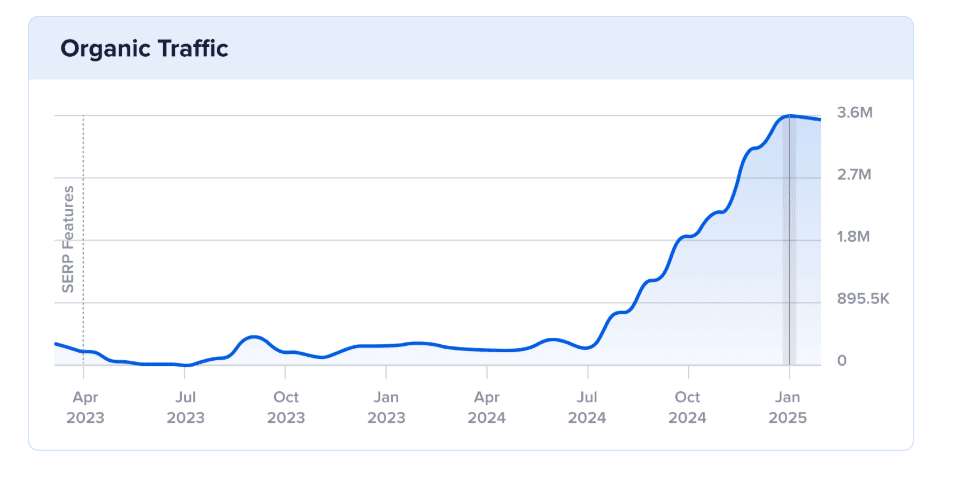
Piktochart’s organic traffic just skyrocketed from about 830K visits in April 2023 to a whopping 3.6 million by January 2025! That’s insane, right? So, in the beginning, from April to July 2023, things were kind of chill, and traffic crept up slowly. Probably just getting the SEO game together, maybe tweaking content or figuring out what keywords worked. Nothing crazy, but it was a start. Fast forward to mid-2023, and traffic kind of plateaued, still steady, but not exactly blowing up.
You could tell the strategy was being refined, slowly but surely improving those keyword rankings and making the content more relevant. But bam then, in January 2025, it was like the floodgates opened! Traffic went from around 1.5 million to 3.6 million, just like that. The SEO stuff was nailed down big time, getting the keywords right, optimising for those SERP features, and all that good stuff. Honestly, it’s like they became this big SEO rockstar. So, yeah, all those little tweaks and big moves? Paid off!
Final Thoughts
Measuring the success of an SEO campaign is a total game-changer. Without tracking organic traffic, keyword rankings, backlinks, user behaviour, and revenue, it’s impossible to know what’s working. Tools like Google Analytics, Google Search Console, and SEMrush are like having a backstage pass to the SEO party. Just look at Piktochart’s growth; focusing on the right keywords, expanding content, and building quality backlinks can completely skyrocket traffic. Keep track, adjust, and watch the SEO game thrive! For brands serious about growth, Genzpro helps navigate the entire SEO journey — from audits to rankings — with strategy-first execution.

