

In the ever-shifting landscape of digital marketing, the phrase “Guaranteed #1 Ranking” has officially moved from a bold promise to a red flag. If an SEO agency or SEO consultant is still pitching you a guaranteed top spot in 2026, they aren’t just behind the times they are likely ignoring the fundamental way search engines now function.
If you’ve started believing SEO is a scam because of promises like these, you need to read this first: You think SEO services are a scam (Yes, unless you read this).
As an SEO strategist who has navigated through the “Blue Link” era into the current age of Search Generative Experience (SGE) and AI Overviews, I’ve seen the metrics of success transform. Today, the “Number One” position isn’t a fixed destination; it’s a moving target influenced by hundreds of real-time variables.
So when an SEO agency says “We guarantee you #1,” here’s what they’re really doing:
Choosing a low-competition keyword you don’t actually care about
Ignoring personalization and location bias
Avoiding revenue accountability
Or using manipulative tactics that will collapse in the next core update
If you want to understand how agencies quietly drain budgets, read: 6 illegal ways to bleed your money by not choosing the right SEO agency (2026).
And I’ve seen the aftermath.
A Dubai-based interior design firm brand came to us after paying for a 6 month “#1 ranking package.” They did rank #1 for a keyword that brought 12 searches per month and zero qualified leads. Traffic went up. Revenue didn’t. When the next update rolled out, the ranking disappeared overnight.
So, Before signing that SEO contract with a Seo Firm understand why #1 guarantees are impossible in 2026.
1. The Structural Shift: Search Is No Longer a Fixed Ranking System
In 2026, the concept of a “fixed ranking” is effectively an Outdated SEO tactic. Google has transitioned from a linear list of results to a dynamic, multidimensional ecosystem where visibility is an interpretation problem, not just a positioning one.
The “Structural Shift” refers to the move from Inverted Indexing (matching words to pages) to Neural Retrieval and Generative Layers, where the SERP (Search Engine Results Page) is built in real-time based on the user’s specific journey.
1. The Mechanics of the Modern SERP
Google no longer simply “looks up” a keyword; it constructs a response using three primary layers:
A. Intent Modelling (Beyond Information vs. Transaction)
Google now uses Micro-Intent Modelling. Instead of just labelling a query, the system analyses behavioural patterns (dwell time, pogo-sticking, and session paths) to predict what you need next.
Vector-based Comparison: Queries and pages are converted into numerical vectors. If your page’s “meaning vector” doesn’t align with the “intent cluster” of the user, you won’t rank even with a perfect keyword match.
B. Entity Relationships (The Knowledge Graph)
Search is now “Entity-First.” Google evaluates your site as a node within a larger web of People, Places, and Things.
Contextual Connectivity: It’s not just about what you say, but how other recognized entities (Wikidata Q-IDs, official brand pages) link to you.
Topical Authority: Google measures how well your content reinforces a “subject space.” If you write about “Solar Panels,” Google expects to see relationships with “Photovoltaic cells,” “Inverters,” and “Net Metering” mapped clearly via Schema.
C. Context Signals
Rankings are now highly volatile based on:
Device & Environment: Mobile INP (Interaction to Next Paint) thresholds are stricter than ever.
Freshness Sensitivity: Google now distinguishes between “cosmetic updates” (changing a date to 2026) and “substantive updates.” Fake freshness is penalised, while real-time data is rewarded.
2. Why Rankings Are Recalculated Continuously
In the past, Google ran major updates every few months. In 2026, the “Core Update” is essentially a continuous state.Lets Understand this through the Different contexts:
Real-Time Feedback Loops: AI Overviews (AIOs) and “AI Mode” features test different citations in real-time. If users don’t click a specific source in a summary, that source is swapped out within hours, not weeks.
The “Great Normalization”: Google uses In-context Ranking (ICR) to process a document’s full conceptual relevance. As new content enters the web, the “Relevance Score” of every other page is recalculated relative to the new best-in-class answer.
3. Experience Angle: Volatility Observations (2025–2026)
Recent algorithm recalibrations, such as the December 2025 Core Update and the February 2026 Discover Update, have shown extreme volatility patterns, we try to explain this further through different factors and the impact examples which are mentioned below in the table:
| Observation | Impact Example |
| The Yoyo Effect | Sites ranking #1 during the first week of a core update drop to #30 by week three as Google tests real user satisfaction before stabilizing positions. |
| AIO Cannibalization | High-authority sites show “Rank 1” in Search Console but experience up to a 60% drop in clicks because AI Overviews (appearing in ~45% of queries) fully answer user intent without requiring a click. |
| EEAT Filter | Heavy volatility in Review and How-to niches where sites without first-hand experience (original photos, videos, documented testing) were replaced by smaller creators with proof-based content. |
| Entity Drift | Websites that moved away from their core topical entity (e.g., a tech blog publishing lifestyle content) experienced site-wide ranking devaluation during the January 2026 recalibration. |
The 2026 Reality: SEO is no longer about “winning a spot.” It is about becoming a trusted node in Google’s knowledge graph so that the AI layer consistently chooses you as its primary reference.
2. AI Overviews Redefined What “#1” Means
In 2026, the traditional metric of “#1 Ranking” has undergone a fundamental decoupling. For the first time in search history, visibility no longer guarantees traffic.
The arrival of the Search Generative Experience (SGE) and AI Overviews (AIO) has created a “Zero-Click Economy” where Google serves as the destination rather than the gateway.
1. The Displacement of Organic Results
The most significant change is the visual hierarchy of the SERP. AI summaries have effectively pushed the “Rank #1” organic result to the middle or even bottom of the mobile screen.
Pixel-Depth Shift: In 2026, AI Overviews typically occupy the top 800–1,200 pixels of the SERP. On mobile, this often requires two full swipes for a user to even see the first organic blue link.
Multi-Source Synthesis: Instead of sending a user to one expert site, Google’s AI synthesizes data from 5–10 sources. While your site might be a “primary source,” the user gets the answer they need without ever leaving the Google interface.
2. The CTR Paradox: Ranking Up, Clicks Down
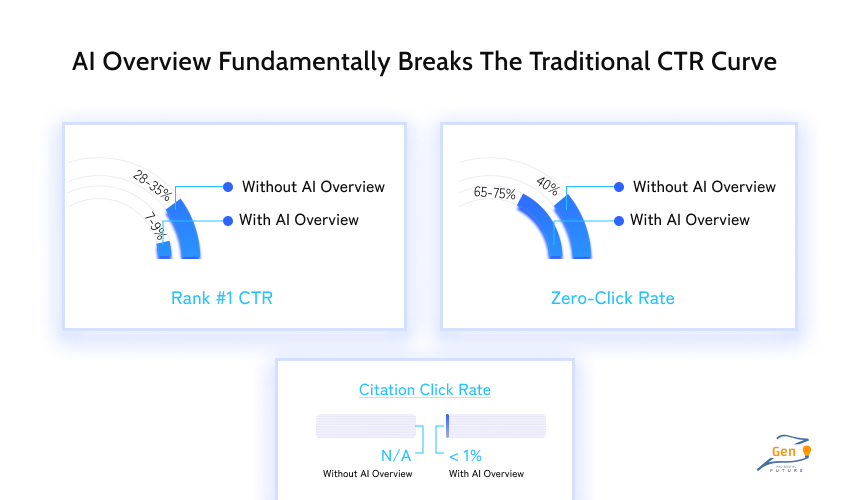
Data from 2025 and early 2026 confirms a brutal reality for informational keywords. Even when a site improves its position, its Click-Through Rate (CTR) often plummets if an AI Overview is present.
Proof: The “Decoupling” Effect
According to large-scale studies (Ahrefs, Seer Interactive, 2025-2026), the presence of an AI Overview fundamentally breaks the traditional CTR curve:
| Metric | Without AI Overview | With AI Overview |
| Rank #1 CTR | ~28% – 35% | ~7% – 9% |
| Zero-Click Rate | ~40% | ~65% – 75% |
| Citation Click Rate | N/A | < 1% (average for sources cited inside AI Overview) |
Case Study Observation: A major B2B SaaS blog saw its target keyword move from Position #4 to Position #1. Under the old rules, traffic should have tripled. Instead, because an AI Overview was triggered for that keyword, clicks dropped by 42% while impressions doubled.
3. Redefining “Winning” in 2026
If the click is disappearing, what does “Position 1” actually mean? It has shifted from a traffic driver to a brand authority signal.
The Citation Advantage: While clicks from citations are low (~1%), being cited by the AI creates “Top of Mind” awareness. Users who see your brand cited in an AI Overview are 35% more likely to search for your brand directly later in their journey.
Assisted Conversions: SEO measurement has shifted to “View-through Conversions.” You may not get the click today, but your presence in the AI summary influences the purchase decision that happens tomorrow via a direct visit.
The Rise of “AI-Native” SEO: Success is now measured by Share of Model (SoM)—how often the AI selects your content to build its summary—rather than just “Share of Voice” in the blue links.
3. Personalization & Location Bias: Your #1 Is Not Universal
In 2026, the idea of a “universal” search result is a myth. If two people standing on opposite sides of a street search for “best solar installers,” they are likely to see two different SERPs. This is because Google has shifted from a Global Index to a Hyper-Personalized Response Engine.
The “Rank #1” you see on your office desktop is a data point of one, influenced by a massive array of silent variables.
1. The Four Pillars of Personalized Search
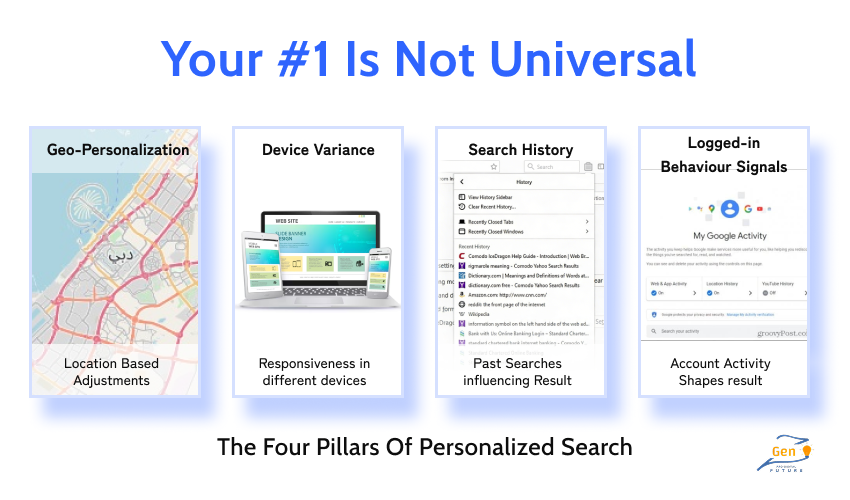
A. Geo-Personalization (Hyper-Localism)
Google uses IP addresses, GPS data, and Wi-Fi triangulation to customize results.
The 5-Mile Radius Rule: For service-based or retail queries, Google prioritises “Nearby” entities. A company with a 4.9-star rating 2 miles away will consistently outrank a global leader with a 5.0-star rating 50 miles away.
Neighbourhood Nuance: Even within the same city, localised “intent clusters” change. Search results in a residential suburb will prioritise different content than results in a commercial downtown district.
B. Device Variance (The Hardware Split)
Google recognises that intent changes with the screen size.
Mobile: Prioritizes “Immediate Action” (Call buttons, Map directions, AI Overviews optimised for voice).
Desktop: Prioritizes “Deep Research” (Long-form guides, Multi-column comparison tables, SaaS dashboards).
Wearables/IoT: Delivers “Snack able Data” ((heart rate bpm – Apple Watch, daily step count – Fit bit Charge 5, sleep score – Oura Ring,)
C. Search History & Journey Mapping
Google’s Neural Matching looks at your “Search Path.” If you previously searched for “organic gardening,” a subsequent search for “best dirt” will prioritise potting soil results over construction fill, even if the latter has higher global SEO authority.
The Retargeting Effect: If you have visited a specific site multiple times, Google’s AI assumes you trust that entity and will “boost” it into your top 3 results specifically for you.
D. Logged-in Behaviour Signals
Being logged into a Google Account (Gmail, YouTube, Maps) provides a rich data layer:
YouTube Synergy: If you watch a specific creator’s videos, their blog posts are more likely to appear in your Search results.
Calendar/Email Context: Google can anticipate needs based on upcoming appointments or flight confirmations, shifting “Helpful Content” to the top of the SERP exactly when you need it.
2. Why Rank Tracking Tools Show “Averages”—Not Reality
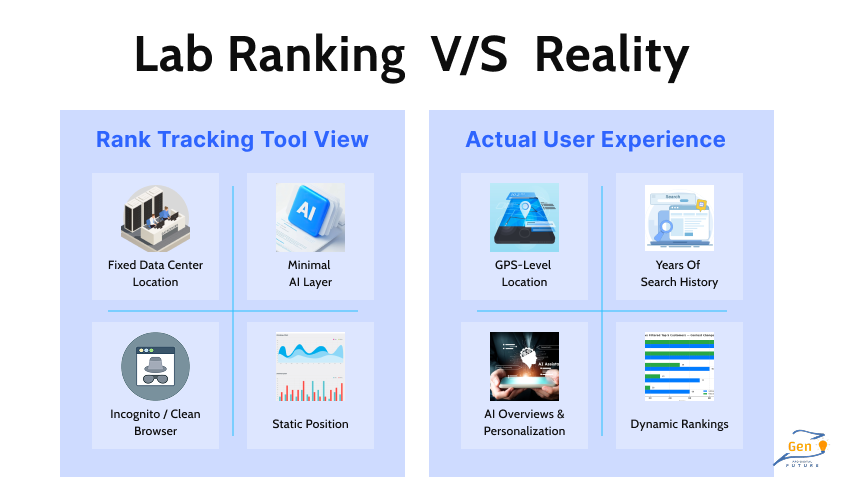
Most SEOs rely on tools like Semrush, Ahrefs, or Moz to track rankings. However, these tools operate by using “Clean Room” Browsing (Incognito mode, static IP, no history).
The “Blind Spot” Risk: If your tool says you are #1, but your organic traffic is flat, it’s likely because you are #1 in a “Neutral Lab,” but ranking #5 or lower in the actual personalized environments where your customers live.
The table below clearly shows how tools like Semrush, Ahrefs, and Moz simulate rankings in a controlled, history-free environment—while real users experience personalized, AI-layered, and location-driven results that look completely different.
| Feature | Rank Tracking Tool | Actual User Experience |
| Location | Fixed Data Center (e.g., Ashburn, VA) | Precise GPS / Neighborhood-level targeting |
| History | Zero (Fresh session, no prior signals) | Years of browsing history, brand interactions, and behavior signals |
| AI Layer | Often stripped to show “pure” HTML results | Heavily filtered through AI Overviews and personalization layers |
| Result | Static average ranking position | Dynamic, context-driven search experience |
3. Shifting the Strategy: From “Rank” to “Presence”
In 2026, we no longer optimize for a position; we optimize for Predictive Inclusion.
Focus on “Zero-Distance” SEO: Ensure your Google Business Profile and Local Schema are flawless to win the Geo-bias.
Niche Authority: Instead of trying to rank for everyone, aim to be the #1 result for your specific user persona’s history.
Omnichannel Signals: Use YouTube and social media to drive “Brand Searches.” The more people search for your brand specifically, the more Google treats you as a “Preferred Entity” in their personalized results.
4. The Algorithm Update Survival Framework
In 2026, the gap between “growth hacking” and “sustainable SEO” has become a canyon. Most agencies are still chasing the ghost of the last algorithm update, trying to reverse-engineer specific ranking weights. Meanwhile, the most resilient brands have moved toward Model Alignment: structuring their digital presence to be inherently understandable and indispensable to AI-driven search engines.
To survive the continuous recalibration of Google’s core systems, you need a framework built on durability, not loopholes.
1. The Survival Framework: Evolution vs. Reaction
| Strategy Type | The Old Agency Way (Reactive) | The Sustainable Way (Proactive) |
| Keywords | Stuffing high-volume terms into headers | Mapping entity relationships and topic nodes |
| Content | AI-generated fluff to “fill the gap” | Topical depth with original data and media |
| Links | Buying guest posts on “DR 50+” sites | Building brand authority and earning press citations |
| Technical | Fixing errors after they appear | Technical resilience (edge delivery, structured schema, performance-first architecture) |
2. The 3-Step SEO Durability Framework
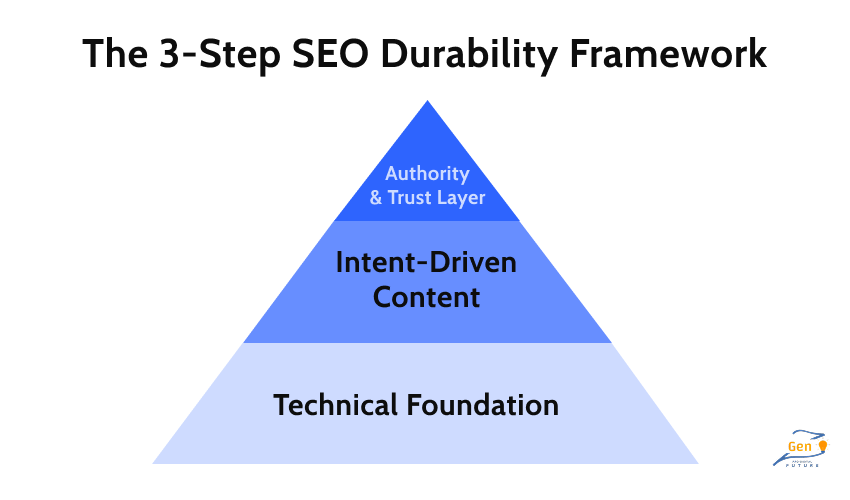
This is the executable blueprint for building a search presence that doesn’t just survive updates but thrives during the volatility.
Phase 1: The Technical Foundation Audit (The “Engine”)
Before Google can rank you, its “Neural Retrieval” system must be able to parse your site without friction.
Infrastructure Health: Move beyond PageSpeed. Focus on INP (Interaction to Next Paint) and server-side rendering to ensure the AI crawler sees exactly what the user sees.
Semantic Architecture: Implement Nested JSON-LD Schema. Don’t just tell Google you are a “Product”; define your “Brand,” your “Founder” (Person), and your “Subject Matter Expert” (Author) to link your entities.
Crawl Efficiency: In 2026, “Crawl Budget” is actually “Compute Budget.” Minimize low-value pages so Google spends its energy on your high-intent assets.
Phase 2: Intent-Driven Content System (The “Value”)
Stop writing “articles” and start building “Knowledge Assets.”
The “Information Gain” Requirement: Google now penalises “Copycat Content.” Every piece of content must provide a new perspective, a unique dataset, or a personal experience (EEAT) that doesn’t exist elsewhere in the top 10.
Clustering for Topical Depth: Don’t write 10 disconnected posts. Build a Topic Map where a “Pillar Page” is supported by “Satellite Content” covering every long-tail nuance. This signals to Google that you are a “Subject Matter Authority.”
Multi-Modal Optimization: Ensure every page has a high-quality image, a structured data table, or a short video. Google’s AI layers look for diverse formats to satisfy different user contexts.
Phase 3: Authority & Trust Layering (The “Shield”)
This is your insurance policy against algorithm drops.
Entity Association: Get cited in non-SEO-driven ways. Mentions in major industry publications, Wikipedia, or official government/educational databases solidify your status as a “Trusted Entity” in the Knowledge Graph.
Brand Search Velocity: Use social media and email marketing to drive Direct Brand Searches (e.g., people searching for “[Your Brand] + Solar Panels”). This is the strongest signal to Google that you are a preferred destination, not just a random search result.
Feedback Loops: Actively manage your Digital Reputation. High-velocity, positive sentiment across third-party review sites (Trustpilot, G2, Google Maps) creates a “Trust Shield” that keeps you stable even when the core ranking weights shift.
The Durability Mindset: In 2026, you don’t “beat” the algorithm. You become part of it by providing the most structured, most authoritative, and most unique answer to a specific human need.
5. Algorithm Volatility: Guarantees Fail the Probability Test
In 2026, the concept of a “guaranteed ranking” is not just a marketing lie—it’s a mathematical impossibility. Google’s transition from a static ranking database to a Real-Time Probability Engine means your position is a fluctuating score, not a fixed seat.
1. Why Ranking is a Probability, Not a Promise
In the past, SEO was like a race: once you crossed the finish line (Rank #1), you stayed there until someone faster beat you. Today, Google calculates the “Best Result” for every single query using a combination of persistent systems and real-time adjustments.
The “Twiddler” Layer
Even if your site is technically perfect, Google applies “Twiddlers”—post-processing modules that re-sort results after the main algorithm has finished. These include:
Diversity Twiddlers: If the top 3 results are too similar (e.g., all listicles), Google will intentionally swap one for a different format (e.g., a video or a forum thread) to ensure user choice.
Freshness Boosts: For trending topics, Google gives a temporary “probability edge” to newer content, even if it has lower authority.
2. The Four Pillars of Modern Volatility
Search volatility in 2026 is driven by four automated systems that are constantly “voting” on your content’s eligibility.
A. Core Updates (The Macro-Revaluation)
Google runs core updates continuously. These updates reassess the entire web’s quality baseline. If a new, superior way of explaining your topic emerges elsewhere, your “Probability of Ranking” drops because the standard for “Helpful” has moved.
B. SpamBrain AI (The Integrity Filter)
Spam detection is no longer about blacklisting keywords. SpamBrain uses pattern recognition to identify:
Behavioural Manipulation: If a site’s CTR looks “unnatural” (bot-driven), its ranking probability is zeroed out instantly.
AI-Generated Noise: Content that adds zero “Information Gain” (repeating what’s already in the top 10) is filtered out by the Helpful Content System.
C. Helpful Content Recalibration
Google now measures “Successive Search Behavior.” > If users click your result and then immediately search for the same thing again, it is a signal of Search Failure. Your ranking probability will drop because your content didn’t resolve the user’s intent.
D. AI Retrieval Adjustments (The SGE Layer)
The AI Overview layer is the most volatile. It uses Vector Retrieval to find the “Ground Truth.” Because AI models are updated and fine-tuned weekly, the sources they choose to cite (and thus the traffic they divert) can change overnight without any change to your actual website.
3. The Probability Curve: Understanding “Rank Drift”
Rankings in 2026 follow a Probability Curve. Instead of “You are #1,” it’s more accurate to say:
“There is an 85% probability that a user in New York on an iPhone will see you in the top 3.”
Why the “Yo-Yo” Effect Happens
You may see your rankings bounce between #2 and #15 in a single week. This is Google “Testing the Hypothesis.” It moves you up to see how users react. If the engagement signals are weak, it moves you back down. This is not a “penalty”—it’s the algorithm collecting data.
| System | Role | Frequency |
| Rank Brain | Interprets user intent and dynamically re-ranks search results based on behavioral signals. | Real-time |
| Spam Brain | Detects and neutralizes manipulative or spam-based ranking signals. | Continuous |
| Helpful Content System | Rewards original content with genuine “Information Gain” and first-hand value. | Every recrawl |
| SGE / AIO | Synthesizes AI-generated answers by combining information from top-ranking entities. | Per-query generation |
4.The Durability Strategy: Hedging Your Bets
Since you cannot guarantee a rank, you must optimize for Stability Factors:
Direct Brand Search: The more people search for you by name, the higher your “Baseline Probability.”
Topical Coverage: Don’t just rank for one keyword; own the entire “Entity Map.”
Format Diversification: If the blue links are volatile, ensure you are present in the Image Pack, Video Carousel, and AI Citations.
6. What a Real SEO Guarantee Should Look Like
In 2026, any agency promising a “#1 spot on Google” is selling you a 2010 solution to a 2026 problem. Because rankings are now personalized, volatile, and often bypassed by AI summaries, a “Rank Guarantee” is effectively a guarantee of vanity metrics, not business growth.
My philosophy shift moves away from chasing positions and toward guaranteeing outcomes. A real SEO partnership with an SEO firm in the AI era is built on the only metrics that actually impact your bottom line.
The New Standard: Performance-Based Guarantees
We have replaced “Rank Tracking” with a Revenue-First Framework. Here is what a modern SEO guarantee looks like:
1. Measurable Organic Growth (The Contextual Lift)
Instead of counting keywords, we guarantee an increase in your Total Organic Footprint.
The Metric: Non-brand organic traffic and “Share of Model” (how often AI models cite your brand).
The Goal: Ensuring that as search behaviour shifts from “Blue Links” to “AI Conversations,” your brand’s visibility across all surfaces (SGE, Voice, and Search) grows.
2. Qualified Lead Improvement
Traffic is a liability if it doesn’t convert. We focus on Intent-Alignment.
The Metric: Conversion Rate by Lead Source and “SQL” (Sales Qualified Lead) volume.
The Goal: We guarantee that the traffic we drive matches the high-intent “Entity Clusters” your business actually serves, reducing “junk” traffic that bounces.
3. Conversion Lift (UX + SEO Synergy)
In 2026, SEO and CRO (Conversion Rate Optimization) are inseparable.
The Metric: Improvements in CTR (Click-Through Rate) and On-Page Engagement.
The Goal: If Google’s AI is summarising your content, we optimize for “Citation Clicks”—ensuring that when a user sees your name in an AI Overview, they have a compelling reason to click through to your site.
The Operational Pillars of Our Guarantee
4. Transparent, Real-Time Reporting
We don’t send static PDFs at the end of the month.INstead We provide our clients:
The 2026 Dashboard: You get access to a live environment that tracks Volatility Adjustments, AI Mention Frequency, and Local Bias.
The “Why” Factor: If a ranking drops, our reporting tells you why (e.g., “AIO displacement” or “Competitor Information Gain”) and what the immediate pivot is.
5. Revenue Attribution (The “North Star”)
We connect SEO efforts directly to your CRM (HubSpot, Salesforce, etc.).
The Metric:First-Touch and Assisted-Organic Revenue.
The Goal: To prove exactly how many dollars were generated by a user who first discovered you through an AI summary or a personalized search result.
Comparison: The Old Way vs. Our Way
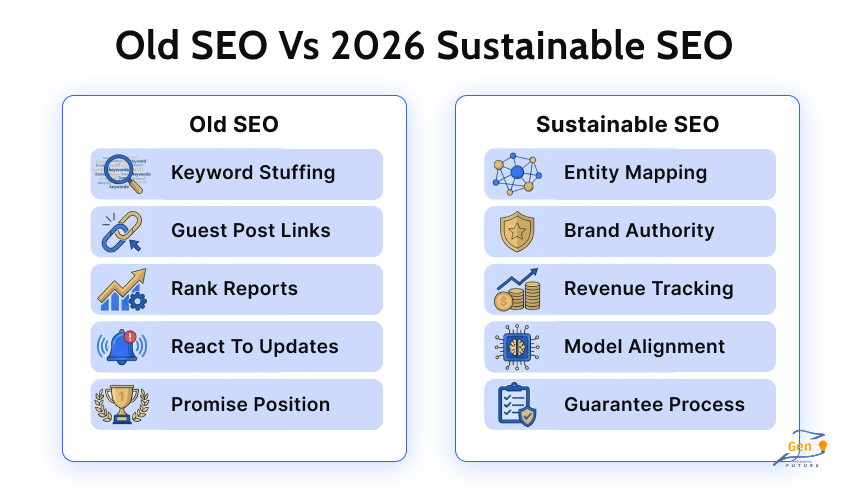
| Feature | The Old SEO Agency | Our Durability Framework |
| Primary Goal | Rank #1 for “Keyword X” | Increase net profit from organic search |
| Success Metric | Monthly keyword ranking report | Qualified lead flow & attributable revenue |
| Strategy | Aggressive link building & keyword stuffing | Entity authority building & intent mapping |
| AI Response | Panic or “wait and see” approach during updates | Active optimization for AI citations & search visibility layers |
| The Guarantee | A promise of ranking position | A commitment to measurable growth metrics |
Our Philosophy: We don’t optimize for Google’s crawlers; we optimize for your customers’ journey. If we win the customer’s trust and solve their intent, the “rankings” become a natural—and sustainable—by-product.
Position this as your philosophy shift.
7. Ask these Questions to Expose Fake Guarantees
The next time an agency offers you a guarantee, ask these five pressure-test questions. A legitimate 2026 SEO agency will answer with strategy; a bleeding agency will give you excuses.
Does your guarantee include visibility in AI Overviews (SGE), or just blue links? (Most guaranteed agencies only track dead keywords that AI already answers.)
What happens to the ‘guarantee’ when Google rolls out a Core Update mid-month?
Are you guaranteeing ‘Ranking’ or ‘Revenue’? Because I can’t pay my staff with a #1 spot for a keyword no one clicks.
Can you show me the ‘Spam Score’ of the domains you’ll use to ‘guarantee’ these results? (This exposes their use of Private Blog Networks.)
If we hit #1 but our Click-Through Rate (CTR) is 0% because of AI summaries, is the guarantee still considered ‘met’?
What variables outside your control affect rankings?
Do you guarantee rankings, or do you guarantee process execution?
A mature agency guarantees:
Technical implementation
Content quality standards
Strategic alignment
Reporting transparency
Can you show me a campaign where rankings improved AND revenue increased?
What happens if a manual penalty hits my site?
If you want SEO that drives revenue — not vanity rankings — let’s build a strategy rooted in data, intent, and long-term visibility.
GenzPro Marketing Services helps brands move beyond “#1 promises” into measurable organic growth that survives every update.
Let’s talk about what real SEO performance looks like for your business.

