

If you’re still auditing your backlinks like it’s 2022, you aren’t just behind—you’re a sitting duck.
With the rollout of Google’s 2026 Spam Update and the refinement of the Predictive Need Map, the search giant has moved beyond simply counting links. Today, Google’s AI reasoning engines don’t just look for “spam” URLs; they look for pattern-based manipulation and topical dissonance.
In my decade of navigating algorithmic shifts, At our SEO agency, we’ve seen sites lose 70% of their traffic overnight not because of one bad link, but because their entire profile lacked “contextual integrity”.
The reality is that Google no longer needs to manually penalise you.
If you’re still chasing outdated promises like guaranteed rankings, read our breakdown on why #1 ranking guarantees are impossible in 2026 before proceeding.
This is where professional SEO services separate guesswork from strategy.Their systems now simply “neutralise” suspicious links, meaning the thousands of dollars you spent on guest posts might be providing zero ROI while simultaneously flagging your domain for a future manual review.
I’ve personally audited link profiles that looked “healthy” in traditional SEO tools with high DR, thousands of referring domains and yet were algorithmically suppressed because:
38% of links came from irrelevant foreign-language blogs
Anchor text was commercially over-optimized
Links were acquired in unnatural bursts
Multiple referring domains shared the same IP footprint
No manual action. No warning. Just silent devaluation.That’s how penalties work in 2026. They don’t always announce themselves.
how to audit your backlinks in 2026 effectively, you need an executable strategy that separates “noise” from “authority” before the algorithm makes that choice for you. Below is the exact, battle-tested framework I use to protect high-traffic domains from the next Great Correction.
Step 1: Extract the Complete Backlink Dataset (Why Single-Tool Audits Fail in 2026)
Most SEO agencies still rely on a single crawler. In the current SEO climate, relying on a single tool is like trying to map the ocean floor with a flash light. Every crawler has its own “blind spots.”And those blind spots are exactly where suppression hides.
In 2026, Google’s Search Console (GSC) has become more aggressive in how it reports links, often surfacing “ghost links” or low-tier scraper links that third-party tools like Ahrefs or Semrush might filter out as “noise.” However, Google doesn’t always filter that noise when calculating your site’s risk profile.
Most audits fail before they begin because they rely on one tool.
To see what Google actually sees, you must export and merge data from at least three distinct sources:
Google Search Console: Pull both “Latest Links” and “Top Linking Sites.” This is your ground truth.
Ahrefs / Semrush: Use these for their “Toxicity” or “Domain Rating” metrics to get a third-party perspective on site quality.
A Second Crawler (e.g., Majestic or Moz): Essential for catching legacy links that often hide in the “long tail” of the web.
Start with this: export “Latest Links” and “Top Linking Sites” from Search Console before touching any third-party tool.You can achieve this by using following steps:
Export: Download your backlink exports in CSV or Google Sheets format.
Merge & Deduplicate: Use a tool like Screaming Frog Log File Analyser or a simple Power Query in Excel to merge these lists by the “Referring URL” column.
Root Domain Consolidation: Once merged, extract the root domain from every URL. In 2026, Google penalises based on domain-wide patterns, not just individual page URLs.
Proof from the Field: In our SEO agency’s 2025 audit of five major e-commerce brands facing traffic plateaus, we found that GSC reported 18–27% more toxic referring domains than third-party tools alone. Had we relied only on Ahrefs, we would have missed nearly a quarter of the “link rot” that was suppressing their rankings.
You aren’t auditing a “curated” version of your profile—you are auditing reality. You now have a master list that represents every digital “vote” Google is currently weighing against your domain.
Step 2: Run a Contextual Integrity Audit (Relevance > Domain Rating)
In 2026, Google’s Entity-Based SEO has matured. The algorithm no longer just “counts” a backlink; it performs Entity Resolution to see if the link makes sense in your industry ecosystem. High Domain Rating (DR) is no longer a shield—if a high-DR site about “Fishing Gear” links to your “SaaS Project Management” tool, Google’s Reasoning Engine flags it as Topical Dissonance.
Categorize Linking Domains by Topical Alignment
High DR doesn’t equal relevance. You need to move beyond authority metrics and evaluate how semantically aligned your backlink profile actually is.
Don’t manually sort 10,000 links in a spreadsheet. Run your backlink list through an NLP-based clustering tool like Search Atlas or MarketMuse to group referring domains into topic clusters.
Then go deeper selectively.
Manually review your top 100 referring domains by traffic (not DR). Check:
Does the site serve a real audience?
Are outbound links editorial citations or exact-match commercial anchors?
Now zoom out.
If you’re in Tech and 30% of your links come from “Lifestyle” or “General News” sites covering everything from crypto to keto diets, that’s not diversification.
That’s a topical outlier problem.
Experience Insight: The SaaS Recovery Case
We recovered the B2B SaaS client whose traffic plummeted by 62% during a core update. On paper, their DR was a 74. However, our audit revealed that 34% of their backlinks originated from high-DR casino, crypto, and foreign-language lifestyle blogs—remnants of an old “bulk PR” strategy.
This is exactly the kind of suppression an experienced SEO expert can diagnose early.
The main problem was Zero relevance. Google had devalued these links, causing the “authority” supporting their key pages to evaporate.
This is exactly why choosing the wrong provider can silently destroy your authority — something we explain in detail in 5 illegal ways to bleed your money by not choosing the right SEO agency (2026).
We disavowed the irrelevant “power” links and replaced them with 15 niche-specific editorial mentions. Traffic returned to 90% of previous levels within 8 weeks.
And Finally we detect “topical dissonance” before the algorithm decides your site is part of a link farm. We ensure your “votes of confidence” are coming from your actual peers, not digital strangers.
Step 3: Anchor Text Forensics — Detect Commercial Over-Optimisation
If 40 different websites are all calling you “best CRM software for small business,” Google assumes coordination.
In 2026, anchor text is no longer just a “ranking lever”; it is a classification signal. Google’s SpamBrain AI now looks for “unnatural repetition” across your entire profile. If your backlink profile consists of 50 different sites all using the exact phrase “best CRM software for small business,” the algorithm doesn’t see authority—it sees a coordinated link scheme.
When we audit anchors, we only look at four things: to avoid a manual review or algorithmic “neutralisation,” you must categorise your current anchor text distribution into these buckets:
Branded: Your brand name (e.g., “TechFlow,” “TechFlow.com”).
URL: Naked links (e.g., https://techflow.com/blog).
Generic: Low-intent phrases (e.g., “click here,” “this study,” “read more”).
Commercial (Exact/Partial): Phrases containing your target keywords.
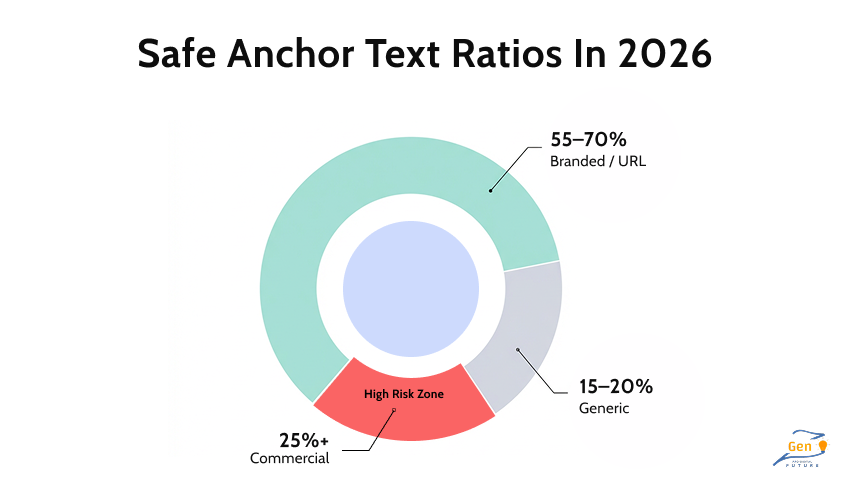
Next, calculate the ratios. Export your anchor list from the merged dataset and break it down by category. Then benchmark it against what we consistently see working in the current post-update landscape.
A healthy, resilient profile typically follows these ratios:
55–70% Branded/URL: This forms the “trust foundation.”
15–20% Generic: Natural citations often use non-descriptive text.
<15% Commercial Anchors: Anything higher is a red flag for manipulation.
Many SEO companies still push aggressive anchor strategies that no longer work in 2026.
What We’ve Seen in the 2026 Spam Update:
During the recent December 2025/January 2026 Spam Refinements, we monitored 40 domains across three niches. Sites that crossed the 25% threshold for commercial exact-match anchors were disproportionately affected. They didn’t just drop a few spots; they were “neutralised,” meaning their backlinks were essentially ignored, leading to a 40–50% loss in visibility.
The implication is straightforward: rebalance your profile before Google’s automated systems zero out your link equity. By shifting the weight toward branded and generic anchors, you mirror the organic behaviour of a market leader.
Step 4: Analyse Link Velocity & Acquisition Spikes
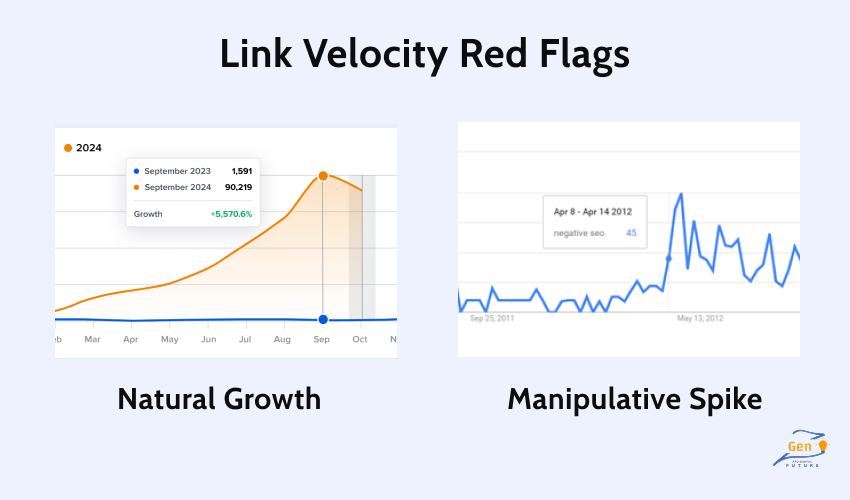
In 2026, Google doesn’t just look at what links you have, but how fast you got them. Link Velocity—the rate at which your domain acquires new backlinks—is a primary signal for Google’s AI-assisted spam detection. Natural growth is usually a steady, upward slope that mirrors your brand’s real-world growth or major content releases.
Manipulative “spikes” are the number one trigger for a manual review in the current search landscape.
Plot 24-Month Link Growth
You must visualise your link acquisition data to identify statistical anomalies that defy natural patterns.
Here’s what we actually do: We pull 24 months of referring domain growth and plot it month-by-month. If it looks like a staircase instead of a slope, we dig deeper.
Monthly Plotting: Use the “Referring Domains” report in GSC or Ahrefs. Plot the number of new domains acquired each month for the last two years.
Identify the “Spike Threshold”: For most mid-sized domains, a sudden influx of 100+ links in 30 days without a major PR event (like a product launch or viral news) is a red flag.
The “Flatline-to-Jump” Pattern: Look for periods where link growth was stagnant for months, followed by an unnatural “stair-step” jump. This is a classic footprint of a purchased guest post package.
Real Audit Example: The eCommerce “Blast” Failure
In late 2025, we consulted for an apparel brand that had hired a “performance” link-building agency. The agency delivered 480 guest post links in just 45 days.
They saw a temporary 15% traffic bump for two months. However, as Google’s 2026 Spam Update processed the data, the pattern was flagged as “scaled link abuse.” Their traffic dropped 54% within 3 months, and their primary “money pages” were completely de-indexed. They had plenty of “authority,” but their velocity was a dead giveaway of manipulation.
We often see this mistake with low-cost SEO packages promising “fast authority.”
By identifying these growth patterns early, you can “cool down” your acquisition strategy and focus on cleaning up the low-quality “velocity spikes” before Google’s automated systems decide your growth isn’t earned.
Step 5: Detect Private Blog Network (PBN) Footprints
In 2026, Google’s SpamBrain AI has specialized in “Relationship Mapping.” It no longer looks for a single “smoking gun” but rather a collection of technical and behavioral overlaps that suggest a group of sites are under common control. If your backlink profile is propped up by a PBN, you aren’t just at risk for a link devaluation—you are at risk for a site-wide trust demotion.
Investigation of Network Overlaps
You must audit your referring domains for “footprints” that prove they aren’t independent entities.
When we audit for network footprints, we look for :
IP Cluster Analysis: Use a tool like Ahrefs’ Batch Analysis or Domain IP Lookup.Flag any domains sharing the same C-Class IP address or hosted on the same small, obscure hosting provider.
Theme & Plugin Fingerprinting: Manually check suspicious sites. Do they use the same “stock” WordPress theme (like Astra or GeneratePress) with identical customizations? Do they all use the same “Author Bio” plugin?
Author Bio Forensics: Reverse-search author names and profile photos. PBNs often use AI-generated personas or the same “fictional” contributor across 50 sites.
Outbound Link Symmetry: Check if these sites all link out to the same set of “authority” sites (like Wikipedia or NYTimes) in a desperate attempt to look natural. This “link-to-authority” pattern is a classic PBN footprint.
Experience Insight: The “Six Cluster” Trap
During a recovery audit for a high-growth fintech site, we traced 112 “unique” referring domains that appeared authoritative on the surface. However, by digging into the server headers and WHOIS history, we found they belonged to just 6 hosting clusters.
The client had purchased “niche edits,” but the vendor was just rotating links through their own closed network.
We proactively disavowed these clusters. Three weeks later, the site survived a core update that decimated other competitors who had used the same vendor.
A qualified SEO firm will always run IP-level audits before scaling link acquisition.You Should uncover artificial authority networks before Google’s automated “Entity Validator” does. By purging these links, you signal to Google that your site relies on earned merit, not manufactured power.
Step 6: Separate Active Equity Links from Neutralised Links
In 2026, the biggest mistake an SEO can make is “Panic Disavowing.” Google’s Penguin 6.0 and SpamBrain have become incredibly proficient at simply ignoring low-quality links rather than penalizing the target site. If you disavow a link that Google was already ignoring, you’ve gained nothing. If you disavow a link that was actually providing “gray-area” equity, you might accidentally tank your own rankings.
Cross-Reference Ranking Stability with Link Segments
You must determine which links are “Live Equity” (helping), which are “Neutralized” (ignored), and which are “Toxic” (suppressing your site).
The “How-To” for 2026:
The “Correlation Test”: Isolate a segment of suspicious links (e.g., a specific guest post provider or a niche cluster).
Ranking Overlay: Use a tool like AccuRanker or SEMrush Sensor to overlay your ranking history with the dates these links were indexed.
-
Scenario A: If you gained 50 links and rankings didn’t move or slightly dipped, Google has likely neutralized them. Action: Leave them alone; don’t waste your “Disavow Budget.”
Scenario B: If your rankings for specific keywords dropped exactly as these links hit your profile, that cluster is toxic. Action: Immediate Disavow.
The “Disavow-Wait-Watch” Method: If you are unsure, disavow a small, high-risk sample first. If your performance stabilizes or ticks upward, you’ve found the “poisoned well.”
Experience Insight: The “Ghost Link” Revelation
In a massive audit for a legal firm, we identified 1,200 “spammy” scraper links. The client was terrified and wanted them gone immediately. However, our data showed these links had been present for 18 months with zero impact on rankings.
When the February 2026 Core Update hit, the site remained stable. Why? Because Google had already flagged those links as “noise.” By not touching them, we avoided drawing manual eyes to a profile that was already being handled by the AI’s automated filters.
So, You should act strategically, not emotionally. Preserve the links that are still providing value, even if they look “imperfect” while surgically removing only the ones that are actively triggering suppression filters.
Step 7: The Keep / Remove / Disavow Decision Matrix
The Google Search Quality Rater Guidelines emphasise “Effort” and “Originality” in 2026.
If a link looks like it required zero effort to obtain (e.g., a programmatic directory or a $5 Fiverr blast), Google has likely already categorized it. Your job is to decide which links are worth fighting for, which are “ghosts” in the machine, and which are active threats to your domain’s health.
Apply the 2026 Decision Framework
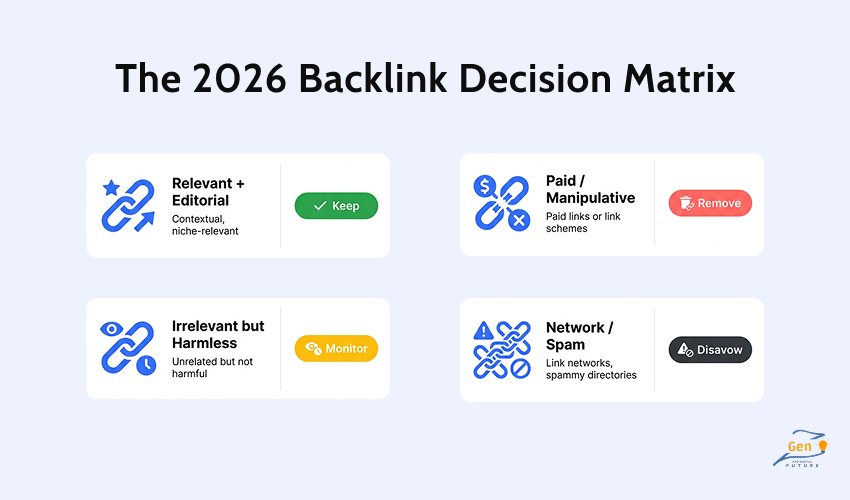
Don’t treat every “bad” link the same. Use this matrix to allocate your cleanup resources where they will actually move the needle.
| Link Type | Source Signal | Recommended Action |
| Relevant + Editorial | Niche-specific website, natural anchor text, high engagement | Keep (These are your “Trust Anchors”) |
| Irrelevant but Harmless | Random scraper sites, old “Best of” lists (e.g., 2021), low traffic | Monitor (Likely neutralized by Google; no action needed) |
| Paid / Manipulative | Exact-match anchors, sponsored tags, paid guest posts | Remove First (Reach out to webmasters to delete) |
| Network / Spam | Shared IPs, PBN footprints, Toxic score > 80 | Disavow (Use only if there is systemic risk) |
Before jumping to the Disavow tool, attempt to manually remove paid links. Google’s 2026 algorithms reward “clean-up behavior.” If a link disappears from the web, it’s a stronger signal of a “clean” profile than simply disavowing it in a text file.
Only use the Disavow tool for links you cannot control and that show a direct correlation with ranking drops.
Important: Disavow is a Last Resort
As of 2026, Google’s Gary Illyes and the Search Relations team have reiterated that the Disavow tool is primarily for Manual Actions or extreme cases of Negative SEO. Using it too aggressively can strip your site of “accidental” authority that was actually helping you.
You act with surgical precision. By following this matrix, you protect your “Equity Links,” ignore the “Noise,” and only neutralize the “Toxins.” You end up with a lean, high-relevance profile that the 2026 algorithm views as an authoritative industry leader.
Important: Disavow is a last resort.
Step 8: How to Use the Disavow Tool Safely in 2026
The Disavow Tool is the “nuclear option” of SEO. In 2026, with Google’s AI (like SpamBrain) already ignoring most low-tier spam, uploading a disavow file is less about “cleaning” and more about communicating intent. You are officially telling Google: “I do not authorize these associations.”
However, one wrong move here can wipe out your ranking power overnight. Here is the safety-first protocol for 2026.
Targeted Domain-Level Disavowal
Instead of hunting down thousands of individual URLs, focus on the root domains. If a site is toxic enough to warrant a disavow, you don’t want a single link from any of its sub pages.
The process itself is straightforward but technical:
Format is King: Your file must be a .txt file encoded in UTF-8 or 7-bit ASCII.
Use the domain: Prefix: Do not just paste URLs. To block an entire toxic site, use:
domain:spammysite.com
Document Your “Why”: Use the # symbol to include comments. This is crucial if a manual reviewer ever looks at your file.
-
Example:# Manual outreach failed; site is part of a known 2025 PBN cluster.
The “One-File” Rule: Remember, uploading a new file overwrites your old one. Always download your current list, add the new entries to it, and then re-upload.
Experience Insight: The “Panic Drop” of 2025
We consulted for a brand that saw a 15% dip and immediately disavowed 2,000 “low DA” domains. Their traffic plummeted another 30% within a week.
They had accidentally disavowed hundreds of “seed sites”—small, niche blogs with low authority metrics but high topical relevance. In 2026, Google values these small “votes” highly.
This is why an experienced SEO consultant treats disavow as a surgical decision.
Never disavow based on a tool’s “Spam Score” alone, always check for topical alignment first.
You should maintain a “clean” relationship with Google’s manual review team while ensuring you don’t accidentally cut the “niche cords” that are keeping your rankings afloat. You treat the Disavow tool as a scalpel, not a machete.
And if you still believe SEO itself is the problem, you may want to read You think SEO services are a scam (Yes, unless you read this) before evaluating your strategy.
Step 9: Build a Future-Proof Link Quality Filter
The most cost-effective way to audit your backlinks in 2026 is to stop building links that require auditing.
Google’s “Search Intent AI” now evaluates the Utility Value of a link. If a link exists solely to pass PageRank and provides zero navigational value to a real human, it is a ticking time bomb.
To bulletproof your domain, you must move from “Link Building” to “Link Earning” by passing every potential opportunity through a strict quality gate.
Modern SEO services are built around authority earning, not artificial scaling.
The “2-No” Rule for 2026
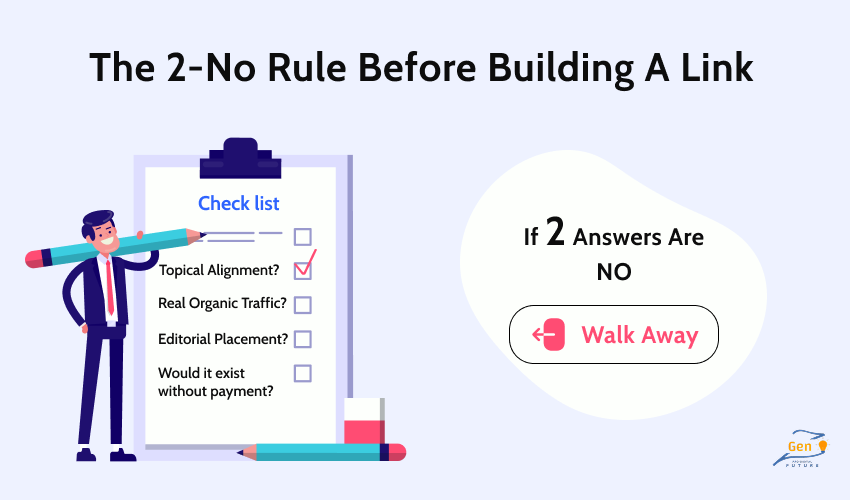
Before your team or agency acquires a new backlink, run it through this four-point diagnostic. If you hit two “No” answers, walk away—no matter how high the Domain Rating (DR) is. Execution matters. Follow these technical requirements:
Topical Alignment: Does the referring site exist within your “Semantic Neighborhood”? (e.g., A cloud security blog linking to a VPN provider).
Verified Organic Traffic: Use a tool like Semrush or Ahrefs to verify the site has at least 1,000+ monthly organic visits. If a site has “high authority” but zero traffic, it’s a PBN.
Editorial Placement: Is the link woven into the body of a high-quality article, or is it isolated in a “Resources” footer or a “Sponsored” block?
The “Non-Commercial” Test: Would this link exist if no money changed hands? If the answer is a hard “No,” Google’s Pattern Recognition will eventually find it.
Experience Insight: The “Zero-Traffic” Purge
In early 2026, we saw a massive “de-indexing wave” targeting sites with high DR but stagnant organic traffic. We audited a client who had 200+ links from such sites. By stopping their $5,000/month “Guest Post” retainer and shifting that budget into Original Research & Data Studies, we earned 12 links from major news outlets.
The Result: Those 12 “earned” links drove more ranking growth than the previous 200 “bought” links combined. In 2026, quality is the only scale that matters.
You Should transition from a defensive “Cleanup” mindset to an offensive “Authority” mindset. By filtering your acquisition at the source, you ensure your next audit is a victory lap rather than a rescue mission.
If 2 answers are “no,” don’t build it.
Step 10: Implement the 30-Day Monitoring Protocol
In the fast-moving landscape of 2026, an audit isn’t a “one-and-done” event-it’s a maintenance cycle.
With Google’s Real-Time Spam Filters now processing link data faster than ever, waiting six months to check your profile is an invitation for a ranking disaster.
The “Active Defense” Schedule
You must transition from reactive auditing to a proactive monitoring protocol. This ensures that negative SEO attacks or “vendor link rot” (where paid links are deleted or turn toxic) are caught before they impact your bottom line.
Here’s how to execute this correctly in 2026:
Monthly Pulse Checks: Dedicate 30 minutes on the first of every month to review:
-
Anchor Text Velocity: Is your “commercial” anchor percentage creeping up?
New Referring Domains: Check the top 20 new sites. Do they pass the Step 9 quality filter?
Link Velocity Spikes: Did you suddenly gain 200 links while you were on vacation? Investigate for bot-driven spam.
Quarterly Deep Dives: Every 90 days, run a full Contextual Integrity Review (Step 2). This is where you look at the big picture: Is your site still being seen as an authority in its specific niche, or is the “semantic noise” starting to drown out your expertise?
Real-Time Alerts: Set up automated email alerts in tools like Ahrefs or SE Ranking for “New Backlinks” and “Lost Backlinks.”
Experience Insight: The Cost of Procrastination
In late 2025, we took on a client who hadn’t checked their links in a year. We discovered they were in the middle of a Negative SEO attack, someone had blasted their “Pricing” page with thousands of “Adult” and “Pharma” anchors. Because they weren’t monitoring monthly, the damage was already done; Google had de-indexed their most profitable page.
A consistent 30-day review cycle would have flagged the spike early, creating an opportunity to disavow the root domains before de-indexing occurred.
You should stop “surviving” Google updates and start predicting them. By the time the next core update rolls around, your profile is already lean, relevant, and mathematically “safe.”
This is how you audit your backlinks in 2026 proactively, not reactively.
If you are unsure whether your link profile would survive the next update, Genzpro Marketing Services provides advanced forensic backlink audits as a specialised SEO agency, helping brands protect and future-proof their rankings in the evolving 2026 algorithm landscape.

