

Choosing to hire an SEO agency is a “fork in the road” moment for your business. If Done right, it’s the engine that drives predictable, compounding growth, and if done wrong, it’s a black hole for your marketing budget and a potential risk to your domain’s reputation.
I’ve spent years navigating the search landscape, both on the agency side and as an SEO consultant, and I have seen the same pattern repeat, businesses often hire based on a “gut feeling” or a flashy pitch deck rather than a proven framework for performance.
The Reality of the Search Market
The barrier to entry for calling yourself an “SEO expert” is dangerously low. Today, anyone with a subscription to a keyword tool can claim they’ll get you to page one. That doesn’t automatically make them a qualified SEO company capable of driving revenue.
However, true SEO isn’t about chasing vanity metrics, it’s about aligning technical health, content authority, and conversion optimization to drive actual revenue.
If you’re still hearing agencies promise guaranteed rankings, read our breakdown on why #1 ranking guarantees are impossible in 2026 before moving forward.
In this guide, I’ll show you:
The one rule that filters out 80% of bad agencies instantly
The exact evaluation framework we use before onboarding any client
The red flags that signal future ranking penalties
And a step-by-step system you can execute before signing any SEO contract
By the end, you won’t just know how do I hire SEO agencies you will know how to hire the right one with measurable proof behind their strategy.
Before You Hire, You Must “Audit” Your Own Knowledge
The most expensive mistake you can make when looking to hire an SEO agency is entering the room as a “blank slate.” When you don’t understand the basic mechanics of how search works, you become the perfect target for agencies that sell “mystery” instead of “mastery.”
I have consulted for dozens of founders who signed five-figure monthly retainers only to realize six months later they were paying for “proprietary secrets” that were actually just basic, automated reports. To protect your investment, you need to be an informed buyer.
The “Knowledge Minimum”: What You Need to Know
You don’t need to be an expert, but you must understand the three pillars of SEO to hold an agency accountable.
Even the best SEO expert will respect an informed client who understands these fundamentals.
Technical SEO: Is your site easy for Google to “read”?
On-Page/Content: Does your site provide the best answer to a user’s question?
Off-Page/Authority: Do other reputable sites trust you enough to link back to you?
Why Education is Your Best Defense
By spending just two hours learning the difference between white-hat (sustainable) and black-hat (risky) tactics, you can change the power dynamic of the sales call.
Coming straight from expert insights a reputable agency like us will actually prefer an educated client. Why? Because an educated client understands that SEO is a marathon, not a sprint, and won’t demand “Rank #1 for by next week after hiring an SEO Company.”
2. The One Rule That Eliminates 80% of Bad SEO Agencies Instantly
Most businesses hire an SEO agency because they want more traffic. That is a mistake. You don’t want traffic; you want qualified leads and sales.
I’ve audited dozens of accounts where the previous agency boasted about a “200% increase in organic sessions.” On the surface, it looked like a win. However, once we dug into the data, 90% of that traffic was hitting a single blog post about a topic completely unrelated to the client’s core product. The “growth” was a ghost.
The one rule that will instantly eliminate 80% of mediocre agencies is about the Demand they explain the bridge between a keyword and your bank account.
If you want to see how unethical agencies quietly drain budgets, read our guide on 5 illegal ways to bleed your money by not choosing the right SEO agency (2026).
The “Reverse-Engineering” Test
During your pitch meeting, don’t just look at their past results. Ask them to perform a live “Growth Modelling” exercise for your specific business. If they can’t do the following three things, they are a “traffic” shop, not a “growth” partner:
Map Keyword Intent to the Funnel: They should be able to distinguish between Informational keywords (someone looking for a definition) and Transactional keywords (someone ready to buy). A high-volume “What is…” keyword is useless if it doesn’t eventually lead to a “Best [Your Product] for…” search.
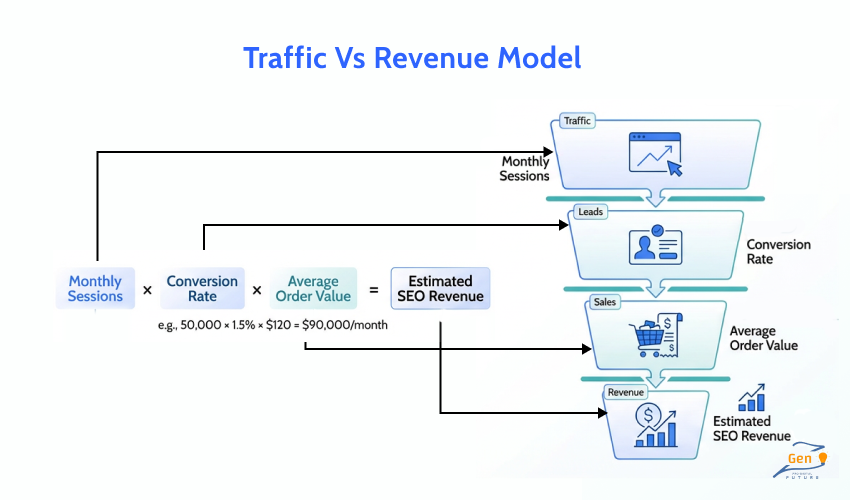
The Formula for Success: Ask them to estimate the value of the traffic they plan to bring in. A professional agency should be comfortable using a basic conversion model to justify their fee:
$$\text{Monthly Sessions} \times \text{Conversion Rate (\%)} \times \text{Average Order Value (AOV)} = \text{Estimated SEO Revenue}$$
The 12-Month Roadmap Requirement: Never sign a contract without seeing a roadmap. It shouldn’t just say “Content Creation.” It should specify:
-
Months 1-3: Technical foundations and “low-hanging fruit” (quick wins).
Months 4-8: Competitive content gap analysis and authority building.
Months 9-12: Scaling and conversion rate optimization (CRO) to maximize the new traffic.
The “Traffic vs. Pipeline” Audit
In a recent audit for a B2B SaaS client, I found their previous agency had secured them #1 rankings for several high-volume terms. However, the bounce rate was 95%. Why? Because the agency was targeting broad terms to pad their reports, but the visitors weren’t the right fit. By shifting the strategy to lower-volume, “high-intent” keywords, we decreased total traffic by 10% but increased qualified leads by 40% in just 90 days.
We Learned a lesson from this which says An agency that focuses on “eyeballs” is easy to find. An agency that focuses on “wallets” is the one you hire.
3. Demand a Strategy Before You Sign (Not a Package)
The fastest way to waste your budget when you hire an SEO agency is to sign up for a “standardized package.” If an agency tells you that you need “10 backlinks and 4 blog posts a month” before they’ve even looked at your Search Console, they aren’t selling growth; they are selling a commodity.
These templated SEO packages often ignore your actual competitive landscape.
Modern SEO isn’t a checklist; it’s a sophisticated response to Google’s evolving algorithms. If an agency pushes rigid SEO packages without auditing your site, that’s a warning sign.
Systems like RankBrain and the Helpful Content System now prioritize intent satisfaction over simple keyword density. A generic package ignores the specific gaps in your unique digital ecosystem.
The Executable Strategic Framework
A high-tier agency follows a diagnostic sequence before prescribing a solution. A mature SEO firm always diagnoses before prescribing.This is the workflow you should demand:
Technical Audit: Identifying “indexation bloat” or crawl errors that prevent Google from seeing your best pages.
Intent Mapping: Aligning your existing pages with the specific stage of the buyer’s journey (Awareness vs. Decision).
Competitor Gap Analysis: Finding the specific keywords your competitors rank for that you have ignored.
Content Architecture: Organizing your site into “Topic Clusters” to build topical authority, rather than publishing random blog posts.
The Power of Architecture Over Volume
We recently audited a client who was paying for 8 blog posts a month but saw zero lead growth. By pausing their “package” and instead restructuring their content architecture—grouping existing posts under a single authoritative “Pillar Page”—we saw a 40% increase in qualified demo requests in 60 days. We didn’t write more content; we made the existing content more navigable for both users and Google.That’s what strategic SEO services look like in practice.
4. How to Audit an SEO Agency’s Past Results (Without Falling for Vanity Metrics)
The “Case Study” is the most manipulated document in a pitch deck. When you hire an SEO agency, they will naturally show you a graph where the line goes “up and to the right.” However, a surge in total impressions is meaningless if that traffic is coming from a viral, non-commercial blog post or a sudden spike in branded searches you already owned.
If you’ve ever felt SEO might be a scam because of tactics like these, this article will change your perspective: You think SEO services are a scam (Yes unless you read this).
To truly vet an agency’s expertise, you must look for ranking stability and intent-driven growth. A “lucky” agency can ride a trend; a professional agency can weather a Google Core Update.
The Executable “Bullshit-Detector” Checklist
During the interview, move past the PowerPoint slides and ask for these specific data points. If they hesitate to show “under the hood” data (anonymized for privacy), they likely don’t have the depth they claim.
Demand Search Console Screenshots: Ask for a 12-month view of “Performance” that is filtered to exclude the company’s brand name. This shows you their ability to capture new customers, not just existing ones.
Ask for Segmented Traffic: Request a “before and after” that separates Informational traffic (blog readers) from Transactional traffic (buyers). You want to see growth in the latter.
The “Post-Update” Stress Test: Ask them to show a client’s performance during a major Google Core Update (like the March 2024 Core Update). Did they crash? If they did, how did they recover?
You can review how Google defines these updates in their official Core Update documentation.
Experience Means Handling Volatility
As an SEO consultant, I’ve seen both explosive growth and sudden crashes.
I once consulted for a brand that lost 60% of its traffic overnight due to a “Helpful Content” penalty triggered by the previous agency’s use of mass-produced AI content. We didn’t fix it by adding more keywords; we fixed it by pruning 400 low-quality pages and manualizing their “Expertise, Authoritativeness, and Trustworthiness” (E-A-T).These principles are outlined in Google’s Quality Rater Guidelines.
The proof of a great agency isn’t just their wins—it’s how they’ve handled a crisis. If an agency claims they have “never lost traffic during an update,” they are either lying or haven’t been in the game long enough.
5. Red Flags That Signal Future Ranking Penalties
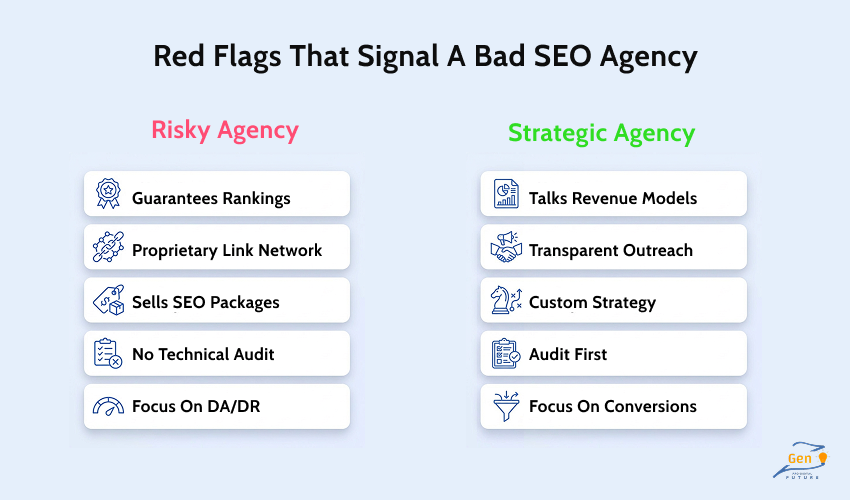
When you hire an SEO agency, the most dangerous thing they can offer you isn’t “bad results”, it’s a “ticking time bomb.” The wrong SEO firm can leave long-term damage.
In my career, I’ve spent more time performing “SEO surgery” on penalized sites than I have building new ones from scratch.
Google’s Spam Updates have become incredibly sophisticated at identifying artificial patterns. If an agency uses shortcuts today, you’ll be the one paying the “recovery bill” eighteen months from now when your organic traffic drops to zero overnight.
The “Walk Away” Red Flag List
If you hear any of the following during a pitch, it is a signal that the agency is using outdated, high-risk tactics that prioritize short-term “pops” over long-term stability:
“We Guarantee Rankings”:No credible SEO company guarantees positions. No one owns Google. Not even Google’s own engineers can guarantee a specific rank for a specific keyword due to the thousands of variables in the algorithm.
“Our Proprietary Backlink Network”: Any SEO firm relying on owned networks is taking a massive risk.This is code for a Private Blog Network (PBN). Google’s link-spam AI (SpamBrain) is designed specifically to find and devalue these. If they own the sites they are linking from, you are one update away from a manual penalty.
“We Focus on DA/DR Metrics Only”: Domain Authority (DA) and Domain Rating (DR) are third-party metrics from tools like Moz or Ahrefs; Google does not use them. An agency that obsesses over moving a third-party needle instead of your actual revenue is redirecting your focus.
No Technical Audit Mentioned: If they want to start “writing content” before checking your site’s crawlability, they are building a house on a cracked foundation.If an SEO company skips this step, walk away.
Thin Content Strategy: If their plan is “500-word SEO articles,” they haven’t read a Google update log since 2015. Google rewards content depth and unique information gain, not word count.
The Reality of “Cleaning Up” the Mess
I recently worked with an e-commerce brand that hired a “budget” agency promising fast results through a “proprietary link strategy.” They saw a 30% jump in three months, followed by a 90% collapse during a Spam Update.
We had to manually audit 2,000 toxic backlinks and submit a disavow file to Google—a process that took six months just to get back to their original baseline.
Expert Advice: If an agency’s tactics sound like a “hack” or a “secret,” they are likely violating Google’s Search Essentials. True SEO is transparent, documented, and based on merit, not trickery.These practices directly violate Google’s official Search Essentials guidelines.
And before you trust any link-building strategy, make sure you understand How to audit your backlinks in 2026 (before Google penalises you).
6. The Step-by-Step System to Hire the Right SEO Agency
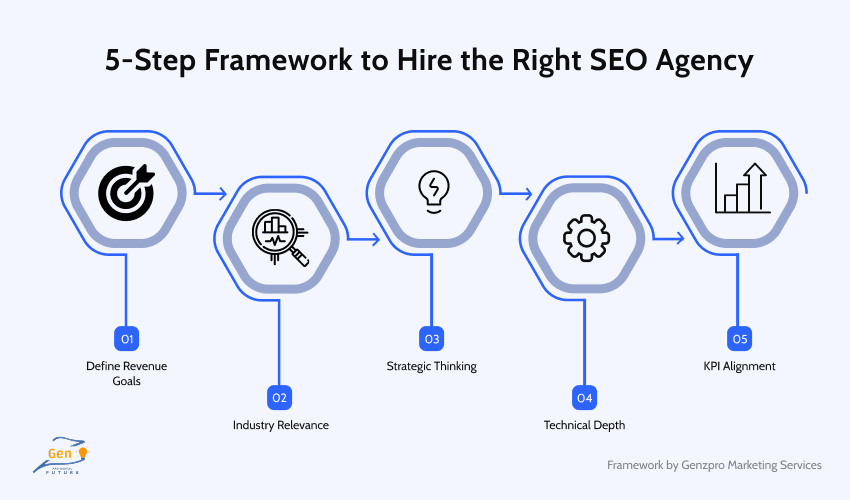
Choosing to hire an SEO agency shouldn’t feel like a gamble. If you follow a repeatable, objective framework, you remove the “sales magic” from the equation and replace it with data-driven vetting. This is the exact system I recommend to CMOs and founders to ensure they find a partner, not just a vendor.
Step 1: Define Your Business Objective (Revenue > Rankings)
Before you even open Google to search for an agency, define what success looks like in dollars, not just clicks. Are you looking to decrease your Customer Acquisition Cost (CAC)? Are you trying to shorten a long B2B sales cycle with educational content?
Action: Write down your target “Cost Per Lead” (CPL) and share it during the first call. A top-tier agency will immediately start calculating if SEO can realistically hit that target.
Step 2: Filter Based on Industry Relevance
SEO for a local plumber is vastly different from SEO for a global Enterprise SaaS or a high-SKU E-commerce store.
Ask for a case study specifically in your niche or a “neighboring” industry with similar buyer behavior. If they only have experience in “easy” niches but you are in a “high-competition” space like Finance or Health (YMYL—Your Money Your Life), their tactics may not scale.
Step 3: Evaluate Their Strategic Thinking
Give the agency a “Scenario Test.” Ask: “If our main competitor doubles their content output next month, how does your strategy pivot?”
Look for an answer that mentions Content Gap Analysis and Information Gain. If they just say “We’ll write more,” they lack the strategic depth to keep you ahead of the curve.
Step 4: Review Technical Depth
SEO is increasingly a technical discipline. An agency without a dedicated technical lead is just a content house.
Ask how they handle Core Web Vitals and JavaScript rendering. If their eyes glaze over, they won’t be able to fix the underlying “plumbing” issues that often prevent even the best content from ranking.
Step 5: Align KPIs Before Signing
The contract should explicitly state how performance is measured. Avoid “Ranking Reports” as the primary KPI. Instead, insist on:
Organic Conversions: (Leads, Sales, or Sign-ups).
Assisted Conversions: How SEO traffic contributes to other channels.
Share of Voice (SoV): Your visibility compared to top competitors for “money” keywords.
Experience-Backed Final Thought
In my years of auditing agencies, the best partnerships are built on transparency. The right SEO Company will tell you “No” when you ask for a “quick fix” and will be the first to flag when a strategy isn’t yielding the expected ROI so you can pivot together.
7.Real-World Scenarios: Which Agency Do You Actually Need?
SEO is not one-size-fits-all. The agency that helps a local bakery won’t have the technical infrastructure to support a global SaaS platform. To hire an SEO agency effectively, you must identify which “growth phase” you are in.
Here are three common scenarios I encounter, along with the specific executable strategy for each.
Scenario A: The Lean Startup (Limited Budget)
You have a great product but low brand authority. You need to build a foundation without the five-figure monthly retainer.
The Agency to Hire: A boutique agency or specialized consultant that focuses on “Content-Led SEO.” They should prioritize high-intent, low-competition keywords where you can win quickly.
What to Avoid: Large “full-service” agencies where you’ll be assigned a junior account manager. You need a senior strategist who can make every dollar count.
Key KPIs: Organic traffic to key landing pages and “Information Gain” (how unique your content is compared to competitors).
Scenario B: The Established Business (Stagnant Traffic)
You’ve had SEO success in the past, but your traffic has plateaued for 12+ months. Competitors are starting to chip away at your rankings.
The Agency to Hire: A Technical & Analytical SEO agency. At this stage, your problem is likely “Technical Debt” or “Content Decay.” You need an agency that can perform deep audits and “Content Pruning.”
What to Avoid: Agencies that suggest “more blog posts” as the only solution. You likely have enough content; you just need to optimize its structure.
Key KPIs: Share of Voice (SoV) in your industry and conversion rate improvements on existing high-traffic pages.
Scenario C: The “Burned” Business (Recovering from a Bad Move)
You recently fired an agency that used “black-hat” tactics, or you’ve seen a 50% traffic drop after a Google Core Update. You are skeptical and defensive.
The Agency to Hire: An SEO Recovery Specialist. You need a partner who leads with transparency, provides weekly updates, and starts with a “Link Toxicity Audit” and a “Manual Action” check.
What to Avoid: Anyone promising a “fast recovery.” Recovery takes 3–6 months of consistent, clean work to signal to Google that the “site is under new management.”
Key KPIs: Reduction in toxic backlinks and a steady, week-over-week recovery in non-branded search impressions.
As an SEO Expert we once took over an account for a retail brand that had been “burned” by a low-cost link-building package. We didn’t build a single new link for four months. Instead, we disavowed 1,200 spammy domains and fixed their internal linking. Their traffic returned to 80% of its peak before we even started “new” SEO efforts.
8. The Safety Net: Pre-Contract Checklist
Before you officially hire an SEO agency and sign on the dotted line, you need to protect your business from “contract lock-in.” I have seen too many companies stuck in 12-month agreements with agencies that went “silent” after the second month.
Think of this checklist as your final filter. If an agency hesitates at any of these points, it’s a sign that their internal processes or their results won’t meet your expectations.
The “Bulletproof” Signing Checklist
| Requirement | Why It’s Non-Negotiable |
| Written 6-Month Roadmap | You need to know exactly what is being built. “SEO Activity” is not a strategy; “Technical Audit in Month 1, Content Gap Analysis in Month 2” is. |
| Defined Revenue-Linked KPIs | Move beyond just “rankings.” Ensure the contract clearly mentions Organic Conversions or Qualified Lead Growth as primary success metrics. |
| Clear Reporting Structure | Will you receive a generic PDF or a live Looker Studio dashboard? Demand a monthly walkthrough call to understand why the numbers changed, not just what changed. |
| No Ranking Guarantees | Google’s algorithm is a “black box.” Any agency guaranteeing a #1 spot is likely using high-risk tactics that could trigger penalties later. |
| 90-Day Exit Clause | SEO takes time, but you shouldn’t feel locked in. A 30- or 90-day exit clause keeps the agency accountable and performance-focused. |
| Total Asset Ownership | This is critical. The contract must state that you own all content, researched keywords, and acquired links. Some agencies remove assets if you stop paying. |
A Note on “Ownership”
We once stepped in to help a client who was leaving a low-cost agency. They discovered that the agency had built their website on a “proprietary platform” and refused to hand over the login credentials or the content they had paid for. We had to rebuild their entire digital presence from scratch.
You must own your Google Search Console, your Google Analytics, and every word of content produced. The agency should have access to your house, but you must keep the keys.
Final Verdict: Hire for the Long Game
SEO is the only marketing channel that offers compounding returns. Unlike paid ads, which stop the moment you stop paying, a well-executed SEO strategy continues to drive traffic years later. By following this framework, you aren’t just hiring a service provider; you are investing in a long-term digital asset.
9. Authority Close: Why Most Businesses Fail at Hiring SEO Help
Most businesses don’t fail at SEO because they lack the budget; they fail because they lack an evaluation framework. They treat the decision to hire an SEO agency like buying a commodity like office supplies or a software subscription rather than hiring a high-level strategic partner.
When you hire based on the lowest bid or the smoothest sales pitch, you aren’t just risking your monthly retainer. You are risking your “digital real estate.” A single year of bad SEO can take three years to undo.
SEO is Your Highest-Leverage Asset
If structured properly, SEO is the only marketing channel that provides compounding interest. While your competitors are stuck on the “paid ads treadmill” where the leads stop the moment the budget runs out a revenue-focused SEO strategy builds an evergreen lead-generation machine that works 24/7.
Why My Methodology Works
I don’t look at SEO through the lens of “tricking” an algorithm. Having spent years navigating high-stakes search environments, I’ve learned that sustainability is the only true path to ROI. My approach is built on three non-negotiable pillars:
Algorithm Volatility Resilience: I’ve steered brands through every major Google update of the last decade, from Penguin and Panda to the recent Helpful Content Updates. I build sites that Google wants to rank because they provide genuine value.
The Recovery Mindset: I’ve managed high-pressure recovery cases for businesses that lost 80% of their revenue due to “cheap” SEO. That experience has made me hyper-vigilant about risk management.
Revenue as the Only KPI: I don’t care about “Ranking #1” if that rank doesn’t result in a conversion. Every keyword we target and every link we build must serve your bottom line.
Choosing the right agency is about moving from “hope-based marketing” to a predictable growth engine. You now have the checklist, the red flags, and the strategic framework to make an informed, confident hire.
Ready to build a search strategy that actually drives revenue? it’s time to make a strategic move.Partner with Genzpro Marketing Services to build the long-term, algorithm-safe SEO systems that turn search visibility into measurable growth.

