

Organic search remains one of the most effective ways to generate traffic in today’s digital landscape. You may not know, but more than 75% of users never click beyond the first page of search results, and only 43% believe they find what they are looking for. So, every business that wishes to be seen and outshine its competition must use SEO. Partnering with a b2b seo agency in Dubai can be a strategic move for companies looking to dominate their niche in a competitive market. If you want to take your business online, be truly present, and find ways to achieve sustainable growth, this is the only blog that will show you the importance of SEO. It is like the secret ingredient that can help your brand not just to exist online, but to live there.
SEO: A Holistic Strategy Beyond Keywords
Most often, SEO is seen as simply inserting a few keywords into whatever content is available on your website. Although keyword optimization is one of the basic tasks of SEO, it’s not the true potential of SEO. Being a modern SEO is a wide range of various things that each plays their role to make a website appear in a superior manner. The main goal is to create a website that satisfies both the user and the search engine by aligning it with search engine algorithms.
Content Quality and User Engagement
SEO is dependent on high-quality, relevant content. 77% of new buyers and consumers read blog posts regularly, highlighting the importance of having engaging content. Additionally, 84% of consumers would buy a product after watching a marketing video, showing that various content formats impact user engagement.
Technical SEO: Enhancing Website Performance
Technical SEO makes use of the aspects of website structure to comply with what a search engine requires. Key elements include:
-
Site Speed: The direct impact of site speed on conversion rates is evident, as websites that load in 2 seconds experience a 9% higher conversion rate than those that take longer to load.
-
Mobile Optimization: Since 87% of Americans use more than one device, it is imperative for your online business or blog to be mobile optimized.
Secure Connections (HTTPS): One crucial aspect for securing your website is to ensure that the website uses HTTPS to protect user data and build trust, which can positively influence SEO rankings.
Off-Page SEO and Link Building
Off-page SEO involves building a website’s authority through external methods, such as link building. The high-quality backlinks are obtained from reputable websites, which give authority and ranking to your site. SEO advertising converts at a rate of 2.4%, compared to 1.3% for PPC.
Real-world SEO Success Stories
1. MedPark Hospital: Leveraging Multilingual SEO to Expand Global Reach
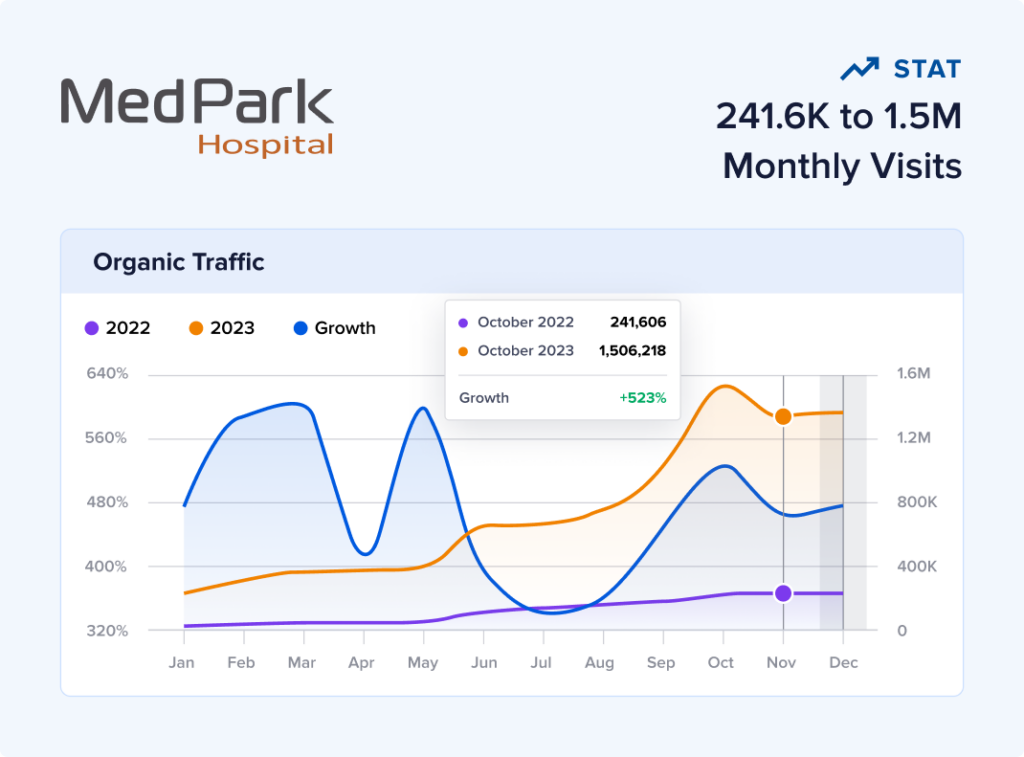
Image source: https://aioseo.com/wp-content/uploads/2024/02/med-park-seo-case-study-1024×757.png
Industry: Medical
MedPark Hospital is a leading private healthcare provider in Bangkok, Thailand, and this has sparked the need to expand its reach within the country and further afield. MedPark in Thailand turned into a global hub for medical, and although they wanted to draw local Thai patients, they also wished to be a leading medical hub for international medical tourists from countries such as the United States and the United Kingdom.
SEO Challenge:
The medical industry is highly competitive, and there are several hospitals competing to attract international patients. The challenge of MedPark was to speak to both the locals in Thailand and medical tourists overseas. Adapting that content to these different patient groups was not simply a matter of translating the content from one language to another. Further, medical tourists may exploit highly specialised treatments, which avoid cities and also healthcare facilities, but both conditions are needed to obtain the desired sort of medical treatment.
Solution and Growth:
In SEO, MedPark’s content aimed to be in tune with the requirements of the Thai and foreign communities. This included building thousands of Thai and English pages to target both local and global audiences. For this, the hospital was able to serve relevant content in both languages and allow the search and find detailed, localized information about the hospital and what it has to offer in the English language.
Using hreflang tags was a key part of how 1088 structured their strategy and was used to tell search engines which language or regional variation of a webpage to display to users depending on where they’re located or if they have a specific language preference. MedPark correctly used these tags to ensure their website delivered the appropriate page to the right audience, preventing content duplication and improving the hospital’s rankings in both local and international search results.
Impact:
The efforts of MedPark’s SEO paid off in spades. The hospital’s keyword rankings and traffic skyrocketed year over year from Thailand. Further, the hospital also progressed into the international markets as its rankings concerning U.S.-based keywords went from almost none to ranking for more than 206,000 keywords. This allowed MedPark to grow its local presence and establish itself as a global name in medical. In just one month, organic visits to MedPark’s English language pages surged past a quarter of a million, demonstrating the effectiveness of their multilingual SEO strategy.
Key Takeaways:
If you are trying to target multiple audiences, whether it’s from various regions, the best thing you can do is make scrupulous content that resonates with each of them. The hospital also benefits from best reaching Thai and international patients by providing content in both Thai and English, in MedPark’s case. Also, if you use hreflang tags properly, it makes sure that your content is showing up to the right audience and thus avoids your site being penalised for duplicate content. Think of structuring your content around the customer journey, like finding out what information your audience is looking for at each stage in the customer journey to help them arrive at the solution you provide, and thus, you attract local as well as global traffic.
2. Transit: Scaling Content Production to Capture Local Search Traffic
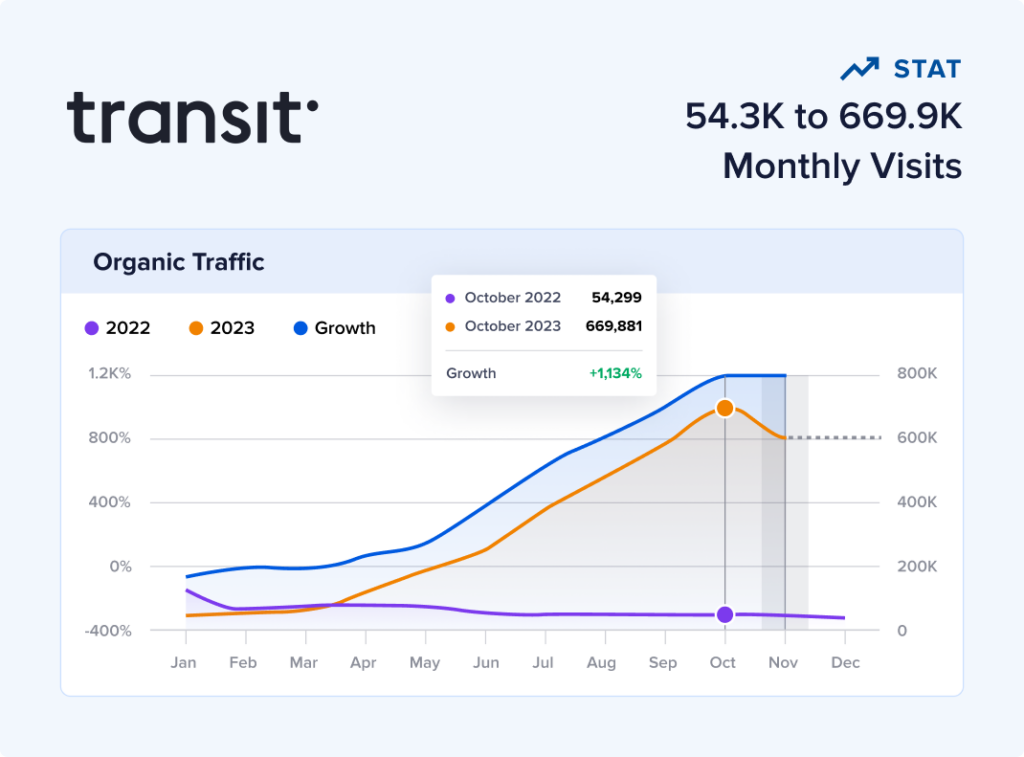
Image source:https://aioseo.com/wp-content/uploads/2024/02/transit-seo-case-study-1024×757.png
Industry: Mobile App
Transit is real-time public transportation information shared with over 300 cities worldwide. Though extremely popular on Android (over ten million downloads) and Apple’s App Store, Transit faced an SEO challenge in that its website had limited pages (less than 300), which meant it could not rank for a wide set of relevant queries. The app itself had already been downloaded more or less successfully, however, the app missed out on a major opportunity to win organic search traffic by neglecting to focus on long-tail keywords around public transportation in different cities.
SEO Challenge:
Given that Transit didn’t have a lot of content to speak of and so few pages of content, it couldn’t rank for the specific, location-based queries that its targeted users were searching for. An example is that people will search for the bus routes or subway system in a given city. Transit lacked enough content to equip all these specific headings with unique content, and so it had been invisible to search engines, unable to get new users from organic search traffic.
Solution and Growth:
In 2023, Transit adopted a programmatic SEO strategy to scale its content portfolio. As an example of a widely useful application for programmatic SEO, our website Transit.com has a great need for content on many topics, created in many languages, all over the world. This was one of the ways Transit built tens of thousands of highly specific landing pages for specific bus routes, subway lines and transportation options in cities all worldwide.
This was nothing short of a revolution. Content portfolio of Transit grew from under 300 pages to more than 10,000 to 21,000 pages. This meant that traffic to the app went into the thousands, and organic traffic and user interaction also significantly increased. Transit saw a 1344% year-over-year growth in organic traffic.
Impact:
The additional content gave Transit the ability to dominate search results for very specific local queries and drove a massive increase in user acquisition via the organic channels. Transit’s app with its highly localized content became the go-to source of transit information for the cities it serves. Finally, the increase in traffic resulted in higher app downloads and engagement, and had a more overall stronger presence in the mobile app and web search spaces.
Key Takeaways:
To attract more targeted traffic and capture a wider range of keywords, you need to build a large content portfolio that covers a broader scope of online searches. For Transit, programmatic SEO was the ability to create thousands of pages targeting very specific long-tail keywords. As a result, they were able to capture search traffic from people searching for localised transit information. When you accomplish scaling content production through automation, you can increase outreach and rank for an even broader set of keywords, which gives you more traffic towards your site.
3. Iowa Girl Eats: Dominating the Food Blog Space with Recipe and Image SEO
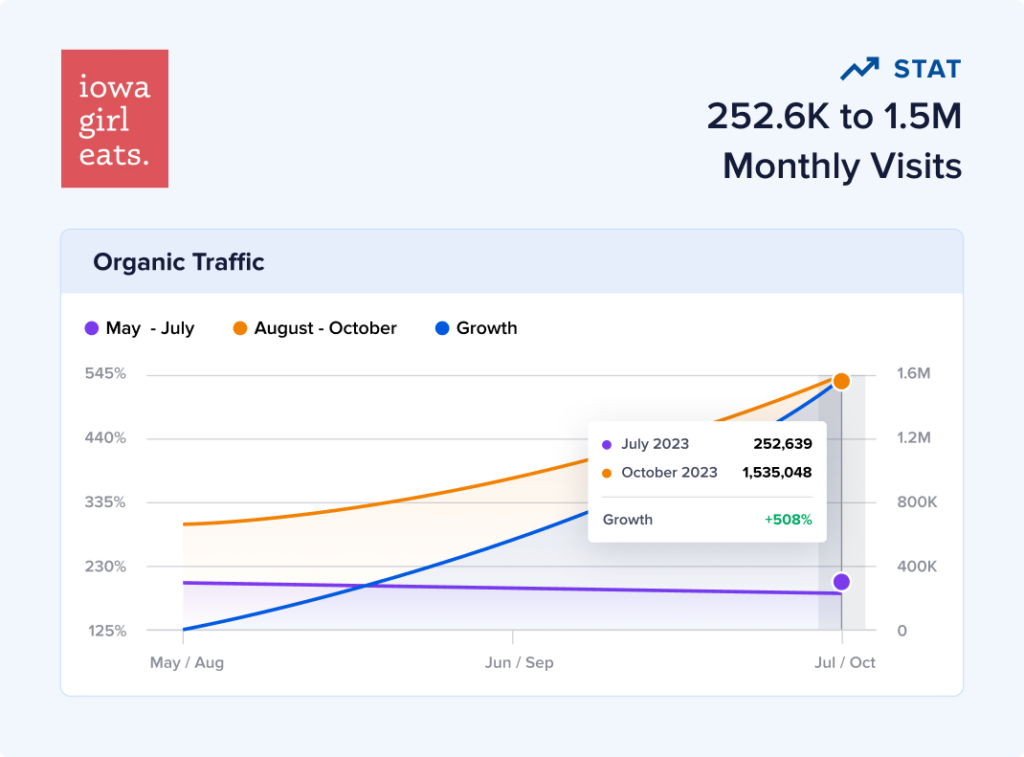
Image source: https://aioseo.com/wp-content/uploads/2024/02/iowa-girl-eats-seo-case-study-1024×757.png
Industry: Food Blogging
Iowa Girl Eats is deemed as Kristin Porter’s gluten-free food blog that provides diet-restricted people with recipes, tips, etc. But despite making good quality content, Kristin found that she was competing with millions of other bloggers and desperately trying to rank for the same or similar keywords in the food blogging space. Specifically, she knows that food blogs are fighting in text-based results alone, somehow, and must make a play for visibility in Google’s image and recipe tools.
SEO Challenge:
Standing out in Google’s search results was a major problem (the food blogging market is already crowded), and they have to compete with numerous big brands. Kristin’s recipes must come up in the main results, but importantly also in the recipe carousel, which shows rich snippets (and is well known) at the top of the page. It was also critical to optimize her photos for Google Image Search since food blogs are usually driven by appealing images to draw readers.
Solution and Growth:
To overcome these challenges, Kristin adopted a multifaceted approach to SEO. To help her recipes show up in the rich snippets, she added recipe schema markup to her blog posts (structured data to her recipes that helps them show up in Google’s rich snippets and recipe carousel). This meant she was far more visible in the search results for specific recipes that users are searching for. She also optimised her food images so that they would rank well in Google Image Search and enhance the odds of them showing up in the search results when people looking for recipes to eat would carry out a search.
Within only three months, Kristin managed to grow her organic traffic by 508%. She was regularly featured on the Google recipe carousel, and her images were very well ranked in Google Image search, helping drive more clicks and more visibility overall.
Impact:
By using structured data and image optimization, Kristin significantly increased the visibility of her blog in search results. In addition, her gluten-free recipes started to become more discoverable and were more engaging. This caused the organic traffic to Iowa Girl Eats to skyrocket, resulting in more page views, increased engagement and the ultimate success in her business.
Key Takeaways:
When competing in a highly saturated space, it’s not enough to optimize just your text-based content; you also need to optimize your images and structured data. Using recipe schema markup to help index her recipes alongside them and image optimization to rank in Google Image search was beneficial to Kristin’s food blog, especially when she used recipe schema markup for her food blog, such as Iowa Girl Eats. Besides that, user-centric content that answers common questions like the ones in Google’s People Also Ask section also helps increase organic traffic. Structured data and image SEO can be a compelling order for getting PAID organically much easier; it’s all about being focused on that.
4. KrispCall: Scaling SaaS with Programmatic SEO
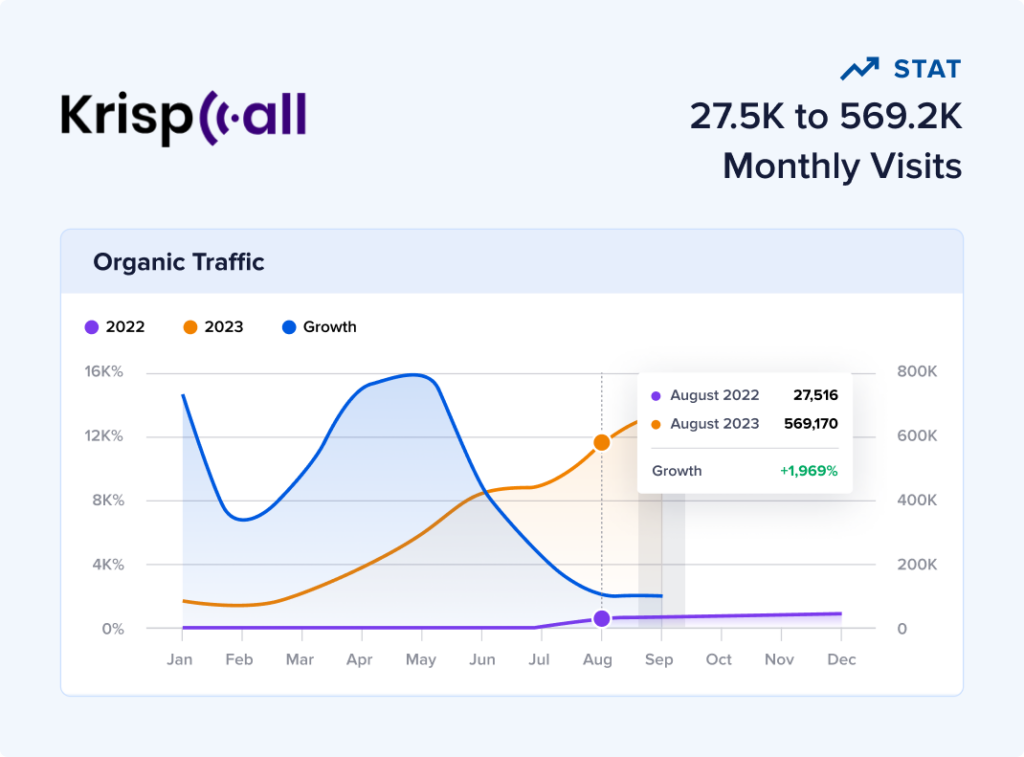
Image source: https://aioseo.com/wp-content/uploads/2024/02/krispcall-seo-case-study-1024×757.png
Industry: SaaS
KrispCall is a cloud-based virtual phone system that provides a host of communication entities, like virtual phone numbers and call centre software. Even though KrispCall, with its Singapore headquarters and an office in Australia, was a global player, it found itself struggling with SEO of growing online presence in the highly competitive SaaS and cloud communication space.
SEO Challenge:
The biggest problem that KrispCall faced was that they were unable to rank for a wide variety of keywords in various geo regions. KrispCall was one of the many SaaS companies serving customers around the world, but they had a very constrained ability to target and serve localized traffic because they had only a few hundred landing pages to help achieve those goals.
Solution and Growth:
KrispCall tackled this by developing programmatic SEO, a technique that builds a large number of landing pages targeting specific geographic and numeric niches, such as area codes. KrispCall could create landing pages for each U.S. area code (and some from other popular high-traffic countries) specifically targeted at highly specific search queries. By implementing this, KrispCall was able to come within reach of users who were searching for virtual phone services in certain regions.
The results were staggering: during the analysis period, 82% of the U.S. traffic came from area-specific landing pages driving KrispCall’s U.S. traffic. With this massive increase in visibility, both the traffic to the site and user engagement increased substantially.
Impact:
KrispCall was able to reach more localized audiences as it expanded its reach, all through the strategic application of programmatic SEO. A localized, high-volume SEO approach led to a 1,969% YoY growth of traffic, proving a great example of how the company grew.
Key Takeaways:
In a competitive, international environment, if you fail to target the suitability of your audience and match their search intent, then you will surely face failure. KrispCall achieved this by designing landing pages for the specific local areas using area codes on the search bars. KrispCall was able to much quicker and efficiently scale its content production by optimizing the page templates for programmatic SEO and subsequently achieving a massive traffic boost. It also granted the company rich snippets, as well as winning additional exposure from FAQ schema markup.
5. The Independent Pharmacy: Capitalizing on FAQs and Schema Markup
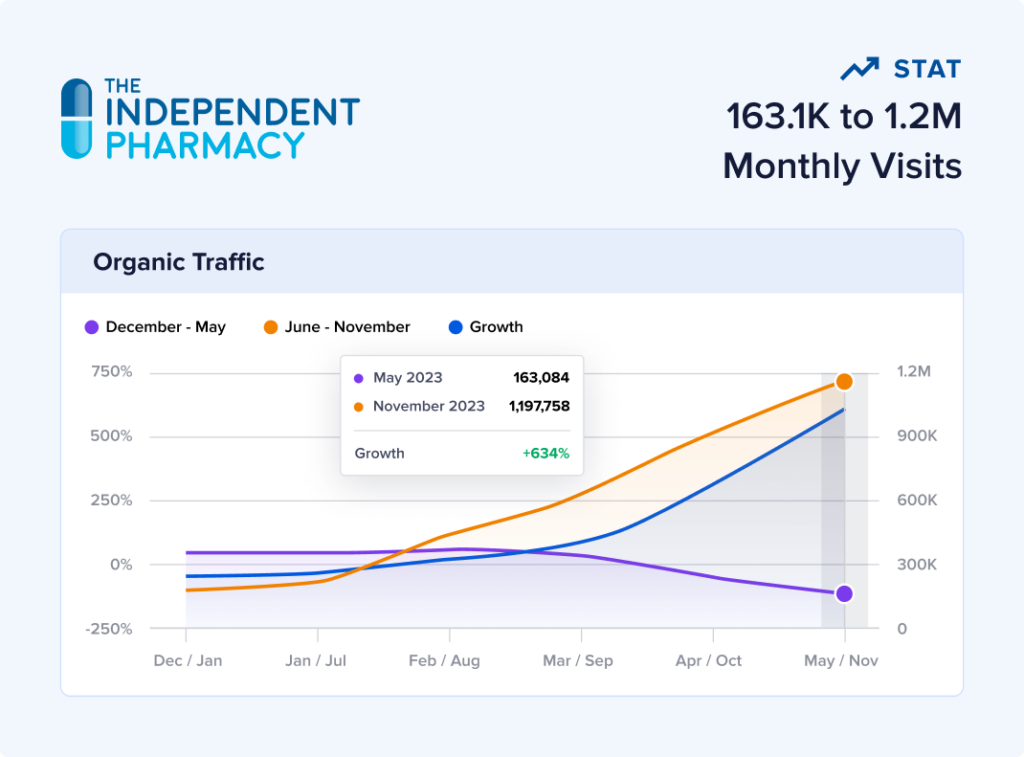
Image source: https://aioseo.com/wp-content/uploads/2024/02/independent-pharmacy-seo-case-study-1024×757.png
Industry: B2C (Online Pharmacy)
Independent pharmacy based in Bristol, UK, is offering a range of services, including medical consultation, advice on health and dispensing prescribed drugs to people who want to buy online. The pharmacy was launched in 2013, and quickly became one of the main players in the UK online pharmacy, but due to increasing competition with both big pharmaceutical corporations and nearby clinics, the borderline was essential for pharmacy needed to secure a leadership position in the UK segment of the online pharmacy.
SEO Challenge:
The biggest problem for The Independent Pharmacy was to increase visibility in a very competitive market. While offering a wide spectrum of services and having over 19,000 positive reviews, the pharmacy required its content to be more searchable on Google’s search engine results page (SERP), mostly for such competitive keywords as pharmaceutical and healthcare.
Solution and Growth:
A major method employed by The Independent Pharmacy was to popularize the FAQs almost everywhere on the landing pages. With the pharmacy incorporating commonly asked questions about each service or product into the pharmacy, it was able to target several other long-tail keywords that were being searched by users.
To increase the chances of the pharmacy’s list showing up in the People Also Ask (PAA) box on Google, the pharmacy began using FAQ schema markup on these pages. By allowing Google to understand the content better, and as such providing it with featured snippets, the site increased its visibility in search results.
Thus, the Independent Pharmacy increased organic traffic by 634% over six months and crossed 1 million monthly visits for the first time. They also improved their visibility on Google by picking up over 8,700 keyword rankings in the PAA box.
Impact:
The combination of too much FAQ optimization and their constant new releases of content, combined with structured data, really drove lots of organic traffic to the site. This helped the Independent Pharmacy maintain its leading position in the very competitive online pharmacy space, by consistently appearing in Google’s highly visible PAA snippets and gaining better overall rankings.
Key Takeaways:
If you want to enhance the visibility, then FAQs can be used to optimize for the People Also Ask (PAA) results. This strategy was so effective for The Independent Pharmacy that they were able to capitalize on PAA boxes and grab a lot of traffic from those results. Additionally, they could win rich snippets and did improve their visibility if they also implemented FAQ schema markup behind the scenes. Also important to staying current and staying ahead of the competition is regularly updating your content.
6. Hawthorn: Expanding Local SEO and eCommerce Presence
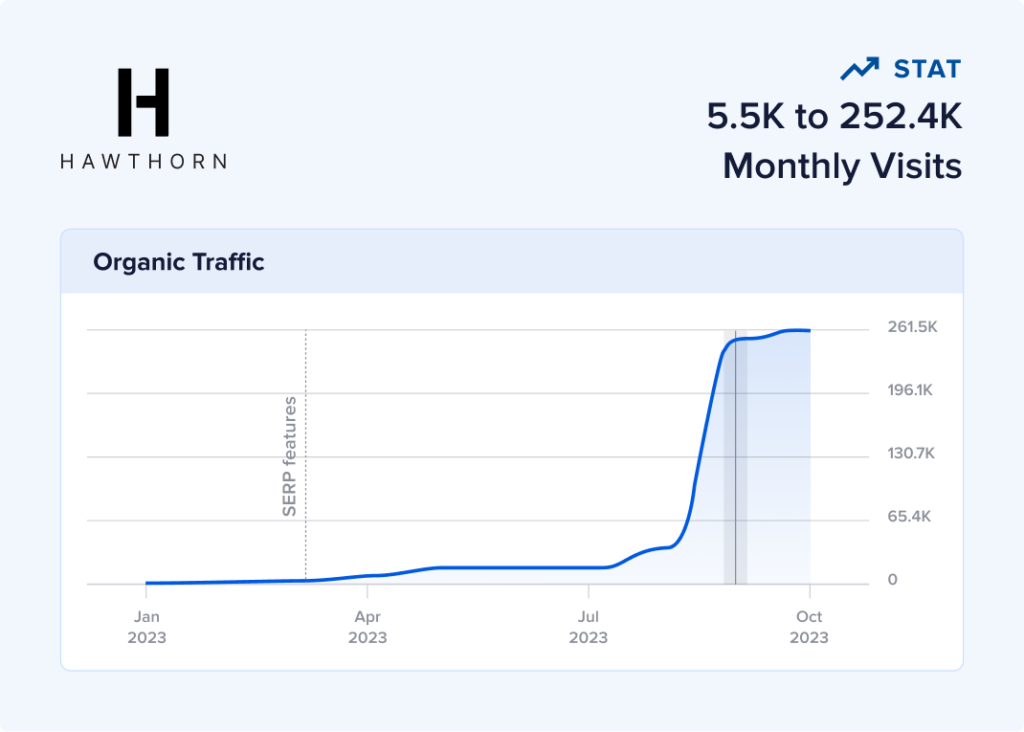
Image source: https://aioseo.com/wp-content/uploads/2024/02/hawthorn-seo-case-study-1024×732.png
Industry: Local & eCommerce
A longstanding neighbourhood staple of Hawthorn Mall in Vernon Hills, Illinois, Hawthorn Mall had been a place to focus on foot traffic. Yet in 2015, Hawthorn moved into the online market, and in the year 2020, it brought to life an e-commerce platform. The problem with Hawthorn was that it needed to find a way to get traffic to the new online shopping platform without disrupting its local goings on.
SEO Challenge:
For an established local business, Hawthorn had to go online and compete with the likes of every other shop in the city. The issue was to get the most out of their local SEO power and build up their reach with e-commerce. Building an online shopping platform meant that an SEO strategy was needed to bring in not only local shoppers but also people from a wider area.
Solution and Growth:
To generate significant customer acquisition in spring 2023, Hawthorn doubled their keyword ranking, multiplying their keyword rankings by 3.5x, increasing their reach to 51,000 new pages online. Hawthorn had targeted relevant keywords that were not associated with its brand and optimised its pages for local and e-commerce traffic. Bearing that in mind, Hawthorn was able to increase the number of customers to its online store.
As an additional point, Hawthorn also placed emphasis on image SEO to make the product images rank well in Google’s image search, and this gives potential shoppers more visibility to see. Within those five months, though, it resulted in a phenomenal 252,000 monthly visits.
Impact:
Content scaling worked for Hawthorn by using new landing pages in conjunction with strategic keyword optimization and image SEO to improve its online presence. This approach helped the mall successfully increase its local and eCommerce traffic, bringing it to new heights in both local and eCommerce search results.
Key Takeaways:
If you’re adding an online component to your brick-and-mortar business, then focus on new, fresh, relevant keywords that pertain to the products and services that you now offer. One of the reasons behind Hawthorn’s SEO success was its ability to target high-value non-branded keywords. Furthermore, they followed a 301-redirect strategy as well as an image SEO to use in order for their domain migration and eCommerce platform to be successful. You can further increase your reach and the amount of local and global traffic you receive by focusing on elements of your site.
How SEO Ties Everything Together in Digital Marketing
If you look at the situation right, SEO is a connecting element that makes all those things come together in digital marketing. Other digital strategies like content creation, paid advertising, and social media play an essential part, but your efforts can only be discovered by your target audience with SEO. It’s essential to understand where SEO fits in your digital marketing strategy so each effort complements the other and contributes to long-term growth. SEO is not just about throwing in keywords; SEO is putting your website up for advancement and visibility, increasing user experience on your website, and making sure your content matches search engine keywords.
Why SEO Is Important in Digital Marketing

-
Increased Visibility and Traffic: SEO is the basis for providing organic traffic to websites since the ranking of content in search engine results is guaranteed. In other words, it means having a larger reach without continuous costs such as those tied to paid advertising. In reality, it is revealed in actuality that search engines are responsible for 53 per cent of all website traffic, thus emphasizing the importance of SEO as part of digital marketing. Plus, figuring out SEO is like hitting the jackpot. The site starts popping up exactly where people are looking, and suddenly there’s this steady stream of visitors without lifting a finger (well, almost). If that’s your goal, you’ll want to follow smart SEO tips to boost website traffic organically to make it happen.
-
Content Quality and User Engagement: High-quality content has a lot to do with effective SEO. Engaging content promotes user interaction, and with a User’s Need strategy, it results in higher conversions. If you optimize your website for search engines, you are ensuring that your content reaches the right audience, and your content can be searched for blog records, items, and services. Content isn’t just about throwing words on a page and hoping for the best. When the focus shifts to making stuff actually helpful, funny, and, yeah, a little dramatic (because why not?), people actually start engaging. Like, real comments, DMs, even shares from strangers.
-
Improved Website Performance: The main focus of technical SEO is enhancing your website’s architecture with respect to being fast, mobile-friendly and secure. Not only will these factors help to enhance user experience, but also it will also make your site aligned with the search engine needs, thereby increasing your rankings and users’ retention.
-
Long-term Cost Efficiency: SEO efforts give permanent value, unlike paid ads. After getting your website to rank high, you no longer need to pay constantly for visibility. One of the most cost-effective ways of digital marketing is that SEO can bring you organic traffic without continuous investments. SEO is like that loyal friend who keeps showing up without asking for anything in return. Once a site ranks high, it keeps pulling in clicks day after day, no ad budget drama, no bidding wars, just pure organic magic. It’s not some one-night-stand tactic; it’s the slow burn that keeps paying off. Sure, there’s a little grind upfront, but once it’s up there? That visibility sticks. And honestly, who doesn’t want free traffic showing up 24/7 while everyone else is still throwing cash at ads?
-
Trust and Credibility: Organic listings in the search engines are often considered more credible than paid ads. About 70 percent of users click on organic results because they increase user engagement and decrease bounce rate. The trust will ensure higher conversion rates, especially when organic search refers the consumer to the business because they know they are working with the company.
-
Supports Other Channels: SEO as a digital marketing technique greatly enhances the efficacy of all the other digital marketing channels. For example, social media sharing can be fuelled by high-quality, optimized content and is a help in the paid search (PPC) activities. Through this, all the components of the marketing strategy work together as a cohesive strategy to reach out to a wider audience.
SEO is also the glue that keeps your entire digital marketing strategy together. If your content is posted, it is guaranteed to reach the right audience at the right time, ensuring that all your efforts in creating content, engaging socially, and using paid ads have been successful. Among the many reasons SEO is important, some of which are a traffic booster, improving user engagement and building your users’ trust, SEO is of importance. This will help you to have long-term success and compete in the world that is becoming digital.
Final thoughts
SEO is much more than a technical tool. It is a strategic element of the company that generates long-term business development. To build such a strong digital presence based on traffic, conversions and brand loyalty, all you have to do is optimize your content, focused on top quality content based on good user experience. Working with a Genzpro can help streamline this process and ensure your efforts align with the latest trends and algorithms. SEO is a continuous work, and for companies that want to advance in the digital age, it is an indispensable part of any wide marketing strategy.

