

one of the most stressful “what ifs” in digital marketing: If I fire my agency today, will my traffic fall off a cliff tomorrow?
The fear isn’t unfounded. Many business owners feel “handcuffed” to their current SEO Services providers, especially when they start believing that SEO services are a scam after a bad experience.
worrying that the moment the contract ends, the secret sauce disappears or, worse, the SEO agency flips a switch and undoes all your progress.
I’ve seen companies stay in bad partnerships with SEO Company for months too long simply because they didn’t know when to switch another SEO company.
But here is the reality: SEO results belong to the asset (your website), not the SEO agency. If your rankings disappear the moment you leave, you didn’t have an SEO strategy; you had a temporary rental.
Transitioning away from an SEO agency should be a clinical, risk-mitigated process—not a leap of faith. How to Exit an SEO Agency Without Losing Your Rankings is something every business owner should understand before making a switch.
In this guide, I’m going to show you the exact “Exit Audit” and transfer protocol we use to ensure your organic visibility stays intact (and often improves) during a handover.
Whether you’re moving in-house or switching to a new partner, this is how you protect your most valuable digital real estate.
It is one of the most stressful “what ifs” in digital marketing: If I fire my SEO agency today, will my traffic fall off a cliff tomorrow?
Before diving into the reasons rankings drop, it’s crucial to understand how to exit an SEO agency without losing your rankings, so you can maintain your traffic and authority
1. Why Rankings Sometimes Drop After You Exit an SEO Agency
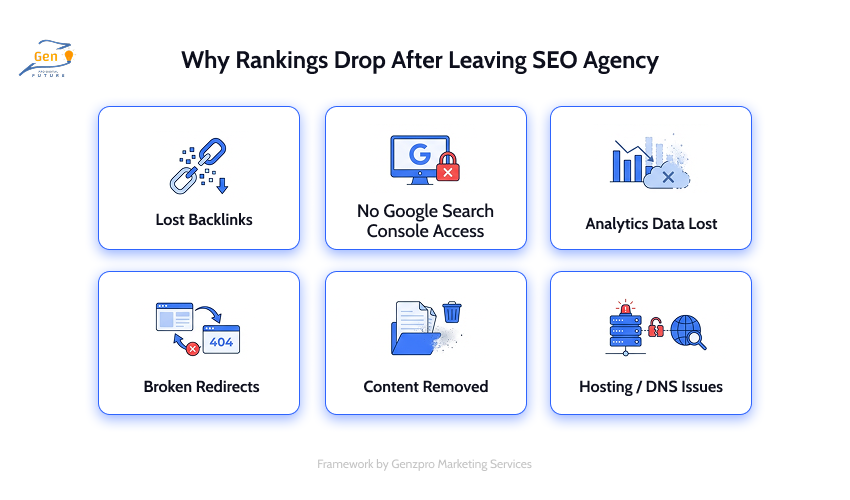
When a site’s performance dips after an agency exit, business owners often jump to “conspiracy theories”—fearing the agency “turned off” the SEO or actively sabotaged the site. In reality, ranking drops are almost always the result of poor hygiene and broken technical links during the handoff.
Having audited dozens of these transitions, the “why” usually boils down to these six operational failures: To prevent any ranking drops, you need to follow a proven process of how to exit an SEO agency without losing your rankings
- Lost Backlinks: This is the most common “invisible” killer. If your SEO agency was “renting” links from a private network (PBN) rather than earning permanent editorial links, those links may be removed the moment your contract ends. When those signals disappear, Google re-evaluates your authority. Understanding your account access is part of how to exit an SEO agency without losing your rankings. Without proper ownership, your new team will be flying blind
- Access Revocation: Losing access to Google Search Console (GSC) or Tag Manager doesn’t just stop reporting; it stops you from seeing critical crawl errors, security alerts, or manual actions that need immediate attention. If a technical error occurs during the switch and you can’t see it, you can’t fix it.
- Tracking Gaps: If the agency owned the GA4 property and deletes it or removes your access, you lose years of historical data. Without data, your new strategy is flying blind, and you won’t know which specific pages started losing steam until it’s too late.
- Technical elements like redirects and content licensing are essential considerations in how to exit an SEO agency without losing your rankings, because even minor missteps can cause major drops
- Broken Redirects: Many agencies implement technical fixes via a third-party “edge” tool (like Cloudflare workers or specialized SEO plugins) to bypass slow development cycles. If that subscription ends or the plugin is deactivated, your site structure could revert to a broken state with hundreds of 404 errors overnight.
- Content Ownership Issues: Some contracts are predatory, specifying that content is “licensed” rather than owned. If they pull those high-ranking blog posts or landing pages, your organic footprint shrinks instantly, and your rankings go with them.
- Hosting/DNS Sabotage: In rare cases, if the agency manages the hosting or DNS and the transition isn’t handled gracefully, the entire site can go offline. Even a few days of a “Server Not Found” error can lead to a massive de-indexing event that takes months to recover from.
2. The Biggest Myth: Agencies Don’t Own Your Rankings — But They Can Control Access
One of the most persistent myths in the industry is that an agency “owns” the spots they’ve earned for you on Page 1. Let’s be clear: Google rankings cannot be owned by anyone but the website itself.
However, there is a massive difference between an Asset and a Service. You own your website (the asset); the agency provides the labor (the service). The danger arises when a business unknowingly hands over the “keys” to the asset itself.
In multiple SEO audits I’ve done, rankings dropped not because Google penalized the site, but because access was lost during the transition. When you lose access, you lose the ability to maintain the “infrastructure” that supports those rankings.
The Ownership Blueprint: Asset vs. Service
To maintain authority, you must ensure your company has “Super Admin” or “Owner” status over these six pillars:
- The Domain: This is your digital deed. If the agency registered your domain under their account, they technically own your brand’s home. It must always be in your name.
- Hosting & DNS: This is the land your house is built on. If the agency pays the hosting bill, they can “turn off the lights” at any time.
- GA4 (Google Analytics) & GSC (Search Console): These are your eyes and ears. GSC is the only way Google communicates with your site about penalties or crawl errors. Without it, you are flying blind.
- Backlinks: While you can’t “own” a link on another site, you must own the documentation of them.
- Content: Every word written for your blog or landing pages should be “Work for Hire.” If the contract says they “license” the content to you, they can legally demand its removal when you leave.
Real Case: The “Proprietary” Trap
I once audited a luxury furniture brand that saw a 40% traffic drop after leaving a “full-service” agency. We discovered the agency had built all their landing pages on a proprietary CMS rather than the client’s main site.
When the contract ended, the agency deactivated the sub-domain. The rankings didn’t disappear because of a Google update; they disappeared because the pages literally ceased to exist.
The Reality Check: A professional partnership is built on transparency. If an agency claims their “process” is too proprietary to give you GSC access, they aren’t protecting a secret—they’re building a cage.
3. The Exit Audit: What We Check Before Leaving Any SEO Agency
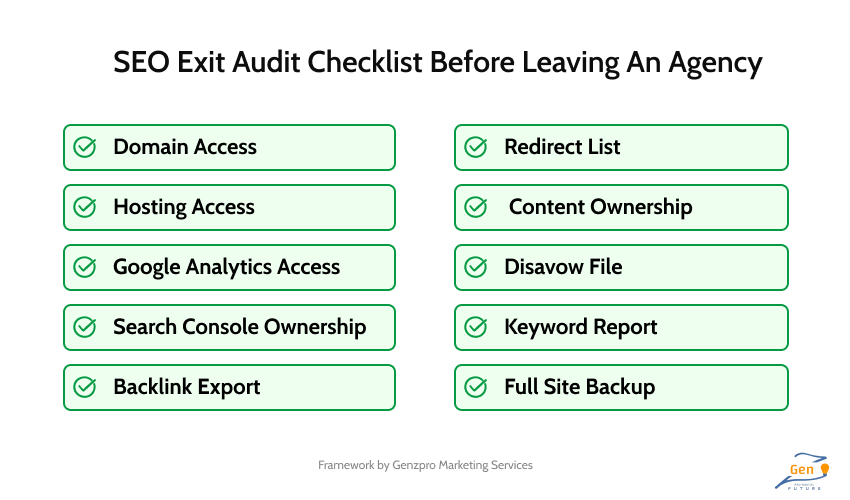
Before you send a termination notice, you need to conduct what I call a Silent Audit. In my experience, the smoothest transitions happen when the business owner has already secured the “intel” while the relationship is still active.
This isn’t just about being cautious; it’s about professional due diligence. If you wait until after the contract ends to ask for these files, you may find the agency’s response time slows down significantly—or worse, the data is “archived” and inaccessible.
Here is the exact checklist we use to “de-risk” a departure:
- Full Backlink Profile Export: Don’t just rely on a summary. You need a raw CSV export of every live backlink the agency has built. If rankings dip later, we need this “snapshot” to see if links were deactivated or removed.
- Search Console Ownership Verification: Go to GSC settings right now. Are you listed as a “Verified Owner” or just a “Full User”? You must be the Verified Owner to ensure you can manage permissions once the agency is gone.
- GA4 Property Portability: Ensure the Google Analytics property is not nested under the agency’s “Master Account.” It needs to be a standalone property that you have “Administrator” rights to.
- The Master Redirect List: This is often overlooked. If the agency has been performing technical SEO, they likely implemented dozens (or hundreds) of 301 redirects. You need a list of these URLs so your next team doesn’t accidentally break them and trigger a 404-error flood.
- CMS & Database Credentials: Verify you have the “Super Admin” login for your WordPress, Shopify, or custom CMS. You’d be surprised how many owners only have “Editor” access to their own sites.
- Domain & Hosting Access: Confirm you have the direct login to your Registrar (like Namecheap or GoDaddy) and your hosting panel (like WP Engine or SiteGround).
- The Disavow File: If the agency ever performed a “toxic link cleanup,” there is a .txt file sitting in your Search Console. You need a copy of this. If it gets lost, Google might start counting those spammy links against you again.
- Inventory of Paid/Licensed Content: Get a list of every URL they created. Cross-reference this with your contract to ensure there are no “licensing” clauses that require you to delete the content upon exit.
- Final Keyword Ranking Report: This is your baseline. It proves what was achieved during their tenure and protects you from the new agency claiming “everything was broken” when they take over.
Expert Tip: I always recommend taking a full site backup (files and database) before you notify the agency of your intent to leave. It is the ultimate “undo” button if anything goes wrong during the transition.
Following these steps ensures a smooth transition and demonstrates exactly how to exit an SEO agency without losing your rankings
4. Step-by-Step Process to Exit an SEO Agency Without Losing Rankings
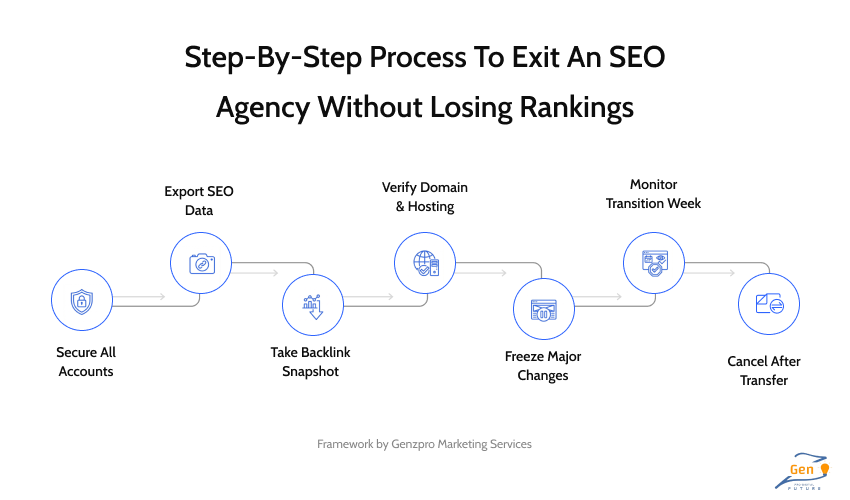
Exiting an agency isn’t a single event—it’s a tactical maneuver. If you treat it like a breakup and lead with emotion, you risk your data. If you treat it like a technical migration, you protect your revenue.
Based on years of managing agency handovers, here is the non-negotiable, seven-step sequence to ensure your rankings remain stable during the transition.
- Secure All Accounts First (The “Silent Switch”) Before any formal announcements are made, verify that you have master administrative access to every platform. Check your CMS (WordPress/Shopify), Google Analytics, and Google Search Console. If you are not a Verified Owner in Search Console, add yourself now. Change the passwords for your hosting and CMS the moment the contract officially expires to prevent any unauthorized late-stage changes.
- Export All SEO Data Agencies often use proprietary dashboards that pull data from various sources. Once you leave, you lose that dashboard. Manually export your historical keyword performance, organic traffic trends, and conversion data into CSV or Excel files. You need this “paper trail” to bridge the gap between the old agency and the new strategy.
- Take a Backlink Snapshot Use a tool like Ahrefs, Semrush, or Moz to run a final backlink audit. Download the full list of “Live” links. This is your insurance policy. If your rankings start to slip 30 days after you exit, you can compare this snapshot to your live profile to see if the agency pulled “rented” links or deactivated a private network.
- Verify Domain & Hosting Ownership This is the most critical technical step. Log into your domain registrar (e.g., GoDaddy, Namecheap) and ensure the Registrant Email is an internal company email, not the agency’s. Do the same for your hosting provider. If they manage the hosting, initiate a “migration” to your own server before the final exit date.
- Freeze Major Changes Stability is your best friend during a transition. Do not allow your internal team or a new agency to perform a “site overhaul,” change URL structures, or delete large batches of content during the 30-day exit window. If rankings drop during a transition, you need to know if it was due to the exit or a new change. A “code freeze” makes troubleshooting possible.
- Plan the Transition Week Coordinate with your new SEO lead or in-house team to have them ready to monitor the site daily during the first week post-exit. They should be looking specifically for 404 errors, robots.txt changes, or drops in indexed pages. Having an expert “on-call” during this week prevents minor glitches from turning into permanent ranking losses.
- Cancel Only After the Transfer is Confirmed Do not send the final termination email until steps 1 through 6 are verified. Once the “keys” are physically in your possession and your data is backed up, you can proceed with the cancellation. This ensures that you aren’t negotiating for access from a position of weakness.
5. Proof From Real Transitions: What Happens When Exit Is Done Correctly
Theory is great, but in the SEO world, the only thing that matters is the graph. I’ve managed several high-stakes transitions where the client was terrified that their multi-million dollar organic revenue would vanish the moment they sent the termination letter.
When you follow a structured exit protocol, the “dip” everyone fears simply doesn’t happen. In fact, a clean break often paves the way for immediate growth because you’ve removed the technical “clutter” and gatekeeping that was holding the site back.
Case Study: The 18% Post-Exit Surge
In one migration audit we handled for a regional service provider, the client had been with their agency for 14 months. They were unhappy with the communication but terrified of losing their Page 1 rankings for their primary high-intent keywords.
- The Strategy: We spent 21 days silently securing the infrastructure. We mapped out 42 critical redirects that were living in a third-party plugin and exported a snapshot of 1,200 active backlinks.
- The Execution: We transitioned the GA4 and GSC ownership on a Tuesday. The formal exit happened on Friday. Because we had the “keys” and the data baseline, there was zero downtime.
- The Result: Traffic didn’t just stay stable; it grew 18% in the following quarter. Why? Because the new strategy could finally be implemented without the old agency’s restrictive “proprietary” bottlenecks.
These case studies show exactly how to exit an SEO agency without losing your rankings in real-world scenarios, proving that a structured approach prevents downtime and traffic loss.
Case Study: Stable Rankings Through a Server Move
Another client needed to exit an agency that was also their hosting provider—a classic “hostage” situation. By mirroring the site to a new, independent server and verifying every DNS record before the old contract expired, we kept the site live 100% of the time. Google’s crawlers never saw a single error.
The result? Rankings stayed exactly where they were, and the client saved 30% on monthly overhead.
The takeaway is clear: Rankings aren’t tied to an agency’s “magic touch.” They are tied to the technical health and authority of your domain. When you protect those, your visibility remains bulletproof.
6. Red Flags That Mean You Should Exit Your SEO Agency Carefully
Trust is the foundation of partnership SEO Company, and if you don’t know how to choose the right SEO agency, you may end up in a situation where exiting becomes risky.
. Over years of auditing underperforming campaigns, I’ve identified several warning signs that suggest an agency isn’t just doing a poor job—they are intentionally making it difficult for you to leave.
If you recognize any of these red flags, you need to initiate the Silent Audit immediately.
- The Agency Controls Your Domain: This is the ultimate “hostage” tactic. If your domain is registered in the agency’s account or under their name, they effectively own your brand. A professional agency will always insist that the client maintains ownership of the domain and hosting.
- Gatekeeping Google Search Console (GSC): If an agency tells you that you “don’t need” access to GSC or that they can only provide “filtered” screenshots, it’s a major red flag. They may be hiding manual penalties, critical crawl errors, or a plummeting indexation count.
- The “Black Box” Link Strategy: If you ask for a list of the backlinks they’ve built and the answer is “it’s proprietary” or “we don’t provide that data,” be very careful. This usually means the links are low-quality, automated, or part of a network that will be deleted the moment you stop paying.
- Lack of Transparent Reporting: A monthly report should be more than just a few green arrows. If your reports lack specific details on which pages were optimized, what content was published, and where your traffic is actually coming from, they are likely hiding a lack of activity.
- The “Google Updated” Excuse: If rankings have been dropping for six months and the agency’s only explanation is a vague “Google changed the algorithm,” they’ve lost the plot. A competent SEO can point to specific technical or competitive reasons for a drop and provide a pivot plan.
- Proprietary “SEO Tools” You Can’t Keep: Be wary of agencies that build your site or your landing pages on their own “custom” platform instead of a standard CMS like WordPress or Shopify. This is a technical cage designed to make leaving as expensive and painful as possible.
According to the Expert Perspective, Red flags don’t always mean the agency is “evil,” but they always mean your business is at risk. If you don’t have the keys to your house, you don’t really own it.
7. What a Professional SEO Handover Should Look Like
A clean exit shouldn’t feel like a battle; it should feel like a corporate handover. In my professional view, the quality of an agency’s exit reflects their integrity as much as their results did.
Any professional SEO agency should be able to hand over a campaign without damage. If they are confident in the value they provided, they won’t feel the need to hide the “how” or the “what.”
When we step in to manage a transition, we expect a “Success Folder” from the outgoing team. If they are pros, they will provide the following documentation without hesitation:
- The Technical Audit History: A record of every major technical change made to the site—from schema implementation to core web vital fixes. This prevents the new team from “fixing” things that aren’t broken.
- Comprehensive Keyword Baseline: Not just a few “ego terms,” but a full report of every keyword that currently drives traffic, its ranking position, and the specific landing page associated with it.
- Complete Link Building Report: A transparent list of every live backlink earned during the contract. This includes the source URL, the anchor text used, and the date it went live.
- The Content Inventory: A list of every blog post, service page, and metadata update they delivered. This ensures you can verify ownership and helps the next team identify content gaps.
- The Strategic Roadmap: A professional agency will show you what they planned to do next. Even if the relationship is ending, they should hand over the “work in progress” so your momentum doesn’t stall.
- The Documentation of Redirects: A clear map of all active 301 and 302 redirects implemented via the CMS or server.
The Authority Tone: When an agency provides this level of documentation, they are proving that their work was based on strategy, not “smoke and mirrors.” If an agency refuses to provide a clear roadmap or a link report upon exit, it’s a confession that they were likely doing very little work at all.
8. Mistakes That Cause Ranking Loss During Agency Switch
In my years of auditing failed transitions, I’ve realized that most ranking losses aren’t caused by the exit itself, but by the reckless way the switch is handled.
These are the “unforced errors” that turn a simple change of providers into a digital emergency.
If you want to keep your traffic, avoid these five critical mistakes at all costs:
- The “Cancel First, Check Later” Approach: This is the single most dangerous move. If you terminate the contract before verifying you have “Super Admin” access to your CMS and Google Search Console, you lose your leverage. If the agency goes silent, you are locked out of your own data and unable to fix issues.
- Neglecting the Backlink Export: As I’ve mentioned, some agencies use “rented” link networks. If you don’t have a snapshot of your link profile before you leave, you won’t know which links were pulled. Without that data, you can’t tell your new agency what needs to be replaced to stabilize your authority.
- Forgetting the Redirect List: SEO is often built on a delicate web of 301 redirects. If your old agency managed these through a proprietary tool or a plugin they take with them, those redirects will break. This results in a “404-error flood” that can tank your rankings in a matter of days.
- Operating Without Domain Ownership: It sounds basic, but I have seen multi-million dollar companies realize too late that their agency registered their domain name. If you don’t own the domain, you don’t own the rankings. Period. You must verify that the Registrant Email is yours before initiating a switch.
- Allowing the New Agency to Change Everything Fast: New agencies often want to “prove their worth” by changing meta titles, headers, and content immediately. This is a recipe for disaster. Google hates sudden, massive fluctuations. A professional transition requires a “Stability Period”—keep things the same for 30 days while the new team audits the environment.
Expert Advice: Don’t let your eagerness for a fresh start blind you to the technical realities. If you change your “digital locks” before you have the keys to the new ones, you’re going to find yourself locked out in the cold.
Following this checklist is a critical part of how to exit an SEO agency without losing your rankings. Each item ensures you keep control of your domain, analytics, and content.
9. Safe Transition Checklist (Use This Before You Cancel Your SEO Contract)
This is the most critical part of your exit strategy. Do not send a termination email or sign a new contract until you can physically check off every item on this list.
Think of this as your “Digital Insurance Policy.” If you have these ten items, your rankings are safe. If you don’t, you are leaving your organic revenue to chance.
The “Keys to the Kingdom” Checklist
- Domain Access: Log into your registrar (GoDaddy, Namecheap, etc.). Ensure your company email is the Registrant Contact. If the agency’s email is there, initiate a transfer immediately.
- Hosting Access: Can you log into your server or hosting panel (CPanel, WP Engine, SiteGround) right now? You must have the ability to take a full site backup.
- GA4 (Google Analytics): Check your permissions. You need Administrator access, not just “Editor” or “Viewer.” Verify the property is not owned by the agency’s master account.
- GSC (Google Search Console): You must be a Verified Owner. This is the only way to ensure the agency cannot remove your access later or ignore critical Google alerts.
- Backlinks Export: Download a full CSV of all live backlinks. Use a tool like Ahrefs or ask the agency for their final link-building report.
- Disavow File: If the agency has done any spam cleanup, download the .txt disavow file from Search Console. Losing this could cause old “toxic” links to haunt your rankings again.
- Content List: Get a full inventory of every URL created or optimized during their tenure. This confirms your ownership of the intellectual property.
- Redirect List: Export a map of all 301 redirects. This is vital to prevent a “404-error” catastrophe if a plugin or server-side rule is deactivated.
- Keyword Report: Get a final ranking report for all target keywords. This is your “Day 1” baseline for the next phase of your SEO.
- Technical Audit: Request the most recent technical audit. You need to know which “bugs” were fixed and which ones were left in the backlog.
As a Seo Specialist I recommend taking a manual site backup the day before you notify the agency of your exit. If a technical glitch occurs during the handoff, you can restore your site to its “peak ranking state” in minutes.
10. Final Advice: Switching SEO Agencies Should Be a Process, Not a Reaction
If there is one thing I have learned from overseeing dozens of agency transitions, it is this: Businesses don’t lose rankings because they switch agencies. They lose rankings because they switch without a plan.
When a partnership isn’t working, it’s easy to let frustration drive the timeline. You want to cut the check, stop the meetings, and move on as fast as possible. But in the world of SEO, a “reactionary” exit is a high-risk move.
Your organic visibility is the result of months—sometimes years—of compounded effort. Treating it with anything less than operational precision is a disservice to your bottom line.
A successful transition is calm, clinical, and data-driven. It’s about moving your “digital equity” from one vault to another without dropping anything along the way. When you follow a structured process—securing your assets, auditing your links, and maintaining technical continuity—you remove the fear of the “post-agency dip.”
My final advice to any business owner or marketing director is this: Don’t jump ship until you know where the lifeboats are. Take the time to secure your access, export your data, and verify your ownership.
When you do that, you aren’t just “firing an agency”—you are taking full control of your brand’s future in the search results.
SEO is a long game. The partners you choose may change, but the authority of your domain is yours to keep. Treat it like the valuable asset it is.
If you’re ready to move forward but want to ensure your organic traffic remains bulletproof, Genzpro Tech is here to bridge the gap. We specialize in managing complex SEO transitions, performing deep-dive technical audits, and ensuring your data stays where it belongs—with you.
Don’t risk your rankings during a switch. Contact Genzpro Tech today for a clinical transition plan that protects your growth.

