

In the digital landscape of 2026, “patience” is often used as a convenient shield for incompetence. I have spent years auditing underperforming campaigns, and the most common tragedy isn’t a lack of effort-it’s a lack of alignment between an agency’s activity and a business’s actual growth. If you’ve been investing in a strategy for over six months and your primary “win” is a monthly PDF full of jargon, you aren’t just losing money; you’re losing market share to competitors who are actually moving the needle.
SEO is a long-term play, but it shouldn’t be a blind one. There is a definitive line between the natural “gestation period” of organic rankings and a campaign that is fundamentally broken.
If you are unsure whether you have reached that point, you should first understand the deeper indicators explained in When to switch another SEO company, where the transition timing is broken down with real campaign examples.
In this guide, I’m drawing on a decade of experience in high-stakes SEO to show you exactly how to spot the warning signs it’s time to switch to other SEO company providers. This isn’t just a list of grievances—it’s an executable audit. I will provide you with the specific benchmarks and “red flag” data points I use to determine when a partnership has moved from a strategic investment to a sunk cost.
The Expertise Behind the Audit
I’ve managed SEO transitions for dozens of firms, often stepping in when a “professional” agency has left a trail of toxic backlinks or stagnant traffic. The solutions I’m presenting are rooted in the SEO Decision Matrix – a framework designed to separate slow execution from a total lack of strategy. By the end of this article, you will have the proof you need to either fix your current relationship or walk away with confidence.
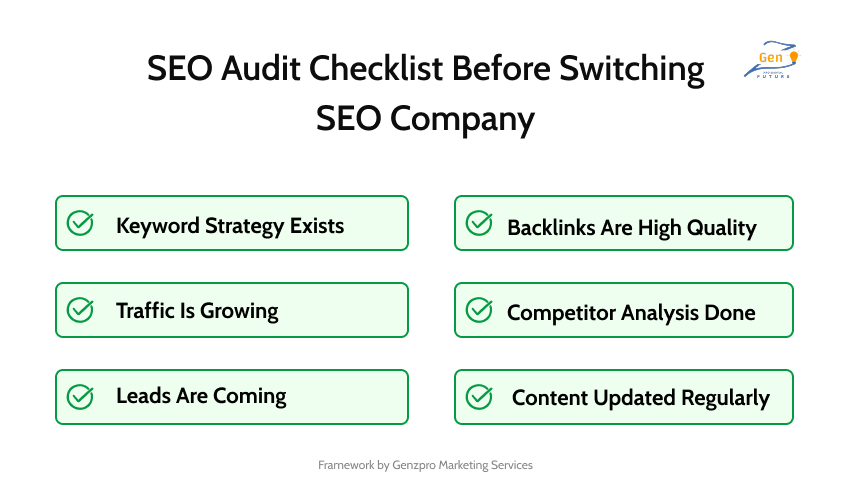
1. No Clear SEO Strategy – Only Tasks, Reports, and Random Activity
In my years of auditing failing campaigns, the most common “silent killer” isn’t a lack of work-it’s a lack of intent. Many agencies stay busy by checking boxes: they’ll post two blogs a month, build five “high DA” backlinks, and send a PDF of green arrows. But if you ask why those specific pages were updated or how those links support a conversion goal, you get silence.
Activity is not the same as progress. If your SEO services provider is just “doing SEO” without a North Star, they are essentially throwing expensive darts in the dark.
Many business owners face this confusion because they never had a clear selection framework in the beginning. If you want to avoid this mistake in the future, read How to choose right SEO agency, where the evaluation checklist is explained step-by-step.
How to Verify: The “Roadmap” Litmus Test
The fastest way to expose a lack of strategy is to request a 3-to-6-month SEO Roadmap.
- The Red Flag Response: “We are focusing on quality content and technical optimization this month.” (Vague, non-committal).
- The Green Flag Response: A document that links specific technical fixes to crawl budget improvements, maps keywords to specific URLs, and outlines a themed link-building outreach plan for the next quarter.
What a Real SEO Strategy Looks Like
A professional strategy is a blueprint, not a to-do list. It must include three non-negotiable pillars:
- Keyword Mapping: A spreadsheet showing which specific keyword matches which specific URL. If they are targeting “luxury villas” on three different pages, they are causing keyword cannibalization—essentially making your own pages compete against each other.
- Search Intent Alignment: Proof that they aren’t just chasing high-volume words, but are targeting transactional intent for service pages and informational intent for blogs.
- A Weighted Link Plan: A breakdown of the types of gaps you have compared to competitors (e.g., “We need 15 niche-relevant guest posts to close the gap on Page 1”).
The “Ghost Strategy” Audit
I once audited a firm’s SEO account where the previous agency had billed for “Monthly Optimization” for over a year. When I dug into the CMS, I found they had optimised the same five pages every single month-changing meta descriptions slightly back and forth-while the actual high-value service pages remained untouched. They had no roadmap, so they repeated the easiest tasks to justify their retainer.
The Solution: The Strategy Document Checklist
If you decide to switch to other SEO company providers, or if you want to give your current one a final chance, demand a SEO packages strategy document that contains:
- The “Gap Analysis”: Where do we sit versus our top 3 competitors today?
- Quarterly Milestones: What specific ranking or traffic benchmarks will be hit by Month 3?
- Content Calendar: Not just titles, but the “Search Intent” and “Target Audience” for every piece of content planned.
2. Rankings Change, But Traffic and Leads Don’t Grow
One of the most common “smoke and mirrors” tactics I see in the industry is the Vanity Metric Trap.your SEO consultant sends a report showing you’re ranking #1 for five different keywords, and the graphs are all pointing up. But when you look at your inbox or your Stripe account, nothing has changed.
If your rankings are climbing but your phone isn’t ringing, you aren’t winning—you’re being distracted. This is a definitive warning sign it’s time to switch to other SEO company partners who understand that traffic is a means to an end, not the end itself.
This is the same reason why promises like guaranteed rankings should always be questioned. If an SEO consultant is still selling fixed positions in search results, you should read Why #1 Ranking guarantees are Impossible in 2026 to understand how modern algorithms actually work.
The Critical Difference: Vanity vs. Money Keywords
- Vanity Keywords: High-volume, broad terms that look great on a report but have zero commercial intent (e.g., “what is interior design”). People searching this are looking for a definition, not a service.
- Money Keywords: Phrases that signal a “ready-to-buy” mindset (e.g., “luxury interior design services Dubai” or “best fit-out companies for office renovation”).
If your agency is high-fiving over ranking for “interior design ideas” while your core service pages are sitting on Page 4, they are chasing ego, not ROI.
The GSC + Analytics “Reality Check”
To prove whether your SEO is actually working, you need to cross-reference Google Search Console (GSC) with Google Analytics (GA4).
- In GSC: Look at your “Top Queries.” Are they informational (“how to…”) or transactional (“service in [city]”)?
- In GA4: Check your “Landing Page” report. Filter by “Session Source/Medium = Organic.”
- The Gap: If your top-performing page by traffic has a 0% conversion rate and a 90% bounce rate, that traffic is worthless. It’s likely “empty” traffic from low-intent blog posts that don’t lead the user to a solution.
The 3-Step “Lead Flow” Check
Don’t take your agency’s word for it. Run this audit yourself in 15 minutes:
- Step 1: Audit Keyword Intent: Take your top 10 ranking keywords and plug them into Google. Do the results show competitors’ service pages or Wikipedia/Pinterest? If it’s the latter, you’re ranking for the wrong intent.
- Step 2: Check Landing Pages: Open your top 3 traffic-driving pages. Is there a clear Call to Action (CTA)? Does the page actually solve the user’s specific problem?
- Step 3: Measure Conversions: If your “Conversions” column in Analytics is empty, your SEO isn’t “optimizing”-it’s just “broadcasting.”
The “Fake Growth” Recovery
I recently took over an account for a fit-out firm that was boasting 10,000 monthly visits. On paper, they looked like industry leaders. However, a quick audit revealed 80% of that traffic was coming from a single blog post about “DIY paint colors” in a country they didn’t even serve. They had zero leads.
We pivoted the strategy to target high-intent “commercial fit-out” keywords. Our total traffic actually dropped by 40%, but their qualified lead volume tripled within 60 days. We traded “ghost traffic” for “paying clients.”
4. Backlinks Are Being Built, But Authority Is Not Increasing
Link building is the most expensive part of SEO, which makes it the most common area for agencies to “cut corners.” If your provider is reporting 20 new links a month, but your Domain Rating (DR) or Authority Score (AS) has stayed flat-or worse, your Spam Score is creeping up-you are paying for toxic digital baggage.
In 2026, Google’s algorithms are more interested in the relevance and traffic of the linking site than the mere existence of a link. If you’re getting links from “link farms” or irrelevant hobby blogs in another country, they aren’t just useless—they are a liability. This is a massive warning sign it’s time to switch to other SEO company partners.
The “Three-Point Health Check”
To see if your links are actually moving the needle, look for these three metrics:
- Referring Domains vs. Total Backlinks: If you have 10,000 backlinks but only 50 referring domains, your agency is likely using “site-wide” footer links or spammy sidebar widgets. You want a diverse range of unique, high-quality domains.
- DR/DA Trend: Use a tool like Ahrefs or Moz to look at your authority trend line. If it’s a flat line despite a “successful” link campaign, those links lack the “juice” to move your site.
- Spam Score & Toxicity: Check the Moz Spam Score or Semrush Toxic Score. If more than 10% of your new links are flagged as “High Risk,” your agency is playing with fire.
Executable Audit: Your Tool-Based Workflow
You don’t need to be a technical expert to run this audit. Use these tools to verify the “proof”:
- Ahrefs: Go to Site Explorer > Referring Domains. Sort by “Domain Rating.” Are the sites linking to you reputable? Do they have actual organic traffic? A link from a site with 0 traffic is a massive red flag.
- Google Search Console (GSC): Go to Links > Top Linking Sites. If you see hundreds of links from domains ending in .xyz, .top, or .click, these are likely automated spam links.
- Semrush: Run the Backlink Audit tool. It will give you a “Toxicity Score.” If it’s high, it means your agency is building links on sites Google likely ignores or penalizes.
The Toxic Cleanup Case
I once took over a project for a Dubai-based interior design firm that was frustrated by a sudden 50% drop in rankings. Their previous agency had built 500+ “high DA” links. Upon audit, I found these links were all from “General News” sites that published everything from gambling tips to crypto news.
These sites were “Link Farms”—they looked authoritative to a beginner, but Google had flagged them as manipulative. We had to manually disavow 400+ domains to “clean” the site’s reputation. Within three months of removing that “junk” and replacing it with five high-quality, niche-relevant links, their traffic returned to its all-time high.
The Solution is Quality Over Quantity
If you switch to other SEO company providers, look for one that promises relevance. A single link from a well-known industry publication or a high-traffic local directory is worth more than 1,000 links from a PBN (Private Blog Network).
5. SEO Work Stops After Google Updates Instead of Adapting
In the world of SEO, a Google Core Update is the ultimate “stress test.” When Google shifts the goalposts, a professional agency moves with them. However, a common red flag is an agency that goes silent or, worse, tells you to “just wait it out” for months without changing a single thing.
If your traffic drops after an update and your agency’s only solution is to keep doing the same tasks they were doing before, they aren’t managing your SEO—they are presiding over its decline. This is a critical warning sign it’s time to switch to other SEO company partners who treat updates as opportunities to pivot, not reasons to panic.
The Contrast: Real SEO vs. Bad SEO
- Bad SEO (Passive): Pauses activity to “see what happens,” continues building the same types of links, and blames “the algorithm” as if it’s an unavoidable natural disaster.
- Real SEO (Adaptive): Immediately analyzes which specific pages were hit, identifies the “intent shift” Google is favoring, and begins a content refresh to meet the new standards of quality.
The “Post-Update” Fingerprint
You can see the proof of adaptation (or lack thereof) by looking at two specific areas:
- Traffic Volatility by Category: After an update, did your agency identify which folders or categories were hit? If they just say “traffic is down,” they haven’t done the work.
- Content Refresh Rate: Look at your CMS. Did your agency update any existing high-value posts in the 30 days following a drop? Google updates often reward “freshness” and “E-E-A-T” (Experience, Expertise, Authoritativeness, and Trustworthiness). If no content was touched, no adaptation occurred.
These quality signals are part of the search quality framework described in the official documentation from Google Search Central, where Google explains how content experience and trust directly affect rankings.
Executable Check: The “Post-Update” Interview
Ask your current provider these three direct questions. Their answers will tell you everything you need to know:
- “Which specific ‘Entity’ or ‘Intent’ did Google prioritize in this latest update?” (A pro will talk about things like ‘Helpful Content’ or ‘User Experience Signals’).
- “Which of our competitors gained traffic, and what are they doing differently now?”
- “What is our specific ‘Recovery Roadmap’ for the pages that lost ranking?”
The Recovery Pivot
I once managed a recovery project for an e-commerce site that lost 40% of its traffic after a Product Reviews Update. Their previous agency had spent three months “monitoring” the situation. When I stepped in, we realized Google had shifted to favoring “first-hand experience” (the extra ‘E’ in E-E-A-T).
We didn’t build more links. Instead, we spent 30 days rewriting their top 20 pages to include original photography, pros/cons lists, and “testing notes.” By the next minor update, we hadn’t just recovered the traffic-we had exceeded the previous peak. Adaptation won where “waiting” failed.
6. Your Competitors Keep Growing While Your Site Stays Stuck
SEO is a zero-sum game. If you are standing still, you are actually falling behind because your competitors are actively climbing. A major warning sign it’s time to switch to other SEO company providers is when you see your direct rivals—the ones who used to be behind you—consistently taking the “Featured Snippet” or the #1 spot for your core services.
If your agency tells you “it’s just a slow month,” but your competitor’s traffic graph looks like a mountain range, the problem isn’t the market—it’s your strategy.
The “Gap Analysis” Reality Check
To prove your site is being out-maneuvered, you need to look at three specific “Gaps”:
- The Keyword Gap: This identifies the “Money Keywords” your competitors rank for that you don’t. If a rival interior design firm ranks for “sustainable office fit-out” and you don’t even have a page for it, they are capturing a market segment you’ve completely ignored.
- The Content Depth Gap: Google favors “Topical Authority.” If your competitor has 15 deep-dive articles on “Dubai Building Regulations” and you only have one generic blog post, Google views them as the expert.
- The Backlink Gap: This isn’t just about the number of links. It’s about the specific industry publications or local directories that are linking to them but refusing to link to you.
The 3-Competitor Comparison
You can perform a high-level gap audit using tools like Semrush or Ahrefs. Follow this workflow:
- Step 1: Plug your URL into a “Keyword Gap” tool alongside your top 3 competitors.
- Step 2: Look for “Missing” keywords—these are terms where all three competitors rank in the top 10, but you are nowhere to be found.
- Step 3: Analyze their “Top Pages.” What is their most successful content? Is it a calculator, a comprehensive guide, or a high-end gallery? If your agency hasn’t suggested building similar high-value assets, they are letting you lose by default.
The “Content Depth” Takeover
I recently handled a transition for a client in the luxury real estate sector. They were stuck on Page 2 for “villas for sale in Dubai,” while a much smaller competitor was dominating Page 1.
The previous agency kept building more links, but the rankings wouldn’t budge. My audit revealed the “Depth Gap”: the competitor had created individual landing pages for every single sub-community (Palm Jumeirah, Emirates Hills, etc.) with custom maps and school data. My client just had one big list. We shifted the strategy from “buying links” to “building depth.” Within four months, by matching and exceeding that content depth, we reclaimed the #1 spot.
Targeted Offensive Strategy
A real SEO partner doesn’t just look at your site; they obsess over your competitors’. If you switch to other SEO company teams, ensure their first deliverable is a comprehensive Competitor Offensive Plan that outlines exactly how they intend to bridge the gap in authority and content.
7. After 6-9 Months, There Is No Compounding Effect
This is the ultimate “moment of truth” for any SEO investment. SEO is designed to be a compounding asset—like high-yield interest. In the beginning, you put in a lot of effort for small gains. But by the 6-to-9-month mark, the work you did in Month 1 should be working for you for free, allowing new efforts to stack on top of an established foundation.
If you are 9 months in and every month feels like you’re starting from zero, or if your results are as flat as a heart monitor on a dead patient, it is the strongest warning sign it’s time to switch to other SEO company providers. You aren’t building an asset; you’re just paying for a temporary billboard.
The “Flywheel” vs The “Treadmill”
In my decade of managing high-growth campaigns, I’ve learned that healthy SEO follows a “Flywheel” effect.
- The Flywheel (Good SEO): Your initial content starts ranking, which earns natural links, which increases your authority, which makes your next piece of content rank even faster.
- The Treadmill (Bad SEO): You only get traffic when the SEO consultant is manually “pushing” (e.g., through temporary social boosts or low-quality PBN links). The moment they stop, the results stop.
The 9-Month “Vitals” Check
Open your Google Search Console (GSC) and set the date range to the “Last 12 Months.” If your agency is succeeding, the “Total Impressions” graph should show a steady, upward “staircase” pattern.
Run these three specific checks for proof:
- The Impressions “Staircase”: Even if clicks are slow to follow, impressions (how often you appear in search) must be growing. This proves Google is testing your content for more and more keywords. A flat impressions line after 6 months is a sign of total stagnation.
- Page Count vs. Ranking Pages: Go to the “Pages” report in GSC. If you have 100 indexed pages but only 5 of them are receiving any traffic, your “Content Efficiency” is failing. A good agency ensures that at least 30-50% of your site’s pages are “active” contributors to your traffic.
- The “Long-Tail” Explosion: Check your total number of ranking keywords in a tool like Semrush or Ahrefs. By month 9, you should see a massive “long-tail” growth—ranking for hundreds of variations of your main services.
Compound Growth vs. Dead Campaigns
I once took over a campaign for a commercial fit-out firm that had been with an agency for a year. Their GSC graph was a perfectly flat line. They had 12 blogs, but 11 of them had zero clicks over the entire year. The agency had “done the work,” but the work had no value.
We replaced their strategy with “Topical Clusters.” We linked their blogs to their service pages and optimized for “Entities” rather than just keywords. Within 6 months, the “Flywheel” kicked in. The authority we built on their “Office Design” guide started pulling their “Office Fit-out” service page onto Page 1. That is compounding in action-and it’s exactly what you should expect from a professional.
The “Move Forward” Framework
If you’ve checked these 7 signs and realized your current partnership is a dead end, don’t fall for the “sunk cost” fallacy. Every month you stay with a failing agency is a month your competitors get further ahead.
The next step is simple: Audit your current “Roadmap” against these signs. If the gaps are there, it’s time to find a partner who values ROI over reports.
The SEO Decision Matrix: Fix the Agency or Switch Immediately
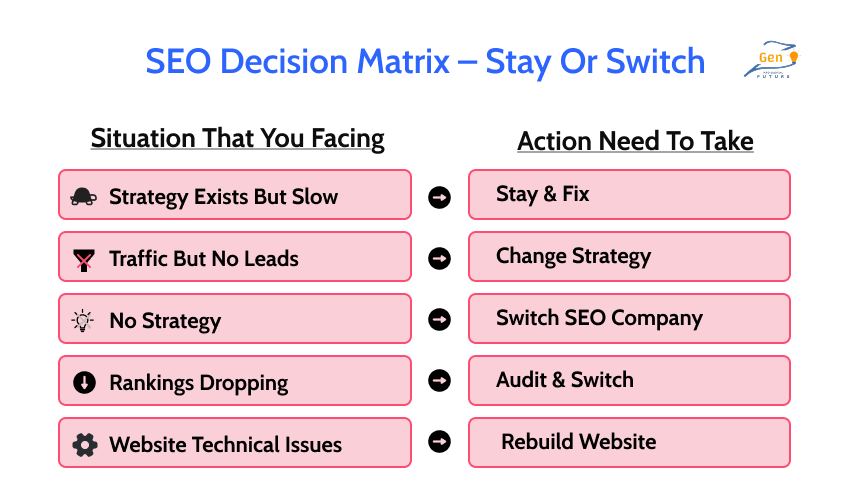
To make this truly executable, I’ve developed the SEO Decision Matrix. This is the same framework I use during initial consultations to determine if a client’s existing campaign is a “fixable project” or a “total loss.”
Instead of relying on gut feelings, use this logic-based grid to map your current reality to the necessary strategic action.
The Decision Matrix
| Situation | Diagnosis | Strategic Action |
| Strategy exists, but execution is slow. | Operational Friction | STAY & FIX: Set tighter 30-day milestones and demand a dedicated account lead. |
| Traffic is growing, but leads are flat. | Conversion Gap | STAY & PIVOT: Redirect the agency to focus on “Money Keywords” and CRO (Conversion Rate Optimization). |
| No strategy, only “random acts of SEO.” | Strategic Incompetence | SWITCH: You cannot fix a lack of vision. Cut ties before more budget is wasted. |
| Traffic/Rankings declining for 6+ months. | Algorithmic Penalty/Decay | AUDIT & SWITCH: Your current SEO agency is likely using outdated or toxic tactics. |
| Technical debt is so high, SEO won’t “stick.” | Foundational Failure | REBUILD SITE: No amount of content can save a site with a broken core. |
1. When to Stay: The “Fix the Relationship” Scenario
If your agency has a clear roadmap, communicates well, and you can see impressions growing in GSC, they are likely doing the right work, but search volatility or high competition is slowing the “clicks.”
- The Fix: Ask for a Priority Shift. Shift resources from new content to “Historical Optimization” (updating old posts) or technical performance.
2. When to Switch: The “Total Loss” Scenario
If you’ve gone 9 months with no strategy, no compounding growth, and your agency is defensive when asked for data, you are in a toxic partnership.
- The Red Flag: They tell you “Google is just weird right now” for the third month in a row.
- The Switch: Hire a consultant to perform a “Transition Audit” to ensure the old agency doesn’t leave “digital landmines” (like deleting optimised metadata) on their way out.
3. When to Pause SEO: The “Budget Reset”
If your business model has changed or your website is currently undergoing a massive rebranding that isn’t SEO-informed, pause your retainer. * The Reason: Paying for backlinks to pages that will soon be deleted or redirected is a waste of capital.
4. When to Rebuild the Site: The “Foundational” Proof
Sometimes, the warning sign isn’t the agency-it’s the engine. I’ve seen cases where agencies were doing “good work” on a site built on a slow, bloated, or non-indexable CMS.
If your “Core Web Vitals” are failing and your site architecture is a “flat” mess with no hierarchy, stop the SEO and invest that budget into a high-performance, SEO-first rebuild.
The “Stay vs. Go” Turning Point
I once audited a client who was ready to fire their agency because leads had dropped. Upon closer inspection of their SEO Decision Matrix, I found the agency had actually increased traffic for “Money Keywords” by 40%, but the client’s sales team wasn’t answering the phone. We stayed with the agency but “fixed” the internal lead-handling process.
Conversely, I’ve had clients “stay” for two years with an agency building 0-value links, losing hundreds of thousands in potential revenue. Knowing when to quit is as much a skill as knowing how to rank.
What Happens When You Switch to the Right SEO Company (The Recovery Timeline)
The most common fear business owners have when switching is: “Will I lose the progress I’ve already made?” The truth is, if your current progress is built on a shaky foundation, a temporary “dip” during a cleanup is often necessary to clear the path for long-term growth. When you switch to other SEO company expert you move from a “guessing” phase to a “compounding” phase.
Based on my experience managing dozens of agency-to-agency transitions, here is the real-world recovery timeline you should expect:
Month 1: The Forensic Audit & Deep Integration
We don’t start by writing blogs; we start by identifying the “leaks” in your current ship. GO for Full technical audit, GSC data deep-dive, and competitor “Gap Analysis.”
A document mapping every “toxic” link or “intent-mismatched” page left by the previous agency.
What you see is Stabilized technical health and a clear 6-month roadmap.
Month 2: The “Clean-up” & Quick Wins
We fix the low-hanging fruit that the previous agency ignored to get early momentum. Fixing 404 errors, optimizing existing meta-titles for higher CTR, and disavowing toxic links.
An “Impressions” lift in GSC. Even if clicks are flat, Google is starting to “re-index” your site with more trust.
Month 3: Content Depth & Topical Authority
This is where we stop chasing keywords and start owning “topics.” Launching the first “Pillar Pages” and supporting clusters. We focus on Search Intent-ensuring your pages solve the user’s problem.
Your first set of “Long-Tail” keywords move from Page 5 to Page 1.
Month 4: The Ranking Shift
The technical fixes from Month 1 and the content from Month 3 begin to synergize. Go for Internal link optimization and high-quality, niche-relevant outreach (Backlinks).
As a result you will see Your “Money Keywords” (transactional terms) begin moving into the Top 10.
Month 5 – Authority Building & Trust Signals
Month 5: The Compounding Traffic Growth
By Month 6, the “SEO Flywheel” is spinning.Analyzing what worked in Months 1-5 and doubling down. We begin Conversion Rate Optimization (CRO) to ensure the new traffic is actually becoming leads.
As a result A steady, “staircase” upward trend in organic traffic and most importantly a measurable increase in qualified inquiries.
Don’t Settle for “Maintenance Mode”
If your current agency has had 9 months and hasn’t reached the “Month 3” milestones of this timeline, you aren’t in a slow-burn campaign—you’re in a stagnant one. SEO should be an investment that makes your business more valuable every single month.
Final Verdict: If You See 3 or More Warning Signs, You’re Already Late
After auditing hundreds of campaigns, I’ve noticed a painful pattern: most business owners wait until their traffic hits zero before they decide to pull the plug. By then, the damage isn’t just financial; it’s structural.
If you have read through this list and identified three or more warning signs, you are no longer in a “slow period.” You are in a failing partnership. Every day you wait to make a change doesn’t just cost you the monthly retainer-it costs you the compound growth you should have been earning.
Avoid the “Sunk Cost” Trap
The most dangerous phrase in business is, “We’ve already invested so much into this agency, let’s give them three more months.” In the SEO world, this is a fallacy. If an agency has spent six months building the wrong foundation, three more months will only bury your site deeper under “technical debt” and toxic links. You aren’t “losing” the work you paid for by switching; you are stopping the bleeding so you can actually start building.
The Real Cost of Delay
The “Delay Cost” is often higher than the agency fees themselves. While your site sits stagnant:
- Competitors are securing “Topical Authority”: Once a competitor owns a niche in Google’s eyes, it takes twice as much effort and budget to unseat them.
- The Recovery Gap widens: It is significantly faster to switch and pivot a healthy strategy than it is to recover a site that has been hit by a manual penalty or total algorithmic neglect.
Remember Recovery time is almost always longer than the time it takes to switch. If you switch to other seo company today, you could see a turnaround in 90 days. If you wait until you’re penalised, you’re looking at a 6-to-12-month rehabilitation project.
Stop Paying for Activity. Start Investing in Results.
Don’t let your SEO become a “black box” expense. If your current provider cannot meet the benchmarks of the SEO Decision Matrix, it’s time to take control of your digital asset.
Ready to see what a real strategy looks like for your business?
At Genzpro Tech, we don’t believe in “guessing” when it comes to your ROI. We can help you perform a “Blind Audit” of your current GSC data to find exactly where the leaks are and provide a clear, executable path forward.

