

If you’re checking your rankings every morning only to see your website stuck on page four, it’s easy to feel like your SEO efforts are shouting into a void. You’ve invested the time, the budget, and the creative energy, yet the “big win”-that coveted #1 spot-remains elusive.
But here is the reality of search engine optimization: Rankings are a lagging indicator-and if you’re wondering how long it actually takes, here’s a detailed breakdown on how long it takes to see SEO results.
In my years working as an SEO consultant managing organic growth strategies, I’ve seen countless businesses abandon their SEO campaigns just weeks before a massive breakthrough because they didn’t know how to read the “silent” signals of success. Before Google grants you the crown of a top position, it puts your site through a series of tests.
SEO isn’t a light switch; it’s a momentum build. If you know what to look for in your data, you can see the engine humming long before you reach your destination.
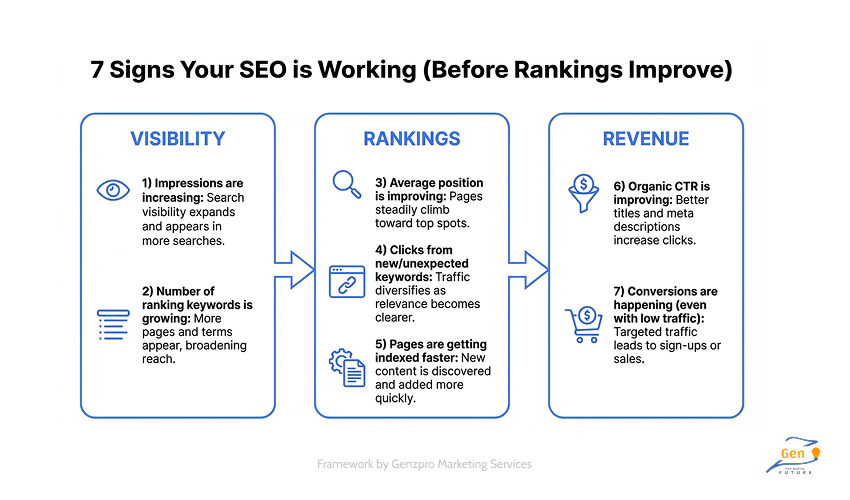
In this guide, I’m going to show you the 7 definitive Signs Your SEO is Working, backed by the exact metrics I use to prove ROI to stakeholders before the first page-one ranking even hits. These aren’t just “feel-good” stats-these are executable data points you can verify in your Google Search Console today.
Sign #1 -Your Impressions Are Growing (Even If Rankings Aren’t)
If rankings are the “sale,” then impressions are the “foot traffic.” In my professional experience delivering high-impact SEO services for industries like interior design and tech, a surge in impressions is the most reliable leading indicator that Google’s algorithm is currently “testing” your content.
When you optimize a page, Google doesn’t immediately hand you a top spot. Instead, it begins surfacing your URL for a wider variety of long-tail queries and secondary keywords-often on pages 3 through 10. You aren’t getting the clicks yet because users rarely venture that deep, but the fact that Google is showing your link at all is proof that your topical relevance is increasing. It’s a sign that the “indexation hurdle” is cleared and the “evaluation phase” has begun. Google is essentially “auditioning” your site to see how it fits into the broader search ecosystem.
How to Verify It (Proof)
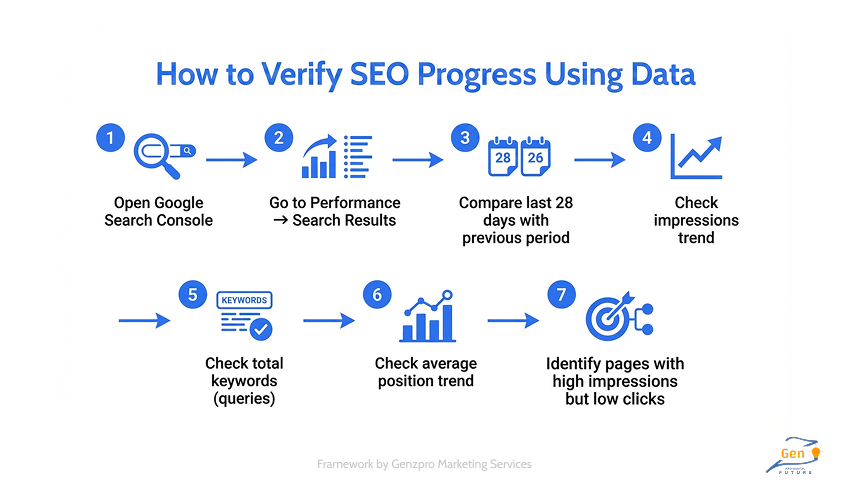
Don’t guess; use the raw data. To see if your SEO is gaining momentum, follow this exact workflow in Google Search Console:
- Open the Performance Report: Navigate to the “Search results” tab on the left sidebar.
- Set the Date Filter: Click the date filter at the top and select Compare > Compare last 28 days to previous period.
- Analyse the “Total Impressions” Checkbox: Look specifically at the purple “Impressions” line.
If your rankings (the orange line) look flat, but the purple line is trending upward with higher peaks than the previous month, your SEO is working. This delta proves that your site is appearing for more search queries than it was 30 days ago.
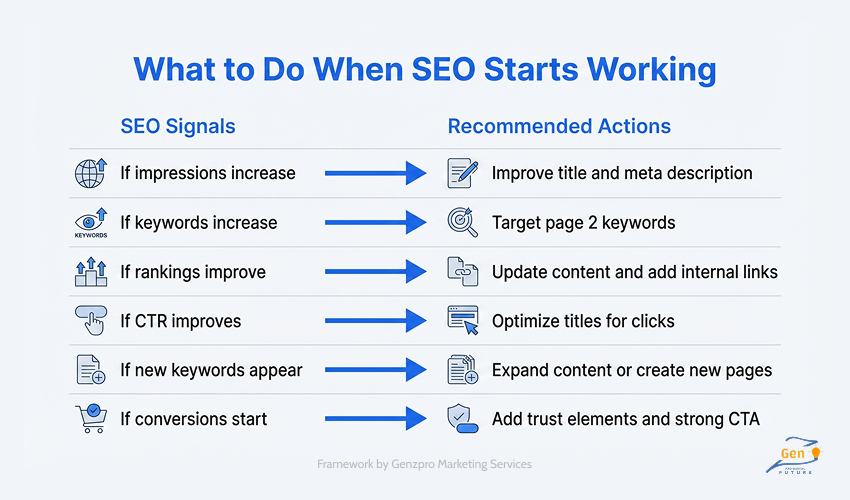
What You Should Do Next (Action)
Growth in impressions is a signal to pivot from content creation to conversion optimization.
- Improve CTR with Metadata: If you have high impressions but zero clicks, your “packaging” is the problem. Rewrite your Title Tags and Meta Descriptions to be more provocative or benefit-driven. This tells Google that when you do show up, users want to click.
- Double Down on Winners: Identify the specific pages driving those impressions. Add 200–300 words of “Expertise” (E-E-A-T) to those pages, such as a case study or a specific technical insight. This extra weight often pushes those “testing” impressions into “ranking” clicks.
Sign #2 -You’re Ranking for More Keywords
Why This is a Major Breakthrough Signal
Before you see a single keyword hit the #1 spot, you will see a “bloom” in the total number of keywords your site is ranking for. In the SEO world, this is the definitive signal of Topical Authority.
When Google begins to trust your expertise, it doesn’t just rank you for your primary keyword; it starts associating your domain with an entire “cloud” of related terms, synonyms, and long-tail variations. This expansion proves that the search engine has successfully mapped your content’s context. If you were previously ranking for 50 terms and you are now appearing for 150, the “breadth” of your reach is growing. This is a massive breakthrough because it creates a wider safety net for traffic and indicates that your site’s foundational structure is sound.
How to Check (Proof)
To see this expansion in real-time, you need to look at the volume of unique queries triggering your site in Google Search Console:
- Navigate to the Performance Report: Click on “Search results.”
- Filter by Date: Compare the “Last 3 months” to the “Previous period.”
- Scroll to the “Queries” Table: Look at the total number of rows at the bottom of the table.
If the total count of queries has increased—even if those queries are currently sitting on position 80—your SEO strategy is gaining traction. It means Google is finding more “reasons” to show your website to users.
The Quick Wins Strategy
Keyword expansion is the perfect roadmap for “Low Hanging Fruit” optimization. You aren’t starting from scratch anymore; you’re just finishing the job.
- Target the “Striking Distance” Keywords: Filter your GSC report to show queries with an average position between 11 and 25. These are your Page 2 and Page 3 keywords.
- The “Quick Win” Edit: Visit the pages ranking for these terms. Often, adding a specific H2 or H3 heading that explicitly mentions these “Page 2” keywords—and providing a 100-word expert answer beneath it—is enough to nudge that ranking onto Page 1 within days.
- Internal Linking: Link from your highest-authority pages to these “rising star” pages using the new keywords as anchor text to pass on ranking power.
Sign #3 -Your Average Position Is Improving Gradually
The “Silent Climb” Most People Ignore
In the world of high-end SEO, progress isn’t usually a vertical jump from page ten to page one; it’s a “silent climb.” Most site owners ignore these micro-movements because they don’t see an immediate spike in traffic, but in my experience working with an SEO company, this is where the real battle is won.
If a keyword moves from position 85 to 45, or from 45 to 22, your traffic won’t change—you’re still invisible to the average user. However, these shifts are a massive “green light” from Google. It signifies that your technical fixes and content updates are moving the needle. It shows that Google is progressively favoring your site over competitors. Tracking these incremental gains—the 10-spot jumps—is the only way to stay motivated during the “plateau” phase of a campaign.
How to Verify It (Proof)
To visualise this momentum, you need to look at the trend line rather than a single snapshot. Use Google Search Console to see the climb:
- Toggle the Average Position: In the Performance report, click the orange “Average position” box to activate the line graph.
- Filter by Page: Don’t look at the site-wide average, as new content can skew the data. Instead, click + NEW > Page and enter the URL of a specific blog post or service page you’ve been optimising.
- Check the Trend: Set the timeframe to the “Last 3 months.”
If that orange line is sloping downward (remember, in rankings, a lower number is better), you have definitive proof that your authority is building.
Pushing the Rankings Faster (Signs Your SEO is Working)
Once you see a “climb” in progress, you need to feed that momentum to break onto the first page.
- Freshness Updates: Google loves “fresh” data. If a page is climbing, go back in and update a few statistics, add a new expert tip, or refresh the “last updated” date. This often triggers a re-crawl that accelerates the climb.
- Strategic Internal Linking: Find your highest-ranking, most authoritative pages and add a descriptive internal link to the “climbing” page. Use specific anchor text (e.g., “modern minimalist interior design tips”) to give Google a clear signal of what that page deserves to rank for. This “link juice” can be the final nudge needed to move from position 12 to position 8.
Sign #4- Clicks Start Coming From Unexpected Keywords
Why This Signals Google Trust
One of the most exciting moments in an SEO campaign is when you notice traffic arriving via keywords you didn’t even explicitly target. This is a powerful signal that Google has moved past “keyword matching” and into intent understanding.
When Google trusts your domain’s authority, it begins to “hallucinate” relevance—in a good way. It starts testing your content against broader, more complex user intents because it views your site as a reliable source of information within your niche. For example, you might be targeting “luxury villa design,” but you start seeing clicks for “minimalist basement gym ideas.” This means Google has recognized the depth of your expertise and is rewarding you by casting a wider net for potential visitors.
How to Verify It (Proof)
You can find these hidden gems by digging into the “Queries” report in Google Search Console:
- Open the Performance Report: Go to “Search results.”
- Filter by Page: Focus on a specific high-performing URL.
- Analyze the Queries Table: Sort by Clicks and scroll past your primary targets.
- Spot the Anomalies: Look for long-tail phrases or “how-to” questions that you haven’t specifically optimized for. If these are generating clicks, you’ve successfully built “topical clusters” that Google finds valuable.
Harvesting New Opportunities
Don’t let these “accidental” rankings go to waste. They are your next big traffic drivers.
- Expand Content Depth: Take those unexpected queries and turn them into dedicated H2 or H3 sections within your existing post. By giving these terms their own “home” on the page, you validate Google’s testing and solidify those rankings.
- The Spinoff Strategy: If an unexpected long-tail keyword is getting significant impressions, it deserves its own page. Create a new, hyper-focused blog post and link it back to your main pillar page. This creates a powerful internal feedback loop that tells Google you are the definitive authority on every sub-topic in your industry.
Sign #5 – Your Pages Are Getting Indexed Faster
Why Indexing Speed = Trust Signal
In the early stages of a website’s life, you might wait weeks for Google to even acknowledge a new blog post. However, as your SEO strategy takes hold, you’ll notice a significant shift: your content starts appearing in search results within hours, or even minutes, of hitting “Publish.”
This isn’t a coincidence; it is a direct reflection of your Crawl Budget and Domain Trust. Google’s “spiders” are constantly prioritizing where they spend their energy. When you consistently provide high-quality, optimized content, Google flags your site as a reliable source.
It essentially “whitelists” your URL for more frequent crawls because it knows that when you publish something, it’s likely to be valuable to users. Speed of indexation is Google’s way of saying, “We trust what you have to say, and we want it in our index as soon as possible.”
How to Verify It (Proof)
Tracking indexation speed is a simple way to measure your increasing authority. Here is how to audit your site’s “freshness”:
- The Live Test: Immediately after publishing a new page, copy the URL and paste it into the URL Inspection Tool in Google Search Console.
- Request Indexing: Click “Request Indexing” and wait 24 hours.
- The “Site:” Search: Go to Google and search site:yourdomain.com/your-new-page.
If your page is appearing in the results without you having to “force” it through the Inspection tool multiple times, your crawl frequency has increased. A healthy, trusted site should see new content indexed automatically within 24–48 hours.
Maintaining the Momentum
Indexing speed is a “use it or lose it” metric. To keep Google coming back daily, you must signal consistency.
- Maintain a Publishing Cadence: Google’s crawlers learn your behavior. If you publish every Tuesday at 10:00 AM, the crawlers will eventually anticipate that update. Consistency breeds frequent crawling.
- Strengthen Your Internal Web: Never let a new page sit in isolation. Immediately link to your new post from 2–3 older, high-traffic pages. This provides a clear “pathway” for the crawler to follow from a trusted page to your new content, ensuring it gets picked up instantly.
Sign #6 – Your Organic CTR Starts Improving
Why CTR Is a Ranking Multiplier
Click-Through Rate (CTR) is the ultimate feedback loop between you and Google’s algorithm. While rankings get you on the stage, CTR tells Google whether the audience actually liked your performance. In my work with high-end luxury brands, I’ve found that a rising CTR is often the “tipping point” that pushes a site from the bottom of Page 1 to the top three spots.
Google uses CTR as a proxy for relevance. If your link is in position #5 but users are clicking it more often than the link in position #3, the algorithm concludes that your content is a better match for that search intent. Improving your CTR essentially “proves” to Google that you deserve a higher rank, turning your search appearance into a ranking multiplier.
How to Verify It (Proof)
You can track this behavioral shift directly in Google Search Console:
- Check the CTR Metric: In your Performance report, check the green “Average CTR” box.
- Analyze Trends: Look for a steady upward slope in the CTR line over the last 90 days.
- Identify Underperformers: Sort your “Pages” by high impressions but low CTR (anything below 2% for a Page 1 result). If you see these numbers starting to tick upward—even by 0.5%—your brand presence and snippet relevance are strengthening.
Engineering the Click
Once you see CTR movement, you should aggressively optimize your “search real estate” to win the click.
- Inject Curiosity and Intent: Rewrite titles to address the user’s specific pain point. Instead of a flat title like “Interior Design Trends,” use “7 High-End Design Trends That Increase Property Value.”
- Use Power Words and Numbers: Data shows that titles including brackets, years (e.g., [2026 Edition]), or specific numbers tend to see a 10–15% higher CTR. Adding these elements makes your result pop against the sea of plain text.
Sign #7 – You Start Getting Conversions (Even With Low Traffic)
Why This Is the Ultimate Validation
The most common mistake business owners make-especially when they hire an SEO agency-is obsessing over “vanity metrics”.like total sessions or unique visitors. However, in my experience—whether I’m optimising for a high-end interior design studio or a technical digital agency—the ultimate proof that your SEO is working is a conversion.
When you start receiving inquiries, form fills, or sales while your traffic is still relatively low, it is a definitive signal that you have achieved Search Intent Alignment.
It means you aren’t just attracting “browsers”; you are attracting “buyers.” High-quality SEO isn’t about casting the widest net possible; it’s about casting the most precise one. If you have only 100 visitors a month but three of them turn into high-ticket leads, your SEO is infinitely more successful than a site with 10,000 visitors and zero conversions.
This “early conversion” phase proves that Google has successfully identified the commercial or transactional nature of your content and is serving it to the right persona.
How to Verify It (Proof)
Validation doesn’t happen in Google Search Console; it happens in your inbox and your analytics dashboard.
- Monitor Lead Quality: Track your contact form submissions, WhatsApp clicks, or direct phone calls. Even if you are only getting one or two a week, look at the source. If they are coming from organic search, your strategy is hitting the mark.
- Check Goal Completions in GA4: Use Google Analytics 4 to look at your “Conversion” events filtered by “First user medium = organic.”
- The “Small Number” Rule: Do not dismiss small numbers early on. If your conversion rate is 2% or 3% on a low-traffic page, that page is a goldmine waiting for more volume. It is a proven asset that just needs more “fuel” (traffic) to explode your ROI.
Scaling the Success
Once a page proves it can convert, it becomes your highest priority asset. You need to move from “ranking” mode to “revenue” mode.
- Maximize Content-Intent Match: Re-read the page that converted. Does it clearly solve the user’s problem? Ensure your Call to Action (CTA) is unavoidable. If it’s a blog post, add a “lead magnet” or a direct link to a service page.
- Optimize for Trust: Add specific “Proof Points” to these high-converting pages. Include client testimonials, project case studies, or professional certifications. If you’re an interior designer, show a “Before and After” gallery; if you’re in SEO, show a growth chart. These trust signals reduce friction and turn more of that “low traffic” into “high revenue.”
- Internal Link Injection: Funnel your site’s authority toward these converting pages. Link to them from your homepage or your highest-traffic posts to ensure they get the “ranking juice” they need to move from page two to page one.
Real SEO Timeline – When Do These Signs Appear?
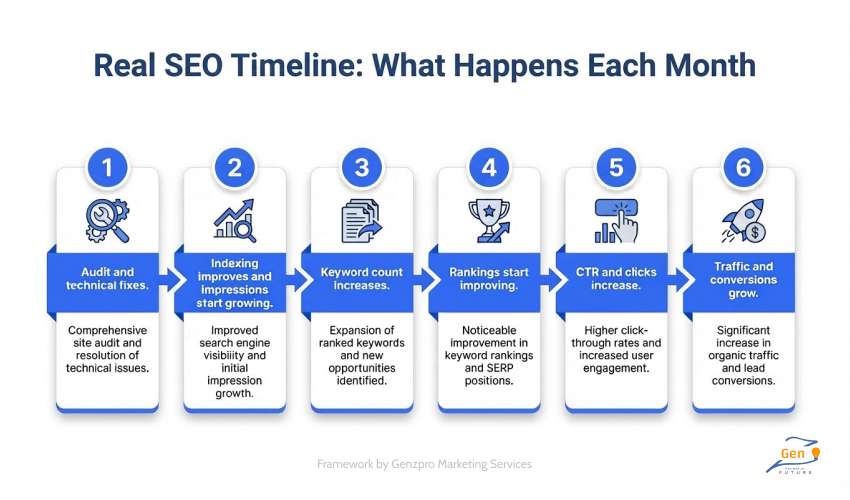
One of the most common questions I get from clients in Dubai’s competitive market is: “When will I see results?” While every niche varies, a strategy used by a professional SEO firm generally follows a predictable six-month maturity curve. Based on my experience managing campaigns as an SEO company for both luxury design studios and digital agencies, here is the realistic timeline you should expect.
Month 1 : Audit & Technical Fixes
The first 30 days are about clearing the “technical debt.” We focus on fixing crawl errors, improving site speed, and ensuring the site architecture is sound. At this stage, you won’t see more traffic, but you are building the foundation.
As a Proof there is a “clean” report in GSC Core Web Vitals.
Month 2 : Indexing + Imp
This is the “Topical Authority” phase. You’ll start ranking for hundreds of long-tail queries you didn’t explicitly target. Even if they are on page 8, it proves Google is finally categorizing your site correctly.
An increase in the “Total Queries” count in your GSC Performance table is seen as a proof.
Month 4 : Ranking Movement
The “Silent Climb” becomes visible. You’ll notice your core keywords jumping from position 80 to 30. This is the most critical month for patience; the momentum is building, but the “fruit” isn’t quite ripe yet.
As a Proof Average position starts trending downward (improving) in GSC.
Month 5 : CTR + Click Growth
As your rankings nudge toward the bottom of Page 1 and the top of Page 2, your clicks will finally start to move. This is when we refine Meta Titles to maximize the Click-Through Rate.
The green CTR line and blue Click line start to mirror the impression growth.
Month 6 : Traffic + Conversions
This is the “Breakthrough” month. If the strategy was executed correctly, the compounding interest of the previous five months results in Page 1 rankings for high-intent terms. The traffic is now qualified, and the inquiries start hitting your inbox.
The proof for this is that there is a measurable increase in organic conversions and ROI.
Final Thoughts: SEO Success Is Visible Before Rankings
If there is one takeaway I want you to remember from my years of navigating Google’s shifting algorithms, it is this: SEO is a game of momentum, not a lottery. The biggest mistake you can make is viewing “Page 1” as the only metric of success. If you wait until you are ranking #1 to decide if your strategy is working, you will likely quit while you are just inches away from the finish line. SEO success is a cumulative process.
SEO begins with Google trusting your technical foundation, moves into a phase where your topical authority is “tested” through impressions, and finally culminates in the high-intent traffic that drives your business forward.
Patience is your greatest competitive advantage. By tracking these seven silent signals-from impression growth to the unexpected long-tail clicks-you can move forward with the confidence that your investment is actually building an asset. Stop looking at your rankings in a vacuum and start looking at the momentum in your data. If these signs are present, the rankings aren’t just a possibility; they are an inevitability.
This is how google evaluates content..
Ready to turn these “silent signals” into a predictable revenue engine? If you’re still evaluating partners, here’s how to choose the right SEO agency before you invest.
Genzpro.tech works as a results-driven SEO consultant specialising in high-intent strategies and premium SEO services that bridge the gap between growing impressions and actual ROI-Contact us today to start scaling your organic growth.

