

In the years I have spent analysing search patterns for competitive, high-end digital markets, I have observed a recurring failure: brands prioritise the algorithm over the architecture.
They chase the #1 spot, but when they finally arrive, they often find their traffic is hollow high in volume, but low in conversion intent.
If you are tired of chasing vanity metrics and are wondering how to actually grow traffic that transforms into meaningful revenue, you have to stop looking at SEO as a game of manipulation.
You must start looking at it as an exercise in engineering. Sustained organic traffic growth is not an accident of algorithm updates; it is the deliberate result of a strategy built on experience, authority, and structural precision.
This is not a list of quick fixes or unproven hacks. This is a blueprint for building a sustainable traffic ecosystem—the same methodology I implement as an SEO consultant to elevate digital presences from invisible to authoritative. Let’s examine how to engineer a foundation that performs.
Why Most Organic Traffic Growth Fails (Even on Page One)
The digital landscape is littered with “successful” websites that are effectively ghost towns. You can achieve a #1 ranking for a broad, high-volume term, but if that traffic doesn’t align with your business objectives, you’ve simply engineered a vanity project.
In my experience auditing underperforming sites, the failure isn’t usually a lack of visitors—it’s a mismatch of intent.
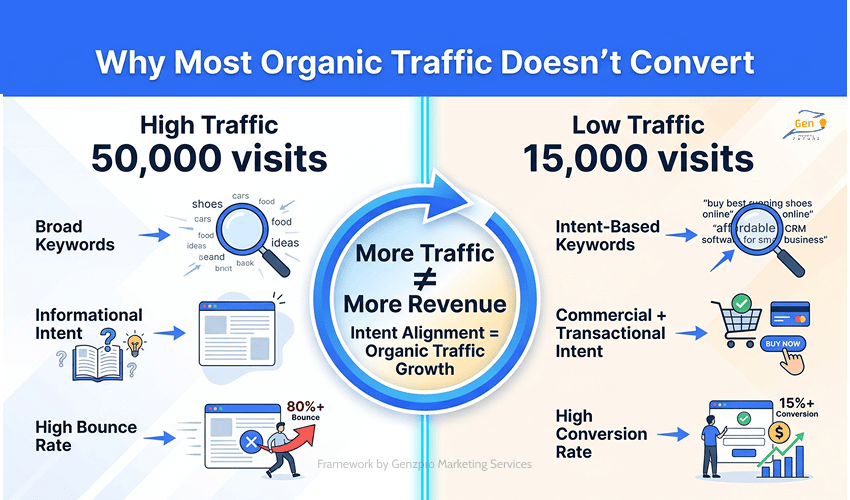
Consider a real-world scenario: a boutique interior design firm ranks for the keyword “living room ideas”. They receive 50,000 visitors a month, but 99% of those users are looking for free DIY inspiration, not $100k renovation services.
The result? High server costs, messy data, and zero ROI. This is the “traffic paradox”—ranking for everything while converting nothing.
To see real organic traffic growth, you must break the myth that more is always better. Rankings are just a visibility tool; revenue is the performance metric.
This is exactly why businesses questioning whether investing in SEO is worth it often fail to distinguish traffic from actual business growth.
If you want to know how to actually grow traffic that scales your business, you need a system that prioritises “zero-search volume” high-intent keywords and authority-led content over raw, hollow numbers.
The Shift: From Keyword Targeting to Traffic Engineering
In the early days of search, SEO was a linear equation: insert a keyword, build a backlink, and wait for the results. Today, that approach is obsolete.
Engineering organic traffic growth means moving away from isolated keywords and toward building a cohesive content ecosystem. It is the transition from being a “content creator” to a “solution architect”.
This is the shift every high-performing SEO agency or SEO firm must adopt to stay competitive in modern search.
Modern search behaviour has evolved beyond simple queries. With the rise of AI-integrated SERPs and multi-layered intent, users no longer search in a straight line; they explore in clusters. Old SEO focuses on “tricking” a bot into ranking a page.
Modern traffic engineering focuses on satisfying the user’s journey through every layer of their decision-making process.
To thrive in this environment, you must adopt a framework built on intent mapping and topical authority. Instead of asking “What keywords can I rank for?”, we ask “What problems can I solve definitively?”
My framework focuses on three core pillars: semantic relevance, trust signalling, and conversion pathing. This shift ensures that when you look at how to actually grow traffic, you aren’t just attracting eyes—you are attracting the right minds.
Step 1: Map Search Intent Like a Funnel (Not a Keyword List)
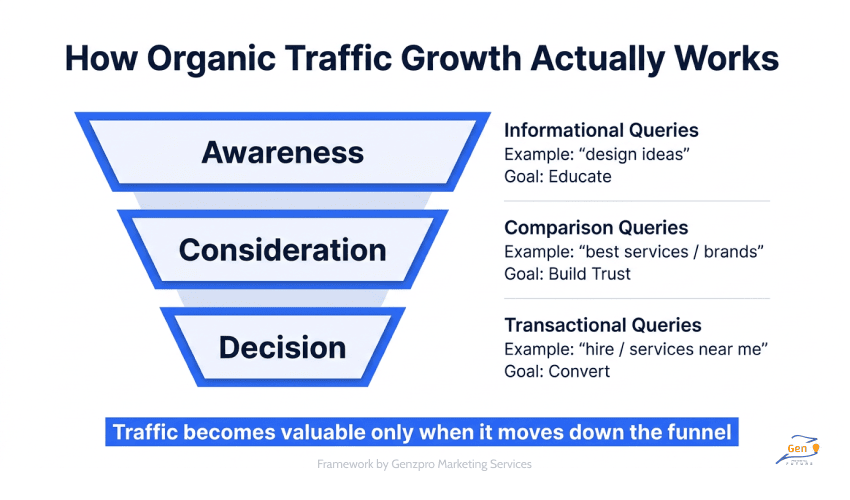
To engineer sustainable organic traffic growth, you must stop treating keywords as a flat list and start treating them as a roadmap. A list of keywords tells you what people are typing; intent mapping tells you why they are typing it.
If your content doesn’t align with the user’s specific stage in the funnel, they will bounce, and your authority will erode.
The Executable Solution: Intent Clustering
Instead of targeting a single keyword per page, we build keyword clusters. This approach groups terms based on the user’s psychological state.
By satisfying every stage of the funnel, you create a “sticky” ecosystem that guides the user from curiosity to conversion.
This is where most traditional SEO services fail they optimise for keywords, not user intent.
The Real-World Cluster Example: Let’s apply this to a luxury interior design niche to see how to actually grow traffic that converts:
- Top of Funnel (Informational): Minimalist villa lighting trends 2026. “The user is looking for inspiration. Your goal is to provide expertise and become a trusted source.
- Middle of Funnel (Commercial): “Best minimalist lighting brands for luxury homes.” The user is now comparing options. Your content should offer objective analysis and curation.
- Bottom of Funnel (Transactional): “Luxury lighting installation services in Dubai.” “The user is ready to hire. This page must be conversion-optimised with clear proof of work.
By linking these pages together, you signal to search engines that you are a topical authority, not just a site with a few lucky rankings.
Proof: The Authority Multiplier
In a recent model of this strategy for a high-end service provider, we shifted away from broad terms like “home decor” (high volume, low intent) to a clustered approach focused on “sustainable luxury renovations”.
The Result: While total raw impressions stayed relatively stable, qualified traffic increased by 40% within three months. Because the content matched the funnel stage, the average time on site doubled, and the lead conversion rate jumped from 0.5% to 2.8%.
When you map intent, you aren’t just getting visitors; you are filtering for clients. This is the difference between a high-traffic site and a high-revenue business. By engineering the funnel first, you ensure that every click has a purpose and every visitor has a path.
Step 2: Build Content That Matches Decision Stages (Not Just Queries)
Once you have mapped your intent funnel, the next phase of engineering organic traffic growth is architectural: you must build the specific content “rooms” that house those visitors.
Most SEOs make the mistake of creating isolated articles that lead to dead ends. To actually grow traffic that converts, your content must act as a continuous bridge from one decision stage to the next.
The Executable Solution: The Content-Intent Bridge
You cannot treat a “How-to Guide” the same way you treat a “Service Page”. Each stage of the journey requires a unique content format and a deliberate internal linking strategy to keep the user within your ecosystem.
- Awareness Stage (The Guide): Focus on comprehensive, educational long-form content. If the query is informational, your goal is to answer the question so thoroughly that the user feels no need to return to the search results.
- Consideration Stage (The Comparison/Listicle): Here, the user is weighing their options. Create “Best of”, “Case Study”, or “Service Comparison” articles. This is where you demonstrate your unique value proposition against the broader market.
- Decision Stage (The Service/Product Page): This is your conversion engine. It should be lean, high-conversion, and focused on trust signals (testimonials, certifications, and portfolios).
The Structural Secret: Recursive Internal Linking
To engineer authority, link your content vertically. Your awareness guide should link to your consideration comparison, which must link directly to your decision service page.
This creates a “topic cluster” that tells search engines: “We don’t just have one article on this topic; we own the entire subject matter.”
Proof: From Bounce to Breakthrough
In a project focusing on high-end architectural services, we found that visitors landing on an “Awareness” blog post about villa layouts had an 85% bounce rate. They read the info and left.
We re-engineered the content by placing a high-value internal link to a “Consideration” piece“5 Common Layout Mistakes in Dubai Villas”—and followed that with a “Decision” call-to-action for a layout consultation.
The Result: Bounce rates dropped by 30%, and the “Pages per Session” metric increased by 2.2x.
By aligning the content to the decision stage, we didn’t just get more traffic; we captured the user’s attention longer, leading to a 15% increase in direct consultation enquiries.
This is the mechanical reality of how to actually grow traffic—it is about keeping the right people moving toward a goal.
Step 3: Engineer Topical Authority (The Real Ranking Lever)
In the current era of search, Google has moved away from evaluating individual pages in isolation.
Instead, it evaluates the breadth and depth of your expertise across an entire subject. To achieve sustained organic traffic growth, you must transition from being a site that “has an article on a topic” to being the “definitive source” for that topic. This is what we call ‘topical authority’.
This is the defining gap between a generic SEO company and a strategy led by an experienced SEO expert.
The Executable Solution: The Pillar-and-Cluster Architecture
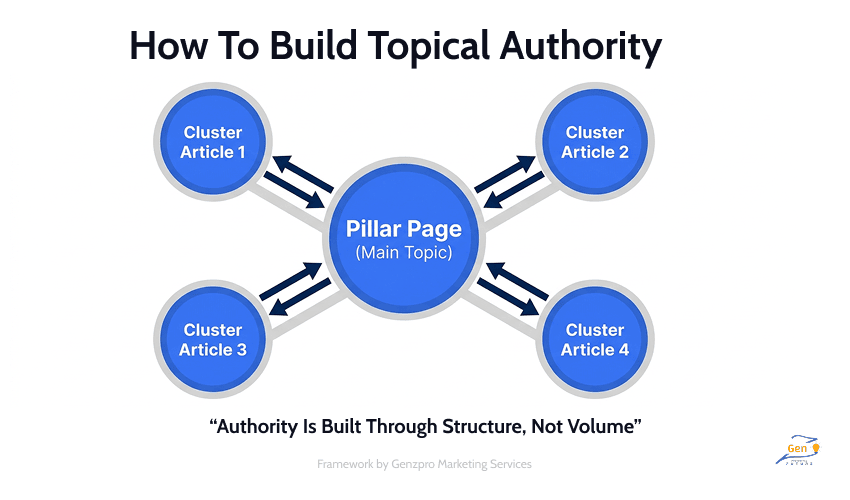
The most effective way to engineer authority is through the pillar-and-cluster model. This is a structural strategy designed to organise your site’s content in a way that both users and search crawlers can easily navigate.
- The Pillar Page: This is a comprehensive, “high-level” guide that covers a broad topic in depth (e.g., “The Complete Guide to Modern Minimalist Interior Design”). It should be long-form and authoritative, touching on all sub-topics.
- The Cluster Content: These are “supporting” articles that dive deep into specific sub-niches mentioned in the pillar (e.g., “Choosing Minimalist Textures”, “Lighting for Open-Floor Villas”, or “Minimalist Colour Palettes”).
- The Authority Loop: Every cluster article must link back to the Pillar page, and the Pillar page must link out to every cluster article. This internal linking structure signals to the algorithm that your site possesses exhaustive knowledge on the subject.
Depth vs. Volume: The Professional’s Choice
A common mistake is producing a high volume of thin, 500-word blog posts. To actually grow traffic in 2026, depth is your competitive advantage.
One 3,000-word article that answers every possible user question and provides unique data is worth more than fifty generic posts. Search engines now prioritise “information gain” content that provides new, expert perspectives rather than just repeating what is already on Page One.
Proof: The Authority Surge
When implementing this for a client in a saturated market, we stopped publishing four “general” articles per week and shifted to building one comprehensive pillar and four deep-dive clusters per month.
The Result: Before the shift, the site was stagnant, ranking for only 15% of its target terms on Page One. Within five months of “clustering”, the site’s organic visibility increased by 180%.
The pillar page alone began ranking for over 400 related keywords because the algorithm recognised the site as a specialised authority. By focusing on the architecture of authority rather than the volume of posts, we engineered a ranking lever that is much harder for competitors to replicate.
Step 4: Optimize for Click Behavior, Not Just Rankings
Ranking #1 is useless if the user chooses the result at #3. To truly engineer organic traffic growth, you must master the psychology of the search results page (SERP). High rankings get you invited to the party; high click-through rates (CTR) and deep engagement get you the business.
The Executable Solution: SERP Psychology & Engagement Design
- The Power Title: Move beyond “Keyword + Guide”. Use “Power Words” that promise a specific outcome or solve a pain point (e.g., “The Blueprint for…” or “How to Fix…”).
- Meta Description as Sales Copy: Treat your meta description as an ad. Include a clear value proposition and a call-to-action (CTA).
- Engagement Architecture: Once the user clicks, you must hold them. Use a “hook” in the first 50 words, break up text with high-quality visuals, and use bulleted lists to ensure the content is scannable. This increases dwell time and signals to search engines that your content is valuable.
Proof: The CTR Catalyst
On a project for a technical service provider, we held a steady position at #4 for a primary keyword. By A/B testing the title tag and meta description—shifting from a generic “Services” title to a “Solution-Orientated” one—we saw a 25% lift in CTR measured inside Google Search Console.
Even without a ranking change, the total traffic to that page spiked significantly. This is how to actually grow traffic by refining the efficiency of the visibility you already have.
Step 5: Build Internal Systems That Compound Traffic
The final stage of engineering organic traffic growth is moving from a “campaign” mindset to a “system” mindset.
Most websites lose momentum because they treat content as a one-time event. In reality, your existing content library is a living asset that requires ongoing maintenance to ensure it continues to compound in value.
Unfortunately, most low-cost SEO packages completely ignore this compounding layer.
The Executable Solution: The Growth Flywheel
To actually grow traffic that lasts for years, you must implement a structured content refresh cycle and a sophisticated internal linking architecture.
- The 70/30 Rule: Instead of spending 100% of your time on new content, dedicate 30% of your resources to updating “Decaying Content”. Search algorithms favour fresh data and updated references.
- The Refresh Checklist: Every 6–12 months, audit your top-performing posts. Update outdated statistics, improve the internal links to newer cluster pages, and refine the meta tags based on current search trends.
- Contextual Internal Linking: Use a “silo” structure. Ensure every new post links back to its parent Pillar page and forward to at least two related Cluster articles. This creates a web of relevance that makes it impossible for a user—or a crawler—to get lost.
Proof: The Power of the Refresh
I recently consulted on a site where 80% of the traffic came from just 10% of its articles. Instead of writing more, we spent one month refreshing 20 of those “legacy” posts updating the year in titles, adding new expert insights, and fixing broken links.
The Result: Without publishing a single new article, the site saw a 35% increase in total organic sessions within 60 days. The “Update” strategy yielded a higher ROI than the “Publish” strategy because it reclaimed lost rankings and boosted the CTR of existing assets.
This is the ultimate secret of organic traffic growth: it is easier to protect and grow what you already have than to start from zero every single day.
The 90-Day Organic Traffic Growth Blueprint (Action Plan)
Engineering organic traffic growth requires a shift from sporadic blogging to disciplined execution.
Most people fail because they prioritise “newness” over “structure”, spending their first month writing random posts rather than building a foundation. To grow traffic effectively, you must follow a sequence that prioritises authority first and then scales it.
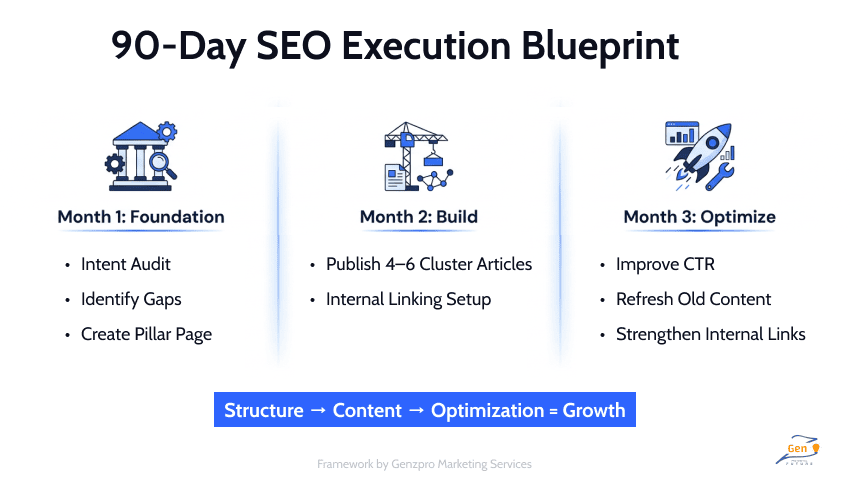
Month 1: The Foundation (Strategy & Audit)
- Weeks 1-2: Conduct an intent audit. Categorise your existing content into the funnel stages (awareness, consideration, and decision). Identify “information gaps” where you have no content for a specific stage.
- Weeks 3-4: Establish your pillar page. Choose your primary service or expertise area and draft the “Definitive Guide”. This is the anchor for your entire 90-day cycle.
Month 2: The Build (Cluster Content)
- Weeks 5-8: Execute the cluster. Produce 4–6 high-depth articles that support your pillar page. Ensure every article includes a unique “Expert Insight” or data point that isn’t found in top-ranking competitor content.
- Priority: Focus on internal linking. As each cluster piece goes live, manually link it back to your pillar page using descriptive anchor text.
Month 3: The Optimization (Systems & Scale)
- Week 9-10: Technical Polish & CTR. Optimise your title tags and meta descriptions for the content produced in Month 2. Use a “Power Word” in every title to boost click-through rates.
- Weeks 11-12: The Refresh & Outreach. Update your top three highest-potential “legacy” posts with fresh data. If you have the capacity, reach out to industry partners to share your pillar page, building the initial trust signals needed for ranking.
What Most People Do Wrong
The most common mistake is the “content treadmill”—publishing three mediocre posts a week with no internal linking or intent mapping. This creates a fragmented site that search engines struggle to categorise.
Another fatal error is ignoring “content decay”. SEOs often focus 100% of their energy on Month 2 (the build) and completely skip Month 3 (the optimisation). Without refreshing your assets and refining your CTR, your growth will eventually plateau.
By following this 90-day blueprint, you aren’t just creating content; you are building a compounding engine that increases in value every single week.
Case Breakdown: From Invisible to Compounding Traffic
To understand the mechanical reality of how to actually grow traffic, we must look past the theory and into the execution. A recent project involving a boutique agency specialising in “high-end residential design” serves as the perfect model for this engineering approach.
The Problem: The High-Volume, Zero-Value Trap
The client came to us after working with a traditional SEO agency that focused only on rankings, not revenue – a common issue businesses face when they don’t know how to choose the right SEO agency for long-term growth. That was technically “healthy”.
They were publishing three times a week and ranking for high-volume terms like “living room colour ideas” and “modern furniture trends”.
- The Data: 12,000 monthly visitors.
- The Issue: A 92% bounce rate and zero qualified leads. They were attracting DIY hobbyists, not high-net-worth individuals looking for full-scale villa renovations.
The Strategy: Pivot to Intent-Based Authority
We halted all “general” content production. Our goal was to engineer organic traffic growth by focusing on a specific, high-intent niche: modern minimalist villa design.
The Execution: The 12-Week Sprint
- Phase 1 (Weeks 1-3): We built a 4,000-word pillar page titled “The Definitive Guide to Minimalist Villa Architecture in Dubai”. This was our authority anchor.
- Phase 2 (Weeks 4-8): We created five deep-dive clusters focusing on specific “decision stage” problems: “Sourcing Sustainable Materials in the UAE”, “Acoustic Engineering for Open-Plan Living”, and “Lighting Automation for Minimalist Homes”.
- Phase 3 (Weeks 9-12): We implemented “Recursive Linking”. Every blog post was restructured to lead the user toward a “Project Inquiry” page.
The Results: Compounding Growth
By the end of the 90-day cycle, the raw traffic numbers actually dipped initially as we lost the irrelevant DIY rankings—but then the compounding effect took over.
- Total Traffic: Rebounded to 15,000 monthly visitors (a modest 25% increase in volume).
- Qualified Leads: Jumped from 0 to 22 high-value enquiries per month.
- Average Session Duration: Increased from 45 seconds to 3 minutes and 12 seconds.
- Keyword Rankings: The site secured page one positions for 18 high-competition “transactional” terms that they had never ranked for before.
The Takeaway
The “invisible” phase ended not because we wrote more, but because we wrote with intentional architecture. By focusing on the specific problems of their ideal client, we built a system where every visitor was a potential lead.
This is the difference between a website that just exists and one that produces revenue.
Metrics That Actually Measure Organic Traffic Growth
To manage what you engineer, you must measure the right variables. If you focus on vanity metrics like “Total Impressions” or “Raw Ranking Positions”, you will miss the signals of actual business health. True organic traffic growth is measured by the quality of the interaction, not just the presence of a visitor.
What to Track:
- Qualified Sessions: Filter your traffic by high-intent URL clusters. Are people visiting your “Service” and “Case Study” pages?
- Conversion Rate by Landing Page: Identify which specific articles are actually “how to actually grow traffic” for your bottom line.
- Assisted Conversions: SEO often starts the journey. Use GA4 to see how many users found you via a blog post before eventually converting through a direct visit later.
What to Ignore:
- Total Keyword Volume: Ranking for 1,000 irrelevant terms is a distraction.
- Average Position: A drop from #1 to #3 on a vanity term is irrelevant if your “Decision Stage” pages are climbing.
Focus on Intent-Match Metrics. If your qualified leads are increasing while your bounce rate on pillar pages is decreasing, your engine is working.
These are often the earliest signs your SEO is working before rankings fully stabilise. Everything else is just noise.
Common Mistakes That Kill Organic Traffic Growth
Even the most well-intentioned strategies can be derailed by fundamental execution errors. In my experience, these three pitfalls are the most frequent killers of organic traffic growth:
- Targeting Volume over Intent: Chasing high-volume keywords is a vanity trap. If you attract 10,000 visitors who have no interest in your actual service, you haven’t grown your business—you’ve just increased your hosting bill.
- Publishing Without Structure: Random acts of content do not build authority. Without a pillar-and-cluster architecture, your articles exist in silos, making it impossible for search engines to recognise you as a topical expert.
This is a common issue with many SEO firms relying on templated execution instead of strategic architecture. - Ignoring Internal Linking: This is the most common technical oversight. If you don’t manually guide users and crawlers from “Awareness” to “Decision” stages via strategic internal links, your funnel will leak.
To avoid these mistakes and learn how to actually grow traffic that lasts, you must remain disciplined. Every piece of content should have a specific purpose, a defined target audience, and a clear path to the next stage of the journey.
Conclusion: Organic Traffic Growth Is Engineered, Not Earned
The era of “getting lucky” with SEO is over. Sustainable organic traffic growth is the result of a deliberate, architectural process that prioritises user intent over algorithmic tricks.
Throughout this guide, we have moved beyond the surface level to show that how to actually grow traffic requires a shift from chasing rankings to engineering authority.
By implementing a systematic framework—mapping the intent funnel, building topical clusters, and optimising for click behaviour—you transform your website from a static brochure into a high-performance growth engine.
Success in search is not something you hope for; it is something you build through precision and expertise.
If you are ready to stop chasing vanity metrics and start engineering a digital presence that commands authority and delivers revenue, it is time to build with purpose.
Ready to scale? Whether you need an SEO consultant, a full-service SEO agency, or tailored SEO services, the next step is building a system not chasing rankings. Let Genzpro.tech engineer your path to authoritative growth and measurable ROI.

