

Choosing a partner to handle your organic growth is one of the most consequential decisions your business will make this year. In a 2026 search landscape dominated by AI Overviews, Generative Engine Optimization (GEO), and a hyper-focus on E-E-A-T (Experience, Expertise, Authoritativeness, and Trustworthiness), the gap between a “good” agency and a “dangerous” one has never been wider.
I’ve spent years auditing underperforming campaigns where businesses were sold “proprietary secrets” only to find their domains penalised or stagnant.Selecting an SEO agency or SEO company isn’t about finding someone who knows how to use a keyword tool; it’s about finding a strategic partner who understands your P&L as well as they understand Google’s latest algorithm.
In this guide, I will provide a battle-tested framework to how to choose right SEO agency -moving past vanity metrics to focus on executable strategies that drive actual revenue.
Why Choosing the Right SEO Agency Matters More in 2026 Than Ever
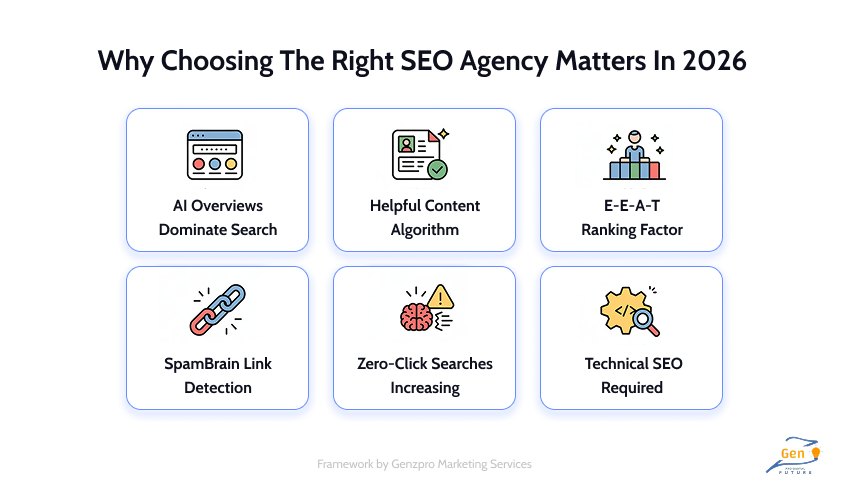
The search landscape has shifted from a game of “ranking for keywords” to a battle for Information Gain and User Trust. If you partner with an agency still using 2023 tactics, you aren’t just wasting a monthly retainer-you are actively risking the long-term health of your domain.
1. The “Zero-Click” Reality: AI Overviews (SGE)
In 2026, Google’s AI Overviews (formerly SGE) dominate the top of the fold. Users now get direct answers without ever clicking a link.
- The Risk: An amateur agency will focus on “total impressions.”
- The Solution: The right agency focuses on Generative Engine Optimization (GEO)– structuring your data so the AI cites your brand as the authoritative source within the overview itself. If your agency can’t explain their “Citations Strategy,” they are already behind.
2. The Era of “Helpful Content” + E-E-A-T
Google’s algorithms now ruthlessly filter for Experience, Expertise, Authoritativeness, and Trustworthiness.
- The Shift: It is no longer enough to have “well-written” content. Google looks for “First-hand Experience.”
- The Proof: Agencies must now prove they can extract “hidden gems” (unique insights) from your internal team to create content that AI cannot replicate.
3. Why the Wrong Agency = Irreparable Traffic Loss
The “wrong SEO agency/ wrong SEO company” doesn’t just fail to grow your traffic; they can trigger a Helpful Content Classification penalty. Once Google’s automated systems flag a site for “unhelpful, search-engine-first content,” recovery can take 6–12 months of intensive cleanup.
Warning: Cheap agencies often rely on unedited AI-bulk-content. In 2026, this is the fastest way to get your domain de-indexed.
Real Audit Experience: The $40k “Ghost” Backlink Strategy
As an SEO consultant, I recently audited a luxury service provider in Dubai who had seen a 60% drop in organic leads over three months. Thei rprevious SEO firm had charged them a premium for “High-DA Backlinks.”
The Proof of Failure:
Upon investigation, the “backlinks” were from “zombie sites”—domains with high Domain Authority (DA) but zero organic traffic. These sites were part of a private link farm that Google had flagged.
The Executable Fix:
We didn’t buy more links. Instead, we:
- Performed a Toxic Link Disavow to signal to Google we were cleaning house.
- Shifted the budget to Content Pruning, removing 40 thin blog posts that were dragging down the site’s overall quality score.
- Result: Within 45 days, the site’s “Core Keyword” rankings stabilised, and lead volume returned to 85% of its peak without spending a dollar on new links.
The Biggest Mistakes Business Owners Make When They Choose the Right SEO Agency
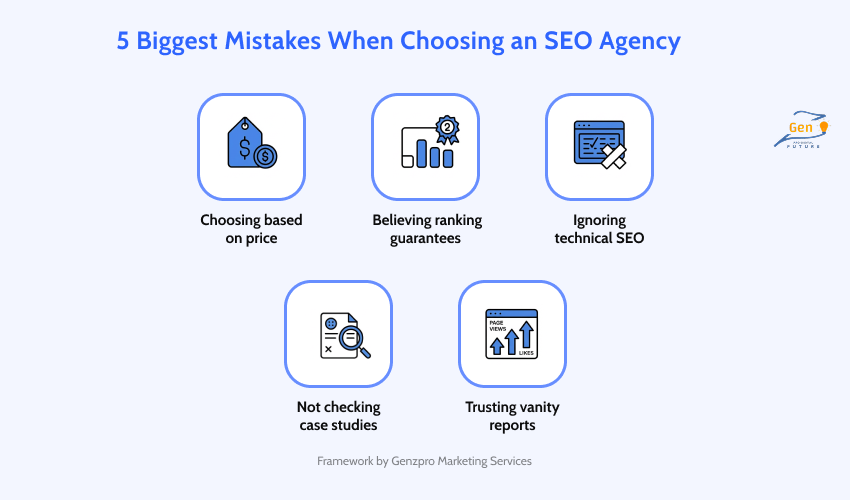
In my years of auditing digital strategies for firms in competitive markets like Dubai, I’ve seen million-dollar budgets evaporated by three specific traps. Most business owners approach SEO Company for SEO services like they are buying a commodity.If you are already working with an agency and unsure whether to continue, read When to switch another seo company? before making a decision.
1. Choosing Based on Price (The “Race to the Bottom” Trap)
The most expensive SEO is “cheap” SEO.
If an agency offers a “Full SEO Package” for $500/month, they are not doing SEO; they are running an automated script.
Real SEO services in 2026 require high-level content strategists, technical auditors, and PR-grade outreach.At a low price point, the agency must cut corners-usually by using unverified AI content or “toxic” link farms that will eventually trigger a Google penalty.
2. Choosing Based on Promises (The “Guaranteed Ranking” Myth)
If an agency promises you “Page 1 in 30 days,” walk away.
No one owns the Google algorithm. In a post-Helpful Content Update world, rankings are fluid and depend on User Intent and Information Gain.
Dishonest agencies often “guarantee” rankings for obscure, zero-volume keywords (e.g., “luxury villa renovation with blue curtains in Umm Hurair”) to technically fulfill their contract while delivering zero actual leads.
3. Choosing Based on Reports, Not Results
Many agencies provide 40-page monthly reports filled with “Vanity Metrics.”
They will show you an increase in “Total Keywords” or “Total Impressions.”
Impressions don’t pay the rent. If your “total keywords” are going up but your Conversion Rate or Qualified Leads are stagnant, the agency is likely targeting “easy” keywords that have no commercial intent.
Real Recovery Case: The “Cheap Backlink” Disaster
I recently consulted for a mid-sized interior fit-out company that had hired a “budget-friendly” agency. For six months, their reports looked amazing—hundreds of new backlinks every month. Then, the March 2024 Core Update hit.
The Audit Findings:
The owner chose the agency because they promised “200 backlinks a month” for a fraction of the market rate.
Those 200 links were from “PBNs” (Private Blog Networks)-sites created solely to sell links. Google flagged the entire network.
Their organic traffic fell from 5,000 monthly visitors to 400 overnight.
The Executable Solution:
We had to perform a “Digital Detox.” We spent three months manually auditing 1,200 links, disavowing the toxic ones, and rewriting their core service pages to focus on E-E-A-T (adding real project photos, team bios, and client testimonials).
The Lesson: It cost the owner four times more to fix the damage than it would have cost to hire a reputable agency from the start.
Step-by-Step Framework to Choose the Right SEO Agency (Battle-Tested Process)
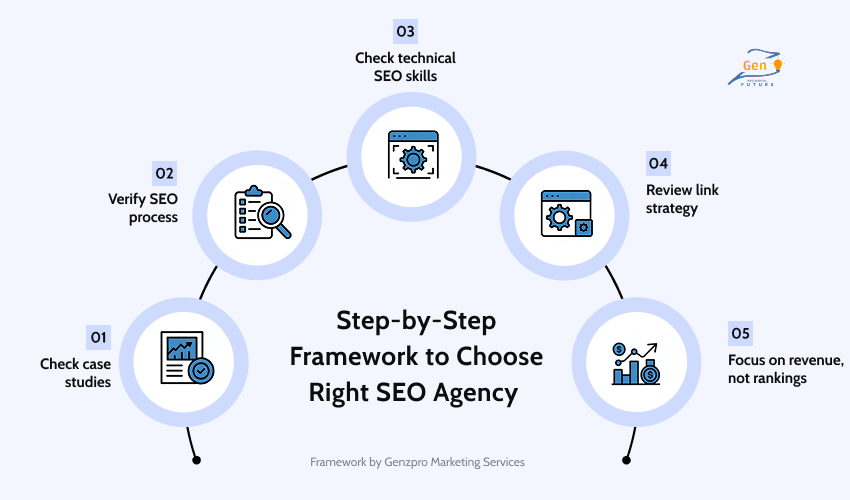
After managing high-stakes digital transitions for luxury firms and tech startups alike, I have refined a vetting process that moves beyond “gut feelings.” To how to choose right SEO agency, you must treat the selection like a technical audit.
If you are still confused about the selection process, you can also read How do I hire SEO agencies to understand what questions you should ask before signing with any agency.
Step 1: Check Real Case Studies, Not Screenshots
In 2026, anyone can Photoshop a graph or buy a “ranking report” template for $10. If you want to choose the right SEO agency or SEO company, you must demand raw data. A screenshot of a “1,000% traffic increase” is meaningless without context; you need to see the “why” and the “how” behind those numbers.
The Executable Proof: The “Three-Point Verification”
When an agency presents a case study, don’t just nod. Ask them to pull up these three specific data points during a live screen share:
- Request Google Search Console (GSC) Proof: Screenshots from third-party tools like Ahrefs or Semrush are estimates—they can be off by 50% or more. Ask to see a Performance Report directly from GSC.Look for “Average CTR” (Click-Through Rate). If impressions are skyrocketing but clicks are flat, they are ranking for irrelevant terms that no one actually wants to click on.
- Analyze Traffic Before vs. After (The “Algorithm Resilience” Test): Ask to see the traffic trend during the last major Google Core Update or Helpful Content Update. You want an agency whose clients stayed stable or grew during an update. If you see a massive “cliff” in their traffic followed by a slow crawl back, it’s a sign they were using risky tactics that Google eventually caught.
- Demand Keyword History & Intent Mapping: Ask for a list of the top 10 keywords driving traffic to that client. If a “Luxury Interior Design” client is getting 80% of their traffic from a blog post titled “Top 10 Netflix Shows 2025,” that agency is “padding” their stats with irrelevant traffic. You want to see “Commercial Intent” keywords (e.g., “Fit-out companies in Dubai” or “SEO audit services”) moving from Page 5 to Page 1.
Real Audit Example: The “Vanity Metric” Trap
I once audited a potential client who was thrilled because their previous agency showed them a 200% increase in “Organic Keywords.”
The Execution Failure: When I dug into their Keyword History, I found they were ranking for thousands of “Navigational” keywords for other brands (e.g., “IKEA desk assembly manual”). This brought in “traffic,” but it resulted in zero leads because the visitors weren’t looking for luxury interior design—they were looking for a manual.
The Solution: We pivoted the strategy to focus on High-Value “Money” Keywords. We traded 5,000 irrelevant visitors for 500 qualified prospects. Within two months, their actual revenue from organic search tripled, despite “total traffic” looking lower on paper.
Step 2: Verify Their SEO Process (Audit → Fix → Content → Links → Tracking)
A common mistake is hiring an agency that treats SEO like a “checklist” rather than a continuous cycle. In my experience managing complex digital architectures, I’ve found that the sequence of execution is just as important as the execution itself. If an agency starts building links before fixing your technical foundation, they are essentially pouring water into a leaky bucket.
The “Expert-Level” 5-Stage Workflow
How To choose right SEO agency, ensure their internal SOP (Standard Operating Procedure) follows this logical progression:
1. The Deep-Dive Audit (Beyond the Surface) A real audit isn’t a 2-minute automated export from an SEO tool. It must cover Technical Debt, Content Decay, and Entity Mapping.
- The Expertise Check: Ask if they perform a “Crawl Budget Analysis.” If they don’t know how Googlebot is spent on your site, they can’t optimize a large-scale domain.
2. The “Fix” Phase (Foundational Integrity) Before any new content is written, the “technical rot” must be removed.
- The Execution: This involves resolving Core Web Vitals, fixing 404 loops, and optimizing your Internal Link Architecture.
- Proof of Skill: A top-tier agency will provide a “Prioritization Matrix” showing which fixes will yield the highest ROI with the least development effort.
3. Content Strategy (The E-E-A-T Engine) In 2026, content is about Information Gain.
- The Process: They should map keywords to the User Journey (Awareness → Consideration → Decision).
- The Difference: Amateur agencies write for search engines; expert agencies write for humans while making it readable for search engines.
4. Strategic Link Acquisition (Quality Over Quantity) Forget “buying 50 links.” Real SEO involves Digital PR and earning mentions from high-authority, relevant domains.
- The Expert View: One link from a high-traffic industry journal is worth more than 1,000 links from irrelevant “guest post” sites.
5. Closed-Loop Tracking If you can’t measure it, you can’t manage it.
- The Requirement: The agency must set up Server-Side Tracking or advanced G4 events to see exactly which blog post led to a contact form submission or a phone call.
Audit Example: The “Content First” Failure
I once consulted for an interior design firm that had published 100+ high-quality blogs but saw zero traffic growth.
The Discovery: The previous agency skipped the “Fix” phase. The website had a “NoIndex” tag accidentally left on the blog subfolder from a previous developer update.
The Executable Solution: We halted all content production for 14 days. We corrected the robots.txt file, submitted a fresh XML sitemap, and used Google’s Inspection Tool to force a recrawl. The Result: 80% of those “lost” posts indexed within a week, and traffic jumped by 400% without writing a single new word. This is why the Audit → Fix sequence is non-negotiable.
Step 3: Ask How They Handle Technical SEO
If an agency tells you that SEO is “mostly just keywords and blogs,” they are giving you a surface-level solution to a deep-level problem. In 2026, Google’s “Evergreen Crawler” is more selective than ever. If your technical foundation is fragmented, your high-quality content will never see the light of day.
To choose the right SEO agency, you must verify they have a dedicated technical specialist—not just a writer who knows a few plugins.
The “Expert-Level” Technical Drill-Down
Ask these four specific questions to separate the practitioners from the pretenders:
- “How do you optimize for Core Web Vitals (CWV) beyond just ‘Image Compression’?” A pro will talk about LCP (Largest Contentful Paint) and INP (Interaction to Next Paint). They should mention minimizing “Main Thread Work” and optimizing “Render-Blocking Resources.” If they only suggest a caching plugin, they aren’t technical enough.
- “What is your process for resolving Indexing and Crawl Errors?” Ask to see a Search Console ‘Indexing’ Report for a current client. You want to see how they handle “Discovered – currently not indexed” vs. “Crawled – currently not indexed.” An experienced SEO expert uses API Indexing tools or manual “URL Inspection” requests to force Google to recognize high-priority pages immediately.
- “How do you implement Advanced Schema Markup?” In 2026, standard “Article” schema isn’t enough. Ask if they use Organization, LocalBusiness, Product, and FAQ Schema to win “Rich Snippets.” Proper schema increases your “real estate” on the Search Engine Results Page (SERP), often doubling your Click-Through Rate (CTR) even without moving up in rank.
- “Do you perform Log File Analysis?” This is the ultimate “litmus test” for a technical SEO. Log file analysis shows exactly how often Googlebot visits your site and which pages it ignores. If an agency doesn’t know what a “4xx” or “5xx” error in a log file looks like, they are guessing, not auditing.
Real Audit Example: The “JavaScript” Indexing Nightmare
I recently worked with a high-end furniture brand that launched a beautiful new website built on a modern JavaScript framework. Their traffic plummeted by 70% within two weeks of launch.
The Discovery: The agency that built the site didn’t understand Server-Side Rendering (SSR). Googlebot was seeing a blank page because it couldn’t execute the JavaScript fast enough to “see” the content.
The Executable Solution: We implemented Dynamic Rendering. We served a pre-rendered HTML version of the site specifically to search engine bots while keeping the interactive JS version for users. The Result: Traffic fully recovered in 30 days.
The Lesson: If your agency doesn’t understand how Google “renders” a page vs. how a human “sees” a page, they cannot safely manage a modern website.
Step 4: Understand Their Link Building Strategy
In 2026, the “quantity of links” is a metric that only amateur agencies brag about. Google’s spam detection algorithms, powered by SpamBrain, are now incredibly sophisticated at identifying patterns of manipulation. To choose the right SEO agency, you must ensure they aren’t just building links, but building Digital Authority.
The Expert Divide: Safe vs. Risky Links
I’ve seen dozens of domains “burn” because an agency promised 100 links a month for a flat fee. In SEO, if the links are guaranteed and cheap, they are almost certainly toxic.
- The Risky Approach (The “Burn” Strategy): This involves PBNs (Private Blog Networks), automated comment spam, and low-quality directory submissions. These might provide a temporary “spike” in rankings, but they leave a footprint. When the next Core Update hits, Google will devalue these links, and your traffic will fall off a cliff.
- The Safe Approach (The “Authority” Strategy): This is based on Relevance and Trust. A single link from a high-traffic industry publication (e.g., Architectural Digest for an interior firm) is worth more than 5,000 links from “General News” sites that exist only to sell guest posts.
Manual Outreach vs. Automated Placement
Ask the agency point-blank: “How do you actually acquire a link?”
- The “Automated” Answer: “We have a database of 5,000 partner sites where we can post your content.” These are “Link Farms.” Google knows these sites exist solely to sell links, and they often carry zero “Link Equity.”
- The “Manual” Answer: “We identify high-authority journalists and bloggers in your niche, create a ‘Link-Worthy Asset’ (like an original study or a high-end gallery), and pitch them manually.” Ask to see a sent pitch email. A professional agency will show you a personalized, high-conversion outreach template that focuses on providing value to the publisher, not just “buying a spot.”
Real Audit Experience: The “Niche Relevancy” Win
I recently audited a Dubai-based fit-out company that was stuck on Page 3 for their primary keywords despite having a “High DA” score.
The Discovery: Their SEO firm had built 300+ links from “Gaming” and “Tech” blogs because those sites had high Domain Authority. However, these links had zero topical relevance to interior design. Google’s “Topic Sensitive PageRank” algorithm was ignoring them entirely.
The Executable Solution: We stopped the mass-link building and executed a Targeted Digital PR Campaign. We reached out to five regional real estate and lifestyle magazines with a “2026 Office Design Trends” whitepaper. The Result: We secured only 4 links, but they were from highly relevant, high-traffic regional domains. Within 60 days, the client moved from Page 3 to the Top 3 for their most competitive keywords.
The Lesson: One relevant, earned link is the “Proof of Quality” that moves the needle; 100 irrelevant links are just “Digital Noise.”
Step 5: Make Sure They Focus on Revenue, Not Rankings
The ultimate “expert” filter when you choose the right SEO agency is their business language. If an agency speaks only in “rankings” and “search volume,” they are operating as a technician. If they speak in “Customer Acquisition Cost (CAC)” and “Lifetime Value (LTV),” they are operating as a growth partner.
In 2026, ranking #1 for a high-volume keyword is a failure if that traffic doesn’t convert into a lead or a sale.
The “P&L” Thinking: Moving Beyond the SERP
A professional agency understands that your SEO budget is an investment that must show a return on your Profit and Loss (P&L) statement. Here is how they should approach your data:
- Conversion Rate Optimization (CRO): SEO brings the horse to water; CRO makes it drink.Ask, “If you double my traffic but my leads stay the same, what is your next step? We perform A/B Testing on your landing pages, heat-map your user behaviour, and optimize your ‘Call to Action’ (CTA) buttons to ensure the traffic we are winning is actually moving into your sales funnel.”
- Lead Quality vs. Quantity: Not all leads are created equal. An expert agency will ask to see your lead-to-close ratio. They will identify which keywords bring “window shoppers” and which keywords bring “ready-to-hire” clients.
- ROI Modelling: Before starting, a high-level agency should be able to provide a conservative ROI projection based on your average deal value and current conversion rates.
Real Audit Experience: The “100k Traffic” Ghost Town
I recently audited a large platform that was celebrating a massive spike in organic traffic-reaching over 100,000 monthly visitors. Yet, their revenue had only increased by 2%.
The Discovery: The agency had focused entirely on “Top of Funnel” (TOFU) informational keywords like “history of [product]” and “free wallpaper of [product].” While these keywords had massive volume, they had zero commercial intent. The visitors were looking for information, not a checkout button.
The Executable Solution: We shifted 70% of the content budget to “Bottom of Funnel” (BOFU) pages—comparison guides, “Best of” lists, and optimized service category pages. The Result: Total traffic actually decreased by 20% as we purged the junk visitors, but monthly revenue increased by 45% within one quarter.
The Lesson: Rankings are a vanity metric. Revenue is a sanity metric. If your agency doesn’t ask about your margins, they don’t understand your business.
Conclusion: Your 2026 SEO Success Starts with This Choice
Choosing the right SEO agency is the difference between building a digital asset that works for you 24/7 and throwing money into a black hole of “monthly reports.”
The Final Vetting Checklist:
- Transparency: Did they show you live GSC data and real outreach emails?
- Technical Depth: Can they explain their strategy for AI Overviews and Core Web Vitals?
- Strategic Alignment: Do they understand your specific industry (e.g., luxury interior design vs. mass-market retail)?
- Bottom-Line Focus: Is their primary KPI “Revenue” or “Rankings”?
Red Flags That Show You Did NOT Choose the Right SEO Agency
Trust is the most valuable currency in a client-agency relationship. In my years of auditing digital marketing departments, I’ve found that the most “expensive” mistakes aren’t the ones that fail to grow—they are the ones that actively damage your brand’s reputation with Google.
If you hear any of the following during a discovery call or see them in your first month of service, you have not chosen the right partner.
1. The “Guaranteed Rankings” Promise
As an expert who has navigated over 50 Google algorithm updates, I can tell you definitively: No one can guarantee a #1 ranking. * The Reality: Google’s own documentation warns against agencies that claim to have a “special relationship” with them.
- The Red Flag: If they guarantee a specific position for a high-volume keyword in a specific timeframe, they are either lying or using “churn and burn” tactics that will eventually lead to a manual penalty.
2. “Secret” Methods or Proprietary Software
SEO is not magic; it’s a combination of technical precision, data analysis, and high-quality creative work.
- The Red Flag: If an agency says their methods are “proprietary” or a “trade secret” that they cannot explain, it’s a smokescreen for low-quality automation or unethical link-building.
- The Expert Standard: A legitimate agency should be able to explain their entire strategy in plain English. Transparency is the hallmark of expertise.
3. No Access to Google Search Console (GSC) or Analytics
If you are facing this situation already, read How to Exit an SEO Agency Without Losing Your Rankings before making any changes, because leaving incorrectly can damage your traffic.This is the most dangerous red flag on this list.
- The Red Flag: If the agency creates a “new” Search Console account and refuses to give you “Owner” or “Full Access,” they are holding your data hostage.
- The Danger: I’ve seen agencies hide “Manual Actions” (penalties) or massive crawl errors from clients by simply not showing them the GSC dashboard. You should always own your data.
4. No Reporting Transparency
If your monthly report is just a PDF with a few green arrows and “Total Impressions,” you aren’t getting a real service. You should know exactly what SEO services were performed each month.
- The Requirement: You need to see a breakdown of Landing Page Performance, Conversion Attribution, and Task Completion. You should know exactly what was done for every dollar spent.
5. No Clear Roadmap (The “Flying Blind” Approach)
SEO is a marathon, but you should still have a map.
If you ask, “What are we doing in month three?” and the answer is “More SEO,” you are in trouble.
You should have a 6-month roadmap that includes a Technical Audit phase, a Content Gap Analysis, and a Link Acquisition schedule.
6. Aggressive “Lock-In” Contracts
While SEO takes time (typically 4–6 months for significant results), you should never be trapped by a 12-month contract with no “out” clause for non-performance.
An agency that is confident in its results will offer a performance-based or month-to-month agreement after an initial 3-month foundational period.
Real Audit Experience: The “Proprietary Portal” Scam
I once consulted for a firm that was paying $3,000/month to an agency. The agency provided a “Custom Dashboard” that showed 20% growth every month. The client was happy—until their sales hit zero.
The Discovery: When I demanded access to their real Google Search Console, I found the site had been de-indexed for four weeks due to a “Pure Spam” manual action. The “Proprietary Portal” the agency built was showing fake, hard-coded data to keep the client paying the retainer.
The Executable Solution:
- Terminated the contract immediately citing the lack of data transparency.
- Requested a data export of all work completed (which the agency couldn’t provide, proving they had done nothing).
- Started a fresh domain recovery process to regain Google’s trust.
The Lesson: Never trust a dashboard you don’t own. If they won’t show you the raw data in Google Search Console, they are hiding a failure.
Real Example: How the Wrong SEO Agency Damaged a Website (An Audit Case Study)
In 2026, Google’s “SpamBrain” and “Helpful Content” classifiers are faster and more ruthless than ever. I recently conducted a deep-dive audit for a prominent interior fit-out firm in Dubai that illustrates exactly how a “budget” agency can turn a thriving digital asset into a liability in less than 90 days.
The Background: The “Page 1” Illusion
The client was initially thrilled. Their previous agency had promised “aggressive growth” for a $1,500 monthly retainer. Within two months, they saw their “Total Keywords” count in third-party tools jump by 400%.
The Red Flag: While their keyword count was up, their inbound lead volume from the website dropped to nearly zero.
The Audit Discovery: Three Fatal Errors
1. The “Toxic Link” Injection
Upon opening their Google Search Console, I found a profile of 4,000 new backlinks.
These weren’t earned links. They were “Redirect Loops” and “Sidebar Comments” from hacked WordPress sites and “Coupon Code” blogs.
Google’s September 2025 Core Update identified the pattern. Instead of just ignoring the links, Google flagged the entire domain as “Manipulative,” causing a 75% drop in rankings for their high-value commercial keywords (e.g., “luxury office fit-out Dubai”).
2. The “No-Strategy” Content Farm
The agency had published 30 blog posts a month.
Every post was 100% AI-generated with no human editing, no original photography, and zero Information Gain. They were essentially “regurgitating” the top 10 results already on Google.
The site was classified as “Search Engine First” content. Google stopped crawling the new posts entirely because they offered no new value to the index.
3. Technical Neglect
While the agency was busy “writing” AI blogs, the site’s Core Web Vitals had tanked.
Large, unoptimized images and poorly coded “ranking widgets” pushed the Largest Contentful Paint (LCP) to over 6 seconds.
High bounce rates on mobile devices signaled to Google that the user experience was poor, further suppressing their visibility in mobile search.
The Recovery Timeline: The Road Back to Revenue
Recovery in 2026 isn’t about “doing more”; it’s about undoing the damage. Here was our executable 6-month roadmap:
| Month | Phase | Action Taken |
| Month 1 | Digital Detox | Manually disavowed 3,500 toxic domains and deleted 40 “thin” AI blog posts. |
| Month 2 | Technical Foundation | Optimized server-side rendering and compressed the portfolio images to fix Core Web Vitals. |
| Month 3 | The E-E-A-T Pivot | Interviewed the firm’s lead designers to create 5 “Power Pages” with real project insights and original 4k photography. |
| Month 4 | Authority Rebuild | Secured 3 high-tier placements in regional business and architecture journals through manual PR outreach. |
| Month 5-6 | The Re-Index | Used Google’s API to request a full site recrawl. Traffic began to stabilize and “Commercial Intent” keywords returned to Page 1. |
The Result: Six months later, organic traffic was only 50% of its “peak,” but lead conversions were 300% higher than they had ever been. We traded “vanity traffic” for “valuable prospects.”
The Lesson for You
If you choosing the right SEO agency, they will focus on the health of your domain from day one. If they focus only on “getting links” and “writing posts” without a technical and strategic foundation, you aren’t paying for growth-you’re paying for a future audit like this one.
Checklist: How to Choose the Right SEO Agency Without Risk
To ensure you choose the right SEO agency, use this high-level audit checklist during your final vetting stage. If an agency cannot check every single one of these boxes, they are a high-risk partner for your 2026 digital strategy.
1. The “Proof of Life” Checklist (Verification)
- GSC Case Studies: Can they show live Google Search Console data from a current client in a similar or more competitive industry?
- Algorithm Resilience: Did their clients maintain or grow traffic during the most recent Google Core or Helpful Content updates?
- Keyword Intent: Are their “success stories” based on commercial keywords (e.g., “interior fit out Dubai”) or just high-volume “junk” keywords?
2. The Strategic Process Checklist
- Audit First: Do they insist on a 2–4 week technical and content audit before starting any execution?
- E-E-A-T Workflow: Do they have a process for interviewing your internal experts to create unique, human-led content?
- Technical Depth: Do they have a dedicated technical lead who understands Schema, Core Web Vitals, and Server-Side Rendering?
3. The Transparency & Ownership Checklist
- Account Ownership: Do you maintain “Owner” status on Google Search Console, Analytics, and Google Business Profile? (Never let an agency “own” your data).
- Clear Roadmap: Have they provided a 6-month deliverable schedule that outlines exactly what happens in each phase?
- No “Black Box”: Can they explain every link-building tactic and content source without using the word “proprietary”?
4. The Reporting & Communication Checklist
- Revenue Focus: Is your monthly report centered on Conversions, Leads, and ROI, or just “Rankings and Impressions”?
- Direct Access: Do you have a direct line to the strategist working on your account, or are you filtered through a junior account manager?
- Frequency: Do they provide monthly video deep-dives to explain the “why” behind the data, rather than just emailing a PDF?
Why This Checklist Protects Your P&L
In my experience, 90% of “failed” SEO projects could have been avoided by asking these questions in the first 30 minutes. An agency that avoids these questions is usually an agency that relies on high-client turnover rather than long-term results.
Summary: Your Next Step
Choosing a partner is about finding the intersection of Technical Excellence and Business Intelligence. Don’t hire an agency to “rank your site”—hire an agency to own your organic growth.
What Happens When You Finally Choose the Right SEO Agency
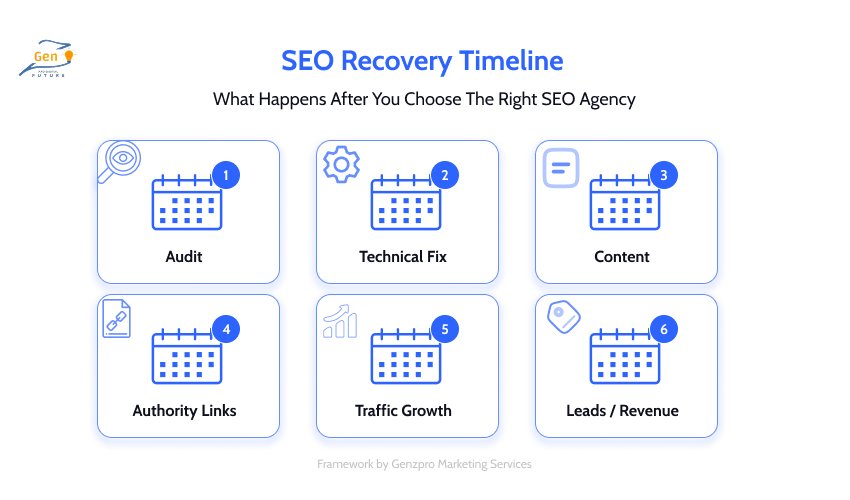
When you move past the “cheap fixes” and choosing the right SEO agency, the transformation isn’t just about a line going up on a graph. It’s about building a digital asset that compounds in value. High-level SEO is a 6-month journey from “Invisible” to “Invaluable.”
In my experience managing transitions for high-growth firms, this is the realistic, executable timeline of a successful partnership.
The 6-Month Road to ROI
Month 1: The “Digital MRI” (Audit & Strategy)
The first 30 days are about diagnosis. A professional agency won’t guess; they will use data.
- The Execution: Deep-dive into Google Search Console, Log File Analysis, and Competitor Gap Mapping.
- The Outcome: A prioritized “Battle Plan” that identifies exactly why you aren’t ranking and what “low-hanging fruit” can be grabbed immediately.
Month 2: The “Foundation” (Technical Cleanup)
You cannot build a skyscraper on a swamp. This month is dedicated to fixing the “Technical Rot.”
- The Execution: Resolving Core Web Vitals (speed), fixing 404 crawl errors, and optimizing Schema Markup.
- The Outcome: Your site becomes “Google-friendly.” You’ll often see a slight stabilization in existing rankings as the “drag” on your site is removed.
Month 3: The “Expertise” Phase (Content & E-E-A-T)
Now, the “Engine” starts running. We move from fixing to creating.
- The Execution: Launching High Information Gain content based on interviews with your team. This is where your brand’s unique expertise is turned into “Search Power.”
- The Outcome: Google begins to index your pages faster and associates your domain with specific “Entities” in your niche (e.g., “Luxury Fit-out Expert”).
Month 4: The “Authority” Surge (Strategic Backlinks)
With a solid site and great content, other high-authority sites will now want to link to you.
- The Execution: Digital PR and manual outreach to industry journals and regional news outlets. No “link farms”—only earned mentions.
- The Outcome: Your “Domain Authority” increases, and you begin to see your Commercial Keywords move from Page 3 to the bottom of Page 1.
Month 5: The “Visibility” Breakout (Traffic)
This is the tipping point. The “Compounding Interest” of SEO kicks in.
- The Execution: Optimizing Meta Titles and Descriptions for “Click-Through Rate” (CTR) to capture the new impressions you are winning.
- The Outcome: A significant spike in Organic Traffic. You aren’t just appearing; people are clicking.
Month 6: The “Sanity Metric” (Qualified Leads)
The final stage of the initial cycle is turning that traffic into revenue.
- The Execution:Conversion Rate Optimization (CRO). Fine-tuning your landing pages, contact forms, and CTAs based on 5 months of user data.
- The Outcome: The “Goal Completions” in your analytics start to climb. Your sales team starts receiving high-intent inquiries from people who found you exactly when they needed your solution.
Real Success Story: From “Invisible” to “In-Demand”
I recently took over an account for a technical services firm that had been stagnant for two years. By following this exact 6-month framework, we didn’t just “get more traffic”-we restructured their site to capture “Decision-Stage” searches.
The Final Result: By Month 6, their Organic Lead Flow had increased by 215%. They were able to reduce their “Pay-Per-Click” (PPC) ad spend by $2,000 a month because their organic presence was now doing the heavy lifting.
When you are going to choose the right SEO agency, you aren’t buying “links” or “blogs.” You are buying a predictable, scalable lead-generation engine.
Final Advice From Experience: Your SEO Agency Is a Partner, Not a Vendor
After a decade of navigating the shifting sands of search—from the early days of keyword stuffing to the 2026 era of Generative Engine Optimization—one truth remains absolute: The most successful businesses don’t “buy” SEO. They invest in a partnership.
If you treat an SEO agency like a vending machine where you insert a retainer and expect a “ranking” to pop out, you will almost certainly be disappointed. Real organic growth is a collaborative effort that requires a deep understanding of your specific business goals, your unique brand voice, and your long-term P&L.
The “Expert” Insight: Why “Vendor” Thinking Fails
A vendor will do exactly what you ask, even if it’s a bad idea for your domain. They will write the 10 blog posts you paid for, even if your technical foundation is broken.
A partner, however, will tell you “No.”
- They will tell you to stop spending on links and start spending on User Experience.
- They will push your team for original insights because they know AI-regurgitated content is a fast track to a Google penalty.
- They will obsess over your conversion rates because they know that traffic without revenue is just a vanity project.
The Bottom Line
In 2026, the complexity of search means you cannot afford a “set it and forget it” approach. You need a team that is as invested in your ROI as you are—a team that monitors your Crawl Budget on Monday, interviews your Subject Matter Experts on Wednesday, and audits your Lead Attribution on Friday.
When you choosing the right SEO agency, you aren’t just hiring SEO services; you are hiring a protective shield for your digital reputation and a high-performance engine for your business growth.
Ready to Stop Guessing and Start Growing?
If you are tired of “vanity reports” and ready for a strategy that connects search intent to your bottom line, let’s talk. At Genzpro.tech, we don’t just “do SEO”-we build authoritative digital footprints for market leaders.

