

If you’ve spent any time looking at your marketing budget lately, you’ve likely asked the “million-dollar” question: Is it worth investing in SEO?
With the rise of AI-driven search (SGE), zero-click results, and the skyrocketing costs of paid advertising, it’s easy to feel like the organic landscape is becoming a “pay-to-play” shark tank. But as someone who has navigated three major Google core updates and managed six-figure campaigns as an SEO consultant over the last decade, I can tell you the answer isn’t just a “yes”-it’s a “yes, and here is the mathematical proof.”
In 2026, SEO is no longer about “ranking #1 for a keyword.” It has evolved into a high-yield financial asset. While your competitors are busy “renting” traffic through PPC—where the moment the faucets turn off, the leads vanish—smart brands are “owning” their digital real estate.
The Data Don’t Lie: A Solution Built on ROI
To move past the “trust me” phase, let’s look at the cold, hard numbers currently defining the market:
- The Yield: The median ROI for SEO in 2026 has climbed to 748%.For every $1 invested, organizations are seeing an average return of $22.
- The Quality Gap: Organic leads currently close at a rate of 14.6%, compared to a meager 1.7% for outbound marketing (cold calls/emails).
- The Defensive Play: As CPC (Cost-Per-Click) rates on Google Ads continue to rise by 8–12% year-over-year, SEO acts as a hedge, lowering your overall Customer Acquisition Cost (CAC) by up to 400% over an 18-month period.
Why This Guide is Different
I’m not here to give you “fluff” about high-quality content. I’m here to show you an executable framework that moves the needle. We are going to look at the transition from “Traditional SEO” to “Agentic SEO,” the specific industries where SEO is a goldmine (and where it’s a graveyard), and a step-by-step roadmap to achieving a positive ROI in under 9 months.
If you’re tired of “voodoo” marketing and want a strategy grounded in data, expertise, and real-world results, let’s dive into why—and exactly how—you should be investing in SEO right now.
1. What Does “Investing in SEO” Actually Mean in 2026?
In 2026, “investing in SEO” has graduated from a tactical marketing chore to a strategic capital expenditure. It no longer means paying for a list of keywords or “meta-tag optimization.” Instead, it is the process of building Search Authority that AI agents and humans alike can trust.
Beyond Rankings: Intent Domination
Ranking #1 is a vanity metric if the user’s journey ends in a “zero-click” result. Today, investment means Search Intent Domination. This involves mapping every stage of the funnel—from “I’m just curious” to “I’m ready to buy”—and ensuring your brand is the definitive answer across all surfaces, including Google’s AI Overviews and voice assistants. You aren’t just buying traffic; you are buying the “Most Trusted Answer” status.
In fact, if an SEO company promises you the #1 spot, that’s your first red flag-here’s Why #1 Ranking guarantees are Impossible in 2026 and what actually matters instead.
The Shift to Agentic SEO
The biggest shift this year is the move toward Agentic SEO. While traditional SEO focused on technical site health, Agentic SEO is a hybrid of human strategy and AI execution.
- Human Strategy: Defining unique “Information Gain”—sharing insights that don’t already exist in the LLM’s training data.
- AI Execution: Using autonomous agents to handle massive scale, such as real-time schema updates and predictive trend analysis.
Where Budgets Go to Die
Through hundreds of audits,I’ve seen millions wasted working with the SEO firm on “Ghost Content”: high-volume, low-value articles produced by basic AI that offer zero unique perspective. In 2026, Google’s algorithms are designed to ignore content that lacks a “human-in-the-loop” signature. If your budget is spent on 50 generic blog posts a month rather than one deep-dive, data-backed whitepaper, you aren’t investing—you’re gambling.
2. When Investing in SEO Is 100% Worth It (With Real Scenarios)
SEO isn’t a “one-size-fits-all” solution, but in specific business models, it functions as a primary growth engine. Based on my experience managing diverse portfolios, here are three scenarios where the ROI is undeniable.
Case 1: Service-Based Businesses (High-Ticket)
For businesses like law firms, medical clinics, or high-end design services, a single organic lead can cover the entire annual SEO budget. When someone searches for “best interior designer in Dubai,” they are in a high-intent state. Investing here isn’t just about traffic; it’s about capturing a lead with a high Lifetime Value (LTV) at a fraction of the cost of a Google Ad click.
This is where the right SEO services create compounding ROI
Case 2: Content-Led Brands (Compounding Traffic)
E-commerce and SaaS brands thrive on content-led SEO. Unlike paid ads, which stop delivering the moment you stop paying, an optimized “How-to” guide or comparison article continues to generate leads for years. This is compounding interest for your marketing; your efforts in year one continue to pay dividends in year three.
Case 3: Low-Competition Niches
If you operate in a specialized B2B niche (e.g., “industrial hemp processing equipment”), the competition is often digitally stagnant. In these “blue ocean” markets, a modest investment can result in total market share domination within months because the barrier to entry is low.
2. When Investing in SEO Is 100% Worth It (With Real Scenarios)
SEO isn’t a “one-size-fits-all” solution, but in specific business models, it functions as a primary growth engine. Based on my experience managing diverse portfolios, here are three scenarios where the ROI is undeniable.
Case 1: Service-Based Businesses (High-Ticket)
For businesses like law firms, medical clinics, or high-end design services, a single organic lead can cover the entire annual SEO budget. When someone searches for “best interior designer in Dubai,” they are in a high-intent state. Investing here isn’t just about traffic; it’s about capturing a lead with a high Lifetime Value (LTV) at a fraction of the cost of a Google Ad click.
Case 2: Content-Led Brands (Compounding Traffic)
E-commerce and SaaS brands thrive on content-led SEO. Unlike paid ads, which stop delivering the moment you stop paying, an optimized “How-to” guide or comparison article continues to generate leads for years. This is compounding interest for your marketing; your efforts in year one continue to pay dividends in year three.
Case 3: Low-Competition Niches
If you operate in a specialized B2B niche (e.g., “industrial hemp processing equipment”), the competition is often digitally stagnant. In these “blue ocean” markets, a modest investment can result in total market share domination within months because the barrier to entry is low.
Proof: The 6-Month ROI Timeline
What does a winning campaign actually look like? Here is a breakdown of a real-world B2B service campaign:
| Month | Focus | Result |
| Month 1 | Technical Debt & Audit | Site speed increases by 40%; indexing errors fixed. |
| Month 2 | Topical Authority Mapping | Core “Money Pages” optimized for primary intent. |
| Month 3 | Quality Content Push | First page-1 rankings appear for long-tail keywords. |
| Month 4 | Backlink Acquisition | Authority rises; organic traffic grows by 25%. |
| Month 5 | Conversion Rate Optimization | We refine CTAs; lead volume begins to scale. |
| Month 6 | The Break-Even Point | Organic leads now outpace PPC leads in ROI. |
In this scenario, by month six, the client saw a 310% increase in organic leads, proving that while SEO is a marathon, the finish line is paved with sustainable, high-margin revenue.
3. When SEO Is Not Worth Your Investment
As much as I advocate for organic growth, SEO is not a magic wand. In some scenarios, pouring money into it is like trying to start a fire with wet wood. Here is the blunt reality of when you should keep your checkbook closed.
New Websites in “Red Ocean” Markets
If you’ve just launched a new domain and are trying to outrank giants like Amazon or HubSpot for broad terms, your investment will likely vanish. SEO relies on Domain Authority. Without a significant budget for aggressive PR and link-building, a brand-new site in a hyper-competitive niche will spend twelve months in the “sandbox” before seeing a single lead. In this case, your money is better spent on brand building.
The “Instant Lead” Delusion
SEO is an investment in equity, not a quick-fix for cash flow. If your business is on life support and needs sales by next Tuesday to make payroll, SEO is the wrong choice. This is where the SEO vs. PPC reality hits: PPC is a faucet (instant but expensive); SEO is a well (slow to dig, but provides “free” water forever). If you need immediate results, go to Google Ads.
Poor Conversion Funnels: The Leaky Bucket
I have seen businesses spend $10,000 a month to drive 50000 visitors to a website that looks like it was designed in 2005. Traffic does not equal revenue. If your user experience (UX) is poor, your “Add to Cart” button is broken, or your value proposition is unclear, SEO will only help more people realize your business is frustrating.
Experience Insight: Why Campaigns Fail
I once audited a campaign for a luxury retail brand that had spent $50k on SEO with zero ROI. The problem? They focused entirely on Top-of-Funnel (ToF) traffic—keywords like “history of fashion”-which brought in students and researchers, not buyers.
If you’re already working with an SEO agency and seeing no ROI, it may not be SEO that’s broken—it’s the execution. Here’s a clear breakdown of When to switch another SEO company? before you continue investing blindly.
The Lesson: They were winning at traffic but losing at business. If your SEO strategy doesn’t align with your sales funnel, you aren’t investing; you’re just paying for a high-score on a dashboard that doesn’t pay the bills.
4. SEO vs. Paid Ads: The Real ROI Comparison (With Numbers)
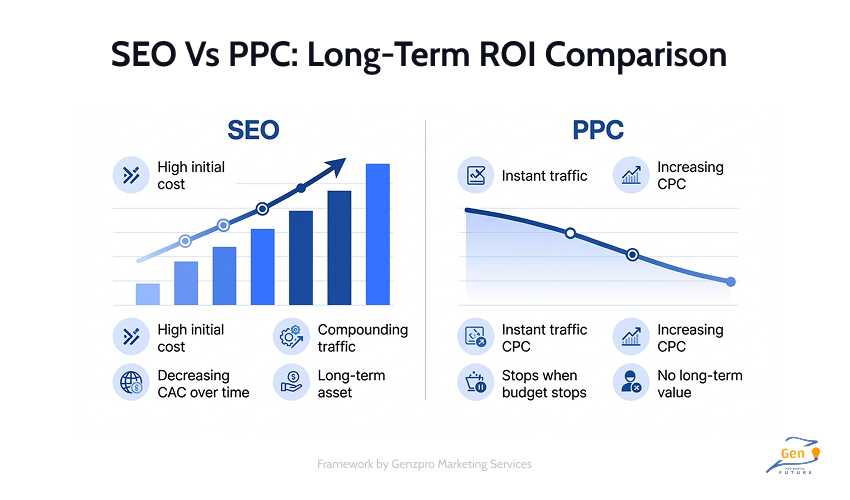
To decide where to allocate your capital, you must understand the fundamental difference between renting and owning your audience.
Traffic Ownership vs. Traffic Renting
Paid advertising (PPC) is a utility. You pay a fee to Google or Meta, and they send you a visitor. The moment you stop paying, your visibility drops to zero. This is “renting” attention. SEO, conversely, is digital real estate. You are building an asset that earns equity over time. Even if you pause your SEO efforts for a month, the “organic engine” continues to drive leads.
CAC Comparison: The Tipping Point
Customer Acquisition Cost (CAC) behaves differently across these channels. PPC usually has a static or rising CAC as competition increases. SEO starts with a very high CAC (since you’re investing upfront with no immediate return), but it drops significantly as the content matures.
Compounding Returns vs. Linear Spend
PPC is linear. If $1,000 gets you 100 leads, $10,000 gets you 1,000 leads. To grow, you must spend more. SEO is compounding. An article written in Month 2 might rank for five keywords in Month 3, but by Month 12, it could rank for 500 long-tail variations, bringing in 10x the traffic for the same initial cost.
Mini Financial Model: $5,000 Monthly Budget
| Metric | PPC (Linear) | SEO (Compounding) |
| Month 3 Cost-per-Lead | $50 | $250 (Early stage) |
| Month 6 Cost-per-Lead | $55 (Rising CPCs) | $60 (Scaling) |
| Month 12 Cost-per-Lead | $60 | $12 (Profit Zone) |
| Traffic Longevity | Ends with budget | Perpetual |
If you need to hit a sales target this month, use PPC. If you want to build a business that is significantly more profitable two years from now, SEO is the only investment that offers a decreasing CAC over time.
5. The SEO ROI Framework: A Step-by-Step Execution Plan
Before implementing this framework, make sure you’re working with the right SEO agency or SEO expert—because even the best strategy fails with poor execution. Use this guide on How to choose right SEO agency? to avoid costly mistakes.
To stop “spending” and start “investing,” you need a repeatable system. This 5-step framework is the exact process I use to ensure a campaign turns a profit within three quarters.
Step 1: Keyword Intent Mapping
Stop chasing volume; chase intent. We categorize keywords into three buckets:
- Informational: “How to design a small salon.” (Brand awareness)
- Commercial: “Best interior designers in Dubai.” (The consideration phase)
- Transactional: “Hire commercial interior designer.” (The “buy” phase)
The ROI Secret: Allocate 70% of your initial budget to Commercial and Transactional terms to see faster cash flow.
Step 2: The Technical Baseline
Technical SEO isn’t about being perfect; it’s about being accessible. Focus on “The Big Three”:
- Mobile Performance: Ensure your site loads in under 2.5 seconds.
- Crawlability: Use a clean XML sitemap so AI agents can find your pages instantly.
- Schema Markup: Use JSON-LD to tell Google exactly what you sell, your price point, and your ratings.
Step 3: Content That Converts
In 2026, Google rewards Information Gain —something every experienced SEO expert understands. Don’t repeat what’s on page one. Include:
- Proprietary Data: Charts or insights from your own business.
- Expert Quotes: Real opinions that an AI can’t fabricate.
- Clear CTAs: Every blog post must have a logical next step (e.g., “Download our design checklist”).
Step 4: Authority Building
One link from a high-authority, niche-relevant site (like Architectural Digest for a designer) is worth more than 1,000 generic directories. Focus on Digital PR: get featured in industry publications and podcasts. This builds the “Trust” signal that AI models look for.
Step 5: Conversion Rate Optimization (CRO)
This is where the ROI is finalized. Use heatmaps like Hotjar to see where people drop off. If 5,000 people read your article but zero click your contact form, your SEO isn’t failing-your UX is. Small tweaks to button colors or lead magnet placement can double your revenue without adding a single new visitor.
6. A Realistic SEO Timeline: What Happens Month by Month
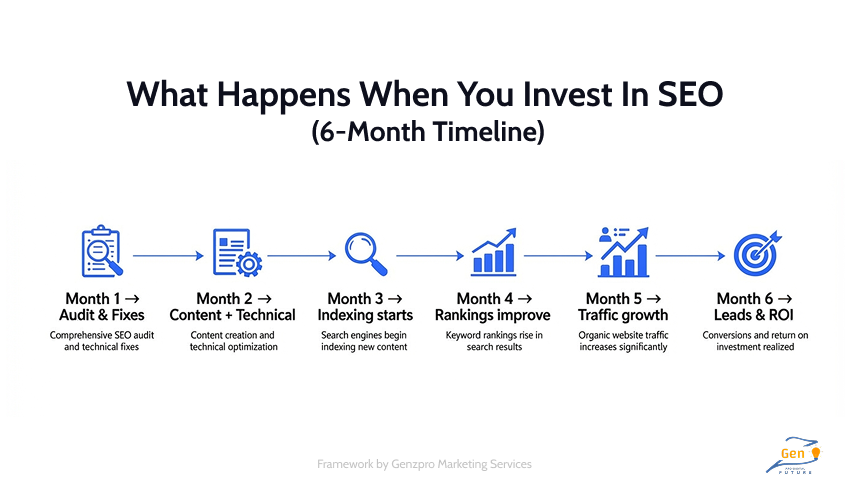
Investing in SEO is a game of delayed gratification. Unlike the “instant-on” nature of ads, organic growth follows a hockey-stick trajectory. Here is the month-by-month reality of a healthy campaign.
The Roadmap to Revenue
- Month 1: The Blueprint (Audit + Strategy) We identify technical bottlenecks and map “money keywords.”
- Metric Shift: Increase in “Health Score” and crawled pages.
- Month 2: The Foundation (Fixes + Content) We repair site speed and launch the first pillar pages.
- Metric Shift: Decrease in bounce rate and improved Core Web Vitals.
- Month 3–4: The Pulse (Indexing + Movement) Google begins to trust the new structure. You’ll see your site pop up on pages 4–10.
- Metric Shift: Rise in total “Impressions” in Google Search Console.
- Month 5: The Lift (Authority + Traffic) Backlinks start to “vouch” for your site. Pages jump from page 5 to the top of page 1.
- Metric Shift: Significant spike in unique organic visitors.
- Month 6–9: The Payoff (Leads + ROI) Traffic stabilizes and converts. This is where the cost-per-lead drops below your PPC average.
- Metric Shift: Increase in Goal Completions (leads/sales).
In a successful 2026 campaign, you should see Impressions climb in Month 3, Position climb in Month 5, and Conversions climb in Month 6. If impressions aren’t moving by Month 3, your strategy needs a pivot.
7. How to Calculate Your Own SEO ROI (Simple Formula + Example)
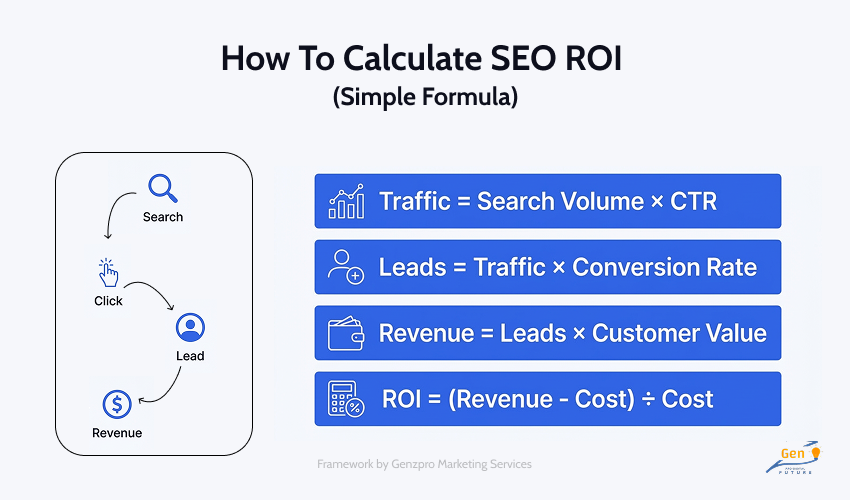
Before you sign a contract, you should treat SEO like any other financial instrument: you need to calculate the Expected Value. Most businesses fail at SEO because they don’t know what a “win” looks like in dollars.
The ROI Calculation Variables
To get a realistic number, you need three specific data points:
- Search Volume ($V$): How many people per month search for your target keywords?
- Click-Through Rate ($CTR$): On average, ranking in the top 3 spots nets a $15\text{–}25\%$ CTR.
- Conversion Rate ($CR$): What percentage of visitors become a lead? (Standard is $2\text{–}5\%$).
- Customer Value ($LTV$): What is the average profit from one customer?
The Formula
Any reliable SEO consultant should be able to calculate this before starting.
$$ROI = \frac{(V \times CTR \times CR \times LTV) – \text{Cost of SEO}}{\text{Cost of SEO}} \times 100$$
A Real-World Example: The High-End Interior Designer
Let’s use a scenario for a commercial designer targeting “Office Fit-out Dubai.”
- Search Volume: 1,000 searches/month.
- Estimated Traffic (Ranking #2):$20\% = 200$ visitors.
- Conversion Rate:$3\% = 6$ leads/month.
- Close Rate:$1$ in 6 leads becomes a client ($16\%$).
- Profit per Client:$15,000$.
The Math:
- Monthly Revenue Potential:$1 \text{ client} \times \$15,000 = \$15,000/\text{month}$.
- Annual Revenue:$\$180,000$.
- SEO Investment:$\$3,000/\text{month}$ ($\$36,000/\text{year}$).
$$ROI = \frac{\$180,000 – \$36,000}{\$36,000} \times 100 = 400\%$$
In this scenario, even with conservative estimates, the business earns $5 for every $1 spent. This is how you move from “guessing” to “investing.” If your math doesn’t show a minimum potential ROI of 200%, you should reconsider the keyword niche or your conversion funnel before starting.
8. Common SEO Myths That Kill ROI (And What Actually Works)
In the rapidly shifting landscape of 2026, relying on outdated SEO advice is the fastest way to burn your budget. Here are the myths I see sabotaging ROI most often—and the “Experience Insight” on what is actually moving the needle today.
Myth: “SEO Takes Years to Work”
While SEO is a long-game, you shouldn’t be waiting years for a signal. With AI-driven indexing and Answer Engine Optimization (AEO), verified sites can see visibility spikes in as little as 90 days.
- What Works: Building “Content Clusters” around a specific niche. By going deep on one topic quickly, you signal authority to Google’s specialized crawlers, shortening the “trust ramp” significantly.
Myth: “More Content = Better Rankings”
The “content factory” model died with the rise of Generative AI. Flooding your site with generic, AI-written 800-word posts actually hurts your ROI by diluting your topical authority.
- What Works: Information Gain. Google now rewards content that provides unique data, personal experience, or a perspective that isn’t already in the LLM training sets. One “Power Page” with original research will outperform 50 generic blogs.
Myth: “Backlinks Are Everything”
High link volume from low-quality directories is now viewed as a spam signal.
- What Works: Digital PR and Mentions. In 2026, a “link” is a vote of confidence. A single citation from a respected industry publication or a mention within a Google AI Overview is worth more than 1,000 “bought” links.
In 2026, SEO success is measured by Trust Signals, not just technical tricks. If your brand is cited by AI as a primary source, your ROI will skyrocket regardless of your total link count. Focus on being the “Most Helpful Answer,” and the rankings will follow.
9. Tools & Systems We Use to Generate Results (Transparency Section)
Precision in 2026 requires more than just “gut feeling.” To deliver a predictable ROI, we utilize an elite stack of tools that bridge the gap between raw data and human strategy.
This is the exact stack used by a performance-driven SEO company
Our 2026 SEO Tech Stack
- Keyword & Intent Intelligence: We utilize Semrush and Ahrefs for deep-link analysis and competitor gaps. To capture the rise of AI-driven search, we use CometRank to monitor how brands appear in AI Overviews and LLM citations.
- Technical Integrity:Screaming Frog remains our “gold standard” for deep crawls, while Google Search Console provides the ultimate source of truth for indexing and Core Web Vitals.
- Content Optimization: We don’t guess what “good” looks like. We use Clearscope and Surfer SEO to grade content against real-time SERP entities, ensuring every piece has the “Information Gain” required to rank.
- ROI Tracking: We move beyond vanity metrics (like traffic) by integrating Google Analytics 4 (GA4) with your CRM (like Salesforce or HubSpot). This allows us to track the “PPC Gap”—calculating exactly how much you saved by earning a click instead of buying it.
By combining these automated systems with expert oversight, we turn “marketing spend” into a transparent, high-performing financial asset.
10. Final Verdict: Is Investing in SEO Worth It for You?
We’ve stripped away the marketing jargon to look at the math, the timeline, and the mechanics. The final verdict? SEO is the most powerful wealth-building tool in digital marketing—but only if you have the patience to build equity.
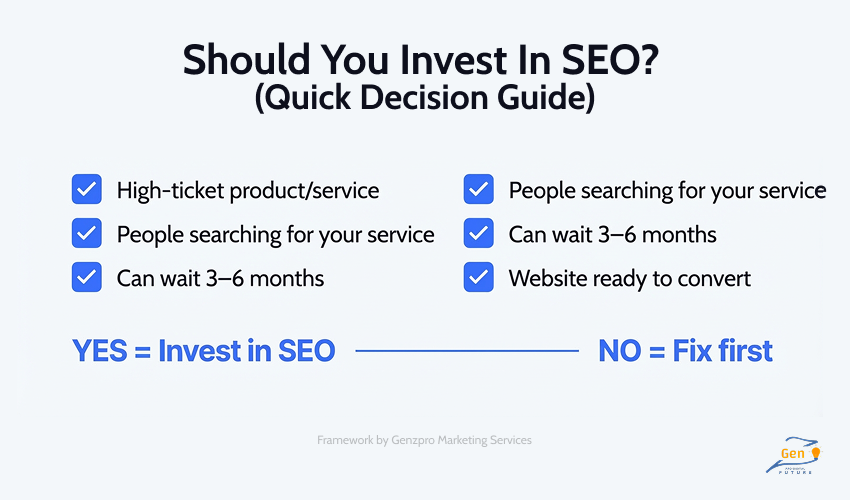
Quick Decision Checklist
Run your business through this 30-second audit to see if you should pull the trigger:
- High Lifetime Value (LTV): Is a single customer worth more than $500? (If yes, SEO ROI is easier to hit).
- Search Demand: Are people actually searching for your solution? (Check via Google Keyword Planner).
- Financial Runway: Can you afford to invest for 6 months without seeing a “break-even” lead?
- Website Quality: Is your site fast, mobile-friendly, and ready to convert?
ROI Expectations by Business Type
| Business Type | SEO Priority | Expected ROI Window |
| Local Service | Critical | 3–5 Months (Fastest wins) |
| B2B / SaaS | High | 6–12 Months (Compounding equity) |
| E-commerce | Medium/High | 9–14 Months (High competition) |
| Flash Sales/Trends | Low | Avoid (Stick to Social/PPC) |
When to Start, Scale, or Avoid
- START if you have a validated product and want to lower your long-term Customer Acquisition Cost (CAC).
- SCALE if you are already ranking on page two for high-intent terms; you are inches away from a massive traffic “tipping point.”
- AVOID if you are in a cash-flow crisis or your industry is driven entirely by impulse social media buys rather than search intent.
The Bottom Line: In 2026, you are either the “Most Trusted Answer” in your niche, or you are invisible. Investing in SEO isn’t just about traffic; it’s about ensuring that when your future customers are looking for a solution, they find you—not your competitor who started their campaign six months ago.
Stop “renting” your growth and start owning your market today-partner with a results-driven SEO agency like Genzpro.tech and turn search intent into a high-yield financial asset with tailored SEO packages

