

For years, SEO was a game of “string matching”. If you wanted to rank for “organic coffee beans”, you repeated that phrase until the algorithm took notice. But in 2026, search has fundamentally shifted from strings to things.
Google no longer just “reads” your content; it comprehends it. Through entity SEO, the search engine identifies specific people, places, and concepts, known as Google entities, and maps the relationships between them using the Knowledge Graph. This evolution into semantic SEO means that ranking is no longer about how many times you say a word but how well you prove your authority over a topic.
The Proof: From Keywords to Contextual Confidence
The shift isn’t just theoretical; it’s backed by measurable data. Recent 2026 industry case studies have shown that sites implementing robust entity linking—connecting on-page concepts to established databases like Wikidata—see an average 19.72% increase in AI Overview visibility.
Why? Because when Google identifies your content as a “Subject” connected to a “Predicate” and an “Object” (e.g., Your Brand [Subject] – specialises in [Predicate] – Sustainable Logistics [Object]), its confidence in your expertise skyrockets. You stop being a collection of keywords and start being a verified source of truth.
In this guide, I will show you exactly how to pivot your strategy to align with this entity-first world, ensuring your content isn’t just seen, but understood.
What Is Entity SEO?
To understand entity SEO, you first have to unlearn the “traditional” way of thinking about keywords. In the past, Google functioned like a librarian looking for exact word matches on a page—this is what we call “strings”. If the string matched the query, you ranked. Entity SEO moves us from “strings to things”.
An entity is a well-defined, singular object or concept that is distinguishable and unique. It could be a person, a brand, a specific interior design style, or even a technical concept like “ROI”. While keywords are just sequences of letters, entities are the meaning behind them.
For example, when a user searches for “Paris”, Google uses semantic SEO to determine if they mean the city in France, the character from Greek mythology, or a specific celebrity. It looks at the context of the search to provide the most relevant “thing”.
The shift to an entity-based model allows Google to move beyond surface-level matches toward a deep, contextual understanding. Instead of counting how many times a phrase appears, the algorithm analyses how various concepts on your page relate to one another.
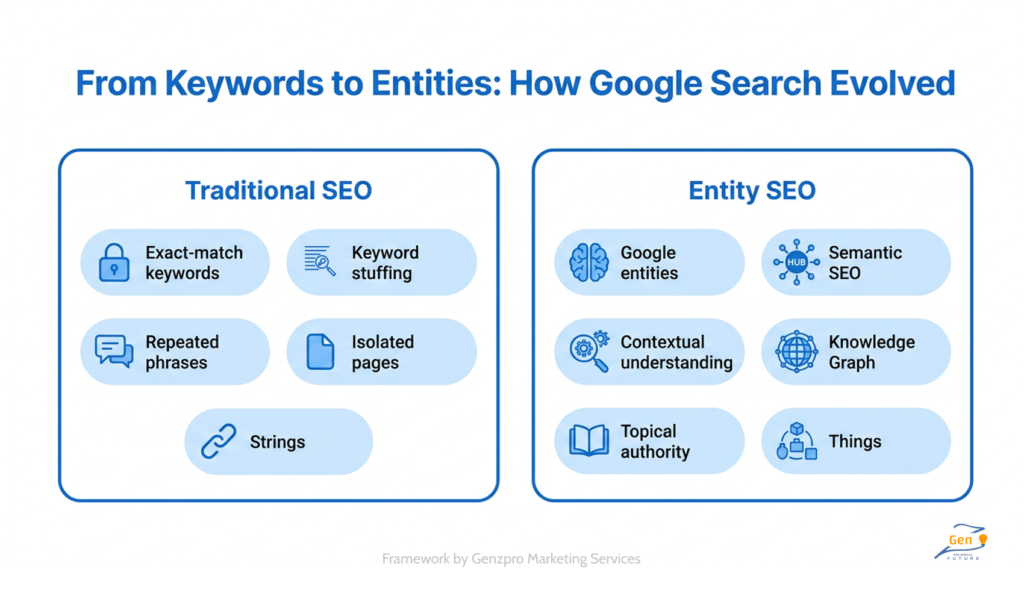
By focusing on entities, you are providing Google with a map of your expertise. You aren’t just trying to rank for a term; you are establishing your authority within a digital ecosystem where Google understands the “who, what, and where” of your content with surgical precision.
How Google Entities Work Inside the Knowledge Graph
Think of the Google Knowledge Graph as Google’s massive, interconnected brain. It doesn’t store words; it stores relationships. To build this brain, Google uses natural language processing (NLP) to “read” your content much like a human does—identifying the actors and the actions within a sentence to build semantic relevance.
The engine looks for co-occurrence: the presence of related entities that prove a page is truly about a specific topic. This is where an experienced SEO expert demonstrates expertise.
If you are writing about “modern minimalist villas”, Google expects to see a cluster of related entities. If your content mentions “natural light”, “open floor plans”, and “high-end finishes”, the algorithm gains high confidence that you are providing a comprehensive resource.
Real-World Execution: The “Design Studio” Example
To see this in action, consider a page optimised for “luxury interior design consultant”. * Keyword Approach: Repeating “interior design consultant” five times. (Result: Low authority).
- Entity Approach: Mentioning entities like “bespoke furniture”, “spatial planning”, “Dubai Design District”, and “mood boards”. (Result: High authority).
When these entities appear together, Google maps the contextual relationships. It recognises that “spatial planning” is a service provided by a “consultant” within the “interior design” entity.
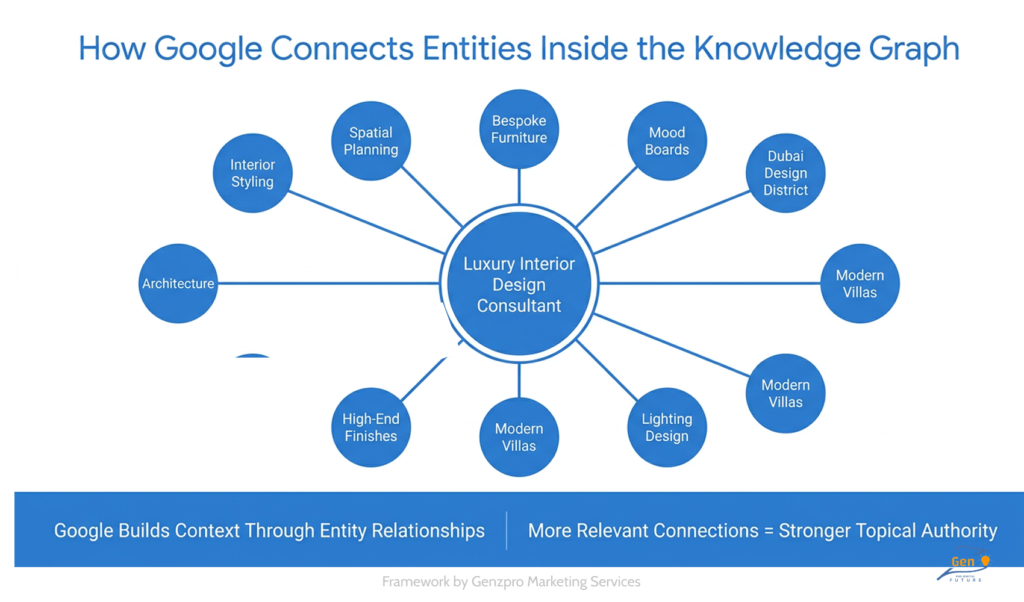
By surrounding your primary topic with these logically connected “things”, you move from trying to trick an algorithm to becoming a verified node in Google’s Knowledge Graph.
Entity SEO is also a long-term authority play, meaning results compound gradually as Google strengthens its confidence in your topical relationships over time, much like understanding how long SEO results actually take.
Entity SEO vs. Semantic SEO
While often used interchangeably, these two concepts represent different sides of the same coin. Semantic SEO is the overarching strategy of optimising for the meaning and intent behind a search query, rather than just the literal words. Entity SEO is the technical execution of that strategy; it is the process of identifying and connecting specific, unique “entities” (people, places, things) within your content to help search engines build that understanding.
Quick Comparison: Strategy vs. Execution
| Feature | Semantic SEO | Entity SEO |
| Focus | Meaning and Search Intent | Unique Objects and Concepts |
| Goal | Contextual Depth | Relationship Mapping |
| Method | Topical coverage and LSI keywords | Schema markup and Knowledge Graph nodes |
| Outcome | Improved relevance for complex queries | Established authority as a verified “source” |
Think of semantic SEO as the “language” you speak to provide value to users, while entity SEO provides the “data points” Google uses to categorise that value.
To rank in a modern ecosystem, you need both. You must use semantic depth to satisfy user curiosity and entity precision to satisfy the algorithm’s need for structured, verifiable information.
Why Most Websites Fail at Entity SEO
Despite the clear shift in how search works, many brands and even established SEO agency teams remain trapped in a 2018 mindset. In my experience auditing mid-to-large-scale sites, the most common reason for stagnant rankings isn’t a lack of backlinks or technical bugs—it is thin entity coverage.
Most websites and even large SEO tech company websites fail at entity SEO because they focus on “keyword obsession” rather than building a topical ecosystem.
They produce disconnected blogs that target individual terms but never bridge the gap between them. For instance, an interior design site might write about “modern sofas” and “living room lighting” in total isolation.
Without strong internal linking and shared semantic themes, Google sees two separate pages of text rather than a cohesive authority on “Contemporary Living Space Design”.
Audit Insight: The Page Two Trap
In many cases, pages lacking entity completeness still show positive behavioural and topical signals before rankings improve significantly, which is why recognising the early signs your SEO is working becomes important during semantic SEO campaigns.
We often see content that is grammatically perfect but lacks semantic depth: it fails to mention the essential “neighbouring” entities that Google expects.
When we strategically inject the missing “nodes” (the related concepts, materials, and industry standards) and implement semantic SEO through structured data, those pages frequently jump to the top three positions.
Failure usually stems from treating a page like a standalone document rather than a data point in a much larger, interconnected knowledge map.
How to Build an Entity SEO Strategy
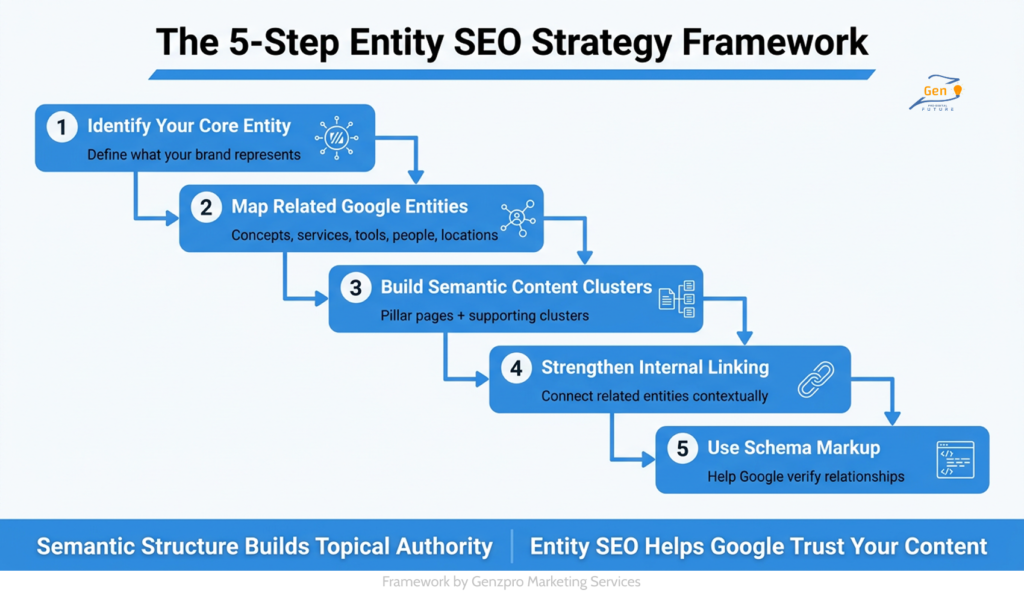
Transitioning to an entity-centric model requires moving beyond a “list of words” to a “map of concepts”. This framework is designed to help you build a digital architecture that Google’s Knowledge Graph can instantly verify and trust.
Step 1 — Identify Your Core Entity
Everything begins with your “primary node”. You must define the singular, unique entity that your brand or page represents. For an interior design consultant or SEO consultant, your core entity isn’t just a keyword; it is a professional identity categorised in the real world.
Search for your brand or primary topic on Google. If a knowledge panel appears, Google has already identified you as an entity. If not, your goal is to provide enough structured data and consistent information to “force” that entity’s SEO realisation.
Step 2 — Map Related Google Entities
Once the core is set, you must identify the “neighbouring” entities that Google expects to see in a comprehensive discussion. An authority doesn’t just mention one topic; they cover the entire ecosystem. Map your entities across these six categories:
- Services: Spatial planning, 3D visualisation, project management.
- Concepts: Biophilic design, modern minimalism, sustainable luxury.
- Locations: Dubai Design District, residential villas, commercial hubs.
- Tools: AutoCAD, Revit, mood boards.
- People: Renowned architects, specific lead designers, or target personas.
- Problems: Space Entity SEO optimisation, lighting deficits, ROI in renovation.
By identifying these, you create a checklist for semantic SEO completeness. If your competitors are mentioning “acoustics” in their design blogs and you aren’t, Google perceives a gap in your entity coverage.
Step 3 — Build Semantic Content Clusters
This is where you establish topical authority. You must move away from “one-off” blog posts and toward a contextual hierarchy.
- The Pillar Page: This acts as your “Master Entity” hub. It provides a high-level overview of a broad topic (e.g., “The Ultimate Guide to Luxury Villa Design”). It defines the core entity and briefly touches upon all related sub-entities.
- Cluster Pages: These are deep-dives into the specific entities mapped in Step 2. Each page focuses on a single sub-topic, such as “Choosing Sustainable Materials for Modern Homes”.
- The Relationship: The Pillar page links to all Cluster pages, and every Cluster page links back to the Pillar.
This structure creates a “semantic loop”. When Google crawls this cluster, it doesn’t just see five separate articles; it sees a sophisticated contextual hierarchy. This proves to the algorithm that you aren’t just writing for traffic: you are building a knowledge base.
In our experience, this “hub-and-spoke” model is the most effective way to rank for high-competition terms because it satisfies Google’s requirement for entity completeness.
Step 4 — Strengthen Entity Relationships With Internal Linking
Internal links are the “connective tissue” of entity SEO. Stop using generic “click here” text. Instead, use contextual anchors that reinforce the relationship between two entities. When you link from a post about “kitchen layouts” to a service page for “bespoke cabinetry”, your anchor text should be descriptive: “[custom cabinetry solutions for luxury kitchens]”.
This provides semantic reinforcement, telling Google exactly how these two “things” are related. This hierarchy ensures that authority flows from your informational content directly to your commercial service entities.
Step 5 — Use Schema Markup to Clarify Google Entities
Schema markup is the “translator” that turns your prose into data. To give Google total clarity, use JSON-LD structured data to define your entities explicitly.
- Organisation Schema: Defines who you are.
- Service Schema: Defines what you do.
- About/Mentions Schema: Use this within your blog posts. By using the about property, you can point Google to a specific Wikidata URL (e.g., the entry for “Minimalism”).
This removes all ambiguity. Instead of Google “guessing” if you are talking about “modern design” as a vague concept, you are providing a digital ID tag that connects your content to a globally recognised entity.
The Role of Internal Linking and Schema in Semantic SEO
In a world governed by Google entities, internal links and Schema markup are not just technical checkboxes: they are the bridges that define your authority. While content provides the “what”, these tools provide the “how” and “why” for search engines.
Strategic Entity Reinforcement
Internal linking serves as the connective tissue of your semantic SEO strategy. By using contextual anchors, you guide the crawl hierarchy, signalling to Google which pages are your “pillars” of truth.
Every link between a sub-topic and a service page acts as an entity reinforcement, proving that your expertise is interconnected rather than a series of random thoughts.
Eliminating Ambiguity with Schema
While links suggest relationships, schema markup provides absolute schema clarification. It translates your human-readable content into a structured format that says, “This page is not just about design; it is about this specific design movement.”
By explicitly tagging your entities, you remove any guesswork for the algorithm, ensuring your brand is mapped correctly within the knowledge graph. Together, these elements turn a standard website into a sophisticated, machine-readable authority.
Common Entity SEO Mistakes That Hurt Rankings
Even with the best intentions, small structural errors can signal a lack of expertise to Google’s NLP models. Avoid these common pitfalls to ensure your entity signals remain clear.
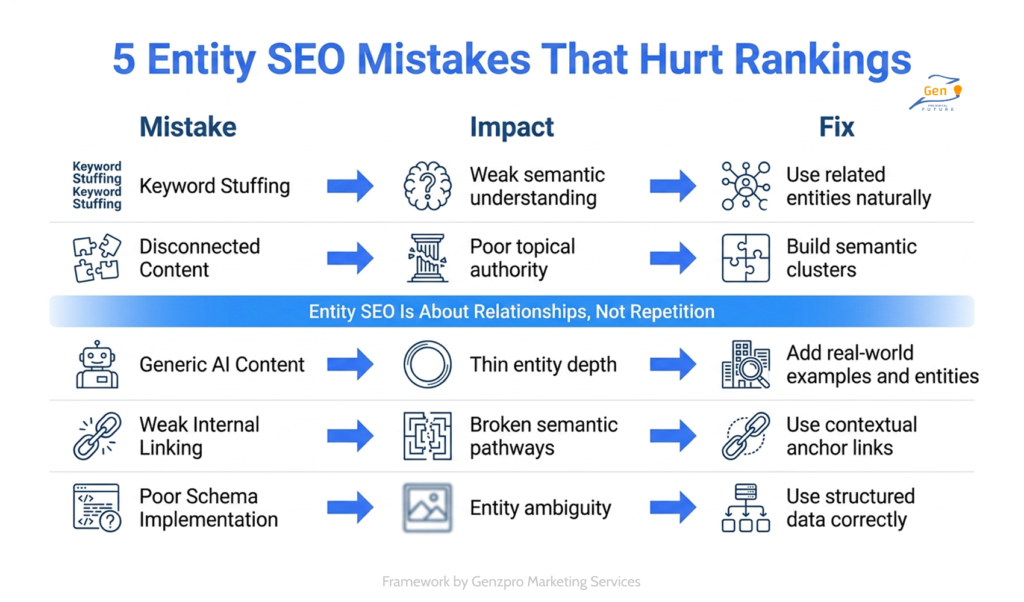
The Mistake-Consequence-Fix Framework
- Mistake: Keyword Stuffing
- Consequence: Degrades semantic SEO as Google sees “strings” instead of a coherent “thing”, often leading to “over-optimisation” penalties.
- Fix: Focus on entity reinforcement by using natural synonyms and related sub-topics that provide context.
- Mistake: Disconnected Content
- Consequence: Creates “orphan nodes” that fail to build topical authority, making it hard for Google to map your site’s hierarchy.
- Fix: Use a hub-and-spoke model to link cluster pages back to a central pillar entity.
- Mistake: Generic AI Content
- Consequence: Results in poor semantic depth; generic outputs often miss the niche-specific entities that prove real-world experience.
- Fix: Manually inject specific entities like industry tools, specialised techniques, and location-based facts.
- Mistake: Poor Schema Implementation
- Consequence: Leads to entity ambiguity, where Google cannot confidently place you in the Knowledge Graph.
- Fix: Be specific about and mention properties to explicitly define your page’s subjects.
Why Entity SEO Matters More in AI Search
As we move deeper into 2026, the traditional search results page has been replaced by a dynamic ecosystem of AI overviews and generative answers.
In this new era, semantic retrieval is the primary mechanism for discovery. AI systems do not look for the “best-optimised page”; they look for the most trusted entities.
AI models are trained to synthesise information by identifying patterns and relationships. When a user asks a complex question, the AI pulls from sources that demonstrate a high degree of topical trust and contextual understanding.
If your website is merely a collection of isolated pages, you are invisible to these systems. However, if you have established your brand as a verified node within the knowledge graph, the AI recognises you as a definitive authority.
The shift is clear: AI systems prefer entities they can verify. By focusing on entity SEO, you aren’t just ranking for a search engine; you are feeding the very data models that define how information is consumed in the AI age. Those who own the entity own the answer.
Conclusion: The Shift from Keywords to Comprehension
The era of “tricking” an algorithm with high-density keyword phrases is officially over. In 2026, keywords are not enough to maintain a competitive edge.
To succeed in the modern landscape, you must transition toward building semantic authority. By treating your website as a map of interconnected Google entities, you provide the structural proof the Knowledge Graph requires to verify your expertise.
Entities build trust. That trust eventually translates into stronger visibility, better lead quality, and more sustainable organic growth, especially for brands questioning whether investing in SEO is still worth it.
When you align your content with the way Google’s NLP models actually perceive information, you stop chasing the algorithm and start leading it. Ultimately, Google ranks understanding, not just text. If you want your brand to survive the shift into AI-driven search, you must ensure every page you publish serves as a clear, authoritative node in your niche’s ecosystem.
The future of SEO belongs to websites Google can confidently understand, connect, and trust, which is why every modern SEO agency must now focus on entity-driven optimisation.
Ready to dominate the knowledge graph? Contact Genzpro.tech today for advanced SEO services and customised SEO packages with a future-proof entity strategy that drives real ROI.

